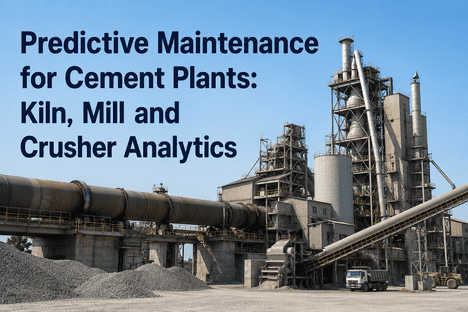
Predictive Maintenance for Cement Plants: Kiln, Mill and Crusher Analytics

By Rebecca on June 5, 2026

predictive-maintenance-cement-plants-kiln-mill-crusher

Cement production faces a persistent reliability challenge — unplanned breakdowns on rotary kilns, ball mills, vertical roller mills, crushers, and conveyors remain the largest source of production loss, with each forced outage costing between $10,000 and $150,000 per hour in lost clinker output, alternative fuel penalties, and emergency logistics. Traditional time-based maintenance cannot address the variable operating conditions — kiln shell temperature cycling, mill vibration from feed composition shifts, crusher impact loads from varying rock hardness — that accelerate refractory wear, bearing degradation, gearbox fatigue, and structural cracking. AI-driven predictive maintenance powered by IoT sensor fusion closes this gap — ingesting shell temperature arrays, vibration spectra, motor current draw, lubricaion oil analysis, and thermal camera data into machine learning models that forecast kiln refractory failure, mill gearbox degradation, crusher rotor imbalance, and conveyor idler wear 2–6 weeks in advance. iFactory's predictive maintenance platform provides this integration layer, connecting PLC data from kiln control systems, vibration monitoring on mills and crushers, thermal imaging on kiln shells, and operator shift observations into a unified intelligence system purpose-built for cement plant reliability. Book a Demo to see how iFactory turns your cement plant data into a live predictive maintenance layer for every critical process asset.

Predictive Maintenance · Cement 2026
Predictive Maintenance for Cement Plants: Kiln, Mill and Crusher Analytics

Rotary kiln shell temperature & refractory monitoring · Ball mill & VRM gearbox prediction · Crusher rotor & bearing condition surveillance · Conveyor idler & belt degradation forecasting · All unified in iFactory's cement plant reliability platform.

01
70%
Reduction in unplanned breakdowns on monitored cement plant assets
02
2–6 wk
Advance warning on kiln, mill, and crusher failures
03
25%
Lower maintenance costs from condition-based planning
04
91%
Of cement plant failures preceded by detectable indicators

Why Reactive Maintenance Fails in Cement Production Environments

Cement manufacturing assets operate under conditions that accelerate wear beyond what fixed-interval maintenance can predict. Rotary kilns experience thermal stress cycles from shell temperature differentials exceeding 200°C between feed and discharge ends, causing brick refractory spalling, shell deformation, and tyre creep. Ball mills grind abrasive clinker and gypsum 24/7, subjecting gearboxes, bearings, and liner plates to continuous impact loads and high particulate contamination. Crushers handle feed material hardness variations from 30 to 120 MPa, producing shock loads that crack rotors, fatigue bearings, and wear hammers unevenly. Fixed-interval maintenance replaces components based on calendar time or operating hours rather than actual condition — resulting in either premature replacement of serviceable parts or catastrophic failure of degraded components. Smart predictive maintenance replaces the schedule with sensor-driven condition monitoring, detecting the earliest signatures of degradation — kiln shell hotspot propagation, mill vibration harmonic shifts, crusher bearing temperature trends, and conveyor misalignment drift — converting them into scheduled, budgeted maintenance events that protect clinker throughput and plant OEE.

Cement Production Assets — Where Predictive Maintenance Improves Plant Availability
3–6wk
Rotary Kiln
Refractory·shell·tyre·drive·burner
Thermal PdM
2–5wk
Ball Mill
Gearbox·bearing·liner·motor·diaphragm
Grinding PdM
2–4wk
Vertical Roller Mill
Grinding table·roller·hydraulic·separator
VRM PdM
2–4wk
Crushers
Rotor·hammer·bearing·grate·impact
Impact PdM
2–4wk
Conveyors
Belt·idler·pulley·take-up·drive
Bulk PdM

Three Cement Plant Failure Categories AI Predictive Maintenance Addresses

01
Rotary Kiln Refractory, Shell & Drive Train Degradation Forecasting
Kiln refractory failures — brick spalling, coating ring shedding, and tyre creep — represent the highest forced outage cost in cement production, with each catastrophic shell event costing $500,000–$2,000,000 in lost production, refractory replacement, and kiln shell repair. iFactory ingests shell temperature data from IR thermal scanners and thermocouple arrays, tyre clearance and creep measurements, drive motor current trends, and burner flame impingement data. ML models trained on historical refractory failure patterns predict brick degradation zones, shell hotspot development, and drive train misalignment 3–6 weeks in advance with 75–85% accuracy. Plants running these systems report 40–60% fewer unplanned kiln stops and extended refractory campaigns of 12–18 months between major relines. Book a Demo to see iFactory's kiln prediction models in production.
3–6 week lead time75–85% accuracy40–60% fewer kiln stops
02
Ball Mill & VRM Gearbox, Bearing & Liner Condition Monitoring
Grinding mill gearbox and bearing failures are the leading mechanical cause of cement mill downtime, with gearbox replacement costs exceeding $250,000 and lead times of 12–16 weeks. iFactory monitors mill vibration spectra in axial and radial planes, bearing temperature trends, gear mesh frequency harmonics, lubricaion oil particle counts and water content, and motor current draw. The platform's ML models detect early-stage pitting, spalling, and wear patterns that precede catastrophic gearbox failure — predicting degradation 2–5 weeks in advance. Vertical roller mill grinding table and roller hydraulic system pressure trends are monitored alongside separator drive vibration. Plants using iFactory's mill monitoring report 30–40% fewer unplanned mill stops with extended gearbox service intervals of 18–24 months.
2–5 week lead time30–40% fewer stopsGearbox·bearing·liner
03
Crusher Rotor Imbalance, Bearing Wear & Hammer Degradation Prediction
Crusher rotor imbalance and bearing fatigue cause vibration-induced structural cracking and unplanned stoppages that disrupt raw material supply to the mill. iFactory applies ensemble ML models to crusher vibration spectra, bearing temperature, motor current and power factor, rotor position, and throughput rate. The platform's continuous learning loop improves prediction precision over time as more feed hardness and wear data accumulates. The Shift Logbook captures operator-reported anomalies — unusual crusher noise, throughput drops, rotor stall events — alongside sensor data, creating a richer training corpus for steadily improving prediction accuracy for rotor imbalance, bearing degradation, hammer uneven wear, and grate bar damage in primary impact and hammer crushers.
Ensemble ML modelsRotor·bearing·hammerShift Logbook fusion

How iFactory Turns Cement Plant Telemetry Into Predictive Intelligence

iFactory is the AI software intelligence layer — not a sensor manufacturer or hardware vendor. The platform integrates with existing cement plant instrumentation including DCS/PLC systems (Siemens, ABB, Rockwell, Schneider), kiln shell temperature scanners (ThyssenKrupp Polysius, FLSmidth, KIMA), vibration monitoring systems (Bently Nevada, Pruftechnik, SPM), lubricaion oil analysis labs, thermal cameras, and IoT gateways already deployed across your kiln, mills, crushers, and conveyor systems. The Shift Logbook captures operator shift reports, defect tags, lubricaion rounds data, and maintenance notes alongside the sensor stream, creating a unified data fabric for predictive model training across every critical asset in your cement plant.

Asset Class
Telemetry Sources
iFactory Prediction Output
Availability Impact
Rotary Kiln
IR scanner·thermocouples·tyre creep·motor current
Refractory·shell hotspot·drive degradation·RUL forecast
40–60% fewer unplanned kiln stops
Ball Mill
Vibration·bearing temp·oil analysis·motor current
Gearbox·bearing·liner·diaphragm fault prediction
30–40% fewer mill stops
VRM
Vibration·hydraulic press·separator·oil condition
Grinding table·roller·hydraulic failure probability
Extended roller service intervals
Crusher
Vibration·bearing temp·motor current·rotor position
Rotor imbalance·hammer wear·bearing forecast
Fewer unscheduled crusher stops

Predictive Maintenance Use Cases for Cement Plant Availability

Rotary Kiln
Refractory Brick & Shell Hotspot Prediction
Continuous

iFactory ingests shell temperature data from IR thermal scanners, thermocouple arrays at critical zones, tyre clearance measurements, drive motor current trends, and burner flame pattern data. ML models trained on historical refractory spalling, coating ring, and shell deformation patterns predict hotspot propagation and refractory degradation 3–6 weeks in advance with a confidence score and recommended intervention window. Maintenance planners schedule refractory patching or section replacement during planned outage windows, avoiding catastrophic brick shedding events that extend kiln stops by 4–8 weeks. Every prediction event is logged in iFactory's Shift Logbook with full traceability to the temperature and sensor data that triggered the alert.

Lead Time3–6 weeks
Accuracy75–85%
Book a Demo
Ball Mill
Gearbox, Bearing & Liner Condition Monitoring
Continuous

Ball mill gearbox failures can extend downtime by 12–16 weeks while replacement gearboxes are sourced. iFactory monitors mill vibration spectra in axial and radial planes, bearing temperature trends, gear mesh frequency harmonics, and lubricaion oil particle counts and water content. The platform pinpoints the specific gear tooth defect, bearing spall, or liner wear zone requiring attention before catastrophic failure — allowing targeted repair rather than full mill teardown. Alerts route directly to the maintenance shift in the Shift Logbook with asset location, severity score, and recommended action timing aligned with cement silo inventory levels and dispatch schedules.

Reduction30–40% fewer mill stops
DetectionGearbox·bearing·liner
Talk to an Expert
VRM
Grinding Table & Roller Hydraulic System Surveillance
Continuous

Vertical roller mills face grinding table and roller wear from abrasive clinker and slag feed. iFactory applies ensemble ML models to VRM vibration spectra, hydraulic system pressure and flow trends, grinding roller position feedback, separator drive vibration, and lubricaion oil condition data. The platform's continuous learning loop improves prediction precision as more feed material and operating data accumulates. The Shift Logbook captures operator-reported anomalies — unusual grinding noise, hydraulic pressure fluctuations, roller lift events — alongside sensor data, creating a richer training corpus for steadily improving prediction accuracy on grinding table segments, roller tyre wear, and hydraulic accumulator degradation.

ModelEnsemble ML·continuous learning
DataSensor + operator shift log
Crushers
Rotor Imbalance & Hammer Wear Prediction
Continuous

Crusher rotor imbalance and uneven hammer wear cause vibration-induced structural fatigue and throughput degradation that cascade into raw mill feed shortages. iFactory monitors crusher vibration spectra, bearing temperature, motor current and power factor, rotor position during coast-down, and throughput rate vs power consumption ratio. Predicted maintenance events are generated with recommended intervention windows aligned to planned kiln maintenance stops, eliminating unplanned crusher downtime during critical clinker production campaigns when limestone feed demand is highest.

ParametersVibration·temp·current·rotor position
OutputHammer change·bearing replacement·planned stop

What iFactory Delivers for Cement Plant Fleet Reliability

70%
Reduction in unplanned breakdowns on monitored cement plant assets
AI-driven prediction vs reactive maintenance response
2–6 wk
Advance warning on kiln, mill, and crusher failures
Planned intervention replaces emergency response
25%
Lower maintenance costs from condition-based planning
Eliminates premature overhaul and emergency logistics
$1.8M
Average annual savings per 1M tpy cement plant with full PdM deployment
Based on published cement industry OEE improvement case studies

FAQ

iFactory is the AI software intelligence layer — not a sensor manufacturer or hardware vendor. The platform integrates with kiln shell temperature scanners (ThyssenKrupp Polysius, FLSmidth, KIMA), vibration monitoring systems (Bently Nevada, Pruftechnik, SPM), PLC/DCS systems (Siemens, ABB, Rockwell, Schneider), lubricaion oil analysis labs, thermal cameras, and IoT gateways already deployed on your kiln, mills, crushers, and conveyors. Your site selects the sensor and telemetry hardware; iFactory turns the data into predictive intelligence, maintenance alerts, and shift-ready work orders.
Model tuning typically requires 6–12 months of operation on a specific cement plant asset fleet to eliminate false positives, tune threshold parameters, and build maintenance team confidence. The platform's continuous learning loop improves precision over time as more failure and operating data accumulates. iFactory recommends starting with one asset class and one failure mode — such as kiln refractory hotspot detection or ball mill gearbox vibration monitoring — proving value before expanding plant-wide across kilns, mills, crushers, and conveyors.
Yes. iFactory connects to SAP, Oracle, Infor EAM, Microsoft Dynamics, and major CMMS platforms as well as DCS/PLC historians from Siemens, ABB, Rockwell, and Schneider. The Shift Logbook captures operator defect reports, shift handover notes, lubricaion rounds data, and maintenance actions alongside sensor-generated predictions. Every prediction event, sensor reading, and maintenance action is recorded with full traceability for audit, compliance, and continuous model improvement.
Initial deployment typically takes 8–12 weeks depending on data availability and asset integration scope. The platform requires 6–12 months of historical DCS historian and condition monitoring data to establish baseline health thresholds and train initial models. If data is available in your existing historian system, initial models can be trained in under four weeks. iFactory deploys on-premise or via secure cloud with pre-built cement plant templates covering rotary kilns, ball mills, VRMs, crushers, and conveyor systems.
Deploy iFactory for AI-Powered Cement Plant Predictive Maintenance

AI-driven predictive maintenance platform connecting rotary kiln, ball mill, VRM, crusher, and conveyor telemetry into one unified intelligence layer — with ML-based failure prediction, Shift Logbook integration, CMMS workflow automation, and plant-wide reliability analytics. Pre-built cement plant templates deploy in weeks, not months. Protect your clinker production throughput and plant OEE with condition-based maintenance intelligence.

Kiln PdM Ball Mill PdM VRM Monitoring Crusher Analytics Shift Logbook

Share This Story, Choose Your Platform!