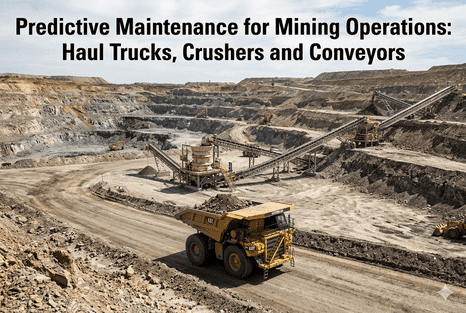
Predictive Maintenance for Mining Operations: Haul Trucks, Crushers and Conveyors

By Daniel Carter on June 5, 2026

predictive-maintenance-mining-operations-haul-trucks-crushers

Mining companies are deploying AI-powered predictive maintenance on haul trucks, crushers, SAG mills, and conveyor belts — preventing catastrophic failures before they strike in the world's harshest operating environments. Unplanned equipment failures in mining cost an average of $180,000 per hour in lost production, with crushing and haulage circuits accounting for over 60% of total downtime events. AI predictive maintenance fuses vibration, thermal, acoustic, and process telemetry from IIoT sensors with adaptive machine learning models that detect developing faults 30–50% earlier than fixed-threshold monitoring — reducing unplanned downtime, improving equipment availability, and cutting maintenance-related operating costs by 8–12% in documented mining deployments. Book a Demo to see how iFactory AI connects your mining equipment telemetry to predictive maintenance intelligence.

AI Predictive Maintenance · Mining Operations 2026
Predictive Maintenance for Mining Operations: Haul Trucks, Crushers & Conveyors

AI vibration monitoring · Crusher bearing fault detection · Haul truck drivetrain prediction · Conveyor belt health · SAG mill analytics · All flowing into iFactory CMMS & Shift Logbook.

30–50%
Reduction in unplanned downtime across documented mining deployments
2–6 wks
Advance warning on crusher bearing & haul truck drivetrain failures
$5.5M
Saved by Votorantim Cimentos using predictive analytics across quarry assets
8–12%
Operational cost reduction from AI predictive maintenance in mining

Why Traditional Mining Maintenance Falls Short

Most mining operations today rely on fixed-interval preventive maintenance schedules and threshold-based SCADA alerts. Scheduled maintenance replaces components based on hours-run, not actual condition — generating unnecessary costs on healthy equipment while missing faults that develop between service windows. Threshold-based SCADA alerts fire only after a parameter has already exceeded its limit — by which point the haul truck engine, crusher bearing, or conveyor motor has often been degrading for days or weeks. The gap is predictive root-cause visibility: AI-powered predictive maintenance closes this gap by detecting subtle changes in vibration signatures, thermal profiles, and acoustic patterns that indicate developing faults 30–50% earlier than conventional monitoring — giving maintenance crews actionable lead time to schedule interventions before catastrophic failure occurs.

Mining Predictive Maintenance — The AI Monitoring Architecture
Sensing
IIoT Data Layer
Vibration · temperature · current · acoustic · pressure · oil quality
Edge inference
Detection
Anomaly Models
Adaptive ML · sensor fusion · ensemble fault detection
2–6 wk lead time
Asset Health
Digital Twin
Crusher wear · haul truck RUL · conveyor belt tension
Per-asset RUL
Optimisation
Shift Logbook AI
Auto shift summaries · top-5 critical alerts · crew briefings
Zero info gaps
Action
CMMS / Work Orders
Auto work orders · SCADA integration · audit trail
Auto-triggered

Three Critical Equipment Categories Where iFactory Predicts and Prevents Failure

01
Haul Truck Drivetrain, Engine & Tyre Failure
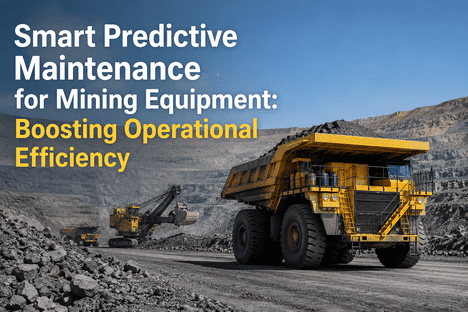
A 300-tonne haul truck failure in a remote open-cut mine doesn't just stop one vehicle — it can freeze an entire haul circuit, starve the crusher, and cost over $180,000 per hour in lost production. iFactory monitors vibration, engine temperature, transmission fluid quality, tyre pressure, and oil analytics from IIoT sensors on every haul truck in the fleet. Adaptive ML models — trained on OEM telematics and historical failure data — detect bearing degradation, drivetrain misalignment, and engine wear 2–4 weeks before failure. Critically, AI sensor fusion filters out operational noise (sharp turns, overspeeding events, grade variations) that causes traditional OEM alerts to misfire, isolating genuine fault signals under consistent operating conditions. Alerts are delivered to the maintenance crew through iFactory's digital shift logbook — ensuring every incoming shift knows which truck to inspect first.
2–4 wk advance warning OEM telematics integration Auto work orders
02
Crusher & SAG Mill Bearing, Liner & Gear Failure
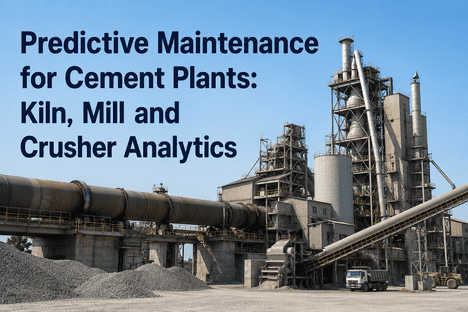
Jaw crushers, cone crushers, and semi-autogenous grinding mills are the backbone of ore processing — and the most expensive single-asset failures in a mining operation. Bearing and gear wear develops gradually and silently, invisible to human inspectors or basic threshold monitoring, yet detectable weeks in advance through AI vibration analysis. iFactory's digital twin models simulate wear in crusher liners and SAG mill charge levels, adapting to historical data and operational variability. When the platform detects an upstream issue — such as a crusher releasing oversized ore that risks blocking the mill — site operators are immediately alerted with recommended crusher gap adjustments and liner replacement schedules. This proactive approach prevents the costly stoppages caused by running equipment past its optimal operating window. Book a demo to see how iFactory maps to your crusher circuit and SAG mill configuration.
Bearing vibration analysis Digital twin wear simulation Gap & liner scheduling
03
Conveyor Belt Motor Burnout, Belt Tear & Roller Failure
Kilometres of conveyor belting carrying thousands of tonnes per hour represent some of the most difficult assets to monitor in mining — high ambient noise makes conventional vibration analysis unreliable. iFactory's AI sensor fusion analyses the relationship between motor torque, belt tension, roller temperature, and speed to identify subtle anomalies that precede catastrophic belt tears or motor burnouts — often without requiring additional hardware installation. AI models detect roller misalignment, belt splice degradation, and idler bearing wear, predicting failures with sufficient lead time to schedule replacement during planned maintenance windows. Every prediction event is logged in iFactory's shift logbook with full traceability to the production tonnes carried during the degradation window.
Motor torque + belt tension fusion No new hardware required Belt tear prevention

What Mining Operations Have Achieved with AI Predictive Maintenance

Public industry data documents AI-driven predictive maintenance deployments across open-cut and underground mining — including Votorantim Cimentos saving $5.5M using predictive analytics across quarry assets, Rio Tinto centralising equipment health data across multiple global sites, and a South African gold mine avoiding mill failure after AI flagged vibration anomalies before any manual inspection detected the fault. AI-powered analytics reduces unplanned mining equipment downtime by up to 30%, with leading deployments reporting reductions within 90 days. iFactory is the AI software intelligence layer — turning equipment telemetry from haul trucks, crushers, conveyors, and drills into predictive alerts, digital twin health models, and shift-logbook-delivered maintenance intelligence. Contact iFactory's team for applicable references in your mining segment.

Equipment
AI Monitoring Method
iFactory Output
Maintenance Impact
Haul trucks
Vibration + OEM telematics AI
2–4 wk drivetrain alert · auto WO
Prevents haul circuit freeze & crusher starvation
Crushers & SAG mills
Bearing vibration + digital twin
Liner wear forecast · gap scheduling
Prevents catastrophic bearing & liner failure
Conveyor belts
Torque + tension + roller fusion
Belt tear prediction · motor RUL
Eliminates emergency belt shutdowns
Drill rigs
Hydraulic pressure + rotation AI
Bit wear RUL · hydraulic seal alert
Prevents remote-pit emergency breakdowns
Pumps & fans
Vibration + thermal + current
Bearing degradation · cavitation alert
Protects dewatering & ventilation circuits

iFactory AI Predictive Maintenance Use Cases in Mining

Haul Fleet PdM
Haul Truck Engine, Drivetrain & Tyre Predictive Maintenance
Continuous

iFactory monitors vibration, engine temperature, transmission heat, tyre pressure, and oil quality across the entire haul truck fleet. Adaptive ensemble ML models detect bearing degradation, drivetrain misalignment, and engine wear 2–4 weeks before failure. AI sensor fusion filters operational noise (sharp turns, grade changes, overspeeding) to isolate genuine fault signals, reducing false positive alerts that cause unnecessary downtime. Alerts are logged in iFactory's digital shift logbook so every incoming crew knows which trucks require immediate attention. Book a demo to see how iFactory maps to your Caterpillar or Komatsu fleet telematics.

Lead Time2–4 weeks before drivetrain failure
IntegrationOEM telematics · SCADA · CMMS
Book a Demo
Crusher & Mill
Crusher Bearing, Liner Wear & SAG Mill Charge Prediction
Continuous

iFactory's digital twin models simulate crusher liner wear and SAG mill charge behaviour, adapting continuously to operational variability and historical failure data. Bearing vibration analysis detects fault signatures 2–6 weeks before catastrophic failure — giving maintenance crews time to schedule liner replacement and bearing change-out during planned windows. When the AI detects crusher gap drift or oversized ore release that risks mill blockage, site operators receive immediate alerts with recommended corrective actions — preventing the costly stoppages that undetected liner wear causes during peak production.

Lead Time2–6 weeks before bearing failure
OutputLiner RUL · gap schedule · WO
Book a Demo
Conveyor AI
Conveyor Belt Tear, Motor Burnout & Roller Failure Prevention
Continuous

iFactory's AI sensor fusion analyses motor torque, belt tension, roller temperature, and speed relationships to identify subtle anomalies that precede catastrophic belt tears or motor burnouts — without requiring additional hardware on most existing conveyor installations. Adaptive ML models detect roller misalignment, idler bearing wear, and belt splice degradation, delivering predicted failure timing and replacement schedules to maintenance crews through the iFactory shift logbook. Every conveyor prediction event is traceable to the production tonnes moved during the degradation window.

MonitoringTorque · tension · roller · speed
OutputBelt tear alert · motor RUL · WO
Book a Demo

What iFactory AI Delivers for Mining Operations

30–50%
Unplanned downtime reduction
Across documented mining PdM deployments
2–6 wks
Advance failure prediction on crushers & haul trucks
vs reactive shutdown response
$5.5M
Saved in documented mining predictive analytics deployment
Votorantim Cimentos quarry assets
8–12%
Operational cost reduction from AI predictive maintenance
Maintenance · emergency callout · parts savings

The Shift Handover Gap in Mining — And How iFactory Closes It

The American Fuel & Petrochemical Manufacturers report that over 40% of industrial incidents occur during shift handover periods — despite accounting for less than 5% of operating time. In mining, where equipment runs 24/7 across multiple crews in remote locations, this risk is dramatically amplified. When an incoming crew doesn't know that a haul truck showed abnormal transmission heat on the previous shift, or that a crusher flagged unusual bearing vibration at 2 AM, they start their shift blind — and the developing fault continues unaddressed.

iFactory's AI-powered digital shift logbook closes this gap. The platform analyses shift entries and equipment health data to auto-generate shift summaries highlighting the top 5 critical items for incoming crews — predictive maintenance alerts, equipment health status, pending work orders, and recurring fault patterns. Every incoming mining crew starts with a structured briefing that ensures no critical equipment issue falls between shifts. Most mining operations go live with iFactory's digital shift logbook in 1–2 weeks, with full CMMS and SCADA integration completing in 3–5 days. Book a demo to see how iFactory's shift logbook integrates with your predictive maintenance alerts.

FAQ

iFactory integrates with OEM telematics systems already installed on most modern Caterpillar and Komatsu haul trucks, meaning many operations can begin without additional hardware investment. For operations requiring additional monitoring, critical sensors include vibration sensors on drivetrain components, engine temperature sensors, transmission fluid analysers, tyre pressure monitoring systems (TPMS), and oil quality sensors. iFactory is an AI software intelligence layer — not a sensor hardware vendor — and connects to your existing IIoT infrastructure via OPC UA, Modbus TCP, MQTT, and REST API. Book a demo to discuss your specific haul fleet sensor configuration.
In documented deployments, AI vibration analysis detects developing bearing faults in cone crushers and jaw crushers 2–6 weeks before failure — sufficient lead time to schedule liner replacement and bearing change-out during planned maintenance windows rather than emergency shutdowns. The exact lead time depends on the failure mode, bearing size, operating load, and sensor density. iFactory's digital twin models adapt continuously to your crusher's operational history, improving prediction accuracy over the first 3–6 months of deployment.
Yes. iFactory's mobile app has 100% offline capability on iOS, Android, and rugged industrial tablets. Mine operators can create shift log entries, capture equipment photos, record fault events, and complete shift handover checklists without internet connectivity. All data syncs automatically when connection is restored. Edge computing deployment options are available for sites with limited bandwidth, enabling local AI inference and alert generation without relying on continuous cloud connectivity.
iFactory deploys in 1–2 weeks against pre-built templates covering haul trucks, crushers, conveyors, pumps, fans, and processing plant equipment. Template configuration and process mapping takes 2–3 days. Integration with existing CMMS, SCADA, and ERP systems takes 3–5 days. Operator training and pilot shift testing takes 1–2 days. Initial AI models can be trained on 6–12 months of historical SCADA data already in your historian. Full enterprise rollout across multiple mine sites completes in 4–8 weeks with dedicated implementation support.
iFactory links every predictive maintenance alert directly to the shift logbook for the incoming crew. When a haul truck drivetrain alert is generated at 3 AM, it automatically appears in the incoming shift's morning briefing — with the asset ID, fault description, recommended action, and urgency level. iFactory's AI analyses patterns across shifts and weeks, detecting recurring equipment issues and escalating fault trends so maintenance supervisors have full visibility without manually reviewing every log entry. This closed loop between equipment health prediction and crew briefing prevents developing faults from falling through shift-change gaps.
Deploy iFactory AI for Mining Predictive Maintenance

AI-powered predictive maintenance platform connecting IIoT sensors, adaptive ML models, digital twins, and real-time fault detection — with 2–6 week failure prediction on haul trucks, crushers, and conveyors, auto-generated work orders, and AI shift logbook briefings ensuring zero critical information falls between crews.
Haul Truck PdM Crusher Bearing AI Conveyor Belt Health SAG Mill Analytics Shift Logbook SCADA Integration

Share This Story, Choose Your Platform!