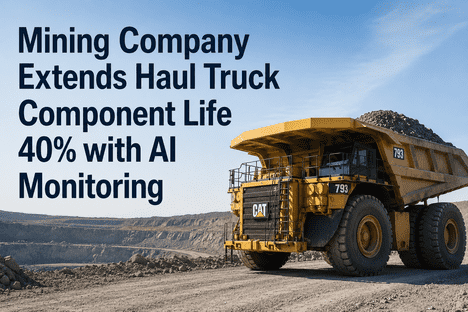
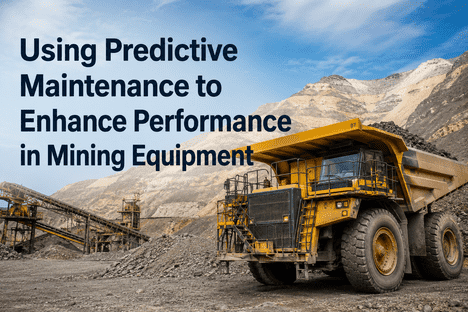
Mining Company Extends Haul Truck Component Life 40% with AI Monitoring
By Rebecca on June 18, 2026
In open-pit mining operations, haul trucks — including CAT 793, 797, Komatsu 930E, and Hitachi EH5000 series — rank among the most capital-intensive and maintenance-critical assets on site, where unplanned engine failure, differential wear, transmission faults, and structural cracking are leading causes of production stoppages and safety incidents. A single catastrophic differential failure on a CAT 793 haul truck can cost $120,000–$180,000 in rebuild costs alone, plus $8,000–$15,000 per hour in lost production, haulage bottlenecks, and downstream mill starvation. Traditional fixed-interval maintenance schedules — oil changes, component overhauls, and inspections at prescribed operating hours — cannot address the variable conditions that accelerate wear across a mixed-age fleet: payload overloading that exceeds rated capacity by 10–25%, ramp grades exceeding 10%, extreme ambient temperatures exceeding 45°C, dust and abrasive particle ingress into driveline components, and operator-induced shock loading during loading and dumping cycles. iFactory's predictive maintenance platform fuses onboard telematics data (J1939 CAN bus, Caterpillar VIMS, Komatsu KOMTRAX), oil analysis results, vibration sensor arrays on final drives and differentials, thermographic imaging of brake systems, and shift log defect reports into machine learning models that forecast differential bearing failure, transmission clutch degradation, engine component wear, and structural fatigue 2–4 weeks in advance — enabling maintenance teams to schedule component change-outs during planned downtime rather than after catastrophic failure. Book a Demo to see how iFactory connects your haul truck telemetry to predictive intelligence.
Predictive Maintenance · Mining 2026
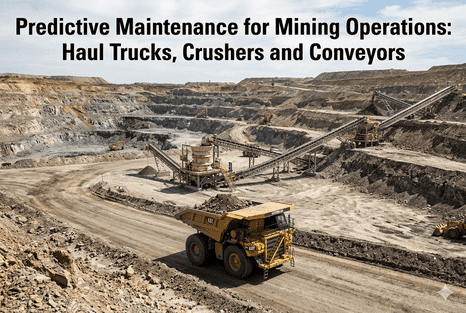
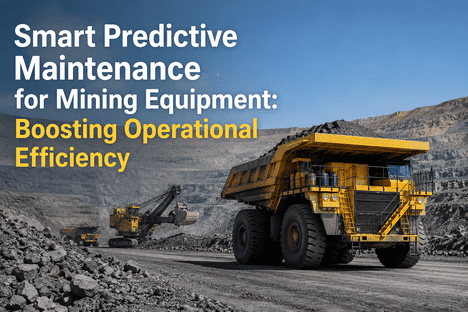
AI Predictive Maintenance for Haul Trucks and Mining Assets
Differential wear prediction · Engine failure forecasting · Transmission health monitoring · Structural fatigue detection · All flowing into iFactory CMMS & Shift Logbook.
Why Reactive Maintenance Fails in High-Volume Mining Haulage
Haul trucks in open-pit mining operate under conditions that accelerate wear beyond what scheduled maintenance intervals can predict. Differentials in a typical CAT 793 fleet transmit 1,500–2,000 hp through final drives subjected to shock loading during loading cycles, ramp haulage at 10–15% grades, and continuous operation in dust-laden environments where abrasive particle ingress into bearing cavities accelerates gear spalling and raceway pitting. A differential pinion bearing failure can progress from initial detection to catastrophic seize in under 50 operating hours — far shorter than the 500–1,000 hour interval between scheduled oil sampling campaigns. Engine components — cylinders, pistons, turbochargers, and fuel injectors — accumulate wear at rates that vary dramatically with payload, ambient temperature, and operator driving style. Fixed-interval overhauls replace components based on calendar time or operating hours rather than actual condition — meaning differential carriers are rebuilt prematurely (wasting 30–50% of remaining useful life) or too late (causing a $120,000–$180,000 emergency rebuild, four-day downtime, and $8,000–$15,000 per hour in lost production). iFactory's condition-based approach replaces the calendar with sensor-driven prediction tailored to each truck's actual duty cycle, payload history, route profile, and thermal operating envelope.
LIMITATIONS OF TIME-BASED MAINTENANCE FOR HAUL TRUCK FLEETS
1
Variable duty cycles ignored — same overhaul interval applied regardless of payload variation, ramp grades, ambient temperature, or operator aggressiveness
2
Sensor-blind to early-stage faults — differential bearing vibration, oil debris particle count, transmission clutch slip, and engine cylinder imbalance remain unmonitored between monthly or quarterly inspections
3
Emergency component logistics nightmare — differential carriers, engine long blocks, and transmission assemblies weigh 2,000–6,000 kg and require crane trucks, specialised rebuild teams, and 5–14 day lead times for rush delivery to remote mine sites
4
No fleet-wide degradation visibility — maintenance decisions based on the last failure rather than cross-fleet wear patterns across multiple trucks of the same model operating in different pits, loads, and conditions
Three Haul Truck Failure Categories iFactory Predicts
01
Differential and Final Drive Bearing Failure Prediction
Differential carriers and final drives in mining haul trucks operate under high torque, low-speed conditions where shock loading, abrasive particle ingress, and inadequate lubrication are the dominant failure modes — accounting for over 35% of all unplanned driveline downtime in CAT 793 and 797 fleets. Each unplanned differential failure costs $120,000–$180,000 in rebuild or replacement, plus 3–5 days of truck downtime at $8,000–$15,000 per hour in lost haulage capacity. iFactory ingests onboard CAN bus telemetry (engine torque, ground speed, gear selection, payload), vibration sensors mounted on differential housings, oil debris particle counters, oil analysis results (spectrometry, ferrography, viscosity, water content), and thermographic data from final drive covers to train ML models that predict bearing spalling, gear tooth fatigue, and pinion bearing failure 2–4 weeks in advance with 70–80% accuracy. Mines running these systems report 35–40% reductions in unplanned driveline downtime. Book a Demo to see iFactory's differential prediction models in production.
2-4 week lead time70-80% accuracy35-40% downtime reduction
02
Engine Component Wear and Prognostic Health Monitoring
Engine failure — including cylinder liner scuffing, piston ring breakage, turbocharger bearing collapse, and fuel injector degradation — is the highest-cost unplanned event in haul truck maintenance, with a complete engine rebuild costing $180,000–$350,000 and requiring 10–18 days of truck downtime. In high-volume production mines, a single engine failure can trigger a haulage bottleneck that reduces mill feed by 10–15% for the duration of the outage. iFactory monitors engine ECU data (exhaust gas temperature per cylinder, fuel trim deviation, turbocharger speed, boost pressure, coolant temperature, oil pressure), crankcase pressure trends, vibration at the engine block, and oil analysis results to detect cylinder-level degradation patterns 3–4 weeks before failure thresholds are reached. The Shift Logbook captures operator-reported performance complaints — power loss, excessive smoke, unusual noises — alongside sensor data to build increasingly accurate engine health prediction models specific to each truck and operating condition.
3-4 week lead timeCylinder-level analyticsEngine life optimisation
03
Transmission Clutch Pack and Gear Fatigue Forecasting
Automatic and planetary transmissions in large mining haul trucks are subjected to repeated high-torque shifts under full payload on ramp grades exceeding 10%, producing clutch pack wear, planetary gear fatigue, and torque converter degradation that manifest as shift quality deterioration, gear slippage, and elevated sump temperatures. These conditions produce distinct signatures in transmission output speed, clutch pressure profiles, shift timing, sump temperature trends, and vibration at the transmission housing. iFactory's ML models learn to recognise these patterns and separate them from normal operating variation — predicting transmission clutch pack failure, planetary gear spalling, and torque converter degradation 2–3 weeks in advance. While prediction accuracy in mixed-fleet, variable-duty-cycle operations ranges from 50–65% initially, the platform's continuous learning loop improves precision as more shift data, maintenance event histories, and oil analysis results accumulate across the fleet.
Ensemble ML modelsContinuous learning loopShift Logbook correlation
How iFactory Transforms Haul Truck Telemetry Into Predictive Intelligence
iFactory is the AI software intelligence layer — not a sensor manufacturer or hardware vendor. The platform integrates with existing haul truck telemetry from onboard CAN bus / J1939 data, Caterpillar VIMS, Komatsu KOMTRAX, Hitachi PMS, Wenco and Modular Mining dispatch systems, oil analysis laboratories, vibration data loggers, thermographic cameras, and tyre pressure monitoring systems already deployed on your fleet. The Shift Logbook captures operator defect reports, pre-start inspection findings, lube truck service notes, and maintenance supervisor observations alongside the real-time sensor stream, creating a unified data fabric for predictive model training and fleet-wide fleet reliability analysis.
Asset Class
Telemetry Sources
iFactory Prediction Output
Business Impact
Differentials
Vibration · oil debris · temp · CAN bus load
Bearing & gear failure forecast · RUL estimate
$120K–$180K per prevented failure
Engines
ECU data · crankcase pressure · oil analysis · vibration
Cylinder health · turbo wear · injector fault alert
Predictive Maintenance Use Cases for Mining Haul Trucks
Open-Pit Mining
Differential Bearing and Gear Health Monitoring
Continuous
Differentials are the highest-failure component on any mining haul truck, where unplanned failure directly impacts production throughput and escalates maintenance costs. iFactory monitors differential housing vibration, oil debris particle count, oil analysis trends, and CAN bus load telemetry continuously. ML models trained on historical failure patterns predict bearing spalling, gear tooth fatigue, and pinion bearing failure 2–4 weeks in advance. Predicted failures include a confidence score and recommended intervention window — maintenance teams schedule differential rebuilds during planned truck down days, shift changes, or low-demand periods, avoiding emergency repairs that cost $120,000–$180,000 plus production losses. Every prediction event is logged in iFactory's Shift Logbook with full traceability to the sensor data and operating conditions that triggered the alert.
In high-production open-pit mines, undetected engine degradation is the leading cause of catastrophic truck failure and the highest-cost single maintenance event. iFactory detects early-stage engine wear patterns through exhaust gas temperature trend analysis per cylinder, fuel trim deviation, crankcase pressure spikes, and oil analysis anomalies. The platform pinpoints the specific cylinder, turbocharger, or fuel system component requiring attention, enabling targeted intervention hours or days before failure. Alerts route directly to the maintenance shift in the Shift Logbook with engine location metadata, severity score, and recommended inspection scope — enabling planned engine change-outs during scheduled downtime rather than emergency pulls on the ramp.
Transmissions and drivelines in mining haul trucks face variable operating conditions — different payloads, ramp grades, shift patterns, and operator techniques throughout the day — producing complex shift profile and vibration signatures that challenge conventional threshold-based monitoring. iFactory applies ensemble ML models with a continuous learning loop that improves prediction precision for clutch pack wear, planetary gear fatigue, and torque converter degradation as more operating data accumulates across the fleet. The Shift Logbook captures operator-reported anomalies — harsh shifts, gear slippage, unusual transmission noise — alongside sensor data to build richer training corpora for mixed-fleet, variable-duty-cycle equipment.
What iFactory Delivers for Haul Truck Fleet Reliability
70-80%
Differential bearing failure prediction accuracy
2-4 week advance warning vs catastrophic seize
35-40%
Reduction in unplanned driveline downtime
Planned component change vs emergency repair
40%
Component life extension across fleet
Differential · engine · transmission life
$2.1M
Saved across 45 CAT 793 trucks
Prevented failures + extended service intervals
FAQ
iFactory is the AI software intelligence layer — not a sensor manufacturer or hardware vendor. The platform integrates with CAN bus / J1939 telematics, Caterpillar VIMS, Komatsu KOMTRAX, Hitachi PMS, Wenco and Modular Mining dispatch systems, vibration sensors, oil debris particle counters, oil analysis laboratories, thermographic cameras, and tyre pressure monitoring systems already deployed on your fleet. Your mine selects the sensor and telemetry hardware; iFactory turns the data into predictive intelligence, maintenance alerts, and shift-ready work orders.
Model tuning typically requires 8–14 months of operation on a specific truck fleet to eliminate false positives from variable-load conditions (payload variation, ramp grades, ambient temperature swings), tune threshold parameters for differential vibration monitoring and oil debris trending, and build maintenance team confidence. The platform's continuous learning loop improves precision over time as more operating data and failure events accumulate across different truck models, pits, and operating conditions. iFactory recommends starting with one failure mode — such as differential bearing prediction — proving value on 10–15 trucks before expanding to the full fleet of 40+ trucks.
Yes. iFactory connects to SAP, Oracle, JDE, Microsoft Dynamics, and major mining-specific CMMS platforms. The Shift Logbook captures operator defect reports, pre-start inspection findings, lube truck service notes, and maintenance actions alongside sensor-generated predictions. Every prediction event, sensor reading, and maintenance action is recorded with full traceability for audit, compliance, and continuous model improvement — enabling your maintenance team to move from reactive truck repairs to data-driven reliability across the entire haulage fleet.
Deploy iFactory for Mining Haul Truck Predictive Maintenance
AI-powered predictive maintenance platform connecting haul truck differentials, engines, transmissions, and structural health telemetry into one unified intelligence layer — with ML-based failure prediction, Shift Logbook integration, CMMS workflow automation, and fleet-wide mining asset reliability analytics.