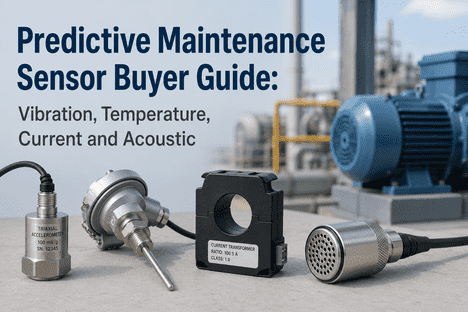
The selection of predictive maintenance sensors — accelerometers, temperature probes, current transformers, and acoustic microphones — is the foundational decision that determines whether an AI-driven reliability program delivers 200% ROI or fails to detect the failures it was deployed to prevent. Unlike enterprise software procurement, sensor selection involves physical installation constraints, environmental operating limits, signal-to-noise ratio considerations, and data acquisition hardware compatibility that vary significantly by asset type, operating speed, and plant environment. A triaxial accelerometer with 100 mV/g sensitivity and ±50 g range that performs flawlessly on a slow-speed cooling tower fan at 300 RPM will produce unusable data on a CNC spindle at 20,000 RPM where the same bearing fault generates vibration energy at frequencies above 10 kHz with amplitudes below 1 g. An RTD probe with ±0.1°C accuracy that serves a bearing housing monitoring application cannot survive the 800°C surface temperature of a steel plant caster roll. A current transformer specified for variable frequency drive input captures motor current signatures at harmonics that a standard 50/60 Hz CT cannot resolve. This guide provides a specification-by-specification comparison of the four sensor categories that form the data foundation of production-grade AI predictive maintenance — vibration, temperature, motor current, and acoustic emission — with selection criteria, mounting considerations, and integration requirements for each. iFactory AI's industrial software platform ingests data from all four sensor categories through standard OPC-UA and API connectors, enabling reliability teams to select the optimal sensor for each asset class without platform compatibility constraints. Book a Demo to review iFactory's sensor compatibility matrix and data acquisition requirements.
Why Sensor Selection Determines AI Predictive Maintenance Success
The accuracy of AI bearing fault classification, tool wear detection, and remaining useful life estimation is fundamentally bounded by the quality and appropriateness of the sensor data feeding the models. A 92% accurate bearing fault classifier trained on IEEE PRONOSTIA benchmark data will produce 55% accuracy if deployed on a facility where accelerometers are underspecified for the speed range, mounted with inadequate surface preparation, or sampled at insufficient rates. The sensor chain — transducer, cabling, data acquisition hardware, signal conditioning, and sampling parameters — introduces signal degradation at every stage. Understanding the specification requirements for each sensor category, the environmental constraints of each plant zone, and the data quality thresholds required for AI model training is essential before any procurement decision. The sections below provide specification-by-specification guidance for each of the four sensor categories that form the data foundation of production-grade AI predictive maintenance programs.
Sensor Category 1: Vibration Accelerometers — The Primary PdM Sensor
Accelerometers are the most widely deployed sensor for rotating equipment condition monitoring, providing the vibration data from which envelope spectrum analysis extracts bearing fault frequencies (BPFO, BPFI, BSF, FTF). The specification requirements vary significantly by application — a sensor optimized for slow-speed bearing monitoring is fundamentally different from one designed for high-speed spindle analysis. Three accelerometer types dominate the industrial PdM market: piezoelectric (ICP/IEPE), MEMS capacitive, and high-temperature piezoelectric for extreme environments.
| Specification Parameter | Low-Speed (100–1,800 RPM) | Mid-Speed (1,800–10,000 RPM) | High-Speed (10,000–30,000 RPM) |
|---|---|---|---|
| Sensor type | Piezoelectric (ICP) or MEMS | Piezoelectric (ICP) | High-frequency piezoelectric |
| Sensitivity | 500–1,000 mV/g | 100–500 mV/g | 10–100 mV/g |
| Frequency range | 0.5 Hz – 5 kHz | 1 Hz – 10 kHz | 1 Hz – 20 kHz |
| Amplitude range | ±5 to ±50 g | ±50 g | ±50 to ±500 g |
| Resonant frequency | 15–30 kHz | 25–40 kHz | 40–60 kHz |
| Mounting method | Flat magnet or stud mount | Stud mount or adhesive | Stud mount (direct) |
| Typical applications | Cooling tower fans, pumps, conveyors | Motors, fans, compressors, gearboxes | CNC spindles, turbines, high-speed tools |
For facilities deploying AI bearing fault classification, the most common specification error is selecting a sensor with insufficient high-frequency response. Bearing fault envelope spectra require usable signal amplitude up to at least 10× the highest bearing fault frequency. For a bearing with BPFI at 8 kHz (common on a 3,600 RPM motor with a 15-element bearing), the accelerometer must provide usable response to at least 80 kHz to capture the harmonic content that distinguishes Stage 1 incipient faults from normal operating noise. iFactory's AI models are trained on data sampled at 25.6 kHz minimum per channel with 24-bit resolution; sensors and data acquisition hardware must support this sampling specification for production-grade classification accuracy.
Sensor Category 2: Temperature Probes — RTD and Thermocouple Selection
Temperature monitoring provides complementary data to vibration analysis for bearing degradation detection, particularly for slow-speed assets where vibration energy is low, and for thermal runaway conditions in spindles and motors. The two primary sensor types — resistance temperature detectors (RTDs) and thermocouples — differ in accuracy, range, and response time.
| Specification Parameter | RTD (Pt100) | RTD (Pt1000) | Type K Thermocouple | Type T Thermocouple |
|---|---|---|---|---|
| Temperature range | −200 to +600°C | −200 to +600°C | −200 to +1,260°C | −200 to +370°C |
| Accuracy (typical) | ±0.1°C at 0°C | ±0.15°C at 0°C | ±1.5°C at 0°C | ±0.5°C at 0°C |
| Response time | 5–15 seconds | 5–15 seconds | 0.5–3 seconds | 0.5–3 seconds |
| Stability | Excellent (0.01°C/yr drift) | Excellent | Moderate (1–2°C/yr drift) | Good |
| Bearing monitoring | Excellent for housing temperature | Excellent | Suitable for extreme heat zones | Good for low-temp bearings |
| Spindle monitoring | Good (limited by speed) | Good | Not recommended (noise) | Not recommended |
| Motor winding | Embedded Pt100 standard | Embedded Pt1000 growing | Surface mount only | Surface mount only |
| Cost per point | $25–$75 | $30–$85 | $8–$25 | $15–$35 |
For AI predictive maintenance, RTDs are strongly preferred over thermocouples for bearing temperature monitoring due to their superior accuracy and long-term stability. A bearing temperature trend increase of 2–5°C above baseline is a reliable indicator of early-stage lubrication breakdown or incipient spalling — but only if the sensor provides ±0.1°C or better repeatability. iFactory's temperature trend models detect deviations as small as 1°C sustained over 4+ hours, enabling intervention before thermal runaway. For extreme-temperature applications above 600°C — steel plant caster rolls, furnace bearing housings — Type K thermocouples are the only practical option, though the wider accuracy band means only larger temperature excursions (5–10°C) are detectable as fault signatures.
Sensor Category 3: Motor Current Transformers — Electrical Signature Analysis
Motor current signature analysis (MCSA) detects rotor bar defects, air gap eccentricity, bearing degradation reflected in load torque variation, and driven-equipment faults through analysis of current harmonics. Current transformers (CTs) for PdM applications differ from protection-grade CTs used in motor control centers — they require higher bandwidth and saturation characteristics optimised for harmonic content rather than fundamental frequency accuracy.
| Specification Parameter | Protection-Grade CT | Split-Core CT (PdM) | Rogowski Coil |
|---|---|---|---|
| Bandwidth | 50/60 Hz fundamental only | 10 Hz – 20 kHz | 0.1 Hz – 1 MHz |
| Phase accuracy | ±0.5–1.0° at 60 Hz | ±0.5° at 60 Hz | ±0.1° at 60 Hz |
| Linearity | 5–100% rated current | 1–150% rated current | 0.1–200% rated current |
| Output signal | 5A secondary (burden dependent) | 0–10V or 4–20 mA analog | Voltage (di/dt output) |
| Installation | Requires power-down and bus disconnect | Clamp-on, no power-down required | Flexible wrap-around, no power-down |
| Motor fault detection | Not suitable (overload only) | Rotor bar, eccentricity, load variation | Rotor bar, eccentricity, high-frequency harmonics |
| VFD compatibility | Not suitable (saturates on DC) | Good with VFD filtering | Excellent (immune to DC saturation) |
For AI-driven motor current signature analysis, split-core CTs with 10 Hz – 20 kHz bandwidth are the recommended standard for most applications. Rogowski coils are preferred for variable frequency drive (VFD) applications where DC components in the drive output would saturate ferromagnetic core CTs. iFactory's current signature models analyse harmonic content up to the 200th harmonic of fundamental frequency, requiring CT bandwidth of at least 10 kHz for 50 Hz systems and 12 kHz for 60 Hz systems. Sampling at 51.2 kHz per phase with 24-bit resolution is the iFactory recommended minimum for production-grade MCSA on motor-driven rotating equipment.
Sensor Category 4: Acoustic Emission and Ultrasonic Microphones
Acoustic emission (AE) sensors detect the stress waves released by crack propagation, friction, and impact events in rotating equipment at frequencies from 20 kHz to 1 MHz — well above the range of conventional accelerometers. AE sensors detect bearing spall initiation at Stage 1, when the micro-crack is 1–5 mm² in area and days or weeks before it becomes detectable in vibration envelope spectra. For slow-speed bearings below 300 RPM, acoustic emission is often the only practical detection method because the impact energy at fault frequencies falls below the noise floor of conventional accelerometers.
| Specification Parameter | Resonant AE Sensor | Broadband AE Sensor | Ultrasonic Microphone (Airborne) |
|---|---|---|---|
| Frequency range | 30–300 kHz (narrowband) | 100 kHz – 1 MHz (wideband) | 20–100 kHz (airborne) |
| Peak sensitivity | 70–80 dB ref 1V/(m/s²) | 55–65 dB ref 1V/(m/s²) | 50–60 dB ref 1V/Pa |
| Detection mode | Bearing spall initiation | Crack propagation, friction | Gas leaks, valve leakage, arcing |
| Mounting | Direct contact (magnetic or adhesive) | Direct contact (stud mount) | Non-contact (airborne, 0.1–2m range) |
| Slow-speed detection | Excellent (<300 RPM) | Good (<300 RPM) | Not suitable |
| Typical cost | $400–$1,200 | $800–$2,500 | $500–$2,000 |
Resonant acoustic emission sensors at 30–300 kHz are the preferred choice for bearing spall initiation detection on slow-speed and critical-path rotating equipment. Broadband AE sensors provide wider frequency coverage for research-grade analysis but generate significantly larger data volumes (10–50 MB per second per channel at 1 MHz sampling), requiring edge processing or data reduction before ingestion into AI models. iFactory's acoustic emission AI models accept envelope-detected AE signals at 25.6 kHz sample rate (after analog envelope processing at the sensor), reducing the data pipeline bandwidth requirement by 40–60× compared to raw AE waveform streaming. Book a Demo to review iFactory's sensor specification template and data acquisition requirements for your specific asset population.
Integration Considerations — How Sensors Connect to iFactory's AI Platform
Sensor selection cannot be separated from data acquisition hardware and platform integration architecture. iFactory's data ingestion layer supports three standard connection paths, each with specific requirements for sensor output type, signal conditioning, and data format.
Sensor Selection Decision Matrix by Asset Class
| Asset Class | Speed Range | Primary Sensor | Secondary Sensor | iFactory Recommended Spec |
|---|---|---|---|---|
| Electric motor (bearing) | 900–3,600 RPM | Triaxial ICP accelerometer | Split-core CT (MCSA) | 100 mV/g, 10 kHz, stud mount |
| Centrifugal pump | 1,200–3,600 RPM | Triaxial ICP accelerometer | RTD bearing temperature | 100 mV/g, 5 kHz, adhesive mount |
| Fan / blower | 300–1,800 RPM | MEMS or ICP accelerometer | AE sensor (if <600 RPM) | 500 mV/g, 2 kHz, magnet mount |
| CNC spindle | 5,000–30,000 RPM | High-frequency ICP accelerometer | Motor current + RTD | 10 mV/g, 20 kHz, stud mount |
| Gearbox | 600–3,600 RPM | Triaxial ICP accelerometer | AE sensor + oil temp | 100 mV/g, 10 kHz, stud mount |
| Compressor (recip) | 300–1,800 RPM | ICP accelerometer + AE | Motor current + valve temp | 500 mV/g, 5 kHz + AE 30–300 kHz |
| Cooling tower fan | 100–300 RPM | AE sensor (resonant) | MEMS accelerometer | AE 30–300 kHz + 500 mV/g MEMS |
| Conveyor drive | 100–600 RPM | MEMS accelerometer | Motor current CT | 500 mV/g, 2 kHz, magnet mount |
Expert Perspective — How to Avoid the Three Most Common Sensor Procurement Mistakes
FAQ
Conclusion: Build the Sensor Foundation Before the AI Layer
The selection of vibration accelerometers, temperature probes, current transformers, and acoustic emission sensors determines the upper bound of AI predictive maintenance accuracy regardless of the software platform deployed. Sensors that are correctly specified for the target asset speed range, properly mounted with appropriate surface preparation, sampled at adequate rates with sufficient bit resolution, and environmentally rated for the plant zone will produce the data quality required for 92%+ bearing fault classification accuracy and 14–28 day prediction lead times. The investment difference between a correctly specified and an underspecified sensor installation is typically 20–40% of the total sensor bill of materials — but the cost of discovering underspecification after commissioning is 3–5x the difference in corrective rework and lost data collection time. Build the sensor foundation correctly, and the AI layer delivers the 200–500% Year 1 ROI documented across 140+ industrial deployments.