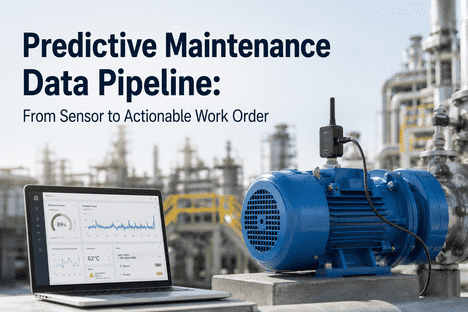
A predictive maintenance data pipeline is the end-to-end architecture that converts raw sensor telemetry from industrial equipment into actionable work orders in a CMMS — spanning six distinct stages from physical sensor sampling through edge preprocessing, secure protocol transport, cloud or on-premise storage, ML model inference, alert generation, and finally automated work order creation with asset ID, fault classification, severity score, and recommended intervention timeline. Unlike general-purpose data pipelines designed for business analytics or IT system monitoring, industrial PdM pipelines must handle asynchronous multi-rate time series data — accelerometers sampling at 10–50 kHz, process variables at 100 ms–1 s intervals, SCADA historian data at 1–60 s intervals, and operator shift log entries at human time scales — while maintaining temporal alignment across all data streams for model training and inference. The pipeline must also enforce data governance constraints: sensor metadata registration in a hierarchical asset model, unit-of-measure standardization, timestamp normalization to a common time base, and security boundaries between operational technology (OT) networks and information technology (IT) systems. iFactory AI's industrial software platform, including its Shift Logbook and predictive maintenance engine, provides a pre-configured PdM data pipeline that connects sensor ingestion through CMMS work order automation without requiring custom integration development for each data source. Book a Demo to see how iFactory's data pipeline architecture converts sensor telemetry into automated maintenance action across bearings, motors, pumps, compressors, and conveying systems. This guide covers the six-stage PdM pipeline architecture, technology choices per stage, data governance requirements for industrial time series, and the vendor evaluation framework for reliability engineers assessing pipeline solutions.
Why Industrial PdM Pipelines Fail When Generic Data Architectures Are Applied
The most common mistake in predictive maintenance data pipeline design is applying IT-centric data architecture patterns to OT telemetry without adaptation. Industrial time series data has fundamentally different characteristics from business application data — high-frequency asynchronous sampling, missing or corrupted readings from sensor degradation, protocol-specific encoding that varies between device manufacturers, operational technology network security constraints that prevent direct cloud connectivity, and temporal data alignment requirements that batch processing architectures cannot satisfy for real-time alert generation. Post-mortem analyses of failed PdM deployments at industrial facilities identify four recurring architecture failures that iFactory's pre-configured pipeline stage architecture is explicitly designed to prevent.
The Six-Stage PdM Data Pipeline Architecture
A production-grade predictive maintenance data pipeline decomposes into six sequential stages, each with specific technology requirements, data quality checkpoints, and security boundaries. The architecture is designed to accommodate the temporal heterogeneity of industrial telemetry — high-frequency vibration data at 10–50 kHz, process data at sub-second intervals, SCADA historian data at multi-second resolution, and human-entered shift log entries — while maintaining temporal alignment and data provenance across all streams for model training and inference.
The Four Pipeline Failure Modes — and How iFactory's Architecture Prevents Each
Each of the six pipeline stages introduces specific failure modes that data architecture must detect and handle. The most common failures occur at the boundaries between stages — where data format changes, transport protocols switch, or temporal alignment assumptions break. iFactory's pre-configured pipeline includes data quality checkpoints at every stage boundary with automated error handling, retry logic, and dead-letter queue management.
Pipeline Stage Comparison: Custom Build vs. Pre-Configured Industrial Pipeline
The decision to build a PdM data pipeline from scratch versus deploying a pre-configured industrial pipeline platform depends on in-house IIoT engineering capability, timeline requirements, and the number of data sources requiring integration. The table below documents the effort, risk, and capability differences across each pipeline stage for the two approaches.
| Pipeline Stage | Custom Build Approach | iFactory Pre-Configured Pipeline | Risk Reduction | Time Saved |
|---|---|---|---|---|
| Sensor Ingestion | Write protocol drivers per sensor type; test against each device | Pre-built adapters for 50+ industrial protocols; plug-and-play device templates | Driver bugs & protocol incompatibility eliminated | 8–14 weeks |
| Edge Preprocessing | Custom FFT implementation per data type; manual filter tuning | Configurable FFT window, filter banks, and outlier detection per measurement class | Signal conditioning errors from custom code reduced | 3–6 weeks |
| Secure Transport | Self-managed MQTT broker, TLS certificates, OT firewall rules | Pre-configured TLS MQTT with OT-safe reverse proxy; IEC 62443 compliant | Misconfigured security boundaries eliminated | 6–10 weeks |
| Time-Series Storage | Select and deploy TSDB; design schema per asset type | Pre-configured TSDB with asset hierarchy metadata schema | Schema design errors eliminate query performance issues | 4–8 weeks |
| ML Inference | Model deployment pipeline; inference API development | Pre-trained base models per asset class; fine-tune with facility data | Model serving latency issues eliminated | 6–12 weeks |
| Work Order Automation | Custom CMMS API integration per platform; alert routing logic | Pre-built connectors for SAP, Oracle, JDE, major CMMS platforms | API integration errors eliminated | 4–8 weeks |
iFactory customers deploying the pre-configured pipeline report an average 6–12 month reduction in time-to-first-alert compared to internal custom build projects — converting from a multi-quarter development program into a multi-week configuration deployment. Book a Demo to see the iFactory pipeline architecture applied to your specific sensor and CMMS environment.
Expert Perspective: Why Pipeline Architecture Determines PdM Success or Failure
In 22 years of industrial data engineering across oil and gas, power generation, and discrete manufacturing, I have reviewed more than 40 predictive maintenance program post-mortems. The finding that appears in the majority of PdM program failures is not model accuracy — it is pipeline architecture failure. The team built or procured an accurate ML model that never reached production because the sensor data feeding it was corrupted by timestamp misalignment, the preprocessing pipeline introduced artifacts that the training data did not contain, the secure transport boundary between OT and IT networks was never properly configured, or the CMMS integration for automated work order creation was deprioritized in the final quarter of a resource-constrained build program. The architecture failure modes are well understood: asynchronous multi-rate time series data requires temporal alignment logic that batch-processing pipelines cannot provide; protocol-specific encoding between different sensor types requires adapter layers that general-purpose data ingestion frameworks do not include; and the feedback loop from work order outcome to model retraining requires a bidirectional CMMS integration that is almost never built in custom pipeline projects. When I evaluate a PdM program, I spend 10% of the assessment on the model architecture and 90% on the data pipeline architecture — because an accurate model that never reaches production delivers zero value, and a pipeline design that accommodates industrial telemetry realities delivers value even before the first ML model is deployed.
Data Governance Requirements for Industrial PdM Pipelines
Industrial predictive maintenance pipelines operate under data governance constraints that IT-focused data platforms do not address. Sensor metadata must be registered in an asset hierarchy that maps each data point to a specific piece of equipment, measurement location, and measurement type. Timestamp normalization must account for multiple clock sources — sensor-local time, edge gateway time, SCADA system time — and convert all to a common UTC reference with source clock drift compensation. Unit-of-measure standardization must convert between sensor-native units and the standard engineering units required by ML models and CMMS work orders. Security boundaries between OT networks and IT systems must prevent any inbound connection from the IT network to the OT network while allowing outbound telemetry transport through a demilitarized zone architecture. iFactory's pipeline includes all four governance capabilities as pre-configured pipeline stages — asset hierarchy metadata registration at ingestion, UTC timestamp normalization with drift compensation, engineering unit conversion library with 200+ industrial measurement types, and IEC 62443-3-3 compliant OT-IT security boundary enforcement.
Vendor Evaluation Framework — PdM Data Pipeline Questions
Generic data pipeline vendors discuss throughput, latency, and scalability. Industrial PdM pipeline specialists discuss protocol adapter libraries, temporal alignment strategies, OT-IT security boundary patterns, and CMMS integration depth. Eight criteria separate vendors who have deployed PdM pipelines in industrial environments from vendors selling general-purpose data streaming platforms adapted for industrial use.
- Ask: "Which industrial protocols do you support natively — OPC UA, MQTT Sparkplug B, Modbus TCP/RTU, Profinet, EtherNet/IP?"
- Ask: "Do you provide tested adapter configurations per device manufacturer or require custom driver development?"
- Ask: "How do you handle protocol version differences between device firmware revisions?"
- Pipeline must handle 50+ industrial protocols with pre-tested device-specific configurations
- Ask: "How does your pipeline align vibration data at 10–50 kHz with process data at 100 ms intervals?"
- Ask: "What interpolation method do you use — linear, spline, or forward-fill?"
- Ask: "How do you handle timestamp drift between sensor-local clocks and gateway clocks?"
- Pipeline must demonstrate temporal alignment across three or more data rates simultaneously
- Ask: "What is your OT-IT network architecture pattern — unidirectional gateway, reverse proxy, or DMZ?"
- Ask: "Does your pipeline comply with IEC 62443-3-3 security requirements for industrial automation?"
- Ask: "How is certificate management handled for TLS-encrypted MQTT or OPC UA transport?"
- Pipeline must enforce no-inbound-connections rule from IT network to OT network
- Ask: "Can I register sensor metadata in a hierarchical asset model — plant, area, line, equipment, component, sensor?"
- Ask: "How does the pipeline handle sensor reassignment when equipment is relocated or reconfigured?"
- Ask: "Are data quality flags propagated through the pipeline with each data point?"
- Pipeline must maintain asset hierarchy with each data point tagged to specific equipment node
- Ask: "Which CMMS platforms do you support — SAP PM, Oracle EAM, IBM Maximo, JDE, Infor, Maintenance Connection?"
- Ask: "What fields are populated in the generated work order — asset ID, fault type, severity, RUL, recommended action?"
- Ask: "Does the pipeline ingest work order closeout data to close the model feedback loop?"
- Pipeline must support bidirectional CMMS integration for both work order creation and outcome ingestion
- Ask: "What signal preprocessing filters are available — median, low-pass, band-pass, envelope detection?"
- Ask: "Can preprocessing rules be configured per measurement type — vibration envelope vs. temperature trend vs. current signature?"
- Ask: "How is preprocessing validation — ensuring output quality before model inference — verified?"
- Pipeline must provide pre-processing filter per measurement type with automated quality validation
- Ask: "How is the model retrained when new failure data becomes available — manual or automated?"
- Ask: "What triggers a retraining cycle — calendar, data volume threshold, or accuracy degradation detection?"
- Ask: "How is model versioning managed — can we roll back to a previous model version?"
- Pipeline must include automated retraining pipeline with version control and rollback capability
- Ask: "When will the first automated work order be generated from sensor telemetry in production — not in test or pilot?"
- Ask: "What is the timeline for adding a new sensor type or CMMS platform that is not in your current adapter library?"
- Ask: "What is the maintenance burden — how many engineer-days per month to keep the pipeline operational?"
- Pre-configured industrial pipeline: first work order in 6–10 weeks. Custom build: 6–12 months
How iFactory's Pre-Configured Pipeline Reduces Deployment Risk
The single biggest risk in predictive maintenance program deployment is the assumption that sensor data will flow reliably from end to end on day one. In custom pipeline builds, stage-by-stage integration testing reveals data quality issues — timestamp skew, unit mismatch, protocol buffer overflows, network dropout handling gaps — that each require 2–6 weeks of engineering rework. iFactory's pre-configured pipeline eliminates this risk by providing tested stage adapters with known data quality characteristics, automated stage-boundary data validation, and multi-rate temporal alignment that has been validated across 200+ industrial deployments. The result is that the first work order from sensor telemetry arrives in 6–10 weeks rather than 6–12 months — not because the ML models train faster, but because the data pipeline between sensor and model is already production-tested.
Conclusion: The Pipeline Is the Product — the Model Is the Plugin
The most important insight from industrial predictive maintenance program outcomes over the past decade is that the data pipeline architecture — not the ML model architecture — determines program success or failure. An accurate model that never receives reliable, temporally aligned, quality-validated sensor data delivers zero value. A production-grade pipeline that delivers conditioned, aligned, metadata-tagged telemetry to a model — any model — delivers value from day one, even before the first model inference. iFactory's pre-configured PdM data pipeline addresses the six-stage architecture end to end: sensor ingestion with 50+ protocol adapters, edge preprocessing with configurable filter banks, secure OT-IT transport with IEC 62443 compliance, time-series storage with asset hierarchy metadata, ML model inference with pre-trained base models per asset class, and CMMS work order automation with bidirectional feedback loop. The Shift Logbook provides the operator and maintenance team interface that connects pipeline-generated alerts to shift handovers, inspection findings, and model retraining data — completing the sensor-to-action feedback loop. The decision worth making in 2026 is not which ML model to deploy — it is which data pipeline architecture will deliver reliable, conditioned telemetry to whatever model your program requires.
Frequently Asked Questions
iFactory's pipeline includes pre-built protocol adapters for OPC UA (client and server modes), MQTT with Sparkplug B payload encoding, Modbus TCP and RTU (master mode supporting up to 247 slaves per serial segment), Profinet IO, EtherNet/IP, Siemens S7, Allen-Bradley DF1, BACnet, and HTTP/HTTPS REST API ingestion from SCADA historians and cloud-based sensor platforms. Each adapter is pre-configured with default buffer sizes, timeout values, and retry logic appropriate for industrial network conditions — tested against the most common device families from Siemens, Rockwell, Schneider Electric, Beckhoff, Mitsubishi, Omron, Emerson, and ABB. For sensor types not currently in the adapter library, iFactory provides a protocol adapter development kit with pre-built MQTT and Modbus transport wrappers that reduce custom adapter development from weeks to days.
iFactory's edge gateway includes a local buffering capability that stores up to 72 hours of conditioned telemetry in non-volatile memory during network outages. When the connection to the analytics platform is restored, the gateway replays buffered data in chronological order with sequence numbers that enable the platform to detect any gaps between the last received data point before the outage and the first data point after the outage. Data points that were transmitted but not acknowledged by the platform before the outage are retransmitted with a duplicate detection flag that the preprocessing stage uses to de-duplicate. For outages exceeding 72 hours, the gateway implements a tiered retention policy — high-frequency vibration data retained for 72 hours, process variable data retained for 168 hours, and aggregated trend data retained for 720 hours — ensuring that the highest-value telemetry for model training is preserved longest.
iFactory's pipeline architecture enforces the fundamental OT security principle: no inbound connections from IT network to OT network are permitted under any configuration. The edge gateway establishes an outbound TLS-encrypted MQTT or OPC UA connection to the analytics platform's DMZ-located broker — the OT network never exposes a listening port to any IT network or cloud endpoint. Certificate-based authentication is required for all gateway-to-broker connections, with certificate expiry monitoring and automated renewal before expiry to prevent data loss. The pipeline supports deployment in air-gapped environments where no external network connectivity is permitted — using an on-premise deployment of the analytics platform with the same DMZ-based architecture. iFactory's pipeline architecture has been reviewed and accepted by the cybersecurity teams at major integrated steel producers, automotive OEMs, and chemical processors — and complies with IEC 62443-3-3 security requirements for industrial automation and control systems.
For sensor types with existing protocol adapters in iFactory's library, connection typically requires 2–4 hours of configuration — selecting the sensor from the device template library, entering the network address and communication parameters, mapping the sensor registers or OPC UA variables to the asset hierarchy in the analytics platform, and verifying data delivery through the pipeline end to end. For sensor types or data sources that use a protocol already supported by an existing adapter but with device-specific encoding differences, configuration typically requires 2–5 days for adapter parameterization and testing. For sensor types using a protocol not currently in the adapter library — such as a proprietary protocol used by a specialized OEM sensor — custom adapter development requires 2–6 weeks depending on protocol documentation quality, testing environment availability, and the complexity of any licensing or certification requirements for the protocol stack.
For a typical industrial facility with an existing SCADA system, PLC network with OPC UA or Modbus capability, and a CMMS platform — but no existing PdM data pipeline — a full iFactory pipeline deployment runs $75,000 to $180,000 in total investment over a 6–10 week timeline. The cost breakdown is approximately: sensor connectivity and protocol adapter configuration for 50–100 data points ($15,000–$35,000), edge gateway deployment and OT-IT security boundary configuration ($12,000–$25,000), time-series storage and asset hierarchy metadata registration ($12,000–$20,000), ML model training for the first two asset classes ($20,000–$50,000), and CMMS integration with work order automation templates ($16,000–$50,000). The deployment timeline breaks into: weeks 1–3 for sensor connectivity and data validation, weeks 4–6 for security boundary configuration and TSDB deployment, weeks 6–8 for model training and alert threshold calibration, and weeks 8–10 for CMMS integration and work order automation go-live. ROI is typically demonstrated within 90 days of go-live from the first prevented equipment failure and automated work order completion.