The Internet of Things (IoT) has transformed predictive maintenance from a theoretical concept into a measurable operational reality. With 18.8 billion connected IoT devices deployed globally by the end of 2024 and projections reaching 40 billion by 2030 (IoT Analytics, 2025), industrial organizations now have the data infrastructure to move beyond reactive and calendar-based maintenance toward true condition-based prediction. Real-time data from vibration, temperature, pressure, acoustic, and current sensors — streamed through edge gateways and analyzed by machine learning models — enables maintenance teams to detect equipment degradation 30–60 days before failure with 85–95% precision. The global predictive maintenance market reflects this shift: valued at USD 14.29 billion in 2025 and projected to reach USD 98.16 billion by 2033 at 27.9% CAGR (Grand View Research, 2025). iFactory AI delivers an on-premise IoT predictive maintenance platform that connects to existing sensor infrastructure, ingests real-time operational data, and surfaces actionable failure predictions without cloud dependency. Book a Demo to see how IoT-powered predictive maintenance unlocks real-time visibility across your industrial operations.
INDUSTRIAL IOT · PREDICTIVE MAINTENANCE · REAL-TIME DATA · 2026
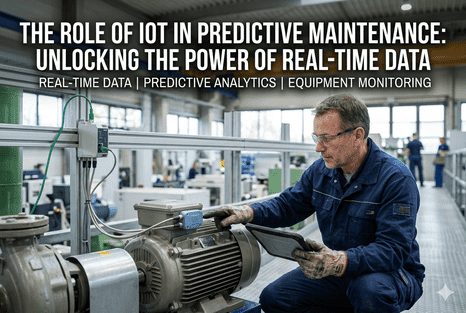
The Role of IoT in Predictive Maintenance: Unlocking the Power of Real-Time Data
IoT sensors stream real-time vibration, temperature, pressure, and current data from every critical asset — AI models analyze these streams to predict failures 30–60 days in advance, reducing unplanned downtime by 30–50% and maintenance costs by 18–25%. No cloud dependency. No data egress.
18.8BConnected IoT Devices (2024)
71%Use AIoT for Predictive Maintenance
30–50%Unplanned Downtime Reduction
$98.16BPredictive Maintenance Market by 2033
The IoT Data Foundation for Predictive Maintenance
Predictive maintenance is fundamentally a data problem. Without sensors, there is no real-time data, and without data, there is no predictive insight (WorkTrek, 2025). IoT devices — from wireless vibration sensors to multi-parameter edge gateways — create the data backbone that AI analytics depend on. Modern sensor costs have dropped more than 50% over the past decade, making continuous condition monitoring financially viable for mid-sized manufacturers. Wireless mesh networks cut installation costs up to 60% relative to wired layouts, bringing remote mines, offshore rigs, and mobile equipment into predictive regimes. Standardized protocols such as MQTT and OPC-UA raise interoperability, reducing integration complexity for multi-vendor plants.
Vibration & Temperature Sensors (Rotating Assets)The most widely deployed IoT sensors in industrial predictive maintenance. Modern MEMS accelerometers deliver flat frequency response up to 6 kHz at sub-mA consumption — sufficient for 80% of Class II and III rotating machines under ISO 10816. Combined with temperature probes, these sensors detect bearing wear, misalignment, imbalance, and lubrication degradation weeks to months before failure. iFactory's platform ingests this data from any industrial IoT sensor network, whether wired (IEPE piezo) or wireless (LoRaWAN, BLE, Wi-Fi Mesh), and applies AI models trained on your specific equipment's failure signatures.
Acoustic & Ultrasonic Sensors (Leaks & Electrical Faults)Acoustic sensors detect the unique sound signatures of developing faults — compressed air leaks, steam trap failures, bearing defects, and partial discharge in electrical equipment. These sensors operate effectively in high-noise industrial environments by filtering for specific frequency bands correlated with fault types. AI models correlate acoustic signatures with vibration and temperature data to differentiate between benign noise and developing failure conditions, reducing false positive rates that otherwise cancel up to 18% of predictive maintenance gains.
Motor Current & Power Signature SensorsCurrent and power-quality sensors monitor electrical signature of motors, pumps, and compressors — detecting rotor bar defects, winding degradation, and load anomalies without direct mechanical contact. These sensors are particularly valuable for hard-to-reach assets where vibration sensor installation is impractical. When combined with vibration and thermal data, current signature analysis improves fault classification accuracy from 75% (single-modality) to over 92% (multi-modality fusion) in documented deployments.
Edge Gateways & Real-Time Data ProcessingEdge gateways process thousands of data points per second locally, ensuring immediacy of alerts while limiting traffic back to the cloud. This is critical for latency-sensitive applications such as high-speed rotating machinery where a 500ms delay in anomaly detection can mean the difference between a planned bearing replacement and a catastrophic spindle failure. iFactory's on-premise architecture runs edge inference without persistent cloud connectivity, maintaining predictive operations even in bandwidth-limited or air-gapped industrial environments.
START WITH YOUR CRITICAL ASSETS
Ready to connect your industrial assets and start predicting failures with real-time IoT data?
The data infrastructure is already within reach — modern IoT sensors, edge gateways, and AI analytics make predictive maintenance deployable on any critical asset. iFactory AI connects to your existing sensor ecosystem or helps you deploy new ones, delivering actionable failure predictions within weeks. Start with 10–20 critical machines and see measurable impact in 30 days.
How IoT and AI Work Together for Predictive Maintenance
The convergence of IoT sensor networks and AI analytics — often called AIoT — is the dominant paradigm in industrial predictive maintenance. 71% of organizations globally use AIoT for predictive maintenance, making it the most widely adopted AIoT use case (SAS / IDC, 2025). Here is how the data flows from sensor to action.
Data Acquisition
Continuous Sensor Streaming
- IoT sensors on each asset sample vibration, temperature, pressure, and current at configurable intervals (every 1–60 seconds depending on criticality)
- Wireless mesh networks (LoRaWAN, BLE, Wi-Fi Mesh) or wired connections (MODBUS RTU, OPC-UA) transmit data to edge gateways
- iFactory's platform supports any standard industrial IoT protocol — no vendor lock-in, no rip-and-replace
- Historical data (up to 3+ years) is ingested on day one to accelerate AI model training
Sensor costs dropped 50%+ over the past decade — continuous monitoring is now viable for mid-sized plants
Edge Processing
Real-Time Anomaly Detection
- Edge gateways pre-process sensor data locally — filtering noise, extracting features, and running lightweight inference models
- Condition indicators (RMS velocity, temperature deltas, current harmonics) are computed at the edge within milliseconds
- Only statistically significant anomalies and trend data are forwarded to the central AI engine — reducing bandwidth requirements by 80–90%
- Critical alerts (e.g., vibration exceeding ISO 10816 severity level) trigger immediate local notification with zero cloud dependency
Edge inference delivers sub-second anomaly detection without persistent connectivity
AI Analytics
Failure Prediction & Classification
- Ensemble machine learning pipelines analyze multi-parameter time-series data to identify early indicators of failure
- Models achieve 85–95% precision in predicting bearing, pump, and motor failures 30–60 days in advance
- Transfer learning and synthetic data techniques enable accurate predictions even when historical failure events are scarce — training in weeks, not years
- Generative AI copilots provide technicians with contextual repair steps, parts lists, and safety checks using natural-language queries
AI predicts failures 30–60 days ahead with 85–95% precision (industry benchmarks, 2025)
Workflow Integration
Actionable Alerts & Automated Work Orders
- Specific failure predictions are routed directly to maintenance technicians — including equipment ID, failure type, and predicted time to failure
- "Bearing failure in Pump P-105, approximately 17 days. Recommended action: replace bearing during planned shutdown on Day 14."
- Maintenance schedules are optimized around production peaks — interventions happen during natural capacity gaps
- Post-repair data is fed back into the AI model to improve prediction accuracy continuously
Documented: 95% of predictive maintenance adopters report positive ROI
The Industrial Internet of Things provides the data infrastructure, and AI provides the analytical engine. Neither works without the other. IoT surfaces the raw operational signal; AI transforms it into a maintenance schedule calibrated to actual equipment condition rather than a calendar.
What the Research Shows: Real-World IoT Predictive Maintenance Impact
The financial case for IoT-driven predictive maintenance is well-documented across multiple research firms and industry deployments. These aren't projections — they are outcomes from organizations that have already made the transition.
78% of Manufacturers Using IoT Report Reduced DowntimeMcKinsey's 2023 study found that 78% of manufacturers using IoT in production have seen a measurable reduction in unplanned downtime. Across 1,165 surveyed companies, nearly one-third actively use predictive maintenance (WorkTrek, 2024), and more than two-thirds of maintenance teams plan to adopt AI-driven maintenance by end of 2026 (MaintainX, 2025). The manufacturing sector alone accounts for 30–32% of total predictive maintenance spending — the largest end-use segment.
McKinsey: Up to 40% Cost Reduction, 50% Less DowntimeManagement consulting firm McKinsey estimates that IoT-enabled predictive maintenance could reduce factory equipment maintenance costs by up to 40%, decrease downtime by up to 50%, and reduce capital investment by up to 5% by extending the life of existing industrial assets. These savings could amount to $630 billion per year globally. Early adopters are already capturing this value: Unilever's Indaiatuba plant deployed IoT sensors across 50,000+ data points and achieved a 45% reduction in annual maintenance costs ($2.3M savings) and a 40% reduction in unplanned downtime (from 8.2% to 4.9% of operating time).
25% Maintenance Cost Reduction, 50% Less Unplanned DowntimeIoT Analytics reports that predictive maintenance applications dominate the IoT analytics market with approximately 45% market share. Organizations deploying predictive maintenance analytics report up to 50% reduction in unplanned equipment downtime and approximately 25% reduction in maintenance expenses compared to reactive and preventive strategies. The global IoT Analytics market is projected to grow from $35.4 billion in 2026 to $136 billion by 2033 at a 21.2% CAGR — with predictive maintenance as the dominant application.
30–50% Total Cost of Ownership Reduction with Subscription ModelsSubscription-based predictive maintenance suites reduce total cost of ownership by 30–50% compared with traditional on-premise builds, enabling multi-site rollouts without proportional hardware growth. Multi-tenant architectures lower entry thresholds so that SMEs pay on a per-asset basis (USD 50–100 per asset per month), aligning fees with realized savings and achieving positive ROI within 12–18 months.
What IoT-Enabled Predictive Maintenance Unlocks That Traditional Approaches Cannot
| Aspect | Traditional Preventive / Reactive | IoT + AI Predictive Maintenance |
| Maintenance Trigger |
Calendar interval (2000 hours) or post-failure |
Real-time sensor data crossing validated degradation thresholds — maintenance only when needed |
| Failure Detection Timeline |
After failure occurs (reactive) or during scheduled inspection window (preventive) |
30–60 days advance warning with specific failure mode, confidence interval, and recommended action |
| Data Sources |
Manual inspection logs, operator observations, CMMS work order history |
Continuous multi-parameter streams from vibration, temperature, pressure, acoustic, and current sensors — hundreds of data points per asset per day |
| Coverage Pattern |
82% of industrial assets exhibit random failure patterns — calendar-based maintenance misses the majority of failure modes (ARC Advisory Group) |
Continuous monitoring detects both age-related and random failure patterns — any deviation from normal operating signature triggers analysis |
| False Positive Control |
Not applicable — no predictive alerts to manage |
AI calibration over initial 3–6 month period reduces false positives; multi-modality sensor fusion improves fault classification accuracy to 92%+ |
| Repair Cost Impact |
Emergency repairs cost 3–5x more than planned work (overtime premiums, expedited shipping, production losses) |
5–7 days' warning enables parts procurement at standard pricing, scheduling during planned downtime, and single-shift repairs — 40x cost reduction vs emergency response |
How IoT Deployment Works: From Pilot to Plant-Wide Coverage
Phase 1: Sensor & Data Assessment (1–2 weeks)iFactory engineers assess your existing sensor infrastructure, control systems, and maintenance workflows. We identify which critical assets already have IoT instrumentation and where additional sensors are needed. Most facilities already have vibration and temperature sensors on critical equipment — the gap is typically in data continuity and analytics, not hardware.
Phase 2: Connect & Configure (2–3 weeks)iFactory connects to your IoT sensor network via standard industrial protocols (MQTT, OPC-UA, MODBUS, OPC-DA). Edge gateways are configured to stream multi-parameter data to the on-premise AI engine. Historical data from CMMS and historian systems is ingested to accelerate model training. No production downtime is required.
Phase 3: Baseline & Calibration (3–6 weeks)AI models learn each asset's normal operating signature — vibration baselines, temperature profiles, current draw patterns. Initial threshold-based alerts are active from day one. AI calibration reduces false positives over 3–6 months, driving multi-modality fault classification accuracy above 92%.
Phase 4: Live Alerts, Scale & Continuous Improvement (ongoing)Predictive alerts are generated 30–60 days before predicted failures with specific failure mode identification and recommended interventions. Maintenance teams transition from reactive dispatch to planned, condition-based interventions. Post-repair data feeds back into model training, continuously improving accuracy and expanding coverage to additional asset classes.
Frequently Asked Questions
Do I need to replace my existing sensors to use iFactory's platform?
No. iFactory connects to your existing IoT sensor infrastructure regardless of vendor. We support standard industrial protocols (MQTT, OPC-UA, MODBUS, OPC-DA) and can ingest data from vibration, temperature, pressure, current, and acoustic sensors already installed on your critical equipment. For assets that lack sensors, we recommend cost-effective wireless retrofits (typically $150–450 per monitored asset including sensor, gateway, and connectivity).
How accurate are the failure predictions, and how long until they are reliable?
Ensemble machine learning models achieve 85–95% precision in predicting bearing, pump, and motor failures 30–60 days in advance (industry benchmarks, 2025). Initial calibration takes 3–6 months as AI models learn each asset's normal operating signature and false positive rates are optimized. During this calibration period, threshold-based alerts (ISO 10816 severity levels, thermal limits) are active and reliable from day one. After calibration, multi-modality sensor fusion drives fault classification accuracy above 92%.
What infrastructure do I need on site to support IoT predictive maintenance?
You need three components: (1) IoT sensors on critical assets — typically wireless or wired vibration, temperature, and current sensors depending on asset type and environment; (2) edge gateways or network connectivity to transmit sensor data to the analytics platform; (3) iFactory's on-premise AI engine installed on existing server infrastructure or dedicated edge hardware. No cloud dependency, no data egress. Wireless mesh networks (LoRaWAN, BLE, Wi-Fi Mesh) eliminate the need for extensive new cabling.
How quickly will I see ROI from IoT predictive maintenance?
Most facilities see measurable ROI within 12–18 months. 95% of predictive maintenance adopters report positive returns overall, with approximately 27% reaching payback within 12 months (IoT Analytics, 2025). Programs targeting high-criticality assets can see returns within weeks — a single avoided major failure often pays for years of monitoring. At current industry benchmarks, facilities typically achieve 18–25% maintenance cost reduction and 30–50% unplanned downtime reduction. For a concrete ROI projection based on your asset portfolio,
Book a Demo and we will model your facility's data.
Can iFactory integrate with my existing CMMS or ERP system?
Yes. iFactory supports bi-directional integration with major CMMS platforms (SAP PM, IBM Maximo, Infor EAM, Fiix, UpKeep) and ERP systems. Predictive alerts can automatically generate work orders in your CMMS, and post-repair data flows back into the AI model for continuous improvement. Integration is typically completed during Phase 2 (Connect & Configure) with no disruption to existing workflows.
Does this work for multi-site industrial operations?
Yes. iFactory is designed for distributed industrial operations. Each site runs its own on-premise instance with local edge processing and centralized fleet-wide analytics. You can compare asset health across sites, benchmark maintenance performance, and deploy standardized AI models across similar equipment types globally. Multi-site deployments typically achieve faster ROI as model training from early-adopter sites accelerates deployment at subsequent facilities.
INDUSTRIAL IOT · PREDICTIVE MAINTENANCE · REAL-TIME ANALYTICS
Turn Your IoT Data Into Actionable Failure Predictions Today.
Real-time IoT sensor data is already available on your critical assets. iFactory AI connects to your existing infrastructure, analyzes multi-parameter data streams with AI models, and delivers 30–60 day advance failure predictions — reducing downtime by 30–50% and maintenance costs by 18–25%. Deploy in 4–6 weeks. Start predicting failures immediately.