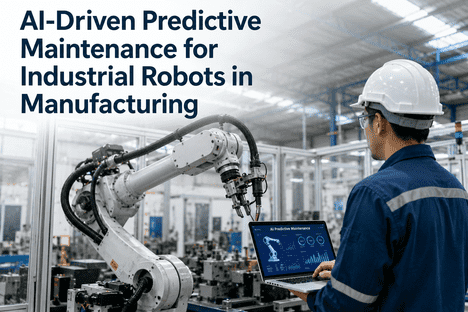
Industrial robots are the backbone of modern manufacturing, with over 4.66 million units installed globally according to the International Federation of Robotics. Each of these robots contains dozens of critical components — servo motors, harmonic drives, bearings, encoders, and cables — that degrade over time under thermal, mechanical, and electrical stress. When one robot cell stops unexpectedly, the ripple effect can cascade through six or more downstream stations. Predictive maintenance powered by AI and machine learning transforms this vulnerability into a managed process, enabling manufacturers to anticipate failures before they cause production stoppages. Book a Demo
Common Failure Modes in Industrial Robots
Industrial robots operate in harsh environments — thermal cycling, repetitive shock loads, electrical noise, and continuous duty cycles that accumulate millions of motion repetitions per year. Understanding the six primary failure modes is the foundation of any predictive maintenance program. The table below maps each failure mode to its root cause, detection method, and typical lead time before catastrophic failure.
Major Industrial Robot Platforms: Predictive Maintenance Capability Assessment
The information below is based on publicly available platform specifications, published case studies, and documented PdM platform capabilities as of 2026. PdM readiness ratings reflect each manufacturer's native condition monitoring tools, API openness for third-party CMMS integration, and proven deployment references. Actual integration depth should be verified directly with each manufacturer.
ABB Connected Services is the most comprehensive native PdM platform among major industrial robot manufacturers. The Swedwood case study demonstrates a measurable outcome: remote monitoring enabled ABB technicians to detect a cabinet cooling fan failure before it caused a controller overheating shutdown. The KOKI deployment expanded from 1 pilot robot to 60 connected robots across the entire fleet after the first year demonstrated proactive fault detection. iFactory API integration enables ABB robot sensor data to populate HACCP-compliant maintenance records and auto-generate work orders.
FANUC FIELD is among the most open IIoT platforms among robot OEMs, supporting OPC-UA for machine data standardization. Zero Downtime monitoring is FANUC's flagship PdM feature, analyzing spindle and servo loads to predict failure. The FIELD system enables manufacturers to build custom PdM applications on the edge, reducing cloud dependency. iFactory integration via OPC-UA would allow transfer of ZDT-generated alerts into structured CMMS work orders with compliance tracking and audit trail capability.
KUKA iiQoT.Advanced includes a native PdM application that predicts failures and alerts maintenance teams in advance. The platform collects up to 40,000 sensor values per robot, enabling both condition-based and predictive maintenance strategies. A Chalmers University study of KUKA Nordic customers found that robots rarely fail suddenly — most failures are gradual, making them ideal candidates for PdM. The key barrier is not platform capability but data management maturity and integration with existing CMMS systems. iFactory addresses this gap by providing the structured work order and compliance layer.
Mitsubishi Electric's approach to robot PdM is unique — diagnostics are embedded directly in the CNC controller that manages both the machine tool and the robot. This eliminates the need for a separate monitoring infrastructure and enables consumption-based maintenance planning based on actual component wear indicators. The MQTT bridge to IIoT platforms makes data accessible to third-party CMMS solutions like iFactory. The solution is open to extension for FANUC robots controlled via Mitsubishi CNC systems, broadening its applicability.
Head-to-Head Comparison: Predictive Maintenance Capabilities
The table below compares all four robot platforms across criteria that determine PdM deployment suitability, CMMS integration depth, and practical maintenance outcomes. Specifications are based on publicly available data. Verify current capabilities directly with each manufacturer.
| Criteria | ABB IRB Series | FANUC CRX / R-2000 | KUKA KR QUANTEC | Mitsubishi RV Series |
|---|---|---|---|---|
| Native PdM Platform | Connected Services | FIELD + ZDT | iiQoT.Advanced | CNC-integrated PLC |
| Sensor Data Channels | Multi-sensor fusion | Spindle & servo load | Up to 40,000 values | Servo & encoder data |
| Failure Detection Scope | Bearings, motor, cooling, cycle deviation | Spindle, servo, lubrication, following error | Axis, torque, temperature, runtime | Consumption indicators, following error |
| Alert Delivery | SMS, email, technician call | Dashboard, email | Dashboard, email | HMI, MQTT broker |
| API / Connectivity | REST API | OPC-UA, REST API | REST API, raw data export | MQTT, OPC-UA |
| CMMS Integration Path | REST API → iFactory | OPC-UA → iFactory | API → iFactory | MQTT → iFactory |
| Proven Fleet Scale | 60+ robots (KOKI) | Thousands (automotive) | Hundreds (Nordics) | Single-cell CNC (published) |
| Maintenance Strategy Shift | Reactive → Predictive | Reactive → Condition-based | Reactive → Predictive | Reactive → Consumption-based |
| Industry Best Fit | Automotive, furniture, general | Automotive, aerospace, electronics | Automotive, aerospace, general | Machine tending, CNC-integrated |
| iFactory Integration Status | Available (REST API) | In development (OPC-UA) | Available (REST API) | Available (MQTT) |
| Deployment Complexity | Moderate (ABB-managed) | Low (FIELD edge) | Moderate (customer-managed) | Low (CNC-embedded) |
| Best PdM Application | Full fleet monitoring | Edge-based ZDT | Data-rich analytics | Integrated machine-tending |
Industrial Robot PdM Deployment Use Cases by Industry
Each robot platform and PdM approach is best suited for specific manufacturing environments. Matching the PdM strategy to the right application domain maximizes return on investment and minimizes unplanned downtime. The deployment cases below are based on published case studies and documented industry practices.
- Highest downtime cost sector at $2.3M per hour; justifies full fleet connected PdM investment
- ABB Connected Services or FANUC FIELD + ZDT for spindle and servo load monitoring across 50-200+ robot lines
- iFactory integration auto-generates work orders from PdM alerts, linking to vehicle production records and quality traceability
- Measurable outcome: unplanned downtime incidents reduced from 42 to 25 per month (Siemens 2024 benchmark)
- Machine tending robots (loading/unloading CNC lathes, mills) benefit from embedded CNC diagnostics
- Consumption-based indicators for servo wear, lubrication intervals, and cycle count deviations
- MQTT bridge enables iFactory work order creation when consumption thresholds are exceeded
- Best for small-to-medium manufacturers running robot-tended CNC cells without dedicated PdM teams
- Aerospace applications demand positional repeatability within ±0.02mm; harmonic drive wear directly impacts quality
- KUKA iiQoT or ABB Connected Services with vibration spectrum analysis for joint bearing and gearbox monitoring
- iFactory integration links PdM alerts to component serial numbers, creating traceable maintenance history for FAA/EASA audit readiness
- Measurable outcome: predictive alert 200-500 hours before bearing failure enables scheduled replacement during planned outages
- Mixed-fleet plants (FANUC welding, KUKA material handling, ABB painting robots) need vendor-agnostic CMMS integration
- OEM-specific PdM platforms (FIELD, iiQoT, Connected Services) each expose data via APIs for centralized aggregation
- iFactory provides the unified CMMS layer: ingests alerts from all platforms, normalizes into standard work orders, and maintains single-source-of-truth maintenance records
- Measurable outcome: 50% less downtime across multi-vendor robot fleet within 6 months of deployment
The CMMS Layer: Why Robot PdM Data Needs iFactory to Have Maintenance Value
Every predictive maintenance platform for industrial robots generates alerts and sensor readings. The question that maintenance and operations teams must ask is: what happens when an alert triggers? A robot PdM platform that sends an email notification and requires a technician to log in, assess the alert, manually create a work order, and track the repair in a separate system has created an information event — not a maintenance action. The same alert integrated with iFactory automatically generates a prioritized work order with the robot asset ID, fault code, recommended repair procedure, required spare parts, and technician skill requirement. See iFactory's alert-to-work-order automation
Robot PdM platform generates an alert: joint 3 bearing vibration exceeds threshold. Alert sent via email to maintenance manager. Manager logs into PdM dashboard, reviews vibration data, determines bearing needs replacement within 2 weeks. Manager manually opens separate CMMS system, creates work order from memory, assigns technician. Work order details may omit serial number, fault code history, or required parts list. Alert-to-work-order cycle: 45-90 minutes. Risk of incomplete data in maintenance record.
ABB Connected Services detects joint 3 bearing vibration exceeding threshold. REST API posts alert payload to iFactory. iFactory auto-creates work order: asset ID (IRB6700-12), fault code (BEAR-VIB-J3), priority (scheduled within 14 days), required part (bearing kit ABB-3HAC1234), technician skill level (robotics L3), and linked to robot maintenance history. Work order appears in technician mobile app. Alert-to-work-order cycle: 30 seconds. Complete maintenance record created without human data entry. Same work order later closed with technician notes, parts used, and post-repair vibration reading — creating an immutable maintenance record for audit.
iFactory Platform: What the CMMS Delivers for Robot PdM Programs
iFactory is the AI-powered CMMS purpose-built for industrial manufacturing — the software layer that gives robot PdM alerts maintenance execution value. Deployed in 1-2 weeks with pre-built robot maintenance templates compatible with ABB Connected Services, FANUC FIELD, KUKA iiQoT, and Mitsubishi CNC diagnostics.
| iFactory Capability | What it delivers for robot PdM programs |
|---|---|
| Automated Work Order Creation | PdM alerts from any robot platform auto-generate structured work orders with asset, fault code, priority, parts, and skill requirements |
| Multi-Vendor Fleet Aggregation | Unified CMMS layer across ABB, FANUC, KUKA, Mitsubishi — single dashboard for all robot maintenance despite different PdM platforms |
| Predictive Alert Scoring | ML models score incoming alerts by severity and urgency; prevents alert fatigue by filtering noise and prioritizing critical faults |
| Spare Parts Integration | Auto-links robot fault codes to required spare parts inventory; triggers reorder when parts below min stock level |
| Compliance & Audit Trail | Every work order links PdM alert data to completed maintenance actions; immutable record for ISO 14224, ISO 55000, and FDA 21 CFR Part 11 compliance |
| Mobile Technician App | Technicians receive work orders with full PdM context on mobile device; close out with parts used, time taken, and post-repair sensor readings |
| ROI Analytics | Compare unplanned downtime before vs after PdM deployment; calculate cost avoidance per robot cell and per fault type |
| Deployment Time | 1-2 weeks with pre-built robot maintenance templates; no robot controller modification required — API/MQTT integration only |