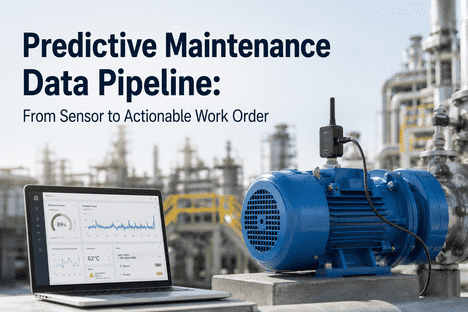
Industrial IoT sensors form the nerve endings of any predictive maintenance program — the physical layer where machine health data is born. From vibration accelerometers that detect bearing wear months before failure to temperature RTDs that catch thermal runaway before winding damage, the architecture of your sensor network determines whether your PdM investment delivers actionable predictions or expensive dashboards. Without a deliberate design methodology spanning sensor selection, placement strategy, wireless protocol choice, edge gateway sizing, and CMMS data pipeline integration, even the most sophisticated AI models cannot compensate for gaps in the data layer. This guide delivers a practical framework for designing and deploying an IIoT sensor architecture that converts raw machine telemetry into prioritized, verified maintenance actions — grounded in industrial deployment experience across hundreds of manufacturing plants. iFactory AI provides the edge platform and integration layer that connects every sensor type to your existing maintenance workflows. Book a Demo to see the complete architecture in a 30-minute walkthrough.
Design Your IIoT Sensor Network for Measurable PdM Outcomes
Sensor selection, placement strategy, protocol selection, edge gateway sizing, and CMMS pipeline integration — built for plant-floor reliability.
Why IIoT Sensor Architecture Determines Predictive Maintenance Success or Failure
The cost of industrial IoT sensor hardware has dropped 85% since 2019 — a vibration monitoring node that cost $600 per point in 2019 now costs under $50, crossing the threshold where sensor-based condition monitoring delivers positive ROI on assets valued at $5,000 or more. Yet 70% of predictive maintenance pilots fail in production. The cause is almost never the AI model or the sensor hardware — it is the architecture between them. Sensor placement that misses the load zone, wireless protocols that cannot penetrate metal-dense plant environments, edge gateways undersized for peak data throughput, and CMMS pipelines that deliver dashboard charts instead of dispatched work orders are the four failure modes that separate successful deployments from expensive data collection exercises. Plants that Book a Demo before architecting their sensor network consistently achieve faster deployment timelines and higher alert-to-action conversion rates than those who buy sensors first and design the system later.
The distinction between consumer IoT and industrial IoT is not semantic — it is architectural. Factory sensors operate in environments with metal shavings, coolant mist, temperature swings from -20°C to 85°C, and electromagnetic interference from variable frequency drives and welders. Consumer-grade hardware fails in weeks under these conditions. Industrial sensors must meet IP65–IP69K ingress protection, IEC 60068-2-6 vibration certification, and provide 10–15 year service life with traceable calibration schedules. Next-Gen Industrial Software standardizes sensor onboarding across all five core sensor types — vibration, temperature, current, pressure, and ultrasonic — through a unified edge gateway that accepts wired (4-20mA, Modbus, OPC UA) and wireless (Bluetooth 5.0, LoRaWAN, Wi-Fi 6) inputs without custom integration.
Vibration Accelerometers
Triaxial MEMS accelerometers covering 10 Hz to 10 kHz for bearing defect detection, imbalance, and misalignment. Piezoelectric sensors for high-frequency resolution above 10 kHz on critical rotating assets. Detection lead time: 4–8 weeks before failure.
Temperature Sensing
PT100 RTDs for ±0.1°C bearing and winding precision. Type K thermocouples for high-temperature processes up to 1,260°C. IR non-contact sensors for moving parts and electrical panel scanning. Detection lead time: 1–4 weeks before failure.
Current & Power Sensors
Split-core current transformers on motor feeds detect mechanical binding through 15%+ current draw increases. Power quality sensors for VFD harmonics, voltage imbalance, and power factor degradation on critical drives.
Pressure & Ultrasonic
Pressure transmitters (4-20mA/HART) for hydraulic, pneumatic, and steam system cavitation detection. Ultrasonic sensors at 35–45 kHz for compressed air leak identification and partial discharge monitoring in switchgear.
Building a Four-Layer IIoT Sensor Architecture for Predictive Maintenance
Successful IoT predictive maintenance operates across four integrated layers — each solving a specific failure point that collapses standalone sensor deployments. Skip any layer and the pipeline breaks. Implement all four and sensor data transforms from unused dashboards into prevented failures and documented savings. Managers that have already booked a demo consistently report that understanding these four layers before procurement is the single most impactful step in their program modernization journey.
| Architecture Layer | Primary Function | Key Components | Failure Mode Addressed | Priority Level |
|---|---|---|---|---|
| Physical Sensor Layer | Signal acquisition | Vibration · Temp · Current · Pressure · Ultrasonic | Wrong sensor or placement | Critical |
| Connectivity & Protocol | Data transport | LoRaWAN · BLE · Wi-Fi 6 · 4-20mA · OPC UA | Dropped packets / range limits | Critical |
| Edge Gateway & Processing | Local inference & filtering | Edge gateway · FFT · ISO threshold · MQTT broker | Cloud latency / bandwidth cost | High |
| CMMS Data Pipeline | Work order automation | Alert scoring · CMMS API · Mobile dispatch | Dashboards without action | High |
| AI Analytics & Retraining | Model lifecycle | Baseline learning · Anomaly detection · RUL models | Stale / inaccurate predictions | Standard |
Five-Step Deployment Sequence for IIoT Sensor Networks
The sequence of deployment decisions determines whether a sensor network delivers actionable predictive maintenance within 90 days or becomes a 12-month pilot that never reaches production. Starting with sensors instead of business outcomes is the most common mistake — selecting vibration sensors before defining which failure modes on which assets justify the investment. The five-step sequence below reverses that pattern, grounding every sensor selection and placement decision in the specific failure modes and criticality rankings of your asset inventory. iFactory AI provides pre-configured sensor templates for 40+ common industrial asset classes that accelerate steps three through five.
Asset Criticality Ranking and FMEA Mapping
Identify the top 20% of assets by failure cost and production criticality. Map each asset's dominant failure modes using FMEA methodology — a pump's dominant failure may be cavitation (pressure + vibration), while a motor's primary risk is bearing wear (vibration + current). This mapping determines sensor type and placement priority.
Sensor Selection and Specification
Match sensor technology to each failure mode's position on the P-F curve. Vibration sensors for early-stage bearing defects (4–8 weeks lead time). Temperature for thermal runaway detection (1–4 weeks). Current for motor electrical faults (3–6 weeks). Select IEC 60068-2-6 rated hardware with IP65+ ingress protection for plant-floor environments.
Wireless Protocol Selection and RF Survey
Conduct an RF site survey before selecting protocols. LoRaWAN for distributed low-data-rate sensors across large facilities. Bluetooth 5.0 mesh for dense indoor sensor clusters with moderate data needs. Wi-Fi 6 for high-bandwidth vibration waveform sensors near access points. 4-20mA wired for critical assets where reliability is paramount and power is available.
Edge Gateway Sizing and Deployment
Size edge compute for peak concurrent data throughput plus 40% headroom. Each gateway handles protocol translation (Modbus/BLE/LoRaWAN to MQTT/OPC UA), local FFT computation, ISO 10816 threshold checking, and store-and-forward buffering for WAN outages. Shift Logbook provides the operator interface for edge-generated alerts and shift handover context.
CMMS Pipeline Configuration and Go-Live
Configure the data pipeline from edge anomaly detection to CMMS work order generation. Every sensor alert must include asset ID, fault type, severity score, and recommended action — not just "vibration high." Run shadow mode for 2–4 weeks to validate alert accuracy against actual failure events before full cutover.
"We had vibration sensors on 200 motors generating terabytes of data with no actionable output. iFactory's architecture workshop helped us redesign our sensor placement, right-size our edge gateways, and connect the pipeline to our CMMS. Within eight weeks, we were auto-generating work orders with fault classification and RUL estimates — no dashboard required."
Top Operational Gaps in IIoT Sensor Network Deployments
Most manufacturing plants pursuing sensor-based predictive maintenance encounter a predictable set of architectural and operational gaps that prevent sensor data from converting into maintenance actions. Understanding these gaps before deployment dramatically improves implementation success and helps reliability engineers allocate finite budgets more strategically across complex plant environments.
A temperature sensor on a bearing housing detects heat only after significant damage has occurred — it is a lagging indicator. Vibration sensors detect the same fault 4–8 weeks earlier. Deploying the wrong sensor type for each failure mode is the most common and costly architectural error in PdM programs.
A vibration sensor mounted 15 cm from the bearing housing can miss fault signals entirely because the structural transmission path attenuates high-frequency content. Sensor placement within the bearing load zone is non-negotiable for reliable defect detection — yet most deployments place sensors where installation is easy, not where data quality is optimal.
Deploying Wi-Fi sensors in a metal-dense factory without an RF site survey results in 30–50% packet loss. LoRaWAN gateways placed near VFDs experience desensitization from electromagnetic interference. Protocol selection must follow a site survey — not a datasheet comparison.
A gateway processing 50 vibration sensors at 10 kHz each must compute 500,000 FFT bins per second. Most off-the-shelf edge devices cannot sustain this throughput and begin dropping data under load. Edge compute must be sized for peak concurrent inference plus 40% headroom for workload growth.
AI anomaly detection models deployed without a 2–4 week baseline learning period produce 60%+ false positive rates because they cannot distinguish between normal load variation and genuine fault signatures. Baseline data must span multiple production cycles and load states.
Sensor alerts that stop at a dashboard produce expensive data but zero failure prevention. Without automated work order generation, priority scoring, mobile dispatch, and post-repair sensor verification, the PdM pipeline is incomplete. Shift Logbook closes this loop with CMMS-native work order integration.
Closing these gaps requires more than off-the-shelf sensor hardware — it demands a purpose-built architecture platform designed for industrial scale and reliability. Reliability engineers regularly Book a Demo to benchmark their current architecture against a proven IIoT sensor deployment framework.
Integrating IIoT Sensor Networks with Edge Gateways and CMMS Platforms
The integration between physical sensors, edge gateways, and maintenance management systems is the architectural backbone of any production-grade predictive maintenance program. Raw sensor data must flow through protocol translation, local feature extraction, anomaly detection, alert scoring, work order generation, and repair verification — with each stage adding value without introducing latency or data loss. iFactory AI's edge platform supports this complete pipeline with pre-built connectors for OPC UA, Modbus, MQTT Sparkplug B, and REST APIs to major CMMS and ERP systems. A robust IIoT sensor architecture ensures that every measurement serves a maintenance decision.
Key IIoT Sensor Architecture Capabilities for Modern Plants
Accept wired (4-20mA, Modbus RTU, OPC UA) and wireless (BLE, LoRaWAN, Wi-Fi 6) sensor inputs through a single edge gateway. No protocol converters or custom middleware required for standard industrial sensor types.
Compute FFT spectra, envelope demodulation, crest factor, and ISO 10816 velocity thresholds at the edge. Only anomaly events and trend summaries are transmitted to the cloud — reducing bandwidth by 90–95%.
Buffer sensor data locally during network outages with configurable storage (256 GB SSD for ~7 hours at 50,000 tags/sec). Replay in timestamp order on reconnection with historical flag to prevent duplicate alarm triggering.
Auto-generate prioritised work orders in your existing CMMS with sensor evidence, fault classification, severity score, and recommended part number. Next-Gen Industrial Software provides pre-built connectors for SAP, Oracle, and major maintenance platforms.
Design and Deploy Your IIoT Sensor Architecture in a 90-Minute Workshop
iFactory AI's sensor architecture practice runs a focused workshop against your specific asset inventory, failure modes, facility layout, and existing CMMS configuration. You leave with a defended sensor deployment plan and an 8-week rollout schedule.
IIoT Sensor Architecture for Predictive Maintenance — Common Questions Answered
How do I select the right sensor type for each machine category?
Start with the dominant failure mode for each asset class using FMEA data. Rotating equipment (motors, pumps, compressors) benefits most from triaxial vibration sensors covering 10 Hz to 10 kHz with 100 mV/g sensitivity. Thermal assets benefit from PT100 RTDs on bearing housings and windings. Hydraulic systems require pressure transmitters with ±0.25% full-scale accuracy. Electrical distribution requires infrared temperature scanning and current transformers. iFactory provides a sensor-to-failure-mode mapping matrix for 40+ asset classes.
Which wireless protocol works best in metal-dense factory environments?
There is no single best protocol — most facilities require a hybrid approach. LoRaWAN provides kilometer-range coverage for low-data-rate sensors (temperature, humidity, status) across large facilities. Bluetooth 5.0 mesh supports moderate-data sensors (vibration trends) in dense indoor clusters with 10–100 meter range. Wi-Fi 6 handles high-bandwidth waveform sensors near access points. Wired 4-20mA or Modbus RTU remains the gold standard for critical rotating assets where reliability and deterministic latency are paramount. A professional RF site survey is essential before protocol selection.
How much edge compute capacity do I need for my sensor fleet?
Size edge compute for peak concurrent data throughput plus 40% headroom. Each vibration sensor at 10 kHz sampling generates approximately 40–200 MB/day. A gateway managing 50 sensors must process 500,000 FFT bins per second for real-time spectral analysis. We recommend industrial gateways with x86 or ARM Cortex-A72 processors and 4 GB+ RAM for clusters of 20–50 sensors. For larger deployments, NVIDIA Jetson-class edge servers provide GPU acceleration for complex ML inference at sensor densities above 200 points.
How does the edge gateway handle sensor data during internet outages?
The gateway buffers sensor data locally using store-and-forward architecture. For a typical deployment of 50 sensors at 1 Hz polling with ~200 bytes per payload, a 256 GB SSD provides approximately 7 hours of continuous buffering. When WAN connectivity is restored, the gateway replays buffered messages in timestamp order with an is_historical flag to prevent downstream alarm systems from re-triggering. Edge inference continues uninterrupted during outages — local anomaly detection and alarming are never cloud-dependent.
How do I integrate IIoT sensor data with my existing CMMS?
iFactory provides REST API and webhook-based integration with major CMMS platforms including SAP, Oracle, and IBM Maximo. The edge gateway generates structured alert payloads containing asset ID, fault type (e.g., "bearing inner race defect"), severity score (1–100), confidence percentage, estimated RUL in days, and recommended replacement part number. These payloads auto-generate prioritised work orders in your CMMS with sensor evidence attached. Shift Logbook provides the operator-facing interface for alert review, shift handover context, and repair verification.
What is the typical ROI timeline for an IIoT sensor deployment?
Plants following the four-layer architecture methodology report 6–9 month ROI payback on critical assets. The primary drivers are unplanned failure reduction (50–70% decrease within first quarter), bandwidth cost elimination (90% reduction in cloud data transmission), and extended asset life through early intervention. For a typical mid-size plant with 50–100 monitored assets, total sensor and gateway hardware costs range from $15,000–$40,000 with deployment costs of $10,000–$25,000 depending on facility complexity.
Can I retrofit IIoT sensors onto legacy equipment without PLC modification?
Yes. iFactory's edge gateway accepts non-invasive sensor inputs through wireless (BLE, LoRaWAN) and clamp-on (current transformers, ultrasonic) technologies that require zero PLC or DCS modification. For equipment with existing 4-20mA or Modbus outputs, the gateway reads these signals through read-only integration — no control system write access is required. Wireless MEMS vibration sensors can be installed during a scheduled lubrication service in under 15 minutes per bearing point without hot-work permits or production shutdowns.
How does the platform ensure data quality from industrial sensors?
The edge gateway validates every sensor reading against configured ranges, rate-of-change limits, and signal-to-noise thresholds before forwarding to the analytics layer. Sensor drift is detected through comparison with peer sensors on the same asset class. Calibration schedules are tracked in Next-Gen Industrial Software with automated alerts when calibration is due. Any sensor producing out-of-spec data is automatically flagged and excluded from AI model inference until validation is restored.