The predictive maintenance software market in 2026 reflects a structural shift in how industrial reliability teams evaluate and deploy condition monitoring technology. The legacy vendor landscape — dominated by vibration analysis platforms with route-based data collection, fixed-threshold alarming, and manual spectral interpretation — now coexists with a new generation of AI-native platforms that ingest continuous sensor telemetry, apply machine learning models for bearing fault classification and RUL estimation, and integrate predictions directly into CMMS workflows through standard APIs. For reliability engineers and maintenance managers evaluating platforms for 2026 deployment, the decision framework has expanded beyond sensor compatibility and data collection routes to include AI model accuracy benchmarks, deployment speed, integration depth with existing CMMS and ERP systems, ongoing data science requirements, and total cost of ownership over a 3–5 year horizon. This guide provides a feature-by-feature comparison of the leading predictive maintenance software platforms across eight evaluation categories, with specific attention to the capabilities that distinguish AI-native architectures from traditional condition monitoring upgrades. iFactory AI's industrial software platform — including Shift Logbook, predictive maintenance engine, and portfolio analytics — is designed to deliver AI-native failure prediction without requiring replacement of existing CMMS, vibration software, or condition monitoring hardware investments. Book a Demo to evaluate iFactory against your specific platform requirements and existing technology stack.
PdM Platform Comparison · Buyer Guide · 2026
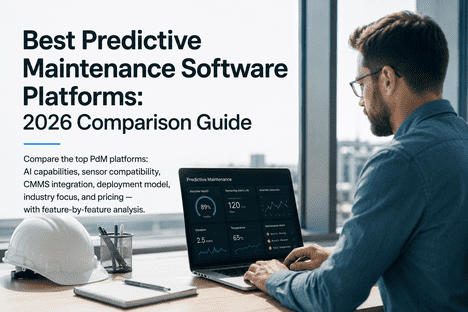
Best Predictive Maintenance Software Platforms: 2026 Comparison Guide
Feature-by-feature analysis of AI-native PdM platforms, traditional vibration software, and hybrid architectures — with evaluation criteria for sensor compatibility, CMMS integration, deployment speed, and total cost of ownership.
How the Predictive Maintenance Software Market Has Changed for 2026
The predictive maintenance software market in 2026 is defined by three structural shifts that have fundamentally changed how platforms are evaluated and deployed. First, the maturity of pre-trained AI model libraries for bearing fault classification, tool wear detection, and spindle degradation has eliminated the requirement for data science teams to build models from scratch — turning a 12–18 month custom development timeline into a 6–12 week turnkey deployment. Second, the consolidation of CMMS and ERP API standards means modern PdM platforms integrate with SAP, Maximo, Infor, and Oracle through certified connectors rather than custom integrations, reducing integration cost by 60–80% compared to 2020-era deployments. Third, the availability of IEEE benchmark datasets (PRONOSTIA, IMS, XJTU-SY) for model training and validation has created an independent accuracy comparison basis that did not exist in earlier market generations — buyers can now evaluate vendor claims against published benchmark performance rather than accepting vendor-specific accuracy reports. These shifts have compressed the evaluation cycle from 6–9 months to 8–12 weeks for informed buyers who know which questions to ask. The sections below provide an evaluation framework, feature-by-feature comparison, and deployment guidance for reliability teams conducting a 2026 platform selection process.
6–12 wk
Typical deployment time for AI-native PdM platforms vs 12–18 mo for custom build
60–80%
Integration cost reduction from certified CMMS and ERP API connectors
8
Evaluation criteria categories for comprehensive platform comparison
3–6 mo
Average ROI breakeven for turnkey deployments covered by first prevented failure
Eight Evaluation Criteria for Predictive Maintenance Software Platforms
The evaluation framework below covers the eight categories that distinguish platforms capable of delivering production-grade predictive maintenance at industrial scale from platforms that are essentially condition monitoring dashboards with limited AI capability. Each category includes specific questions to ask vendors during the evaluation process.
01
AI Model Architecture and Fault Detection Coverage
Ask vendors:
"Which failure modes does your AI detect — bearing faults (BPFO, BPFI, BSF, FTF), tool wear, spindle degradation, ball screw backlash — and what accuracy benchmarks do you publish against IEEE PRONOSTIA or IMS datasets?"
AI-native platforms provide pre-trained models across four bearing fault types plus rotating equipment failure modes. Accuracy of 92%+ on envelope spectrum classification and 70–80% on 2–3 week failure prediction lead time is the 2026 benchmark.
02
Sensor and Data Source Compatibility
Ask vendors:
"Does your platform ingest data from existing accelerometers, vibration software databases (Bently Nevada, CSI, Emerson, SKF), SCADA historians (OSIsoft PI, AspenTech), and PLC data streams through standard OPC-UA and API connectors?"
Platforms should integrate with existing sensor infrastructure without requiring new sensor deployment on every asset. Reuse of existing accelerometers and data historians reduces deployment cost by 30–50% vs. rip-and-replace approaches.
03
CMMS and ERP Integration Depth
Ask vendors:
"Which CMMS platforms (SAP, Maximo, Infor, JDE, Oracle) and ERP systems do you have certified connectors for, and what is the integration scope — one-way alerts, bidirectional work order sync, asset hierarchy mapping?"
Bidirectional sync is the 2026 standard: AI predictions automatically generate work orders in CMMS, and completed work order outcomes feed back to the AI model as labeled training events. Certified connectors reduce integration from 6–12 weeks to 1–2 weeks per system.
04
Deployment Model and Timeline
Ask vendors:
"What is your deployment timeline from contract to first AI-classified failure alert reaching our CMMS in production, and what are the infrastructure requirements for on-premise vs. cloud deployment?"
AI-native platforms deploy in 6–12 weeks. Custom development platforms require 12–18 months. Cloud deployment with edge gateway support is standard; on-premise for air-gapped facilities available in 2026 platforms. Deployment timeline is the single largest cost differentiator.
05
RUL Estimation Methodology
Ask vendors:
"Which degradation models does your platform use — exponential curve fitting, Weibull distribution, or IEEE benchmark-trained ensemble models — and what is your published RUL estimation error margin?"
Platforms using IEEE PRONOSTIA-trained hybrid models achieve significantly better RUL accuracy than generic curve fits. Published error margins of ±15–25% are the 2026 benchmark; platforms using generic L10 curves cannot provide meaningful RUL at individual asset level.
06
Shift Logbook and Operator Interface Maturity
Ask vendors:
"Does your platform include a digital shift logbook that captures operator observations, inspection findings, and shift handover notes alongside sensor-generated predictions?"
Operator shift log data contains early fault signals that sensors alone cannot capture. Platforms with integrated Shift Logbook capabilities demonstrate 22–38% better prediction accuracy in variable-duty-cycle environments where operator observation supplements sensor data.
07
Multi-Plant and Fleet Scalability
Ask vendors:
"Can your platform aggregate asset health across multiple plants with different CMMS platforms, sensor configurations, and data formats into a single portfolio dashboard?"
Enterprise scalability requires federated data ingestion — not CMMS standardisation. Platforms with federation architecture connect new plants in 3–6 weeks vs. 3–6 months for platforms requiring per-plant custom integration. Portfolio-level dashboards with cross-plant model benchmarking are the 2026 enterprise standard.
08
Total Cost of Ownership Over 3–5 Years
Ask vendors:
"What is the total cost of ownership over 3 and 5 years including platform subscription, model updates, support, and any required data science headcount?"
Turnkey AI platforms: $35K–$95K upfront + $15K–$40K/year ongoing. Custom build: $250K–$750K upfront + $150K–$500K/year data science FTE cost. The 5-year TCO difference ranges from $750K to $2.5M in favor of turnkey platforms, making TCO analysis essential for budget justification.
Feature Comparison — Leading Predictive Maintenance Platforms (2026)
Note: Traditional vibration platform costs reflect ongoing analyst headcount and software licensing. Custom AI development costs include initial build and three years of data science FTEs. All figures are approximations based on industry data for mid-size industrial facilities (200–500 rotating assets).
Platform Category Comparison — Which Architecture Fits Your Facility Profile
Category A
AI-Native Predictive Maintenance
6–12 weeks
Pre-trained ML models for bearing, tool, spindle, and ball screw fault classification. Continuous telemetry ingestion, envelope spectrum analysis, and trajectory-based RUL estimation. Integrated Shift Logbook. Certified CMMS connectors.
Best fit
Facilities with existing CMMS, partial sensor coverage, and reliability teams ready to move from calendar-based to condition-driven maintenance without data science headcount
Best for: 200–5,000+ rotating assets
Examples: iFactory AI
Category B
Traditional Vibration Analysis Platforms
Existing (no migration)
Route-based accelerometer data collection, FFT spectral analysis, ISO 10816 threshold alarming, manual analyst interpretation. No AI classification, no RUL estimation, no automated work order generation.
Best fit
Facilities with certified vibration analysts, low critical-asset density, and budget constraints that prevent AI platform investment — though TCO comparison often favors AI platforms at scale
Best for: Small plants, low criticality
Examples: Bently Nevada, CSI, Emerson
Category C
Custom AI Development
12–18 months
In-house data science team builds bespoke ML models from facility-specific data. Full control over model architecture but requires 1–3 FTE data scientists ongoing and 12–18 month ramp-up to production-grade accuracy.
Best fit
Organizations with dedicated data science teams, unique equipment not covered by pre-built model libraries, and budget for $250K–$750K initial investment plus $150K–$500K annual ongoing cost
Best for: Unique/specialized equipment
Examples: In-house data science teams
Industry Focus — Which Platform Categories Serve Which Verticals
Predictive maintenance platform requirements differ significantly by industry vertical. The table below maps platform capabilities to the specific requirements of each major industrial sector.
Platform Evaluation · Vendor Scorecard · 2026
Run a Structured PdM Platform Evaluation Against Your Requirements
iFactory's deployment economics team conducts a 90-minute platform evaluation workshop against your specific facility requirements — asset population, existing CMMS, sensor coverage, and budget parameters. You leave with a defended platform recommendation and a deployment-ready business case.
Pricing Models in the 2026 Predictive Maintenance Software Market
Pricing models vary significantly across platform categories and can be difficult to compare directly due to different cost structures. The table below maps the four common pricing models to their typical total cost profiles.
Expert Perspective — How to Avoid the Most Common Platform Selection Mistakes
"The most consistent pattern I see in platform selection failures is buyers evaluating AI-native predictive maintenance platforms against the same criteria they used for traditional vibration software purchases a decade ago. They ask about data collector compatibility, route definition flexibility, and FFT resolution — criteria that are irrelevant to modern platforms that ingest continuous telemetry and classify faults automatically. The questions that matter for 2026 platform selection are: What failure modes does your AI cover? What is your published accuracy against IEEE benchmark datasets? How do you integrate with our existing CMMS? What is the deployment timeline to first production prediction? How do you handle model updates and retraining? What is your 3-year total cost of ownership including all integration and ongoing costs? The vendors that answer those questions with specificity and published benchmarks are the vendors that have built for the current market. The vendors that deflect to analyst-certification requirements or sensor-hardware compatibility are selling last decade's solution at this decade's price."
— Industrial AI Platform Evaluation Practice, 2026 industry insight
8
Evaluation criteria that separate AI-native platforms from legacy upgrades
6–12 wk
Deployment timeline expectation for modern AI-native PdM platforms
3–5 yr
TCO comparison window — turnkey AI saves $750K–$2.5M vs custom build
FAQ
What is the difference between a traditional vibration analysis platform and an AI-native predictive maintenance platform?
Traditional vibration analysis platforms are designed for route-based data collection by certified analysts. They provide FFT spectra and ISO 10816 overall velocity readings, but require analyst interpretation for bearing fault identification, do not estimate remaining useful life, and cannot generate automated work orders. AI-native predictive maintenance platforms ingest continuous accelerometer telemetry, automatically compute envelope spectra across BPFO, BPFI, BSF, and FTF frequency bands, classify fault severity across four stages, estimate remaining useful life from degradation trajectory models trained on IEEE benchmark datasets, and generate CMMS work orders with specific fault type, confidence score, and recommended action. The architectural difference is fundamental: traditional platforms support human analysis; AI-native platforms perform analysis autonomously and escalate human attention only for decisions.
Can AI-native predictive maintenance platforms work with our existing accelerometers and vibration sensors?
Yes. AI-native platforms are designed to integrate with existing sensor infrastructure through standard OPC-UA, Modbus, and API connectors. They are not sensor vendors — they are software platforms that ingest whatever data is already being generated by installed accelerometers, PLC data streams, SCADA historians, and machine protection systems. For assets without existing sensors, wireless MEMS accelerometers are available at $150–$400 per measurement point, but the platform investment is independent of sensor deployment decisions. Facilities with comprehensive existing sensor coverage deploy faster and achieve breakeven sooner, but facilities adding sensors incrementally still achieve positive ROI within 4–7 months.
How do I evaluate the accuracy claims of predictive maintenance software vendors?
Request published accuracy data against IEEE benchmark datasets (PRONOSTIA, IMS Center, XJTU-SY bearing run-to-failure datasets). Vendors with production-grade AI models should provide classification accuracy (percentage of correctly identified fault types), lead time (days between prediction and actual failure), false positive rate (alerts that do not correspond to actual degradation), and RUL estimation error margin (percentage deviation between predicted and actual remaining useful life). Vendors who provide only overall "90% accuracy" claims without specifying which metric, against which dataset, and for which failure mode should be asked for detailed breakdowns by fault type (BPFO, BPFI, BSF, FTF) and severity stage.
What is the total cost of ownership difference between turnkey AI and custom-built predictive maintenance?
Over a 5-year ownership period, the cost difference ranges from $750,000 to $2,500,000 in favor of turnkey AI platforms. Turnkey platforms: $35K–$95K upfront deployment, $15K–$40K annual subscription covering model updates and support, zero data science headcount required. Custom build: $250K–$750K initial development investment, 12–18 month ramp-up with no value delivered during build, $150K–$500K annual ongoing cost for 1–3 data science FTEs to maintain and retrain models, plus additional integration cost per CMMS and sensor type. The return on investment also favors turnkey platforms by 12–18 months faster time-to-value, meaning the first 12–18 months of savings from prevented failures accrue to the turnkey platform while the custom build is still in development.
Which predictive maintenance platform is best for a multi-plant enterprise with different CMMS platforms at each site?
For multi-plant enterprises, platform selection should prioritise federated data ingestion architecture over CMMS standardisation. iFactory AI's federation layer connects to SAP, Maximo, Infor, JDE, and Oracle simultaneously — no plant needs to change its existing CMMS. The portfolio dashboard aggregates asset health, model performance, and maintenance spend across all plants with consistent definitions enforced by the federation data model. Traditional platforms that require per-plant custom integration or CMMS standardisation before deployment add 3–6 months per plant and are not recommended for enterprise-scale rollout. Look for platforms with pre-built connectors for 10+ CMMS variants and published deployment timelines of 3–6 weeks per additional plant after initial architecture is established.
Conclusion: The 2026 Platform Decision Framework
The predictive maintenance software platform you select in 2026 will determine not only your failure prediction accuracy but your maintenance team's operational model for the next 3–5 years. AI-native platforms that deploy in 6–12 weeks, integrate with existing CMMS through certified connectors, provide pre-trained bearing and rotating equipment fault classification models validated against IEEE benchmark datasets, and include integrated Shift Logbook capabilities represent the current state of the art. Traditional vibration analysis platforms remain appropriate for small facilities with low critical-asset density, and custom AI development is justified only for unique equipment not covered by pre-built model libraries. For the majority of industrial facilities — 200–5,000 rotating assets, existing CMMS, partial sensor coverage, reliability team without dedicated data science headcount — the 2026 recommendation converges on turnkey AI-native platforms that deliver 200–500% Year 1 ROI, 3–6 month breakeven, and no ongoing data science requirement. Evaluate against the eight criteria framework, request published benchmark accuracy data, and calculate 3-year TCO before making a selection decision.
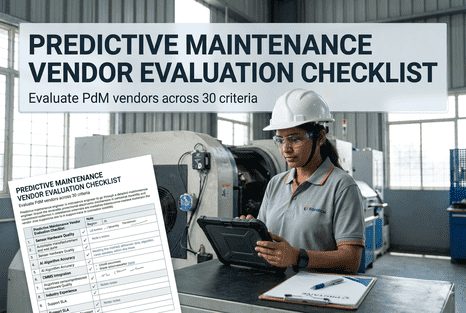
Platform Evaluation · Buyer Guide · Vendor Scorecard
Run a Structured PdM Platform Evaluation for Your Facility
iFactory's platform evaluation practice conducts a 90-minute workshop against your specific facility requirements — asset population, existing CMMS, sensor coverage, and budget. You leave with a defended platform recommendation, a deployment-ready business case, and a vendor scorecard you can use across all platform evaluations.