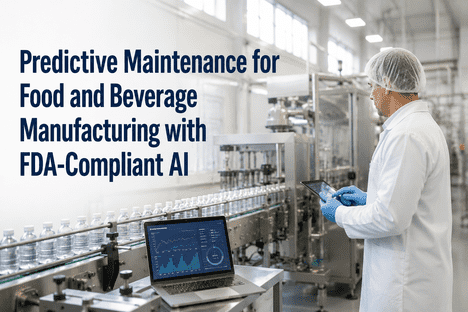
Predictive Maintenance for Food and Beverage Manufacturing with FDA-Compliant AI
By Ethan Walker on June 5, 2026
Food and beverage manufacturers face a growing reliability challenge — unplanned downtime on mixers, fillers, conveyors, refrigeration systems, and packaging lines costs $15,000–$50,000 per hour in lost product, rework, waste disposal, and overtime labour, while the F&B predictive maintenance market is projected to reach $1.12 billion as FSMA Preventive Controls requirements drive demand for intelligent maintenance solutions. Traditional time-based maintenance cannot address the unique failure patterns in wet, corrosive, and sanitation-intensive environments — gearbox seal failure from daily CIP washdown, conveyor bearing degradation from moisture ingress, filler valve wear from abrasive particulate, and refrigeration compressor valve fatigue from thermal cycling. AI-driven predictive maintenance powered by IoT sensor fusion closes this gap — ingesting vibration spectra, bearing temperature trends, motor current signatures, refrigeration performance metrics, and sanitation log data into machine learning models that forecast mixer gearbox failure, filler valve degradation, conveyor bearing seizure, refrigeration compressor valve wear, and packaging line servo motor fault 2–6 weeks in advance. iFactory's predictive maintenance platform provides this integration layer, connecting PLC data from processing lines, vibration sensors on rotating assets, temperature probes on refrigeration systems, and operator shift observations into a unified intelligence system purpose-built for food and beverage plant reliability. Book a Demo to see how iFactory turns your food and beverage plant data into a live predictive maintenance layer while maintaining full FDA compliance.
Predictive Maintenance · Food & Beverage 2026
Predictive Maintenance for Food and Beverage Manufacturing with FDA-Compliant AI
Mixer gearbox & seal failure prediction · Filler valve & servo degradation monitoring · Conveyor bearing & belt surveillance · Refrigeration compressor & HVAC analytics · All unified in iFactory's F&B reliability platform.
Advance warning on mixer, filler, conveyor, and refrigeration failures
21 CFR 11
FDA Part 11 compliant electronic records and audit trail
Why Reactive Maintenance Fails in Food and Beverage Manufacturing
Food and beverage production assets operate under conditions that accelerate degradation beyond what fixed-interval maintenance can predict. Mixers and blenders — handling dough, slurries, batters, and viscous pastes — experience gearbox seal failure from daily CIP chemical washdown and bearing contamination from ingredient dust ingress. Fillers handling carbonated beverages, viscous sauces, or particulate-laden products suffer valve seat erosion, servo motor encoder drift, and fill nozzle clogging that degrades fill weight accuracy and triggers product giveaway or FDA net weight compliance violations. Conveyors transporting raw ingredients, work-in-progress, and packaged goods face bearing failure from washdown water ingress, belt tracking drift from temperature and humidity variation in baking and freezing zones, and drive coupling fatigue from start-stop cycling on packaging lines. Refrigeration systems — ammonia compressors in cold storage, glycol chillers in processing, and HVAC in production areas — experience compressor valve fatigue, condenser fouling from ambient particulates, evaporator icing from defrost timer drift, and lubricant degradation from moisture contamination. Fixed-interval maintenance replaces components based on calendar time or operating hours rather than actual condition, either discarding usable service life or missing degradation that leads to catastrophic failure, product loss, and food safety exposure.
Three Food and Beverage Operational Problems iFactory Solves
01
FOOD SAFETY
Equipment Failure That Compromises Product Quality and FDA Compliance
Food safety and quality are directly impacted by equipment reliability — a failed refrigeration compressor can raise cold storage temperatures above critical limits, spoiling perishable inventory before temperature alarms trigger. A worn mechanical seal on a CIP return pump can contaminate cleaning solution effectiveness, leading to inadequate sanitation and allergen cross-contact risk. iFactory's predictive maintenance platform ingests refrigeration compressor discharge temperature, suction pressure, oil condition, and condenser approach temperature to detect performance degradation 3–5 weeks before failure. The platform generates audit-ready maintenance records with full traceability — every prediction event, sensor reading, and maintenance action is logged with timestamps and operator identity, supporting 21 CFR Part 11 electronic record compliance for FDA inspections. The Shift Logbook captures sanitation line clearance, allergen changeover verification, and CCP deviation notes alongside equipment health data, creating a unified quality-maintenance-compliance record. Book a Demo to see iFactory's FDA-compliant maintenance tracking in production.
3–5 week failure lead21 CFR Part 11 recordsCCP deviation tracking
02
WET ENV
Washdown Environment Accelerated Wear — Bearing, Seal and Motor Degradation
Food processing environments subject equipment to daily CIP washdown with caustic and acid cleaners, high-pressure water jets, and steam sanitation that accelerate bearing degradation, seal failure, and motor winding insulation breakdown. Motors with failed seals allow moisture ingress that degrades winding insulation resistance and triggers ground fault trips — a leading cause of unplanned line stoppages in wet processing areas. iFactory monitors motor winding insulation resistance trends via online insulation testers, bearing vibration with hermetically sealed wireless sensors, and seal condition via acoustic emission sensors. The platform detects the earliest signs of moisture ingress, bearing grease washout, and seal degradation — predicting motor failure 2–4 weeks in advance and enabling planned motor swap during scheduled sanitation downtime rather than emergency line stoppage mid-production. Pre-configured washdown equipment templates cover IP69K-rated sensor integration paths for meat, poultry, dairy, beverage, and bakery processing areas.
Packaging Line Servo, Filler and Conveyor Stops That Blast OEE
Packaging lines experience the highest downtime frequency in F&B plants — servo motor encoder faults on cartoners and case packers, filler valve wear that drifts fill weight outside specification, conveyor bearing seizures that stop product flow to multiple downstream machines. A single conveyor bearing failure on a packaging line can halt three upstream fillers and two downstream case packers within 90 seconds. iFactory applies ensemble ML models to packaging line servo motor current and position error data, filler valve vibration and acoustic emission signatures, and conveyor bearing temperature and vibration arrays. The platform's continuous learning loop improves prediction precision as more product formats, packaging speeds, and changeover patterns accumulate. The Shift Logbook captures changeover verification, packaging material lot tracking, and operator-reported packaging defects alongside sensor data, creating a richer training corpus for steadily improving prediction accuracy on servo encoder drift, valve seat erosion, bearing fatigue, and coupling wear across multiple SKU formats and line speeds.
Ensemble ML modelsServo·filler·conveyor·case packerShift Logbook fusion
How AI Predictive Maintenance Maps to Food and Beverage Equipment
Equipment Family
Common Failure Modes
iFactory PdM Integration
Impact on OEE & Compliance
Mixers & Blenders
Gearbox seal wear · bearing contamination · shaft misalignment · motor overload
Vibration + bearing temp · 2–5wk seal failure prediction · auto work orders
CIP washdown accelerates seal failure; early detection avoids gearbox oil contamination and batch rework
Refrigeration compressor valve failures and condenser fouling are the leading causes of cold storage temperature excursions in F&B plants, with each event potentially spoiling $50,000–$500,000 in perishable inventory. iFactory ingests compressor suction and discharge pressure, discharge temperature, superheat and subcooling values, condenser approach temperature, evaporator superheat, and oil analysis data. Machine learning models trained on compressor performance degradation patterns predict valve fatigue and condenser fouling 3–5 weeks in advance with a confidence score and recommended intervention window. The platform generates work orders that schedule valve inspection or condenser cleaning during planned defrost cycles or production shutdowns, avoiding cold storage temperature alarms that trigger FDA product hold investigations. Every prediction event is logged with full traceability in iFactory's Shift Logbook, supporting 21 CFR Part 11 electronic record compliance. Pre-configured refrigeration templates cover ammonia screw compressors, reciprocating compressors, glycol chillers, and air-cooled condensers.
Filler Valve Seat Wear & Servo Encoder Drift Prediction with Fill Weight Optimisation
Monitoring: Continuous
Filler valve seat erosion and servo encoder drift cause progressive fill weight deviation that generates either product giveaway (overfill) or FDA net weight compliance risk (underfill). iFactory monitors filler valve acoustic emission signatures, servo motor position error trends, fill weight checkweigher feedback, and nozzle pressure profiles. Multi-parameter fusion models detect valve seat wear 3–4 weeks before fill weight drift exceeds specification limits. The platform generates work orders with the specific valve seat kit and encoder part numbers, schedules replacement during the next planned sanitation window, and tracks fill weight performance before and after the intervention to validate improvement. The same model predicts servo encoder drift that causes container positioning errors and label placement defects on downstream labelers — enabling coordinated repair across multiple packaging line assets during a single stop. Talk to an Expert about filler line deployment.
Filler dataAcoustic emission · servo position · fill weight · nozzle pressure
Value impact15–25% reduction in product giveaway; FDA net weight compliance assurance
Washdown
CIP Washdown Motor & Bearing Condition Surveillance for Wet Processing Areas
Monitoring: Continuous
Wet processing areas — meat, poultry, dairy, beverage, and prepared foods — face accelerated motor and bearing degradation from daily CIP chemical washdown, high-pressure water jets, and steam sanitation. iFactory applies ensemble ML models to motor winding insulation resistance trends, bearing vibration with hermetically sealed wireless sensors, and mechanical seal acoustic emission. The platform's continuous learning loop improves prediction precision as more washdown cycles, chemical types, and environmental conditions accumulate. The Shift Logbook captures sanitation team observations — unusual motor noise during washdown, bearing grease purging from seals, water ingress evidence — alongside sensor data, creating a richer training corpus for steadily improving prediction accuracy on winding insulation breakdown, bearing grease washout, and seal failure in wet processing environments across multiple sanitation protocols and washdown frequencies.
FAQ: Predictive Maintenance for Food and Beverage with iFactory
iFactory is sensor-agnostic and integrates with sensors appropriate for food processing environments — IP69K-rated wireless vibration and temperature sensors for washdown zones (e.g. Banner, ifm, SICK, Baumer), hermetically sealed bearing temperature sensors, online winding insulation resistance monitors, acoustic emission sensors for valve and seal monitoring, and existing PLC motor current data via Modbus or OPC-UA. The platform supports manual inspection data entered through the Shift Logbook mobile app — including sanitation line clearance verification, CCP deviation logging, and equipment condition observations during pre-op inspections. Pre-built F&B equipment templates map the recommended sensor types, enclosure ratings, and placement for each equipment family — mixers, fillers, conveyors, refrigeration, ovens, and CIP pumps — enabling phased deployment starting with critical assets in wet processing areas.
iFactory's platform is designed to support 21 CFR Part 11 compliance requirements for electronic records and electronic signatures. Every prediction event, sensor reading, maintenance action, and Shift Logbook entry is recorded with a timestamp, operator identity, and full audit trail. Records are tamper-evident with electronic signature support. The platform's maintenance module aligns with FSMA Preventive Controls requirements by maintaining equipment-related preventive maintenance procedures linked to food safety plans — compressor oil change frequency tied to refrigerant leak prevention, conveyor bearing replacement intervals tied to lubricant migration risk, and filler valve rebuild schedules tied to fill weight compliance. Automated maintenance records are readily exportable for FDA inspection presentation. A 21 CFR Part 11 compliance workbook is provided during deployment to support your validation team's IQ/OQ/PQ activities.
The platform can begin generating value with 30 days of operational data — vibration levels, motor current, bearing temperature, and run hours — from as few as 10–20 critical assets such as refrigeration compressors, filler heads, mixer gearboxes, and packaging line conveyors. The machine learning models use transfer learning from iFactory's industrial equipment population baselines, so you do not need years of failure data to start seeing predictions. As the platform accumulates equipment-specific data, the models self-tune to your plant's sanitation cycles, washdown protocols, product specifications, and environmental conditions. Most F&B plants see meaningful failure prediction alerts within 45–60 days of deployment on monitored equipment. For plants with no existing sensor infrastructure, iFactory's recommended F&B starter kit bundles IP69K-rated wireless vibration and temperature sensors for 20 critical assets with gateway and configuration support.
Yes. iFactory's platform bi-directionally integrates with leading CMMS and ERP systems — SAP, Oracle, Infor, JDE, Maximo, Maintenance Connection, UpKeep, Fiix, and others via REST API, flat file, or database connector. Integration with quality management systems for CCP deviation tracking and non-conformance record creation is also supported. Predictive alerts generated by the AI engine can auto-create work orders in your existing CMMS or be managed within iFactory's work order module with subsequent sync to corporate systems. The integration layer resolves duplicate asset records, synchronises equipment hierarchies across production lines, and maps iFactory's health statuses to your CMMS status codes. A standard integration is completed during the first week of deployment. No rip-and-replace of existing systems is required.
iFactory deploys in 1–2 weeks against pre-built F&B equipment templates. The full ROI programme — assessment, sensor gap analysis (if needed), platform configuration, pilot on 20 critical assets across one processing line, plant-wide rollout, FDA compliance validation support, and training — runs 12 weeks end-to-end. Most F&B plants achieve positive ROI within 4 months of go-live on the pilot group, driven by reduced emergency maintenance spend, avoided product spoilage from refrigeration failure, and reduced product giveaway from predictive filler valve management. Typical 12-month results on monitored equipment populations are 30–50% less unplanned downtime and 25–40% lower total maintenance cost. The programme includes 90-day implementation support from a dedicated industry specialist with F&B domain expertise.
Deploy Predictive Maintenance for Your Food and Beverage Plant
iFactory AI connects sensor data, PLC telemetry, equipment history, and operator observations into a single predictive maintenance platform — purpose-built for food and beverage manufacturing with full FDA 21 CFR Part 11 compliance support. Pre-built equipment templates for mixers, fillers, conveyors, refrigeration, ovens, CIP pumps, and packaging lines. 1–2 week deployment with 90-day implementation support. Positive ROI within 4 months.