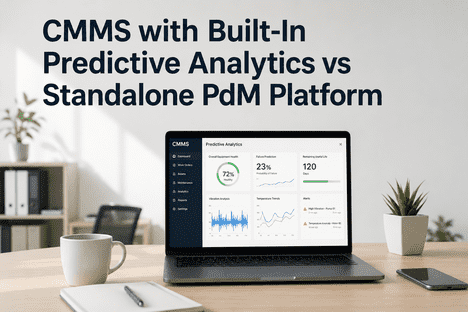
CMMS with Built-In Predictive Analytics vs Standalone PdM Platform

By Christopher Hayes on June 19, 2026

cmms-built-in-predictive-analytics-vs-standalone-pdm-platform

Every maintenance team evaluating a predictive maintenance platform faces a structural choice: deploy a standalone AI PdM platform that operates alongside the existing CMMS, or adopt a CMMS with embedded predictive analytics that keeps maintenance planning, work order execution, and condition monitoring in a single interface. The decision is not about which technology is more advanced — it is about which integration model fits the existing maintenance workflow, data infrastructure, and organizational readiness of the plant. Standalone PdM platforms generally offer deeper analytics, broader sensor support, and more sophisticated ML model architectures because condition monitoring is their sole function. CMMS-integrated predictive analytics offer tighter workflow coupling — predictions become work orders without an integration layer, operator observations in the Shift Logbook are linked directly to asset condition data, and the entire maintenance history from prediction to parts procurement to repair completion lives in one system. The right choice depends on CMMS maturity, IT integration capability, analytics depth requirements, and whether the team prioritizes analytics power or workflow simplicity. iFactory AI's platform, including its Shift Logbook and predictive maintenance engine, integrates with existing CMMS systems as a standalone analytics layer or operates as the primary condition monitoring hub that writes predictions and work orders into any CMMS. Book a Demo to see both integration models demonstrated against your maintenance environment.


CMMS Integration · Standalone PdM · Platform Comparison · 2026
CMMS with Built-In Predictive Analytics vs Standalone PdM Platform

Integration depth vs analytics power · Workflow coupling vs sensor flexibility · CMMS-native vs best-of-breed prediction — the decision framework that determines whether your PdM investment simplifies maintenance operations or adds another platform to manage.

CMMS-Integrated PdM
Single interface · automated work order creation · full audit trail
Standalone PdM Platform
Deep analytics · multi-sensor fusion · independent from CMMS vendor
Hybrid Integration
iFactory writes predictions to any CMMS — best of both models
Shift Logbook
Operator observations linked to sensor data and CMMS work orders

Why the CMMS vs Standalone PdM Decision Matters for Maintenance Operations

The choice between a CMMS with embedded predictive analytics and a standalone PdM platform affects four dimensions of maintenance operations: workflow integration depth, analytics capability breadth, vendor dependency, and total cost of ownership over the platform lifecycle. Teams that prioritize workflow simplicity — predictions that automatically become CMMS work orders without middleware — tend to prefer integrated solutions. Teams that prioritize analytics depth — multi-sensor fusion, customizable ML model architectures, and protocol-agnostic sensor connectivity — tend to prefer standalone platforms that optimize for prediction accuracy rather than CMMS compatibility. The right answer for most industrial plants is a hybrid model: a standalone AI PdM platform that writes predictions and recommended actions into the existing CMMS through a standard API integration, preserving the workflow simplicity of a single maintenance interface while delivering the analytics depth of a purpose-built condition monitoring platform.

FOUR DECISION DIMENSIONS — CMMS VS STANDALONE PdM
1
Workflow integration depth — CMMS-native PdM creates work orders automatically from predictions with full traceability to sensor data. Standalone PdM requires an integration layer to write predictions into the CMMS, adding implementation complexity.
2
Analytics capability breadth — Standalone platforms support multi-sensor fusion, customizable ML models, and protocol-agnostic connectivity across OPC UA, MQTT, Modbus, and proprietary protocols. CMMS-native analytics are limited by the CMMS vendor's sensor and protocol roadmap.
3
Vendor dependency and lock-in — CMMS-native PdM ties condition monitoring capability to the CMMS vendor's product development cycle. Standalone PdM platforms can be replaced or upgraded independently of the CMMS, preserving flexibility.
4
Total cost of ownership — CMMS-native analytics typically add 20–40% to the base CMMS license. Standalone PdM platforms have separate licensing but avoid per-integration middleware costs. Five-year TCO varies by 2–3x depending on asset count and integration complexity.

Three Integration Models iFactory Supports

iFactory AI is designed to operate in any integration model — CMMS-native analytics layer, standalone PdM platform, or hybrid that combines both approaches. The platform's architecture separates the prediction engine from the work order interface, enabling each plant to choose the deployment model that fits its maintenance workflow without compromising analytics depth.

01
Model A: Standalone PdM Platform with CMMS Integration
iFactory operates as the primary condition monitoring platform, ingesting sensor data from any protocol, running AI prediction models, and writing predictions and recommended work orders into the existing CMMS through standard API connectors. The CMMS remains the maintenance execution system; iFactory provides the analytics layer that the CMMS did not have. This model delivers the full analytics depth of a purpose-built PdM platform while preserving the existing CMMS as the single source of truth for maintenance work. Book a Demo to see iFactory's CMMS integration in production.
Full analytics depthCMMS-agnosticAPI-native integration
02
Model B: CMMS-Native Predictive Analytics with iFactory Engine
For plants that want predictions and work orders in a single interface, iFactory's prediction engine operates as a backend analytics module that feeds the CMMS interface directly. Operators see predictions, risk scores, and recommended actions within the CMMS interface they already use. Sensor data ingestion, ML model training, and prediction generation happen in iFactory's backend; the CMMS front end displays the results without requiring operators to switch platforms.
Single interfaceNo platform switchingUnified audit trail
03
Model C: Hybrid — iFactory Standalone + Shift Logbook + CMMS Sync
iFactory operates as a standalone PdM platform with its own Shift Logbook for operator observations, sensor data dashboards, and AI prediction review interface. Shift Logbook entries and prediction-triggered work orders sync bidirectionally with the CMMS, ensuring that maintenance history is recorded in both platforms. This model is ideal for plants that want the full analytics and operator workflow capability of a dedicated PdM platform while maintaining CMMS data consistency for ERP and compliance reporting.
Dual-platform syncOperator Shift LogbookBidirectional CMMS sync

How iFactory Compares: CMMS-Integrated vs Standalone Deployment

iFactory supports both deployment models on a single software platform. The comparison below maps the capabilities that differ between CMMS-integrated predictive analytics and standalone PdM platform deployment, based on iFactory's deployment experience across 900+ plants operating in both models.

Capability
CMMS-Integrated PdM
Standalone iFactory Platform
Sensor protocol support
Limited to CMMS vendor connectors
Full — OPC UA, MQTT, Modbus, S7, PROFINET, EtherNet/IP
ML model architecture
Fixed — vendor-defined algorithms
Customizable — ensemble models, continuous learning loop
Work order creation
Automatic — native CMMS integration
Automatic — writes via API to any CMMS
Operator Shift Logbook
Limited — CMMS work log only
Full — dedicated Shift Logbook with sensor data linkage
Multi-sensor fusion
Limited — single-sensor thresholds
Full — vibration, temperature, current, thermal, acoustic fusion
Deployment flexibility
Tied to CMMS vendor infrastructure
On-premise, private cloud, public cloud, or hybrid
CMMS vendor independence
Full dependency on CMMS vendor roadmap
Independent — replace or upgrade without CMMS impact

Integration Use Cases for CMMS and Standalone PdM

Enterprise SAP/Oracle
Standalone PdM with SAP CMMS Integration
API-native

A global chemical manufacturer operates SAP PM as its enterprise CMMS across 12 plants. SAP PM does not include native predictive analytics. iFactory deploys as a standalone PdM platform at each plant, ingesting vibration, temperature, and process data from 2,400 rotating assets. iFactory's AI models predict bearing failures, pump seal degradation, and compressor valve wear 2–3 weeks in advance. Prediction-triggered work orders — including fault type, severity score, RUL estimate, and recommended replacement part — write directly into SAP PM through the standard iFactory-SAP connector. Maintenance planners see PdM-generated work orders in the same SAP interface they use for PM and corrective work, without switching platforms.

ModelStandalone + SAP integration
Assets2,400 across 12 plants
Talk to an Expert
Mid-Market CMMS
CMMS-Native PdM with iFactory Analytics Engine
Embedded

A mid-market food processing plant runs Maintenance Connection as its CMMS and wants predictive analytics for 180 rotating assets without adding a separate platform for operators to learn. iFactory's prediction engine deploys as a backend analytics module feeding the Maintenance Connection interface. Operators see bearing health scores, tool wear predictions, and pump degradation alerts within the CMMS work order screen they use daily. Sensor data ingestion and ML model training happen in iFactory's backend; operators never leave the CMMS interface. The Shift Logbook is accessed through the same CMMS portal for operator observations and shift handovers.

ModelBackend engine + CMMS front end
Deployment8 weeks, no operator retraining
Talk to an Expert
Multi-Site Hybrid
Bidirectional Sync — Standalone + CMMS + Shift Logbook
Hybrid

A metals producer with 5 plants uses different CMMS platforms across sites — SAP PM at two legacy sites, JDE at one, and a regional CMMS at two newer sites. Standardizing on one CMMS is not feasible. iFactory deploys as a standalone platform at all five sites with a unified Shift Logbook for operator observations, sensor dashboards, and AI prediction review. Predictions and Shift Logbook entries sync bidirectionally with each site's CMMS through site-specific API connectors. Enterprise reliability managers access the iFactory platform for fleet-wide analytics while each plant's maintenance team works in their local CMMS for execution.

ModelHybrid — multi-CMMS bidirectional sync
Scope5 plants, 3 CMMS platforms
Talk to an Expert

What iFactory Delivers Across Both Deployment Models

900+
Plants deployed across CMMS-integrated and standalone models
Both models on the same software platform
12+
CMMS and ERP platforms with production-grade API connectors
SAP, Oracle, JDE, MS Dynamics, and more
Zero
Proprietary hardware required for either deployment model
Software-only — uses existing sensors and infrastructure
6–12 wk
Deployment timeline for either integration model
Same platform, same accuracy, different integration depth

FAQ

iFactory does not replace your CMMS. The platform is designed to integrate with existing CMMS, ERP, and maintenance systems through standard API connectors. iFactory adds the continuous condition monitoring and AI prediction layer that your CMMS did not include, writing prediction-triggered work orders, risk scores, and Shift Logbook entries directly into your existing maintenance management system. No data migration or system replacement is required.
Yes. iFactory operates as a full standalone predictive maintenance platform with its own sensor data ingestion, AI prediction engine, operator Shift Logbook, work order management interface, and fleet health dashboards. Plants without a CMMS or plants that want a dedicated condition monitoring platform independent of their CMMS can deploy iFactory as the primary maintenance intelligence system. CMMS integration can be added later when the plant's maintenance workflow requires work order synchronization.
iFactory has production-grade API connectors for SAP PM, Oracle EAM, JDE, Microsoft Dynamics 365, Maintenance Connection, Fiix, UpKeep, eMaint, Infor EAM, and IBM Maximo. For CMMS platforms without a pre-built connector, iFactory's API integration framework enables custom connector development within 2–4 weeks. The platform's write-back architecture ensures that every prediction, risk score, and Shift Logbook entry is recorded with full traceability in the CMMS of record.
Deploy iFactory in the Model That Fits Your Maintenance Environment

Standalone PdM platform with CMMS integration · CMMS-native predictive analytics engine · Hybrid with Shift Logbook and bidirectional sync — the same iFactory AI platform, the same ML prediction models, deployed exactly how your maintenance workflow needs it. No feature gaps between integration models. No vendor lock-in to a single deployment approach.
Standalone PdM CMMS Integration Shift Logbook Hybrid Sync API Connectors

Share This Story, Choose Your Platform!