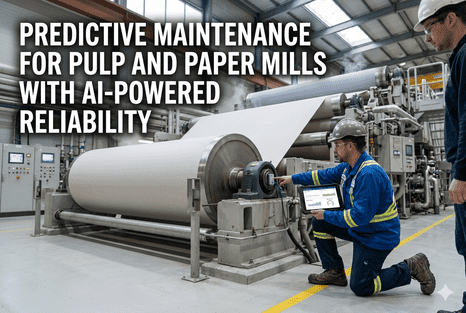
Predictive Maintenance for Pulp and Paper Mills with AI-Powered Reliability

By Rebecca on June 5, 2026

predictive-maintenance-pulp-paper-mills-ai-reliability

Pulp and paper mills operate some of the most asset-intensive continuous processes in manufacturing — headboxes, press sections, dryer cylinders, refiners, digesters, recovery boilers, and winders running 24/7 under extreme heat, humidity, and mechanical load. A single unplanned failure on a dryer bearing or refiner motor can cascade through the entire mill: steam balance collapses, sheet breaks propagate, grade changes are missed, and off-spec reels accumulate before the quality lab confirms the drift. Traditional time-based maintenance schedules cannot keep pace with the degradation patterns of equipment that runs at variable loads across multiple grades. iFactory's AI-powered predictive maintenance platform closes this gap — fusing vibration, motor current, temperature, acoustic, and process telemetry from IIoT sensors with adaptive machine learning models that detect developing faults 30-50% earlier than fixed-threshold monitoring. For pulp and paper operations, this translates to fewer unplanned outages, higher first-pass yield, extended asset life, and measurable reductions in maintenance cost per ton. Book a Demo to see how iFactory connects your mill's telemetry to predictive reliability intelligence.

AI Predictive Maintenance · Pulp & Paper 2026
AI-Powered Predictive Maintenance for Pulp and Paper Mills

Adaptive ML fault detection · Real-time asset health monitoring · IIoT sensor fusion · Closed-loop reliability optimisation · All flowing into iFactory CMMS & Shift Logbook for complete operational continuity from digester to winder.

93.4%
Adaptive ML fault prediction accuracy vs 86.1% non-adaptive
25-40%
Unplanned downtime reduction with IoT + logbook + CMMS closed loop
17-23%
Maintenance cost per ton reduction in documented pulp & paper deployments
30-90 day
AI failure prediction lead time with 95% confidence on monitored assets

Why Traditional Maintenance Falls Short in Pulp and Paper Mills

Most pulp and paper mills still rely on time-based preventive maintenance schedules and reactive run-to-failure strategies for critical rotating assets. Dryer bearings, refiner motors, fan pumps, and winder drives are serviced at fixed calendar intervals regardless of actual condition — meaning components are either replaced too early (wasting capital) or fail unexpectedly between scheduled stops (causing costly unplanned downtime). End-of-shift paper logbooks capture equipment observations inconsistently, and critical handover information about vibration anomalies or temperature drift is lost between crews. The gap is root-cause visibility and closed-loop action: your SCADA system detects an alarm but no work order is generated, no shift entry is created, and no maintenance action is scheduled until someone notices the trend. iFactory's AI predictive maintenance closes this gap by connecting equipment health signals directly to structured shift records and auto-generated work orders — flagging bearing degradation on a dryer cylinder 72 hours before it induces a sheet break or forces a machine slowdown. Book a Demo to see how iFactory closes the loop from sensor signal to maintenance action in under 60 seconds.

Pulp & Paper Predictive Maintenance — The iFactory AI Connection
Sensing
IIoT Data Layer
Vibration · temp · motor current · acoustic · pressure · consistency
Edge inference
Detection
Anomaly Models
Adaptive ML · ensemble · autoencoder
93.4% accuracy
Prediction
Failure Forecast
Remaining useful life · CNN-LSTM · 95% confidence
30-90 day lead
Action
Auto Work Orders
CMMS integration · parts reservation · technician assignment
<60 sec creation
Logging
Shift Logbook
Structured entries · handover continuity · audit trail · AI summaries
Auto-logged

Three Critical Failure Categories iFactory Predicts and Prevents in Paper Mills

01
Dryer Bearing & Dryer Cylinder Degradation Causing Sheet Breaks and Off-Spec Reels
Dryer cylinders and their bearings operate under sustained high temperature and moisture — conditions that accelerate bearing wear, lubrication breakdown, and thermal degradation. When a dryer bearing begins to fail, vibration signatures shift, operating temperature rises, and drum surface temperature uniformity degrades — all precursors to sheet breaks, moisture profile drift, and off-spec production. iFactory monitors vibration waveforms, bearing temperature, motor current draw, and acoustic signatures on every critical dryer section asset. Adaptive ensemble ML models trained on 6-12 months of historical data detect bearing spalling, inner race defects, and lubricant degradation 48-72 hours before they trigger sheet quality excursions. Alerts include the asset ID, the specific fault type, and a recommended corrective action — enabling maintenance teams to plan bearing replacement during a grade change window rather than reacting to a catastrophic failure mid-run.
72hr advance warning93.4% detection accuracyAuto work orders
02
Refiner Motor & Pump Bearing Failures That Drive Energy Cost and Production Loss
Refiner motors, fan pumps, and stock pumps are the heart of stock preparation — they consume the largest share of electrical energy in a paper mill and directly influence fibre quality, freeness, and final sheet properties. A bearing failure on a refiner motor does not simply stop production; it introduces freeness variability that produces off-spec stock for hours before the quality lab detects the trend. iFactory's closed-loop monitoring fuses vibration spectra, motor current signatures, and process parameters (consistency, flow, pressure) on every critical rotating asset. When the AI detects an inner race defect or lubrication degradation pattern, it calculates remaining useful life and auto-generates a work order in your CMMS with the required spare parts and skill set. Energy efficiency improvements of 8% have been documented alongside unplanned downtime reduction, as better-maintained motors and pumps operate closer to their efficiency inflection point. Book a Demo to learn how refiner and pump monitoring integrates with your mill's existing PLC and CMMS infrastructure.
Real-time motor healthRUL per asset8% energy gain
03
Recovery Boiler & Pressure Screen Reliability Risk With Compliance Implications
Recovery boilers, pressure screens, and digesters operate under high pressure and temperature with significant safety and environmental compliance implications. A feed pump motor bearing failure on a recovery boiler can cascade into a steam balance collapse, auxiliary fuel firing, and increased emissions intensity — driving up both operating cost and environmental reporting exposure. iFactory monitors critical boiler feed pumps, fans, and screen rotors with multi-sensor fusion covering vibration, temperature, motor current, and process pressure. The AI platform distinguishes between mechanical degradation (bearing wear, misalignment, imbalance) and process-induced anomalies (cavitation, load cycling, fouling) — reducing false alarms and building operator trust. Every anomaly event is auto-logged in iFactory's Shift Logbook with full traceability, creating an auditable maintenance history that satisfies OSHA PSM, ISO 55000, and mill-specific compliance requirements. Prescriptive recommendations include the optimal intervention window aligned with planned maintenance stops, so fixes land inside stops the mill was already taking.
Boiler feed pump PdMEmissions risk reductionCompliance-ready audit trail

What iFactory Delivers for Pulp and Paper Mill Reliability

iFactory is the AI software intelligence layer purpose-built for industrial asset reliability — turning equipment telemetry, process data, and operator observations into predictive intelligence, closed-loop maintenance actions, and audit-ready compliance records. The platform fuses vibration, motor current, temperature, acoustic, and process signals into a single reasoning layer so that mechanical, electrical, and process-induced failure modes on the same asset are evaluated together — not in isolation. Every prediction event is automatically logged in iFactory's Shift Logbook with full traceability to the production lots and operating conditions at the time of detection. Work orders are auto-generated in SAP PM, IBM Maximo, Oracle EAM, or Fiix with asset ID, fault diagnosis, remaining useful life, and recommended parts pre-filled — zero manual intervention from sensor signal to scheduled repair. Book a Demo to see how iFactory transforms mill data into predictive reliability.

Mill Asset
Monitoring Technology
iFactory Output
Reliability Impact
Dryer cylinders & bearings
Vibration PdM + adaptive ML
72hr bearing fault forecast · auto work orders
Prevents sheet breaks and off-spec reels
Refiner motors & pumps
Motor current + vibration fusion
RUL prediction · energy efficiency alert
8% energy gain · 25% less unplanned downtime
Recovery boiler feed pumps
Multi-sensor fusion + prescriptive AI
Fault classification · optimised intervention window
Eliminates steam balance collapses
Winders & slitters
Acoustic + load + cycle time
Per-tool RUL · replacement work orders
Eliminates unnoticed quality defects at reel
Pressure screens & digesters
Vibration + temp + process correlation
Auto-logged shift entries · compliance audit trail
Reduces safety and environmental risk

AI & Predictive Maintenance Use Cases in Pulp and Paper Mills

Dryer Section
Dryer Bearing & Cylinder Predictive Maintenance With Sheet Break Prevention
Continuous

iFactory monitors vibration, temperature, motor current, and acoustic emissions on every dryer section bearing and cylinder. Adaptive ensemble ML models detect bearing spalling, inner race defects, and thermal degradation patterns 48-72 hours before they produce sheet breaks or moisture profile drift. Alerts include the specific fault type, affected dryer group, and corrective action with optimal intervention window. Production lots produced during the wear window are flagged for quality inspection. The shift logbook captures every event automatically with cross-shift continuity enforcement.

Detection48-72hr before sheet break
Accuracy93.4% adaptive ensemble
Book a Demo
Stock Prep
Refiner & Pump Motor Health With Energy Optimisation
Continuous

iFactory fuses vibration spectra, motor current signatures, and process parameters (consistency, flow, freeness) on every refiner and stock pump. ML models detect bearing degradation, rotor bar faults, and cavitation patterns before they affect stock quality or motor efficiency. When a fault is detected, the platform calculates remaining useful life and auto-generates a work order with required parts and technician skills. Energy efficiency gains of 8% have been documented as motors operate closer to their design efficiency point. Book a Demo to see how closed-loop motor health monitoring integrates with your mill's existing PLC and CMMS infrastructure.

ModelAdaptive ML · 95% confidence
Improvement8% energy · 25% downtime reduction
Book a Demo
Recovery
Recovery Boiler Feed Pump & Fan Reliability With Compliance Traceability
Continuous

Recovery boiler feed pumps, induced draft fans, and forced draft fans are critical to mill steam balance and emissions compliance. iFactory monitors these assets with multi-sensor fusion — vibration, temperature, motor current, and process pressure — and applies prescriptive AI that distinguishes mechanical degradation from process-induced anomalies. Each prediction is logged in the Shift Logbook with full traceability for OSHA PSM and ISO 55000 compliance. Auto-generated work orders include optimal intervention windows aligned with planned maintenance stops, so fixes land inside scheduled downtime.

MonitoringVibration · temp · current · pressure
OutputPrescriptive alerts · compliance audit trail
Book a Demo

Deployment: How Fast Can Your Mill Go Live

iFactory deploys in existing mill infrastructure without rip-and-replace. The platform connects to your existing PLCs, SCADA (Rockwell, Siemens, Wonderware, Valmet DNA), CMMS (SAP PM, Maximo, Oracle EAM, Fiix), and ERP systems via OPC UA, Modbus TCP, MQTT, and REST API. If 6-12 months of historical machine data is available in your existing historian or SCADA database, initial AI models can be trained in under four weeks. Most mills go live with predictive monitoring on priority assets within 3-4 weeks and achieve full mill-wide coverage within 8-12 weeks. Dedicated implementation support is included for 90 days post-go-live with remote and on-site options.

93.4%
Adaptive model fault prediction accuracy
vs 86.1% for non-adaptive baselines
25-40%
Unplanned downtime reduction with closed-loop PdM
IoT + logbook + CMMS integrated loop
17-23%
Maintenance cost per ton reduction
Tool-in-hand time · spare parts optimisation
<4 weeks
Time to first prediction on priority assets
With existing historical data available

FAQ

iFactory is an AI software intelligence layer — not a sensor manufacturer. The platform integrates with existing IIoT sensor networks, PLCs, SCADA (Rockwell, Siemens, Wonderware, Valmet DNA, ABB), DCS, CMMS (SAP PM, Maximo, Oracle EAM, Fiix), and ERP systems via standard protocols including OPC UA, Modbus TCP, MQTT, and REST API. Your mill selects the sensing hardware; iFactory turns the data into predictive intelligence, closed-loop maintenance actions, and audit-ready compliance records. No rip-and-replace required.
iFactory links each predictive maintenance alert to the production lots and operating conditions during the degradation window. When a dryer bearing or refiner motor alert is generated, the platform traces all reels produced during the preceding hours and flags them for quality inspection. This closed-loop connection between equipment health and product quality enables operators to contain suspect material before it ships — transforming predictive maintenance from a reliability-only tool into a quality prevention system. The Shift Logbook maintains full traceability of every event for compliance and root-cause analysis.
Publicly documented deployments of AI predictive maintenance in pulp and paper operations report 25% reduction in unplanned downtime, 8% improvement in energy efficiency on monitored motors, 40% reduction in emergency repair costs, and 17-23% reduction in maintenance cost per ton. iFactory customers typically achieve payback within 6-12 months of deployment. Multi-mill enterprises benefit from fleet-wide learning — failure modes identified at one facility improve prediction models across all plants in the network.
iFactory's digital Shift Logbook ensures that no predictive alert can be forgotten between shifts. Every anomaly event is automatically written to the shift logbook as a structured entry — timestamped, attributed to the asset and sensor, classified by severity, and visible to all shift personnel. Open predictive alerts carry forward automatically in every handover summary until the linked work order is closed. The incoming shift supervisor sees all open machine health alerts in their AI-generated handover summary and must acknowledge them digitally before the shift is formally accepted. This enforces continuity across every shift change until resolution is confirmed with full attribution.
Deploy iFactory for AI-Driven Predictive Maintenance in Your Pulp and Paper Mill

AI-powered predictive maintenance platform connecting IIoT sensors, adaptive ML models, auto-generated work orders, and digital shift logbook — with real-time fault detection, 30-90 day failure prediction, prescriptive recommendations, compliance-ready audit trails, and closed-loop reliability intelligence from digester to winder.


Adaptive ML PdM Dryer Section Monitoring Refiner Motor Health Recovery Boiler Reliability Shift Logbook Auto Work Orders

Share This Story, Choose Your Platform!