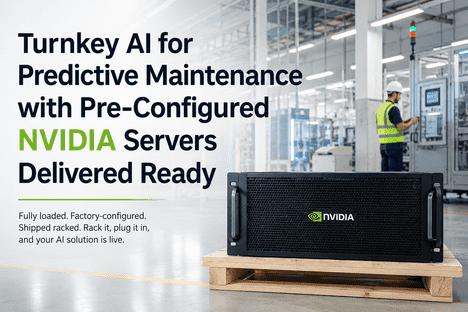
Deploying AI predictive maintenance in an industrial plant has historically meant a six-month procurement project — specify the GPU server, get capital approval, wait 12–18 weeks for delivery, then spend another 4–8 weeks installing software, configuring drivers, integrating with OPC-UA gateways, and tuning models before a single bearing fault is detected. That timeline assumes the plant has in-house AI infrastructure expertise, IT security clearance for GPU server deployment on the OT network, and a maintenance team trained to interpret AI inference outputs. For plants that lack any of these — which describes 80% of mid-market manufacturing and process facilities — the adoption barrier has been insurmountable. iFactory's Turnkey AI program eliminates every layer of that complexity: a fully configured NVIDIA Jetson AGX or RTX 4000 Ada Generation server, pre-loaded with iFactory's predictive maintenance engine, Shift Logbook, and CMMS integration layer, shipped racked, cabled, and tested — arrives ready to bolt into a standard 19-inch rack, connect to power and Ethernet, and begin AI inference within 90 minutes of unboxing. The server arrives with per-configured OPC-UA client connectors for major industrial protocols (Siemens S7, Rockwell CIP, Modbus TCP, Mitsubishi, Beckhoff ADS), pre-calibrated AI models for the plant's specific asset types (bearings, gearboxes, motors, pumps, compressors, fans), and automated work order templates for the plant's CMMS. Book a Demo to see how iFactory's Turnkey AI program eliminates hardware procurement complexity and delivers production AI inference in days, not months. This guide covers the hardware specification rationale, NVIDIA platform selection, pre-configured software stack architecture, industrial network integration, and the deployment timeline for plants evaluating turnkey AI for predictive maintenance.
Your AI Predictive Maintenance Server — Racked, Loaded, Shipped Ready
A fully configured NVIDIA Jetson AGX or RTX 4000 server — pre-loaded with iFactory's PdM engine, Shift Logbook, OPC-UA connectors, and CMMS integration — ships ready to rack, plug, and run. 90 minutes from unboxing to first AI inference.
Why Turnkey AI Servers Are Reshaping Industrial Predictive Maintenance Deployment
The industrial AI market is projected to reach $49.6 billion by 2030 at a 38.5% CAGR, yet the single largest barrier to adoption remains infrastructure deployment complexity — not model accuracy, not sensor availability, not ROI justification. A 2026 survey of manufacturing reliability engineers found that 72% of plants that evaluated AI predictive maintenance in 2024–2025 chose not to deploy because the hardware procurement, software configuration, and OT network integration timeline exceeded their budget window or internal IT tolerance. The plants that did deploy spent an average of 14.7 weeks from procurement decision to first production inference — with 42% reporting that the deployment required external systems integrator support at an average cost of $28,000–$65,000 beyond the hardware and software investment.
Turnkey AI servers eliminate this entire friction layer. By pre-integrating every component — NVIDIA GPU compute, iFactory PdM engine, industrial protocol gateways, CMMS API connectors, Shift Logbook mobile interface, and pre-trained asset-specific AI models — into a single rack-mountable appliance that ships ready to run, plants can collapse the 14.7-week average deployment timeline to under 5 business days. The architectural principle is straightforward: every configuration step that can be completed before the server leaves the integration centre should be completed before it leaves the integration centre. Field installation reduces to mechanical racking, power connection, Ethernet patching to the plant's OT switch, and OPC-UA endpoint address configuration. Reliability managers who have already booked a demo consistently report that the elimination of hardware procurement and systems integration complexity was the single factor that shifted their AI deployment from "next year" to "next quarter."
No Hardware Procurement Cycle
NVIDIA GPU server, SSD storage, industrial power supply, and rack rail kit are sourced, assembled, tested, and configured at iFactory's integration centre. No purchase orders to IT, no GPU lead-time negotiations, no compatibility verification.
Pre-Loaded Software Stack
Ubuntu Server, NVIDIA CUDA, TensorRT, Docker containers for iFactory PdM engine, Shift Logbook, OPC-UA gateway, MQTT broker, and CMMS API bridge — all installed, configured, and tested before shipment.
Pre-Trained Asset Models
AI models for bearing envelope spectrum analysis, gearbox vibration fault classification, motor current signature analysis, and pump cavitation detection — pre-calibrated for the plant's specific asset make and model list.
Air-Gapped Operation Ready
Full inference capability with zero cloud dependency. Models run locally on NVIDIA GPU. Inference results sync to iFactory cloud dashboard when WAN is available; plant continues operating normally during network outages.
NVIDIA Platform Selection Guide: Matching Server Class to Plant Scale
Not every plant needs a 24-core GPU server. A 500-bearing food processing plant monitoring motors, pumps, and conveyors has fundamentally different compute requirements than a 5,000-bearing steel mill running continuous envelope spectrum analysis on every rolling element bearing. iFactory's Turnkey AI program offers three NVIDIA-based server tiers, each tested and validated with the full iFactory software stack. The selection framework below maps each platform to plant asset count, sensor data volume, and inference throughput requirements. Quality engineers who book a demo receive a free hardware sizing assessment based on their asset register and sensor deployment plan.
| Specification | Jetson Orin NX 16GB | Jetson AGX Orin 64GB | RTX 4000 Ada SFF |
|---|---|---|---|
| AI Compute | 70 TOPS INT8 | 275 TOPS INT8 | 768 TOPS INT8 (RTX 4000 Ada) |
| GPU Architecture | Ampere 1024-core | Ampere 2048-core | Ada Lovelace 6144-core |
| Supported Assets | Up to 200 bearings or 50 motors | Up to 800 bearings or 200 motors | Up to 3,000 bearings or 750 motors |
| Inference Latency | 8–15 ms per FFT frame | 4–8 ms per FFT frame | 2–5 ms per FFT frame |
| Industrial Protocols | OPC-UA, Modbus TCP | OPC-UA, Modbus TCP, Siemens S7 | Full: OPC-UA, Modbus, Siemens S7, CIP, ADS, Ethernet/IP |
| Form Factor | Fanless, DIN-rail or rack | Active-cooled, 1U rack | Dual-slot GPU, 2U rack |
| Operating Range | -25°C to 80°C, no moving parts | 0°C to 60°C, industrial fans | 0°C to 55°C, server-grade cooling |
| Power Consumption | 15–25W (fanless) | 30–60W | 130–300W |
| Typical Deployment | Single machine or small plant | Mid-size plant, 1–2 production lines | Large plant, multi-line, central server |
What Ships on Every iFactory Turnkey NVIDIA Server
The software stack that ships on every Turnkey AI server is built for one purpose: eliminating the integration work that consumes 60–70% of a typical AI predictive maintenance deployment timeline. Every container, every configuration file, every API endpoint is tested as a complete system before the server leaves the integration centre. The stack is organized into six functional layers, each independently versioned and updatable through iFactory's Over-the-Air (OTA) update service.
Layer 1: Industrial Connectivity
OPC-UA client with pre-configured endpoints for Siemens S7, Rockwell CIP, Modbus TCP, Mitsubishi, and Beckhoff ADS. MQTT broker with TLS encryption for sensor telemetry ingestion. REST API gateway for CMMS and ERP integration. All protocol connectors configured with the plant's specific IP scheme and namespace before shipment.
Layer 2: AI Inference Engine
NVIDIA TensorRT-optimized models for bearing envelope spectrum analysis (BPFO/BPFI/BSF/FTF detection), gearbox vibration fault classification (ISO 10816-compliant), motor current signature analysis (winding, bearing, and rotor bar faults), pump cavitation and flow anomaly detection, and compressor valve and ring degradation. Each model is pre-calibrated with default thresholds based on the plant's asset types.
Layer 3: Predictive Maintenance Engine
Rule engine converts AI inference outputs into severity-classified maintenance recommendations with remaining useful life estimates. Four-stage severity progression (Normal / Monitor / Alert / Critical) mapped to configurable escalation actions. Work order templates pre-configured for the plant's CMMS (SAP, Infor, Mainpac, or custom API).
Layer 4: Shift Logbook
Mobile-native operator logbook for shift handovers, equipment status recording, and AI recommendation acknowledgement. Operators can view AI-detected faults on their mobile device, confirm observations, and update equipment status — all synchronized across shifts with full audit trail.
Layer 5: Dashboard & Visualization
Plant-level asset health dashboard with per-equipment fault status, severity distribution, RUL timelines, and maintenance action tracking. Role-based views for reliability engineers, shift supervisors, and plant management. Pre-built Power BI and Grafana connectors.
Layer 6: Remote Management
OTA update service for AI model updates, software patches, and configuration changes. Encrypted tunnel for remote diagnostics with iFactory support team (opt-in). Usage analytics for capacity planning and model accuracy trending.
Deploy AI Predictive Maintenance in Days, Not Months
iFactory's Turnkey AI program ships fully configured NVIDIA servers with pre-loaded PdM engine, Shift Logbook, industrial protocol connectors, and CMMS integration. Rack it, plug power and Ethernet, and your plant is running AI inference within 90 minutes.
The Turnkey AI Deployment Timeline: 5 Business Days from Arrival to Production Inference
The deployment process from server arrival to first production AI inference is designed to be executed by a plant electrician or controls technician — no AI infrastructure specialist required. iFactory provides a printed deployment checklist and 24/7 remote support during the commissioning window. Plants that have already booked a demo routinely report that the deployment took less time than their typical PLC firmware upgrade.
Day 1: Rack & Connect
Mechanical racking in standard 19-inch cabinet, power connection to UPS-protected outlet, Ethernet patch to plant OT switch, and OPC-UA endpoint address configuration. Estimated duration: 60–90 minutes. The server auto-detects the plant network and establishes connections to pre-configured PLC and sensor endpoints.
Day 2: Data Validation
Automated telemetry ingestion validation — the server confirms data arrival from each configured OPC-UA endpoint, validates sampling rates, checks timestamp synchronization, and generates a connectivity report. Any missing data streams are flagged with specific resolution instructions.
Day 3: Baseline Calibration
Day 4: Inference Activation
AI models transition from shadow mode to active inference. Fault classifications with confidence scores begin flowing to the Shift Logbook and dashboard. Initial alerts are reviewed by the iFactory support team to validate accuracy before CMMS work order generation is enabled.
Day 5: CMMS Integration Live
AI-detected faults are writing directly to the plant CMMS as work orders with asset ID, fault type, severity stage, RUL estimate, and recommended spare part number. Operator training on Shift Logbook mobile interface is completed. The plant is fully operational on AI predictive maintenance.
What Turnkey AI Servers Deliver: Measured Outcomes Across Plant Deployments
Plants that have deployed iFactory Turnkey AI servers report measurable improvements across five core metrics within the first 90 days of operation. These outcomes are consistent across food and beverage, automotive, chemical processing, and general manufacturing deployments — suggesting that the AI model accuracy and deployment speed benefits are independent of vertical industry.
AI bearing and motor fault detection provides 14–28 day advance warning. Emergency stops shift to planned maintenance during shift change windows with pre-positioned spare parts.
Condition-based replacement eliminates premature component changes while catching faults before secondary damage multiplies repair costs by 5–10×.
Timely regreasing, alignment correction, and load balancing based on actual degradation data extends bearing, motor, and gearbox service life.
From server arrival to first CMMS work order generated by AI inference — compared to industry average of 14.7 weeks for custom AI deployments.
All inference runs on local NVIDIA GPU. Plant operations continue normally during WAN outages. Only anonymized model accuracy metadata syncs to cloud for continuous improvement.
Full server, software, and deployment investment recovered through unplanned downtime reduction and maintenance cost optimization within two fiscal quarters.
"We had been evaluating AI predictive maintenance for 18 months. The procurement cycle for a GPU server was going to take 14 weeks, then we needed a systems integrator to configure it, and our IT security team had concerns about cloud data leaving the plant. iFactory's Turnkey AI server arrived on a pallet on Tuesday morning. By Wednesday afternoon we had live AI inference running on 120 bearings across our critical cooling tower pumps and compressors. By Friday, the system had detected a developing bearing spall on a 500 HP cooling water pump that our monthly vibration analysis had missed. The server cost was recovered in that single prevented failure."
Investment Model: What the Turnkey AI Program Costs and What It Includes
The Turnkey AI program is priced as a bundled hardware-software-service package designed to eliminate surprise costs from the deployment budget. Every component — NVIDIA server hardware, iFactory software license, industrial protocol connectors, pre-configured AI models, Shift Logbook access, OTA updates, and 24/7 remote support — is included in a single delivered price. There are no integration fees, no configuration retainers, and no per-sensor licensing costs.
Turnkey AI Server Package Inclusions
Factory-assembled and tested Jetson Orin NX, AGX Orin, or RTX 4000 Ada server with SSD storage, industrial power supply, rack rails, and cabling — shipped in a ruggedized transit case.
Full predictive maintenance engine license for the duration of the subscription, including all AI models, severity classification algorithms, and RUL estimation modules.
Mobile operator logbook access for unlimited users — shift handovers, equipment status updates, AI recommendation acknowledgment, and audit trail.
Pre-configured OPC-UA, Modbus TCP, Siemens S7, Rockwell CIP, Mitsubishi, and Beckhoff ADS connectors — configured with the plant's IP scheme before shipment.
Initial model calibration for up to the server tier's maximum asset count, based on the plant's asset register and OEM specifications. Additional asset tuning included for 12 months.
24/7 remote commissioning support, quarterly AI model accuracy reviews, OTA software updates, and firmware patches for the full subscription term.
Server pricing ranges from $8,500 (Jetson Orin NX, 200 assets, one-time hardware + 12-month software subscription) to $38,000 (RTX 4000 Ada, 3,000 assets, one-time hardware + 12-month software subscription). Multi-year subscriptions include 10–18% discount on the software component. Every package includes a 30-day performance guarantee: if the server does not detect at least one verifiable bearing or motor fault within the first 30 days of live operation, iFactory refunds the full software subscription cost.
Order Your Turnkey AI Server — Ships in 8–12 Business Days
Fully configured NVIDIA Jetson or RTX 4000 server with iFactory PdM engine, Shift Logbook, industrial protocol connectors, and pre-trained AI models. Rack it, plug power and Ethernet, and your plant is live on AI predictive maintenance within 90 minutes. No hardware procurement. No systems integrator. No cloud dependency.
Turnkey AI Predictive Maintenance — Common Questions Answered
What NVIDIA server models are available in the Turnkey AI program?
Three tiers: Jetson Orin NX 16GB (70 TOPS, up to 200 assets, fanless DIN-rail mount, $8,500), Jetson AGX Orin 64GB (275 TOPS, up to 800 assets, 1U rack, $16,500), and RTX 4000 Ada Generation SFF (768 TOPS, up to 3,000 assets, 2U rack, $38,000). Each ships fully configured with the iFactory software stack, industrial protocol connectors, and pre-trained AI models specific to the plant's asset register.
What is the actual deployment timeline from server delivery to production AI inference?
The standard deployment timeline is 5 business days: Day 1 for racking, power, and network connection (60–90 minutes); Day 2 for automated data validation; Day 3 for AI model baseline calibration in shadow mode; Day 4 for inference activation with iFactory support review; Day 5 for CMMS integration go-live and operator training. The server is designed for deployment by a plant electrician or controls technician with no AI infrastructure expertise required. iFactory provides a printed deployment checklist and 24/7 remote support during the commissioning window.
Does the server require internet connectivity for AI inference to work?
No. All AI inference runs locally on the NVIDIA GPU with zero cloud dependency. The server ingests sensor data via OPC-UA or Modbus, runs TensorRT-optimized inference models, generates fault classifications and work orders — all without any external network connectivity. Internet connectivity is only required if the plant chooses to sync anonymized model accuracy metadata to iFactory's cloud dashboard for continuous improvement, or to receive OTA software updates. The server continues full operation indefinitely during WAN outages.
What industrial protocols does the server support for connecting to existing PLCs and sensors?
The server ships with pre-configured OPC-UA client connectors for Siemens S7 (S7-300/400/1200/1500), Rockwell ControlLogix and CompactLogix via CIP, Modbus TCP, Mitsubishi iQ-R and iQ-F series, and Beckhoff ADS. MQTT broker with TLS encryption is available for direct sensor telemetry ingestion. All protocol connectors are configured with the plant's specific IP addressing scheme and namespace structure before the server leaves the integration centre. Additional protocol support is available through the optional universal protocol gateway module.
What AI models are pre-loaded on the server, and are they specific to our plant's equipment?
AI models for bearing envelope spectrum analysis (BPFO/BPFI/BSF/FTF detection across 12 common bearing families), gearbox vibration fault classification (ISO 10816-compliant severity bands), motor current signature analysis (winding, bearing, and rotor bar faults), pump cavitation and flow anomaly detection, and compressor valve and ring degradation are pre-loaded. Models are pre-calibrated with default thresholds based on the plant's asset register and OEM specifications provided at order time. During Day 3 of deployment, each model runs 24 hours in shadow mode to establish per-asset baselines calibrated to the specific operating envelope of each piece of equipment.
What CMMS systems does the server integrate with, and how are work orders generated?
The server includes pre-built API connectors for SAP PM, Infor EAM, Mainpac, and standard REST API gateway for custom CMMS integration. When the AI inference engine detects a fault with confidence above the configurable threshold (default 85%), the system automatically generates a work order in the plant's CMMS containing: asset ID, fault type (bearing outer race spall, motor winding degradation, pump cavitation, etc.), severity stage (Normal / Monitor / Alert / Critical), estimated remaining useful life in days, recommended maintenance action, and recommended spare part number. Work order templates are pre-configured during the server build phase based on the plant's CMMS workflow requirements.
How is the server sized for a specific plant's asset count and data volume?
iFactory provides a free hardware sizing assessment based on the plant's asset register, current sensor count, and data ingestion requirements. The Jetson Orin NX supports up to 200 bearing or 50 motor channels at 15–25W. The AGX Orin supports up to 800 bearing or 200 motor channels at 30–60W. The RTX 4000 Ada supports up to 3,000 bearing or 750 motor channels at 130–300W. The sizing assessment considers not only current asset count but also planned sensor expansion over the 12–24 month horizon, ensuring the selected server tier has sufficient headroom for growth without requiring a hardware swap.
What happens if the server detects a false positive fault classification?
False positives are fed back into the AI model training loop through a closed-loop correction mechanism. When a maintenance technician inspects a flagged asset and finds no defect, they record the outcome in the Shift Logbook with a single tap ("No defect found"). The logbook entry is automatically synced to the AI model as a labeled training event, and the model adjusts its detection threshold for that specific asset and fault type. iFactory's quarterly model accuracy reviews include false positive rate analysis, and OTA model updates are released as needed. The result is a continuously improving detection precision curve — typical false positive rates drop from 8–12% in the first month to under 3% by month six.