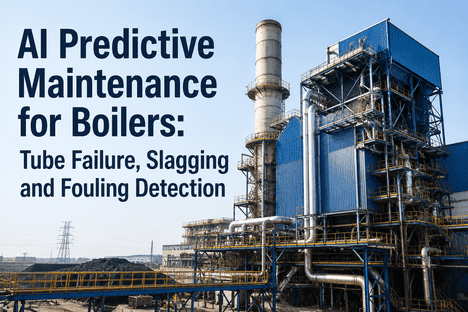
AI Predictive Maintenance for Boilers: Tube Failure, Slagging and Fouling Detection
By Rebecca on June 9, 2026
Boiler tube failures account for approximately 60% of forced outages in coal and biomass power plants, making them the leading cause of unplanned generation loss in the thermal power industry. The damage mechanisms are well characterized — fireside corrosion, waterside hydrogen damage, caustic gouging, creep, fatigue, and ash-related erosion each produce distinct metallurgical signatures that experienced failure analysts can identify during post-mortem examination. The limitation is timing: by the time a tube rupture occurs, the damage accumulated over thousands of operating hours has already propagated beyond the point where planned intervention was possible. Traditional condition monitoring relies on periodic wall thickness measurements using ultrasonic testing, visual inspection during planned outages, and manual trending of historical failure data. A boiler with 500+ tube circuits may see each tube inspected once every 18–24 months, creating vast blind spots where localized corrosion, slagging-induced overheating, or fouling-driven gas temperature excursions develop undetected. AI-native predictive maintenance eliminates these blind spots by ingesting continuous sensor telemetry — furnace exit gas temperature, tube metal temperatures, slag deposition indicators, flue gas CO and O₂ profiles, steam-side chemistry — and correlating these signals against known tube failure models. iFactory AI's industrial software platform, including its Shift Logbook and predictive maintenance engine, enables reliability teams to deploy AI-driven boiler failure prediction without replacing existing CMMS or condition monitoring software. Book a Demo to see how iFactory applies AI boiler failure prediction across coal, biomass, and industrial boiler fleets. This guide covers tube failure mechanism fundamentals, AI model architectures for slagging and fouling detection, remaining useful life estimation from degradation trajectories, and the practical deployment path for thermal power reliability engineers evaluating modernization.
AI Predictive Maintenance for Boilers: Tube Failure, Slagging and Fouling Detection
Continuous tube metal temperature monitoring · AI slagging and fouling classification · trajectory-based RUL — reducing forced outages from tube failures, optimizing sootblowing schedules, and extending boiler asset life across coal and biomass fleets.
Why Periodic Boiler Tube Inspection Is Hitting Its Ceiling in Failure Prevention
The traditional approach — scheduled outage-based ultrasonic thickness readings, manual visual inspection of waterwall and superheater tubes, and post-mortem failure analysis after each tube rupture — was the standard for boiler reliability management through the 2000s. A typical 500 MW coal-fired boiler contains over 50,000 linear feet of tube circuits across waterwalls, superheaters, reheaters, economizers, and generating bank sections. Even with a dedicated NDT team walking the boiler during an annual outage, each tube section may be inspected on a 24–36 month cycle. For tubes experiencing fireside corrosion rates of 0.5–2.0 mm per year, that inspection interval allows wall loss to progress from nominal thickness to rupture threshold without detection. The four specific ceilings are well documented in boiler failure research.
01
Inspection Sampling Gap
Annual or biennial UT thickness surveys cover less than 5% of total tube surface area. Localized corrosion, hydrogen damage, and creep cracking develop between inspections at rates that exceed the inspection interval safety margin.
Gap: Sparse vs Continuous
02
Slagging Blindness
Slag deposition on furnace waterwalls changes heat absorption patterns gradually over days to weeks. Operators detect slagging only after furnace exit gas temperature excursions trigger alarms — typically 24–48 hours before a slag drop blocks a hopper opening.
Gap: Reactive vs Predictive
03
Analyst Variability
UT thickness readings vary by 15–30% depending on technician technique, couplant quality, and probe alignment. AI models analyzing continuous tube metal temperature patterns detect overheating events with consistent accuracy across every boiler section.
Gap: Human-dependent vs Automated
04
Failure Mechanism Misdiagnosis
Without continuous operational data, post-mortem failure analysis often misattributes root cause between fireside corrosion, waterside chemistry excursions, and creep-fatigue interaction. AI correlation of multiple sensor streams identifies the true failure driver.
Gap: Post-mortem vs Real-time
What AI Boiler Predictive Maintenance Actually Adds to Reliability Programs
The misconception some thermal power reliability engineers carry: AI boiler failure prediction replaces existing NDT programs, ultrasonic thickness databases, or boiler inspection expertise. It doesn't. Your existing inspection protocols, thickness trending databases, and failure analysis procedures remain. What changes is the continuous data ingestion layer and the pattern recognition capability. Continuous sensor telemetry — tube metal thermocouples, furnace exit gas temperature probes, flue gas CO and O₂ analyzers, slag deposition monitors, steam chemistry sensors — feeds AI models that detect slagging onset, classify fouling severity across convection pass sections, identify tube overheating events before creep damage accumulates, and estimate remaining tube life from degradation trajectory models. The existing CMMS receives higher-quality input — not just "waterwall tube thinning detected" but "waterwall tube metal temperature elevation of 35°C above baseline at elevation 15m — slagging-induced overheating pattern at 89% confidence — local corrosion rate acceleration risk — recommended action: targeted sootblowing at elevation 12–18m, schedule UT confirmation during next planned outage." iFactory AI's Shift Logbook provides operators and reliability engineers with a unified interface for equipment status updates, shift handovers, and AI-generated boiler recommendations integrated with existing CMMS workflows.
Capability
Periodic Boiler Inspection
AI Continuous Boiler Prediction
Tube condition monitoring
Annual UT thickness survey + visual inspection
Continuous tube metal temperature telemetry 24/7
Slagging detection
FEGT excursion alarms + manual observation
AI slagging onset detection from heat flux profiles
Fouling classification
Draft loss trending + outlet temperature deviation
AI classification with per-section fouling severity scores
Tube life estimation
Larson-Miller parameter from periodic thickness
Trajectory-based from continuous temperature + corrosion models
Detection latency
Missed between inspection intervals
Real-time overheating detection at onset
Sootblowing optimization
Fixed schedule based on coal ash analysis
AI-driven targeted sootblowing from slagging state
Operator interface
NDT reports + boiler inspection software
Mobile dashboards + shift logbook + AI copilot
Boiler Tube Failure Modes — What AI Detects at Each Stage of Degradation
Boiler tube failures occur through six primary damage mechanisms, each producing distinct thermal, chemical, and operational signatures. AI models trained on these signatures detect degradation onset well before wall loss reaches critical levels. Understanding the mechanism characteristics is essential for evaluating predictive maintenance vendors serving thermal power assets.
FC
Fireside Corrosion
Molten ash corrosion on waterwall tubes in reducing atmosphere zones. Metal loss rates of 0.5–2.0 mm/year. AI detects by correlating wall temperature, flue gas CO, and local stoichiometry. Sulphidation damage accelerates above 450°C metal temperature.
Predictive lead time: 6–12 months
HD
Hydrogen Damage
Hydrogen atoms from steam-water reaction diffuse into tube metal, reacting with carbides to form methane blisters. Rapid wall loss in 500–1,000 hours. AI detects by monitoring steam chemistry — pH excursions, phosphate hideout, and conductivity spikes.
Predictive lead time: 2–4 weeks
CG
Caustic Gouging
Concentrated NaOH beneath deposits dissolves the protective magnetite layer. Localized wall loss at 3–5 mm/year. AI identifies by correlating boiler water chemistry, heat flux, and deposit loading patterns. Most aggressive at tube ID surface.
Predictive lead time: 3–6 months
CR
Creep & Fatigue
Repeated thermal cycling causes stress-rupture in superheater and reheater tubes. Each 10°C above design metal temperature halves remaining creep life. AI tracks cumulative creep exposure from continuous metal temperature data and cycle counting.
Predictive lead time: 12–24 months
The Keep / Retire / Transform / Replace Decision Matrix
Migration discipline starts here. Every boiler reliability artifact in your current operation falls into one of four categories. Getting the categorization right in week one of the workshop saves quarters of debate later.
Keep
Core boiler reliability foundations
CMMS work order engine
Parts inventory & procurement
Existing NDT inspection database
ERP financial integration
Boiler OEM design specs
Established reliability capabilities. No business case to replace. AI boiler prediction writes recommendations to these systems.
Retire
Legacy detection layers
Scheduled outage-only UT surveys
FEGT threshold-only slagging alarms
Manual draft loss trending
Paper inspection data sheets
Email-based alarm notification
Replaced by continuous telemetry ingestion and AI-driven tube condition classification. 80–90% reduction in manual data collection effort.
Transform
Analysis workflows
Tube health scoring
Metal temperature deviation trending
Slagging & fouling severity tracking
RUL dashboard reporting
Shift handover for boiler status
Become AI model invocations grounded in continuous sensor telemetry. Intelligence upgraded via iFactory Shift Logbook.
Replace
Alert & notification layer
Legacy alarm threshold gateways
Manual escalation workflows
Email-based slagging alerts
Paper-based shift logs
Standalone tube inspection reports
Event-driven AI alert engine replaces manual notification. Faster, context-aware, with automated work order creation in CMMS.
Want this matrix applied to your specific boiler configuration in a working session? Book a Demo to walk through every boiler section and prioritize your AI failure prediction rollout.
Three Deployment Paths for Boiler AI Predictive Maintenance
Same starting point, three valid destinations. The right path depends on boiler type, tube population size, current sensor coverage, and data infrastructure maturity. Plants that pick the wrong path spend 12 months in pilot purgatory. Plants that pick the right path deploy in 6–12 weeks.
Path A
Augment in Place
6–8 weeks
AI boiler monitoring runs alongside existing NDT inspection program. Shadow mode for 4 weeks. Alerts flow to CMMS for review. No legacy inspection protocols retired in this phase.
Best fit
Critical boiler assets · risk-averse reliability teams · first AI deployment in boiler condition monitoring
Wk 1–2 Sensor & data federation
Wk 3–5 Shadow mode AI
Wk 6–8 CMMS integration live
Path B
Hybrid Migration
8–12 weeks
AI boiler prediction layer augments NDT inspection. Existing UT database retained for analyst review. CMMS and ERP systems preserved. Tube sparing logic integrated.
Best fit
Mature reliability programs · moderate budget authority · sponsorship for digital transformation
Wk 1–3 Discovery · matrix
Wk 4–8 Deploy AI boiler layer
Wk 9–12 Mobile UX migration · cutover
Path C
Full Modernization
10–14 weeks
Scheduled outage-only NDT approach retired entirely for AI-native continuous monitoring. All boiler sections covered against matrix with automated tube sparing optimization.
Best fit
Large boiler fleets (3+ units) · siloed legacy systems · strategic platform consolidation goal
Wk 1–4 Full boiler section inventory + matrix
Wk 5–10 Parallel build + test
Wk 11–14 Cutover + legacy sunset
Pick the Right Path for Your Boiler Fleet in a 90-Minute Workshop
iFactory AI's boiler reliability practice runs a focused workshop against your specific boiler configuration, existing tube metal temperature coverage, CMMS setup, and outage planning strategy. You leave with a defended path recommendation, an 8-week deployment plan, and a cost reduction projection grounded in your boiler failure history.
Generic industrial IoT vendors handle the sensor hardware. Boiler-aware vendors handle the integration reality — slagging and fouling model calibration per coal type, tube metal temperature alarm logic tuned to creep life curves per ASME Section I, CMMS-native work order generation with tube part number and location, and zero-disruption deployment alongside existing NDT programs. Eight criteria separate vendors who've done boiler fleet modernizations from vendors selling a demo.
01
Slagging model calibration per fuel
Ask:
"Does your AI platform calibrate slagging onset detection for specific coal and biomass ash chemistry, including ash fusion temperature and slagging index?"
Slagging behavior varies dramatically with coal type — PRB subbituminous, Appalachian bituminous, and petcoke blends each produce different ash deposition rates and sintered strength. Platforms must auto-calibrate slagging thresholds from fuel analysis data without manual reconfiguration per coal shipment.
02
Tube metal temperature creep tracking
Ask:
"Does your platform track cumulative creep exposure from continuous metal temperature data and calculate remaining creep life per ASME Section I guidelines?"
Each 10°C above design metal temperature approximately halves remaining creep life. AI must track time-temperature history continuously, apply Larson-Miller parameter calculations per tube material grade, and flag sections approaching end-of-life well before UT thickness readings show significant wall loss.
03
Fireside corrosion rate modeling
Ask:
"Does your AI model estimate local fireside corrosion rates from flue gas composition, metal temperature, and deposit chemistry indicators?"
Corrosion rates depend on local reducing zone stoichiometry, sulfur content, and metal temperature. Models must separate corrosion-driven wall loss from creep-driven deformation to avoid false failure predictions and correctly attribute damage mechanism.
04
Convection pass fouling classification
Ask:
"Does your platform classify fouling severity independently for each convection pass section — superheater, reheater, economizer, and air heater?"
Fouling accumulates differently across sections based on gas temperature, ash particle size distribution, and tube geometry. Each section requires independent severity classification and individual sootblowing optimization to maintain boiler efficiency.
05
Waterside chemistry integration
Ask:
"Does your platform integrate boiler water chemistry data — pH, conductivity, phosphate, dissolved oxygen — to detect hydrogen damage and caustic gouging precursors?"
Water chemistry excursions precede many tube failures by 2–6 weeks. AI models correlating chemistry anomalies with heat flux and tube temperature identify developing damage conditions before wall loss becomes critical. Chemistry-only monitoring misses the tube temperature context.
06
CMMS-native work order with tube evidence
Ask:
"Does your platform generate CMMS work orders with damage mechanism, tube section location (elevation, row, panel number), RUL estimate, and recommended tube material grade?"
AI predictions without actionable, specific work orders create process friction. Work orders must include the precise boiler section location, mechanism classification, temperature trend data, and days to estimated failure threshold.
07
Boiler fleet health dashboard
Ask:
"Does your platform provide a boiler fleet health dashboard with per-section damage mechanism, RUL, and outage priority ranking?"
Total boiler section visibility is the primary decision tool. Dashboards must rank tube sections by RUL, damage mechanism, and production criticality with drill-down to individual temperature trends and corrosion rate projections.
08
Deployment timeline commitment
Ask:
"When does the first AI-classified tube overheating alert reach our CMMS in production?"
6–12 weeks is the production-grade benchmark for hybrid migration. Path A is 6–8 weeks. Path C is 10–14 weeks. Vendors quoting 6+ months are building custom development.
Want to score your shortlisted vendors against this 8-criterion framework? Run a vendor evaluation working session with our team and get a structured scorecard against your boiler fleet requirements.
The ROI Math — What AI Boiler Prediction Delivers for Thermal Power Reliability
The business case for AI-native boiler predictive maintenance isn't about software cost — it's about cost avoidance on forced outages from tube failures that cost $200,000–$500,000 per day in replacement power for a typical 500 MW coal unit. Plants moving from periodic NDT inspection and reactive slagging management to AI continuous boiler monitoring see measurable improvements across four metrics in the first quarter post-deployment.
−50–70%
Forced outages from tube failures
AI detects tube overheating and corrosion acceleration 4–12 weeks before rupture. Emergency outages shift to planned repairs during scheduled maintenance windows with pre-positioned tube sections.
−2–5%
Heat rate improvement
Optimized sootblowing from AI slagging classification reduces excess O₂ and improves heat transfer. Each 1% heat rate improvement on a 500 MW unit saves approximately $250,000 annually in fuel cost.
+20–40%
Tube section mean time to failure
Timely sootblowing, chemistry correction, and targeted UT inspection extends tube service life by minimizing creep exposure and corrosion acceleration before wall loss reaches critical levels.
6–9 mo
Typical ROI payback
Full investment recovery through forced outage reduction, heat rate improvement, maintenance cost optimization, and extended boiler tube asset life.
Expert Perspective
"The single biggest mistake thermal power reliability teams make in boiler condition monitoring modernization is treating it as a sensor installation project. It isn't. Your existing UT thickness data, NDT inspection protocols, and failure analysis expertise work as designed — there's no business case to replace them wholesale. What needs to change is the data ingestion density and the pattern recognition layer. Annual thickness surveys capturing one data point per tube per year need to migrate to continuous tube metal temperature and flue gas telemetry feeding AI models that detect slagging onset, classify fouling severity across convection pass sections, identify tube overheating events before creep damage accumulates, and estimate remaining tube life from degradation trajectory models validated against your boiler's actual operating history. The architectural decision isn't NDT-or-AI — it's NDT-plus-AI-plus-continuous-telemetry-plus-degradation-models. Plants that frame it correctly deploy in 8–12 weeks. Plants that frame it as rip-and-replace spend 12 months in pilot purgatory."
— Boiler Reliability Practice, 2026 industry insight
8–12 wk
hybrid deployment with pre-configured boiler templates
80–90%
reduction in manual tube condition trending effort
Zero rip
of existing CMMS, NDT database, or DCS required
Conclusion: The Modernization Decision Has Three Right Answers
Scheduled outage-based tube inspection and manual slagging management aren't failing in boiler reliability programs — they're hitting a sampling ceiling that human-dependent data collection can't cross. AI-native continuous boiler predictive maintenance adds the slagging onset detection, fouling severity classification, and trajectory-based tube life estimation layer that traditional methods were never designed to deliver: 24/7 tube metal temperature monitoring, automated slagging and fouling detection across all boiler sections, damage mechanism classification with confidence scores, degradation trajectory-based remaining tube life estimates, and mobile-native operator interfaces grounded in real-time boiler health data. The modernization conversation has three valid answers depending on boiler type, section population, and existing sensor coverage — augment in place (6–8 weeks), hybrid migration (8–12 weeks), or full modernization (10–14 weeks). All three keep existing NDT programs, CMMS, and DCS infrastructure intact and reuse current sensor and thermocouple installations. All three deliver 50–70% reduction in forced outages from tube failures within the first quarter. The decision worth making in 2026 isn't whether to modernize boiler predictive maintenance — it's which of the three paths fits your specific thermal power asset context. Walk through your specific boiler sections and continuous monitoring requirements with our team.
Run the AI Boiler Predictive Maintenance Workshop Built for Your Fleet
iFactory AI's boiler reliability practice runs a 90-minute workshop against your real boiler sections, existing thermocouple and sensor coverage, and CMMS configuration. You leave with a defended path recommendation, the matrix applied to your boiler configuration, and a cost reduction projection grounded in your boiler failure history.
Does AI boiler predictive maintenance replace our existing NDT inspection program?
No. Your existing ultrasonic thickness survey protocols, certified NDT technicians, and failure analysis procedures continue providing their respective value — these are well-established reliability capabilities. What changes is the data ingestion density and pattern recognition layer: continuous tube metal temperature, flue gas, and steam chemistry data now feeds AI models that detect slagging onset, classify fouling severity, and identify tube overheating events, in addition to the periodic thickness data your NDT team already collects. The AI prediction layer sits on top of existing boiler monitoring data streams through standard API integration.
What boiler failure mechanisms can AI actually predict?
Production-grade AI boiler failure prediction covers all primary damage mechanisms: fireside corrosion identified by metal temperature and flue gas CO correlation in reducing zones, hydrogen damage detected through steam chemistry excursions and local heat flux monitoring, caustic gouging identified by boiler water chemistry and deposit loading pattern correlation, creep damage tracked through continuous time-temperature history with Larson-Miller parameter calculation per ASME Section I guidelines, thermal fatigue identified through cycle counting and temperature ramp rate analysis, and ash erosion detected through flue gas velocity and particle loading pattern recognition. Each mechanism is independently classified with severity trending through the degradation progression.
Does deployment require new thermocouples on every tube?
Not necessarily. Production-grade AI platforms integrate with existing tube metal temperature thermocouples, furnace exit gas temperature probes, and flue gas analyzers already installed on most utility and industrial boilers. iFactory's federation layer reuses your current investment in installed sensors, DCS data streams, and CEMS data. The platform also ingests existing UT thickness databases and inspection records to establish baseline condition. For boilers with limited sensor coverage, wireless temperature sensor kits can be installed strategically — typically 20–40 sensor locations for a 500 MW boiler — during a scheduled burner or maintenance outage.
How does remaining tube life prediction work for boilers?
Each boiler section's continuous temperature, flue gas, and chemistry telemetry feeds into dedicated AI models that track degradation through mechanism-specific progression stages. For creep-related damage, the model applies the Larson-Miller parameter from continuous time-temperature history, accumulating creep exposure relative to the tube material's design curve. For fireside corrosion, the model tracks metal loss rate by correlating temperature, local stoichiometry, and deposit chemistry indicators. For hydrogen damage and caustic gouging, the model tracks chemistry excursion frequency and magnitude against known damage thresholds. Each mechanism produces an independent remaining life estimate; the overall tube section RUL is the minimum of all mechanism-specific estimates. Confidence intervals narrow as damage indicators progress through later stages. This approach achieves significantly better accuracy than generic tube life curves which ignore actual operating condition trajectory.
Which deployment path fits a critical boiler asset best?
Path A (Augment in Place) is the right starting point for boilers where unplanned tube failure carries severe production or safety consequences — particularly for supercritical and ultra-supercritical units where tube rupture events involve high-pressure steam releases. The platform runs alongside existing NDT inspection for 4 weeks in shadow mode, generating tube condition classifications and RUL estimates logged for review but not triggering work orders. Reliability teams compare AI predictions against existing UT thickness data and actual tube failure events before approving cutover with full traceability. No legacy inspection protocols retire in Path A — the existing NDT program continues running as a control comparison. After 6–12 months, most plants progress to Path B or C to capture additional efficiency benefits from automated sootblowing optimization and integrated tube sparing.