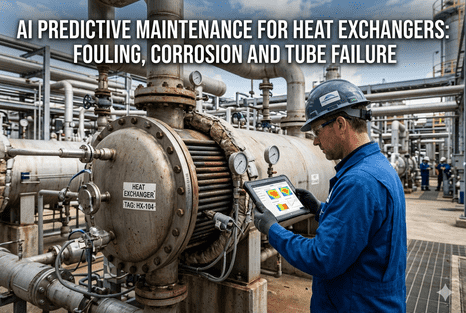
Heat exchangers are the thermal transfer backbone of every process industry — refining, chemical, power generation, pharmaceutical, food and beverage, and HVAC — responsible for heating, cooling, condensing, and recovering thermal energy across thousands of process streams. Despite their apparent simplicity, heat exchanger performance degradation due to fouling, corrosion, and tube failure represents one of the largest sources of energy waste and unplanned downtime in industrial operations. Fouling alone — the accumulation of crystalline, particulate, chemical reaction, corrosion, and biological deposits on heat transfer surfaces — reduces thermal efficiency by 20–30% before detection triggers cleaning intervention, increasing energy consumption by 5–15% across the facility. Tube failure from corrosion under deposit, vibration-induced fatigue, and thermal stress causes unplanned production stoppages costing $50,000–$500,000 per event depending on process criticality and environmental release risk. Traditional condition monitoring relies on periodic manual calculation of fouling factors from pressure drop and temperature measurements, quarterly thickness readings from ultrasonic testing, and visual inspection during scheduled turnarounds — leaving weeks of degradation undetected between measurement intervals. AI-native predictive maintenance eliminates this gap by ingesting continuous process data — approach temperature, differential pressure, flow rates, and tube wall temperature — applying thermal performance models to estimate fouling resistance trajectories, corrosion rates, and remaining useful life before tube failure occurs. iFactory AI's industrial software platform, including its Shift Logbook and predictive maintenance engine, enables process engineers to deploy AI-driven heat exchanger monitoring without replacing existing DCS, CMMS, or ERP systems. Book a Demo to see how iFactory applies AI predictive maintenance for heat exchangers across refining, chemical, and power generation facilities. This guide covers fouling mechanism physics, AI thermal performance models, tube failure prediction, and the practical deployment path for process engineers evaluating modernization.
Continuous fouling factor monitoring · AI corrosion prediction · remaining useful life estimation — reducing energy waste by 5–15%, preventing tube failure downtime, and optimizing cleaning intervals across refining, chemical, and power generation facilities.
Why Periodic Thermal Performance Monitoring Is Hitting Its Ceiling in Heat Exchanger Reliability
The traditional approach — monthly manual calculation of fouling resistance from process data, quarterly ultrasonic thickness readings on tube walls, annual eddy current testing, and visual inspection during plant turnarounds — was designed for an era when data collection was labor-intensive and computational analysis was expensive. A process engineer manually calculating fouling factor for a single exchanger requires pressure drop, flow rate, inlet and outlet temperature data from both shell and tube sides — typically retrieved from DCS historian, entered into spreadsheet calculations, and trended monthly. For a facility with 50+ exchangers, this process produces one data point per exchanger per month. Fouling that develops over days to weeks — such as crystallization fouling in cooling water systems or particulate fouling in crude preheat trains — progresses significantly between measurement intervals. The four specific ceilings are well documented in heat exchanger performance monitoring research.
What AI Predictive Maintenance Actually Adds to Heat Exchanger Performance Programs
The misconception some process engineers carry: AI predictive maintenance replaces existing DCS, thermal performance software, or inspection programs. It doesn't. Your DCS continues controlling process variables. Your thermal performance software continues tracking long-term efficiency trends. Your inspection program continues providing periodic UT and eddy current data. What changes is the continuous intelligence layer. DCS historians stream temperature, pressure, and flow data into AI models that calculate fouling resistance automatically at 15-minute intervals, detect fouling rate changes in real time, estimate remaining time to cleaning threshold, and flag tube failure risk from combined corrosion rate, pressure cycling, and temperature excursion data. The existing CMMS receives higher-quality input — not just "heat exchanger performance degraded" but "fouling resistance increased from 3.5E-4 to 5.2E-4 m²K/W over 14 days — cooling water side particulate fouling detected at 93% confidence — estimated 28 days to cleaning threshold — recommended action: schedule hydroblasting during next planned outage, pre-arrange cooling water side access." iFactory AI's Shift Logbook provides operators and process engineers with a unified interface for heat exchanger status updates, shift handovers, and AI-generated maintenance recommendations integrated with existing CMMS workflows.
Heat Exchanger Failure Mechanisms — What AI Detects Before Conventional Monitoring Can
Heat exchangers fail through specific thermal, chemical, and mechanical processes that leave identifiable signatures in process data before they become visible to inspectors or cause operational issues. AI models trained on these signatures detect degradation 14–30 days before cleaning thresholds are breached or tube failure occurs — the window that separates planned intervention from unplanned outage and environmental release. Understanding the fouling and corrosion mechanisms is essential for evaluating predictive maintenance vendors.
The Keep / Retire / Transform / Replace Decision Matrix
Migration discipline starts here. Every heat exchanger performance monitoring artifact in your current operation falls into one of four categories. Getting the categorization right in week one of the workshop saves quarters of debate later.
Want this matrix applied to your specific heat exchanger inventory in a working session? Book a Demo to walk through every exchanger class and prioritize your AI predictive maintenance rollout.
Three Deployment Paths for Heat Exchanger AI Monitoring
Same starting point, three valid destinations. The right path depends on exchanger fleet size, process criticality, current DCS instrumentation, and inspection program maturity. Plants that pick the wrong path spend 12 months in pilot purgatory. Plants that pick the right path deploy in 8–14 weeks.
iFactory AI's heat exchanger practice runs a focused workshop against your specific exchanger classes, DCS instrumentation, cleaning history, and CMMS configuration. You leave with a defended path recommendation, a 10-week deployment plan, and a cost reduction projection grounded in your heat exchanger performance history.
Vendor Evaluation Framework — Heat Exchanger-Specific Questions
Generic predictive maintenance vendors handle the AI math. Heat exchanger-aware vendors handle the integration reality — DCS historian connectivity, TEMA standard fouling factor calculation, multi-modal sensor fusion across temperature, pressure, flow, pH, and vibration, UT data ingestion, cleaning interval optimisation, and zero-disruption deployment. Eight criteria separate vendors who've done heat exchanger fleet modernizations from vendors selling a demo.
Want to score your shortlisted vendors against this 8-criterion framework? Run a vendor evaluation working session with our team and get a structured scorecard against your heat exchanger fleet requirements.
The ROI Math — What AI Predictive Maintenance Delivers for Heat Exchanger Reliability
The business case for AI-native heat exchanger monitoring isn't about software cost — it's about energy savings from optimised cleaning, cost avoidance on tube failure events, and extended exchanger life from corrosion-informed inspection planning. Plants moving from periodic to AI continuous predictive monitoring see measurable improvements across four metrics in the first quarter post-deployment.
Expert Perspective
Conclusion: The Modernization Decision Has Three Right Answers
Periodic manual thermal performance monitoring isn't failing in heat exchanger reliability programs — it's hitting a data resolution ceiling that spreadsheet-based analysis can't cross. AI-native continuous predictive maintenance adds the real-time fouling factor calculation, mechanism classification, corrosion rate estimation, and tube failure risk assessment layer that traditional methods were never designed to deliver: 15-minute DCS data ingestion, automated TEMA-standard fouling resistance computation, fouling mechanism classification from trajectory characteristics, UT data-fused corrosion rate modelling, cleaning interval optimisation balancing energy cost against cleaning cost, and mobile-native operator interfaces grounded in real-time exchanger performance data. The modernization conversation has three valid answers depending on exchanger fleet size, criticality mix, and existing DCS instrumentation — augment in place (6–8 weeks), hybrid migration (8–12 weeks), or full modernization (10–14 weeks). All three keep existing DCS, CMMS, and inspection programs intact and reuse current process instrumentation. All three deliver 30–50% reduction in tube failure events and 5–15% reduction in energy consumption within the first quarter. Walk through your specific exchanger classes and continuous monitoring requirements with our team.
iFactory AI's heat exchanger practice runs a 90-minute workshop against your real exchanger classes, DCS instrumentation, cleaning history, and CMMS configuration. You leave with a defended path recommendation, the keep/retire/transform/replace matrix applied to your exchangers, and a cost reduction projection grounded in your thermal performance history.