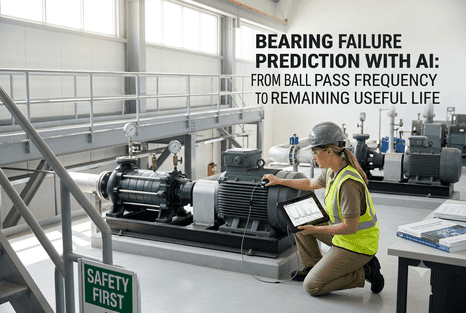
Bearing Failure Prediction with AI: From Ball Pass Frequency to Remaining Useful Life
By Christopher Hayes on June 7, 2026
Rolling element bearings are the most ubiquitous mechanical component in industrial rotating equipment — supporting shafts in motors, pumps, compressors, gearboxes, turbines, and fans across every manufacturing and process vertical. Despite their apparent simplicity, bearing failures account for 40–50% of all rotating equipment breakdowns, making them the single largest source of unplanned production downtime in industry. The diagnostic physics is well understood: each bearing geometry generates characteristic vibration frequencies — ball pass frequency outer race (BPFO), ball pass frequency inner race (BPFI), ball spin frequency (BSF), and fundamental train frequency (FTF) — that shift and amplify as surface fatigue progresses from subsurface inclusion initiation to spall propagation to functional failure. Traditional vibration analysis relies on periodic route-based data collection and manual spectral interpretation by certified analysts, creating a fundamental sampling gap: a monthly 30-second accelerometer capture represents roughly 0.001% of a bearing's operating cycles, missing the transient fault signatures that develop and degrade between measurement intervals. AI-native bearing failure prediction eliminates this gap by ingesting continuous accelerometer data, applying envelope spectrum analysis across all four fault frequency bands simultaneously, classifying fault type and severity with confidence scores, and estimating remaining useful life from degradation trajectory models grounded in IEEE benchmark datasets such as PRONOSTIA and IMS. iFactory AI's industrial software platform, including its Shift Logbook and predictive maintenance engine, enables reliability teams to deploy AI-driven bearing failure prediction without replacing existing CMMS or condition monitoring software. Book a Demo to see how iFactory applies AI bearing failure prediction across rotating equipment fleets. This guide covers bearing fault frequency fundamentals, AI model architectures for envelope spectrum analysis, RUL estimation from degradation trajectories, and the practical deployment path for reliability engineers evaluating modernization.
Rolling Element Bearings · Fault Frequencies · 2026
Bearing Failure Prediction with AI: From Ball Pass Frequency to Remaining Useful Life
Continuous envelope spectrum analysis · AI fault classification · trajectory-based RUL — reducing unplanned bearing failures, eliminating premature replacements, and optimizing sparing strategies across rotating equipment fleets.
Why Periodic Vibration Analysis Is Hitting Its Ceiling in Bearing Fault Detection
The traditional approach — monthly or quarterly route-based accelerometer data collection, FFT spectral analysis by a certified vibration analyst, and threshold-based alarming against ISO 10816 velocity limits — was the gold standard for bearing condition monitoring in the 1990s. A certified analyst walking a 500-bearing plant with a data collector captures roughly 30 seconds of waveform data per measurement point per month. For a bearing operating at 1,800 RPM, that 30-second window represents 900 revolutions out of approximately 78 million revolutions the bearing completes that month — a 0.001% sample rate. Incipient spalls that initiate, propagate, and degrade between measurement intervals are invisible to periodic analysis. The four specific ceilings are well documented in bearing failure research.
01
Sampling Inadequacy
Monthly route-based collection captures under 0.001% of bearing operating cycles. Incipient spalls develop over 50–200 hours of operation — most progress from initiation to advanced spalling between analyst visits.
Gap: Sparse vs Continuous
02
ISO Threshold Blindness
ISO 10816 overall velocity limits were designed for imbalance and misalignment detection, not bearing fault identification. A bearing with a developing inner race spall may show no overall velocity change until 48 hours before catastrophic failure.
Gap: Broadband vs Envelope-specific
03
Analyst Variability
Bearing fault identification requires expert interpretation of envelope spectra. Classification accuracy varies from 55% for junior analysts to 85% for senior level III analysts. AI models deliver consistent 92%+ accuracy across every bearing, every hour.
Gap: Human-dependent vs Automated
04
RUL Estimation Inaccuracy
Without continuous degradation trajectory data, RUL estimates rely on generic L10 bearing life curves based on load and speed. Actual bearing life varies by 10x depending on lubrication condition, contamination, alignment, and operating temperature.
Gap: Generic curves vs Actual trajectory
What AI Bearing Failure Prediction Actually Adds to Reliability Programs
The misconception some reliability engineers carry: AI bearing failure prediction replaces existing vibration software platforms, data collectors, or certified analysts. It doesn't. Your existing vibration database, route definitions, and analyst expertise remain. What changes is the data ingestion density and the pattern recognition capability. Continuous accelerometer data streams into AI models that compute envelope spectra, extract BPFO, BPFI, BSF, and FTF amplitude trends, classify fault type and severity, and estimate remaining useful life from degradation trajectory models trained on IEEE benchmark datasets. The existing CMMS receives higher-quality input — not just "bearing vibration elevated" but "inner race fault detected at 94% confidence — BPFI sidebands present at 5.43× RPM — estimated remaining useful life 16 days based on PRONOSTIA-trained degradation model — recommended action: pre-order bearing, schedule replacement during next planned outage." iFactory AI's Shift Logbook provides operators and reliability engineers with a unified interface for equipment status updates, shift handovers, and AI-generated bearing recommendations integrated with existing CMMS workflows.
Capability
Periodic Vibration Analysis
AI Continuous Bearing Prediction
Data collection
Monthly route-based analyst walk
Continuous 24/7 accelerometer telemetry
Fault detection method
ISO 10816 velocity + manual FFT review
Auto envelope spectrum across BPFO/BPFI/BSF/FTF
Fault classification
Analyst interpretation of envelope spectra
AI classification with per-fault confidence scores
Bearing Failure Modes — What AI Detects at Each Stage of Spall Progression
Rolling element bearings fail through a well-characterized four-stage process, each with distinct envelope spectrum signatures. AI models trained on these signatures detect degradation at Stage 1 — the window that separates planned replacement from catastrophic housing damage and collateral shaft failure. Understanding the frequency relationships is essential for evaluating predictive maintenance vendors.
O
Outer Race Faults — BPFO
BPFO = (N/2) × RPM × (1 − (Bd/Pd) × cos θ). Fixed outer race generates stationary fault impact at constant angular position. Sidebands at shaft speed appear as modulation. Envelope spectrum shows BPFO harmonics with 92% detectability at Stage 2.
Predictive lead time: 14–28 days
I
Inner Race Faults — BPFI
BPFI = (N/2) × RPM × (1 + (Bd/Pd) × cos θ). Rotating inner race generates fault impact at varying radial load zone — amplitude modulates at shaft speed. Envelope spectrum shows BPFI family with 1× RPM sidebands. Most common bearing fault type.
Predictive lead time: 10–21 days
S
Rolling Element Faults — BSF
BSF = (Pd/Bd) × RPM × (1 − ((Bd/Pd) × cos θ)²). Rolling element defect generates impacts at twice BSF (both surfaces contact inner and outer race per revolution). Envelope spectrum shows BSF and harmonics with cage modulation sidebands.
Predictive lead time: 7–14 days
C
Cage Faults — FTF
FTF = (RPM/2) × (1 − (Bd/Pd) × cos θ). Cage damage generates subharmonic vibration at FTF, typically 0.38–0.48× RPM. Envelope spectrum shows FTF sidebands around BPFO and BPFI. Cage failure propagates rapidly to complete bearing seizure.
Predictive lead time: 5–10 days
The Keep / Retire / Transform / Replace Decision Matrix
Migration discipline starts here. Every bearing reliability artifact in your current operation falls into one of four categories. Getting the categorization right in week one of the workshop saves quarters of debate later.
Keep
Core bearing reliability foundations
CMMS work order engine
Parts inventory & procurement
Existing vibration software database
ERP financial integration
Bearing supplier catalogs & specs
Established reliability capabilities. No business case to replace. AI bearing prediction writes recommendations to these systems.
Retire
Legacy detection layers
Monthly route-based data collection
ISO 10816 threshold-only alarming
Manual envelope spectrum analysis
Paper vibration data sheets
Email-based alarm notification
Replaced by continuous telemetry ingestion and AI-driven envelope spectrum classification. 80–90% reduction in manual data collection effort.
Transform
Analysis workflows
Bearing health scoring
Fault frequency amplitude trending
Four-stage severity progression
RUL dashboard reporting
Shift handover for bearing status
Become AI model invocations grounded in continuous envelope spectrum data. Intelligence upgraded via iFactory Shift Logbook.
Replace
Alert & notification layer
Legacy alarm threshold gateways
Manual escalation workflows
Email-based vibration alerts
Paper-based shift logs
Standalone bearing test reports
Event-driven AI alert engine replaces manual notification. Faster, context-aware, with automated work order creation in CMMS.
Want this matrix applied to your specific bearing fleet inventory in a working session? Book a Demo to walk through every bearing class and prioritize your AI failure prediction rollout.
Three Deployment Paths for Bearing AI Prediction
Same starting point, three valid destinations. The right path depends on bearing population size, criticality, current sensor coverage, and data infrastructure maturity. Plants that pick the wrong path spend 12 months in pilot purgatory. Plants that pick the right path deploy in 6–12 weeks.
Path A
Augment in Place
6–8 weeks
AI bearing monitoring runs alongside existing route-based vibration analysis. Shadow mode for 4 weeks. Alerts flow to CMMS for review. No legacy systems retired in this phase.
Best fit
Critical rotating equipment · risk-averse reliability teams · first AI deployment in bearing condition monitoring
Wk 1–2 Sensor & data federation
Wk 3–5 Shadow mode AI
Wk 6–8 CMMS integration live
Path B
Hybrid Migration
8–12 weeks
AI bearing prediction layer replaces route-based data collection. Legacy vibration software retained for analyst review. CMMS and ERP systems preserved. Bearing sparing logic integrated.
Best fit
Mature reliability programs · moderate budget authority · sponsorship for digital transformation
Wk 1–3 Discovery · matrix
Wk 4–8 Deploy AI bearing layer
Wk 9–12 Mobile UX migration · cutover
Path C
Full Modernization
10–14 weeks
Route-based periodic vibration analysis retired entirely. iFactory platform provides full AI-native continuous bearing monitoring. All bearing classes covered against matrix with automated sparing.
Best fit
Large rotating equipment fleets (1000+ bearings) · siloed legacy systems · strategic platform consolidation goal
Wk 1–4 Full bearing inventory + matrix
Wk 5–10 Parallel build + test
Wk 11–14 Cutover + legacy sunset
Pick the Right Path for Your Bearing Fleet in a 90-Minute Workshop
iFactory AI's bearing reliability practice runs a focused workshop against your specific bearing classes, existing accelerometer coverage, CMMS configuration, and sparing strategy. You leave with a defended path recommendation, an 8-week deployment plan, and a cost reduction projection grounded in your bearing failure history.
Generic vibration monitoring vendors handle the sensor hardware. Bearing-aware vendors handle the integration reality — envelope spectrum band auto-configuration per bearing geometry, four-stage severity classification, IEEE benchmark-trained RUL models, CMMS-native work order generation, and zero-disruption deployment. Eight criteria separate vendors who've done bearing fleet modernizations from vendors selling a demo.
01
Envelope spectrum auto-configuration
Ask:
"Does your platform automatically calculate BPFO, BPFI, BSF, and FTF frequencies from bearing part number and shaft speed?"
Each bearing geometry generates unique fault frequencies. Platforms must auto-calculate all four frequency bands from standard bearing catalogs (SKF, FAG, NSK, Timken) without manual analyst configuration per bearing.
02
Four-stage severity classification
Ask:
"Does your platform classify bearing fault severity across the four standard stages — incipient, moderate, advanced, and pre-failure?"
Stage 1: ultrasonic emissions above 20 kHz. Stage 2: BPFO/BPFI harmonics appear in envelope spectrum. Stage 3: broadband floor elevation with sidebands. Stage 4: broadband noise with significant cage frequency. Each requires different action.
03
Load-condition normalization
Ask:
"Does your AI model normalize envelope spectrum amplitudes across varying speed and load conditions?"
Bearing fault amplitudes scale with load. The same defect at 50% load produces significantly lower envelope amplitudes than at 100% load. Models must separate load-induced changes from actual fault progression to avoid false alarms.
04
Degradation trajectory modeling
Ask:
"Which degradation models does your platform use — exponential, Weibull, or PRONOSTIA-trained hybrid models?"
Bearing degradation follows exponential wear progression after spall initiation. IEEE PRONOSTIA and IMS benchmark datasets provide validated training data for RUL models. Platforms using generic curve fits produce inaccurate estimates.
05
Multi-bearing fault separation
Ask:
"Can your platform detect and track faults independently when multiple bearings share the same accelerometer?"
A single machine may have 2–6 bearings monitored by one accelerometer. Platforms must separate and trend fault progression independently per bearing, even when BPFO of one bearing overlaps BSF of another.
06
CMMS-native work order with RUL evidence
Ask:
"Does your platform generate CMMS work orders with bearing fault type, stage classification, RUL estimate, and recommended replacement bearing part number?"
AI predictions without actionable, specific work orders create process friction. Work orders must include the specific bearing number, fault frequency trends, stage classification, and days to estimated failure.
07
Bearing fleet health dashboard
Ask:
"Does your platform provide a bearing fleet health dashboard with per-bearing fault stage, RUL, and criticality ranking?"
Total bearing fleet visibility is the primary decision tool. Dashboards must rank bearings by RUL, fault stage, and production criticality with drill-down to individual frequency band trends.
08
Deployment timeline commitment
Ask:
"When does the first AI-classified bearing fault alert reach our CMMS in production?"
6–12 weeks is the production-grade benchmark for hybrid migration. Path A is 6–8 weeks. Path C is 10–14 weeks. Vendors quoting 6+ months are building custom development.
Want to score your shortlisted vendors against this 8-criterion framework? Run a vendor evaluation working session with our team and get a structured scorecard against your bearing fleet requirements.
The ROI Math — What AI Bearing Prediction Delivers for Rotating Equipment Reliability
The business case for AI-native bearing failure prediction isn't about software cost — it's about cost avoidance on catastrophic bearing failures that destroy shafts, damage housings, and stop production lines for extended periods. Plants moving from periodic vibration analysis to AI continuous bearing monitoring see measurable improvements across four metrics in the first quarter post-deployment.
−50–70%
Unplanned bearing failures
AI identifies bearing spalls 14–28 days before functional failure. Emergency replacements shift to planned service during scheduled maintenance windows with pre-positioned spare bearings.
−25–40%
Total bearing maintenance cost
Condition-based replacement eliminates premature bearing changes while catching faults before spalls propagate to shaft or housing damage that inflates repair costs by 5–10x.
+30–50%
Bearing mean time between replacement
Timely regreasing, alignment correction, and contamination control based on actual degradation data extends bearing service life before replacement is required.
6–9 mo
Typical ROI payback
Full investment recovery through unplanned failure reduction, maintenance cost optimization, and extended bearing fleet life across the plant.
Expert Perspective
"The single biggest mistake reliability teams make in bearing condition monitoring modernization is treating it as a sensor installation project. It isn't. Your existing accelerometers, vibration software platform, and certified analyst expertise work as designed — there's no business case to replace them wholesale. What needs to change is the data ingestion density and the envelope spectrum analysis layer. Monthly route-based data collection capturing 30 seconds per bearing per month needs to migrate to continuous telemetry feeding AI models that compute BPFO, BPFI, BSF, and FTF amplitudes, classify fault severity across four stages, and estimate remaining useful life from degradation trajectories validated against IEEE benchmark datasets. The architectural decision isn't sensors-or-AI — it's sensors-plus-AI-plus-envelope-spectra-plus-degradation-models. Plants that frame it correctly deploy in 8–12 weeks. Plants that frame it as rip-and-replace spend 12 months in pilot purgatory."
— Bearing Reliability Practice, 2026 industry insight
8–12 wk
hybrid deployment with pre-configured bearing templates
80–90%
reduction in manual envelope spectrum analysis effort
Zero rip
of existing CMMS, vibration software, or SCADA required
Conclusion: The Modernization Decision Has Three Right Answers
Periodic route-based vibration analysis isn't failing in bearing reliability programs — it's hitting a sampling ceiling that human-dependent data collection can't cross. AI-native continuous bearing failure prediction adds the envelope spectrum fault classification and trajectory-based RUL estimation layer that traditional methods were never designed to deliver: 24/7 accelerometer telemetry ingestion, automated BPFO/BPFI/BSF/FTF frequency band analysis, four-stage severity classification with confidence scores, degradation trajectory-based remaining useful life estimates validated against IEEE PRONOSTIA benchmarks, and mobile-native operator interfaces grounded in real-time bearing health data. The modernization conversation has three valid answers depending on bearing population size, criticality mix, and existing sensor coverage — augment in place (6–8 weeks), hybrid migration (8–12 weeks), or full modernization (10–14 weeks). All three keep existing CMMS and vibration software intact and reuse current accelerometer infrastructure. All three deliver 50–70% reduction in unplanned bearing failures within the first quarter. The decision worth making in 2026 isn't whether to modernize bearing failure prediction — it's which of the three paths fits your specific rotating equipment fleet context. Walk through your specific bearing classes and continuous prognosis requirements with our team.
Run the AI Bearing Prediction Workshop Built for Your Fleet
iFactory AI's bearing reliability practice runs a 90-minute workshop against your real bearing classes, existing accelerometer coverage, and CMMS configuration. You leave with a defended path recommendation, the matrix applied to your fleet, and a cost reduction projection grounded in your bearing failure history.
Does AI bearing failure prediction replace our existing vibration analysis program?
No. Your existing vibration software platform, route definitions, and certified analyst expertise continue providing their respective value — these are well-established capabilities. What changes is the data ingestion density and pattern recognition layer: continuous accelerometer data now feeds AI models that compute envelope spectra and classify BPFO, BPFI, BSF, and FTF amplitudes, in addition to the periodic route-based data your analysts already review. The AI prediction layer sits on top of existing vibration data streams through standard API integration.
What bearing failure modes can AI actually predict?
Production-grade AI bearing failure prediction covers all four fault types: outer race faults (BPFO — fixed race spalling detected via envelope spectrum harmonics), inner race faults (BPFI — rotating race spalling identified by sideband modulation at shaft speed), rolling element faults (BSF — ball or roller spalling detected at twice the spin frequency with cage modulation), and cage faults (FTF — cage damage identified by subharmonic vibration typically at 0.38–0.48× RPM). Each fault type is detected, classified, and severity-trended through the four standard progression stages independently, with remaining useful life estimated from degradation trajectory models.
Does deployment require new accelerometers on each bearing?
Not necessarily. Production-grade AI platforms integrate with existing accelerometers already installed on critical rotating equipment. iFactory's federation layer reuses your current investment in installed sensors, PLC data streams, and machine protection system data. For bearings without existing accelerometers, wireless MEMS accelerometer kits can be installed during a scheduled lubrication service. For slow-speed bearings below 300 RPM, additional signal processing techniques such as stress wave analysis or acoustic emission may be deployed.
How does remaining useful life prediction work for bearings?
Each bearing's envelope spectrum telemetry feeds into dedicated AI models trained on IEEE benchmark datasets including PRONOSTIA and IMS bearing run-to-failure tests. The models track BPFO/BPFI amplitude trajectories through the four severity stages — incipient (Stage 1), moderate (Stage 2), advanced (Stage 3), and pre-failure (Stage 4). Bearing degradation follows an exponential progression after spall initiation; the RUL model fits an exponential curve to the amplitude trajectory and projects time-to-threshold. Confidence intervals narrow as the bearing progresses through later stages. This approach achieves significantly better accuracy than generic L10 life curves which ignore actual degradation trajectory.
Which deployment path fits a critical rotating equipment plant best?
Path A (Augment in Place) is the right starting point for plants where unplanned bearing failure on critical equipment carries severe production or safety consequences. The platform runs alongside existing vibration analysis for 4 weeks in shadow mode, generating bearing fault classifications and RUL estimates logged for review but not triggering work orders. Reliability teams compare AI predictions against analyst findings and actual bearing failure events before approving cutover with full traceability. No legacy systems retire in Path A — the existing vibration program continues running as a control comparison. After 6–12 months, most plants progress to Path B or C to capture additional efficiency benefits from automated work order creation and integrated bearing sparing.