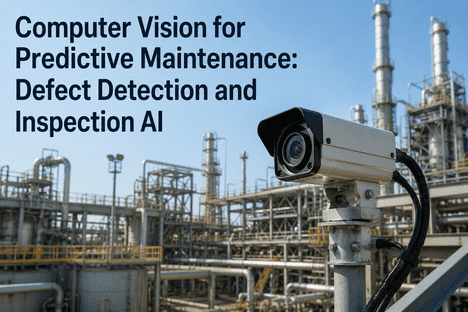
Computer vision for predictive maintenance represents one of the highest-impact applications of artificial intelligence in industrial asset management — replacing manual visual inspection with continuous, automated defect detection across corrosion monitoring, crack propagation tracking, insulation degradation assessment, and surface anomaly classification. Unlike vibration analysis or thermal monitoring, which infer equipment condition from secondary measurements, computer vision directly observes the physical surface condition of industrial assets: corrosion pitting on pressure vessel walls, fatigue crack growth on turbine blades, coating degradation on structural steel, insulation damage on electrical infrastructure, and surface spalling on rotating equipment components. The inspection AI pipeline spans four stages — image acquisition via industrial cameras, drones, or mobile devices; preprocessing including illumination normalization and geometric correction; feature extraction using convolutional neural networks trained on labeled defect datasets; and defect classification with severity scoring and recommended intervention timing. iFactory AI's industrial software platform, including its Shift Logbook and predictive maintenance engine, enables reliability teams to deploy computer vision defect detection pipelines alongside existing vibration, temperature, and current-based monitoring — creating a multi-sensor condition assessment that captures visual degradation modes invisible to conventional sensor packages. Book a Demo to see how iFactory's AI vision platform automates visual inspection across corrosion, crack, insulation, and surface defect detection use cases. This guide covers the four-stage vision pipeline architecture, defect detection model architectures, industrial deployment considerations, and the vendor evaluation framework for reliability engineers assessing computer vision inspection platforms.
Automate Visual Inspection With AI-Powered Defect Detection
Unify corrosion monitoring, crack detection, insulation assessment, and surface anomaly classification into one intelligent computer vision platform designed for industrial predictive maintenance programs.
Why Computer Vision Is Transforming Industrial Predictive Maintenance
The stewardship of industrial asset surfaces has always been uniquely challenging — but the stakes have never been higher. Corrosion under insulation on a refinery pipe, fatigue cracking on a wind turbine blade, insulation degradation on a high-voltage motor winding, and spalling on a bearing race all share a common characteristic: they are visually detectable before they become functionally critical, but manual visual inspection schedules cannot achieve the frequency required to catch them at the earliest stage. Most industrial facilities conduct visual inspections at intervals ranging from monthly to annually, meaning a corrosion cell that initiates one day after inspection can propagate for months before the next inspection cycle. Modern computer vision analytics platforms bridge this critical gap by aggregating data from fixed industrial cameras, drone-mounted sensors, and mobile device captures into a single, unified AI inspection layer. When maintenance managers deploy AI vision inspection, the most common discovery is that their assets are generating enormous volumes of visual data that — once connected to an AI classification pipeline — can prevent irreversible structural degradation and dramatically reduce manual inspection labor requirements.
The shift from periodic to continuous visual inspection begins with surface visibility. Corrosion rates accelerate exponentially once protective coatings are breached. Fatigue cracks propagate at rates that vary by 10x depending on load conditions. Insulation degradation in electrical equipment generates partial discharge precursors detectable in visible-spectrum imaging before electrical failure. AI-vision models trained on labeled industrial defect datasets can detect these conditions at their earliest stage and trigger inspection work orders days or weeks before the defect reaches a critical severity threshold. This data layer transforms a reliability engineer's ability to intervene early, protect asset integrity, and maintain compliance with regulatory inspection requirements for pressure vessels, structural steel, and electrical infrastructure.
Corrosion Detection & Monitoring
Deploy AI vision models trained on corrosion morphology datasets to detect and classify pitting, galvanic corrosion, crevice corrosion, and under-deposit attack. Receive progressive severity alerts before coating loss escalates to wall thinning.
Crack Propagation Tracking
Monitor fatigue cracks, stress corrosion cracks, and thermal fatigue cracks across metallic and composite surfaces. AI models classify crack length, width, and branching patterns with automated growth rate trending between inspection cycles.
Insulation Degradation Assessment
Identify insulation damage, moisture ingress, corona discharge tracks, and thermal degradation on electrical equipment. Integrate visual inspection findings with partial discharge and thermography data for multi-modal insulation health scoring.
Surface Anomaly Classification
Detect spalling, fretting, galling, erosion, and wear patterns on rotating equipment surfaces, bearing races, gear teeth, and seal faces. Automatically classify defect type and severity with recommended intervention timeline.
Building a Unified AI-Vision Pipeline for Industrial Inspection
A purpose-built computer vision predictive maintenance platform must address four foundational requirements unique to industrial inspection: illumination-robust image preprocessing, defect-specific CNN model architectures, cross-platform image source integration, and severity-graded alert generation integrated with existing CMMS workflows. Managers who have already deployed computer vision inspection programs consistently report that connecting their fragmented inspection photographs, drone survey footage, and fixed camera streams into a unified AI classification layer is the single most impactful step in their inspection modernization journey.
| Vision Module | Primary Function | Inspection Application | Maintenance Benefit | Deployment Priority |
|---|---|---|---|---|
| Corrosion Detection | Pitting & coating loss tracking | Piping · Vessels · Structural Steel | Early wall loss intervention | Critical |
| Crack Analysis | Length & growth rate trending | Turbine Blades · Crane Beams · Shafts | Prevents catastrophic fracture | Critical |
| Insulation Assessment | Damage & moisture ingress detection | Motors · Transformers · Cable Trays | Prevents electrical failure | High |
| Surface Wear Monitoring | Spalling & fretting classification | Bearings · Gears · Seal Faces | Extends component life | High |
| Compliance Documentation | Audit-ready inspection records | Regulatory & Insurance Inspections | Zero documentation gaps | Standard |
The Four-Stage Computer Vision Inspection Pipeline
A production-grade computer vision predictive maintenance pipeline decomposes into four sequential stages, each with specific technology requirements, model architecture decisions, and data quality checkpoints. The architecture is designed to accommodate the visual diversity of industrial inspection imagery — fixed camera streams with controlled lighting, drone footage with variable perspective and illumination, and mobile device captures with uncontrolled background conditions — while maintaining consistent defect classification accuracy across all image sources.
Image Acquisition & Ingestion
Fixed industrial cameras (visible spectrum, thermal, or multispectral), drone-mounted sensors with GPS-tagged capture locations, and mobile device uploads from inspector walk-downs. Automated ingestion with image quality validation — blur detection, exposure verification, and resolution minimum enforcement before model inference.
Preprocessing & Conditioning
Illumination normalization using histogram equalization or Retinex algorithms to compensate for variable lighting conditions. Perspective correction and scale calibration using reference markers in the field of view. Image tiling for large-surface inspection — high-resolution images decomposed into overlapping tiles for CNN inference with spatial coordinate preservation.
CNN Model Inference & Classification
Convolutional neural network architectures trained on labeled industrial defect datasets. Classification output: defect type (corrosion, crack, wear, coating loss, insulation damage), severity score on a 0–100 scale, bounding box or segmentation mask for defect localization, and confidence interval for each classified region.
Alert Generation & Work Order Creation
Defect classification output routed through consequence-based severity scoring against asset criticality. Severity thresholds calibrated per defect type and asset class — a corrosion cell on a non-critical structural beam vs. a corrosion cell on a high-pressure steam pipe. Automated CMMS work order creation with annotated defect image, classification summary, severity score, and recommended intervention window.
"Before deploying iFactory's AI-vision corrosion detection system, we were relying on manual visual inspections every 90 days for 4,000 pressure vessel and piping circuits. Our inspectors were walking 15 miles per shift and still missing corrosion under insulation that developed between inspection cycles. With AI vision, we reduced manual inspection labor by 60% and caught three corrosion cells in their earliest stage — preventing what would have been a combined $1.8M in unplanned repair costs."
Top Operational Gaps in Manual Visual Inspection Programs
Most industrial facilities pursuing improvements to their visual inspection programs encounter a predictable set of operational and documentation challenges. Understanding these gaps before a computer vision platform deployment dramatically improves implementation success and helps reliability engineers allocate finite inspection budgets more strategically across complex asset portfolios.
Corrosion and crack growth rates vary by 10x depending on environmental conditions, load cycles, and material properties. Fixed-interval inspection schedules inevitably miss defects that initiate and propagate between inspection cycles.
Two inspectors examining the same surface may classify defect severity differently. Inter-rater reliability in industrial visual inspection ranges from 55–80%, creating inconsistent work order prioritization and missed critical defects.
Manual inspection reports describe defects in qualitative terms — "moderate corrosion," "small crack" — without quantitative measurements. Growth rate trending over successive inspections is impossible without consistent dimensional reference.
Inspection photographs, written reports, and repair records sit in disconnected systems. Trend analysis across inspection cycles requires manual cross-referencing that is rarely performed in practice.
Manual inspection of elevated structures, confined spaces, and hazardous areas exposes inspectors to safety risks. Each inspection of a pressure vessel or elevated pipe rack requires scaffolding, fall protection, or rope access.
Visual inspection findings documented in paper forms or disconnected software never reach the CMMS in a structured format. Defect remediation relies on manual transcription and supervisor attention — creating a system where documented defects are routinely lost in the gap between inspection and action.
Closing these gaps requires more than a defect classification model — it demands a purpose-built platform designed for the inspection complexity and documentation requirements of industrial asset management. Reliability engineers regularly Book a Demo to benchmark their manual inspection gaps against a proven computer vision inspection architecture.
Get iFactory's Computer Vision Inspection Configuration Kit
Pre-built corrosion detection models, crack classification CNNs, insulation assessment templates, drone survey integration rules, and CMMS work order automation workflows — deployable against your existing camera infrastructure and maintenance management platform.
Integrating AI Computer Vision Into Existing Inspection Programs
One of the most technically demanding aspects of computer vision inspection deployment is the responsible integration of AI classification into protected industrial fabric without disrupting existing inspection workflows. Existing camera infrastructure, drone survey programs, and inspector mobile device workflows must all be connected to the central AI platform while preserving existing safety protocols and operational procedures. A robust computer vision inspection platform supports this process by maintaining detailed documentation of every image source, model version, and classification event — creating a complete digital record that satisfies regulatory audit requirements and supports continuous model improvement.
Key Computer Vision Inspection Capabilities for Industrial Reliability Programs
Pre-trained CNN models for corrosion, crack, wear, and insulation damage classification. Models fine-tunable with facility-specific defect imagery to improve accuracy for unique asset configurations and environmental conditions.
Ingest images from fixed cameras, drone survey footage, inspector mobile devices, and existing inspection databases. Automated quality verification before model inference with blur, exposure, and resolution checks.
Register defect locations in spatial coordinates and trend dimensions across successive inspection cycles. Automated growth rate calculation for cracks, corrosion pits, and wear zones with projection to critical dimension threshold.
Classified defects automatically generate CMMS work orders with annotated image, severity score, location metadata, and recommended intervention window. Work order closeout outcomes fed back as model training data.
Vendor Evaluation Framework — Computer Vision Inspection Questions
Generic computer vision vendors discuss model accuracy, dataset size, and inference speed. Industrial inspection AI specialists discuss defect class definitions, inspection integration workflows, illumination robustness, and CMMS work order automation depth. Seven criteria separate vendors who have deployed vision inspection in industrial environments from vendors selling general-purpose object detection platforms adapted for defect classification.
Defect Class Definitions
Ask: "Which defect classes does your platform detect — and do you provide pre-trained models for each?" Platforms must offer defect-specific CNNs for corrosion, cracks, wear, coating loss, and insulation damage — not generic anomaly detection that flags any visual deviation as a defect.
Illumination Robustness
Ask: "How does your platform handle variable lighting — indoor vs. outdoor, direct sunlight vs. shadow, high-contrast industrial environments?" Models must include illumination normalization preprocessing that maintains classification accuracy across the full range of industrial lighting conditions.
Multi-Source Image Support
Ask: "Can your platform ingest images from fixed cameras, drone surveys, and mobile devices simultaneously — with consistent classification accuracy across source types?" Each image source presents different perspective, resolution, and lighting characteristics that models must accommodate.
Defect Trending Across Cycles
Ask: "Can your platform register defect locations across successive inspections and trend growth rates automatically?" Without spatial registration and dimensional trending, each inspection cycle is an isolated snapshot rather than a continuous degradation monitoring program.
CMMS Integration Depth
Ask: "Which CMMS platforms does your work order automation support — and what fields are populated in the generated work order?" Work orders must include annotated defect image, classification result, severity score, location, and recommended intervention window.
Model Retraining Pipeline
Ask: "How is the defect classification model retrained when new defect images are available — manual or automated?" Platforms must include a continuous learning pipeline that incorporates confirmed findings from work order closeouts as labeled training data for model improvement.
Deployment Timeline
Ask: "When will the first automated defect classification alert reach the CMMS in production — not in pilot or test mode?" Pre-configured vision inspection platforms deploy in 6–10 weeks. Custom development projects require 6–12 months.
"The single most common mistake in computer vision inspection deployment is treating it as a model training project rather than an inspection workflow integration project. A CNN that achieves 97% accuracy on a curated test dataset will fail in production if the preprocessing pipeline does not handle variable lighting, the image ingestion system does not accept drone footage formats, the defect severity thresholds are not calibrated per asset criticality, and the CMMS work order automation does not include annotated images that the maintenance technician can act on without additional research. The model is the classification engine — but the workflow integration is the inspection program. Industrial computer vision inspection platforms that deploy successfully in 6–10 weeks spend 80% of the implementation effort on workflow integration and 20% on model configuration. Platforms that fail spend the inverse ratio."
Deploy AI Vision Inspection for Your Industrial Asset Fleet
Automate visual inspection across corrosion, crack, wear, and insulation defect detection — with pre-trained CNN models, multi-source image ingestion, defect growth rate trending, and CMMS work order automation. Built specifically for industrial predictive maintenance programs.
Computer Vision for Predictive Maintenance — Common Questions Answered
How does the platform handle variable lighting conditions in industrial environments?
iFactory's vision pipeline includes an illumination normalization preprocessing stage that applies adaptive histogram equalization and Retinex-based algorithms to compensate for direct sunlight, shadow, high-contrast industrial lighting, and low-light conditions. Models are trained on augmented datasets that simulate the full range of industrial lighting variability — ensuring consistent classification accuracy from a sunlit outdoor pipe rack to a dimly lit electrical room. For fixed camera installations, controlled LED lighting can be synchronized with capture intervals to eliminate ambient light variability entirely.
Can the system detect corrosion under insulation or behind protective coatings?
Direct visual detection of corrosion under insulation requires removal of the insulation layer, which is not practical for continuous monitoring. However, iFactory's platform supports multi-modal inspection integration: visual indicators of CUI risk — staining, insulation jacketing damage, sealant degradation — are detected by visible-spectrum cameras and flag areas for priority inspection. For direct CUI detection, the platform integrates with thermal imaging cameras that detect temperature anomalies indicative of wet insulation and with portable ultrasonic thickness gauging that provides quantitative wall loss measurements at flagged locations. The Shift Logbook consolidates all inspection modes into a unified CUI assessment record per asset.
What defect types can the pre-trained CNN models detect without custom training?
iFactory's model library includes pre-trained CNNs for ten industrial defect classes: general corrosion pitting, galvanic corrosion, stress corrosion cracking, fatigue crack propagation, coating loss and blistering, abrasive wear, fretting wear, surface spalling, insulation damage (cut, abrasion, moisture ingress), and electrical discharge tracking. Models are pre-trained on a labeled dataset of 500,000+ industrial inspection images collected across refining, power generation, manufacturing, and mining facilities. Facility-specific fine-tuning with 500–2,000 labeled images per defect class is recommended for sites with unique asset configurations or environmental conditions that differ from the training distribution.
How does the platform track defect growth across successive inspection cycles?
Each classified defect is registered with spatial coordinates derived from GPS tags (for drone and mobile captures) or fixed camera field-of-view registration. Successive inspection images of the same asset are automatically aligned using feature matching, and the defect region is segmented using the trained CNN model. Defect dimensions — crack length and width, corrosion pit diameter and depth projected from shading analysis, wear scar area — are measured in pixel coordinates and converted to physical dimensions using scale reference markers in the field of view. Growth rate is calculated as the change in critical dimension per unit time, and a projected time-to-critical-severity estimate is generated using linear or exponential regression on the growth trajectory.
What cameras and hardware are required to deploy computer vision inspection?
iFactory's platform integrates with existing camera infrastructure and does not require proprietary hardware. Compatible image sources include fixed industrial IP cameras (visible and thermal spectrum), drone-mounted cameras with GPS tagging, inspector mobile devices (smartphone or tablet captures uploaded via the iFactory mobile app), and existing inspection photograph databases uploaded in batch. Minimum image resolution for reliable defect classification is 2 megapixels for close-range inspection and 8 megapixels for wide-area surveys. For fixed camera installations, recommended hardware ranges from $500–$2,500 per camera depending on resolution, environmental rating, and lighting requirements. Drone survey integration requires a drone capable of GPS-positioned waypoint navigation and consistent capture altitude for multi-cycle image alignment.
How does the platform integrate with existing CMMS and maintenance workflows?
iFactory provides pre-built CMMS connectors for SAP PM, Oracle EAM, IBM Maximo, JDE, Infor EAM, and Maintenance Connection. When a defect is classified above the severity threshold configured per asset type and criticality, the platform automatically generates a CMMS work order populated with asset ID, defect classification result, severity score, annotated defect image with bounding box or segmentation mask, location metadata (GPS coordinates or equipment tag), and recommended intervention window. Work order closeout findings — confirmed defect, false positive, or repaired — are fed back to the platform as labeled training data for continuous model improvement via the Shift Logbook feedback integration.
What is the typical timeline and investment for deploying computer vision inspection?
For an industrial facility with 500–2,000 inspection points, existing IP camera infrastructure, and a supported CMMS platform, a full computer vision inspection deployment runs $85,000 to $195,000 over a 6–10 week timeline. The cost breakdown: camera connectivity and image ingestion pipeline configuration ($15,000–$35,000), pre-trained model deployment and facility-specific fine-tuning with 1,000–5,000 labeled images ($25,000–$60,000), severity threshold calibration per asset class ($12,000–$20,000), CMMS work order automation integration ($18,000–$45,000), and training and commissioning ($15,000–$35,000). ROI is typically demonstrated within 90 days of go-live through manual inspection labor reduction and the first prevented equipment failure detected by AI vision before reaching critical severity.