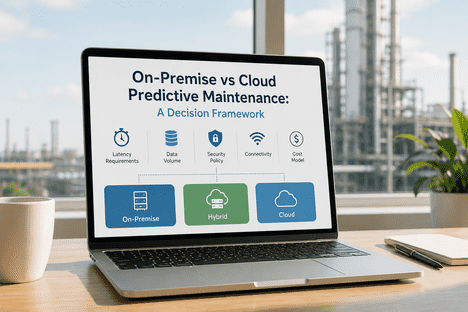
Choosing between on-premise, cloud, or hybrid deployment for a predictive maintenance platform is not a technology preference decision — it is an operational constraint decision that affects prediction latency, data governance, connectivity resilience, capital cost, and long-term scalability. Plants operating in environments where milliseconds matter — high-speed spindles rotating at 30,000 RPM, continuous casting moulds where thermal excursions develop in seconds, or chemical reactors where vibration signals change faster than a cloud round-trip — cannot afford the 200–500 millisecond network latency that a cloud-only architecture introduces into every prediction cycle. Plants processing 500+ sensor data streams at 50 kHz sample rates generate over 200 GB of raw vibration data per day — streaming that volume to the cloud for processing incurs bandwidth costs that can exceed the platform licensing fee within six months. Plants in defence, critical infrastructure, or pharmaceutical manufacturing face data sovereignty regulations that mandate on-premise data residency regardless of the cloud provider's compliance certifications. And plants operating in remote or offshore environments with intermittent satellite connectivity cannot depend on a cloud connection for real-time machine health alerts. This decision framework provides a structured methodology for evaluating deployment architectures across seven dimensions — latency, data volume, connectivity, security, scalability, cost, and maintenance burden — and maps each dimension to the deployment model that best serves the plant's operational reality.
Deployment Architecture · On-Premise · Cloud · Hybrid · 2026
On-Premise vs Cloud Predictive Maintenance: The Decision Framework
Latency requirements · Data volume · Security policy · Connectivity constraints · Cost model · All mapped to the deployment architecture that fits your plant — on-premise edge, private cloud, public cloud, or hybrid. No vendor bias. Just a repeatable method.
◉
On-Premise Edge
Sub-10ms latency · air-gapped operation · full data sovereignty
▤
Private Cloud
Dedicated infrastructure · regional data residency · predictable cost
◈
Public Cloud
Elastic scaling · global aggregation · zero hardware management
⟐
Hybrid Deployment
Edge for real-time · cloud for analytics · best of both
The Seven Dimensions of the Deployment Decision
DECISION FRAMEWORK — SEVEN DIMENSIONS
1
Latency Sensitivity — Real-time machine protection requires sub-100ms prediction cycles. On-premise edge processing delivers 2–15ms end-to-end. Cloud round-trips add 100–500ms of network latency that is acceptable for trend analysis but catastrophic for spindle bearing or tool breakage detection.
2
Data Volume & Bandwidth — A single CNC machine with triaxial vibration at 50 kHz generates 180–250 GB of raw data per month. Aggregating 50 such machines to a cloud instance requires 5–12 TB of monthly data egress — bandwidth costs that quickly exceed on-premise storage economics.
3
Connectivity Profile — Offshore platforms, remote mines, and mobile assets operate on satellite links with 600–2000ms latency and intermittent dropouts. Cloud-dependent PdM platforms are non-functional in these environments without an on-premise edge fallback that processes alerts locally.
4
Security & Compliance — Defence contractors, pharmaceutical manufacturers, and critical infrastructure operators face data residency regulations — ITAR, GDPR, HIPAA, NERC CIP — that restrict where sensor data and maintenance records can be stored and processed. Cloud deployment is not an option in these regulatory environments.
5
Scalability Requirements — Multi-plant enterprises adding 10–50 new assets per quarter benefit from cloud elasticity that provisions compute and storage instantly. Single-site operations with stable asset counts achieve better TCO with on-premise infrastructure that avoids per-GB cloud egress fees.
6
Cost Model Preference — On-premise requires upfront CapEx of $50,000–$150,000 for edge servers and storage but delivers predictable ongoing costs. Cloud offers zero upfront investment but variable OpEx that grows with data volume — a difference of 2–4× TCO over five years depending on asset count and data generation rate.
7
IT Maintenance Burden — Cloud platforms offload server management, OS patching, database administration, and backup management to the vendor. On-premise deployments require in-house IT capability or a managed services agreement — a cost and headcount consideration that is often underestimated in the initial architecture decision.
On-Premise vs Cloud: Capability Comparison by Industrial Use Case
01
High-Speed Spindle and Rotating Equipment Protection
CNC spindles, turbine bearings, and high-speed compressors require sub-100ms prediction-to-alert cycles because the time from detectable fault onset to catastrophic failure is measured in hours or minutes, not days. Cloud-only architectures introduce 200–500ms of network latency that is tolerable for trend monitoring but unacceptable for real-time machine protection. On-premise edge processing at the machine or PLC level delivers 2–15ms end-to-end latency.
Book a Demo to see iFactory's edge deployment architecture for high-speed rotating assets — sub-10ms latency, zero cloud dependency for alerting.
Sub-10ms latencyEdge processingZero cloud dependency
02
Multi-Plant Fleet-Wide Analytics and Benchmarking
For enterprises operating 10–50 plants across multiple regions, the value of predictive maintenance is maximized when data from all sites is aggregated for fleet-wide model training, cross-site asset benchmarking, and centralized reliability reporting. Cloud deployment enables this aggregation natively — each plant's edge layer streams processed features and alerts to a central cloud instance that builds and distributes improved models back to every site. On-premise-only architectures require a separate data lake and ETL pipeline to achieve the same multi-site visibility, adding infrastructure cost and integration complexity that cloud deployment eliminates by design.
Centralized aggregationFleet-wide model trainingCross-site benchmarking
03
Regulated Environments: Defence, Pharma, and Critical Infrastructure
Plants operating under ITAR, GDPR, HIPAA, NERC CIP, or equivalent regulatory frameworks face binding constraints on where sensor data, maintenance records, and equipment history can be stored and processed. Cloud deployment — even on dedicated instances with compliance certifications — may not satisfy regulatory requirements that mandate data residency within national borders or prohibit any third-party access to production data. On-premise deployment with air-gapped operation and role-based access control is the only architecture that satisfies the full compliance envelope for these environments. iFactory's platform is deployable in fully air-gapped configurations with no external network connectivity required for core functionality.
Air-gapped operationITAR/GDPR/HIPAAFull data sovereignty
Deployment Architecture Decision Matrix
iFactory supports all three deployment models — on-premise edge, private cloud, public cloud, and hybrid combinations — on a single software platform. The decision matrix below maps each operational requirement to the deployment option that best satisfies it, drawn from iFactory's deployment experience across 900+ plants operating under diverse connectivity, regulatory, and data volume conditions.
Real-time alert latency (<50ms)
Optimal — 2–15ms
Adequate — 50–150ms
Poor — 200–500ms
High-frequency data (50+ kHz)
Optimal — local processing, no bandwidth cost
Adequate — dedicated bandwidth
Prohibitive — data egress costs exceed licensing
Remote/offshore connectivity
Only viable option — satellite-tolerant
Not feasible without edge fallback
Not feasible without edge fallback
Data sovereignty compliance
Full compliance — air-gap capable
Compliant with dedicated infra
Constrained — jurisdiction-dependent
Multi-plant aggregation
Requires separate data lake
Optimal — dedicated cross-site network
Optimal — elastic, global, built-in
Elastic scaling (10+ assets/month)
Poor — hardware procurement lag
Adequate — virtual provisioning
Optimal — instant, pay-per-asset
Predictable monthly cost
Optimal — fixed infrastructure cost
Adequate — reserved instance pricing
Variable — data-volume-dependent
Zero IT maintenance burden
Requires in-house IT or MSP
Requires in-house IT or MSP
Optimal — vendor-managed infrastructure
Deployment Profiles: Three Common Industrial Scenarios
An offshore production platform operates 25 rotating assets — compressors, pumps, generators — connected via satellite link with 800ms latency and 4-hour daily blackout windows. Cloud-dependent PdM is not viable. iFactory deploys on-premise edge servers that process all sensor data locally, generate real-time alerts within 5ms of fault detection, and store historical data locally. A compressed metadata stream syncs to the cloud during satellite windows for remote dashboards and model updates. No cloud connectivity is required for machine protection.
ArchitectureEdge-only with cloud sync
Alert Latency3–8ms local
Talk to an Expert
An automotive supplier operates 18 plants across three continents producing machined components. Each plant has 60–90 CNC machines, grinders, and assembly stations. iFactory deploys edge servers at each plant for real-time spindle monitoring and tool wear detection with sub-15ms latency, while streaming processed feature vectors and alert metadata to a central cloud instance for fleet-wide model training, cross-plant reliability benchmarking, and global KPI dashboards. The hybrid model delivers real-time machine protection at each site with the aggregation benefits of cloud across the enterprise.
Local Latency8–15ms per plant
Central CloudFleet-wide model training
Talk to an Expert
A defence manufacturing facility operates 45 CNC machines producing ITAR-controlled components. No data of any kind — sensor readings, maintenance records, or alert metadata — may leave the facility network. iFactory deploys in a fully air-gapped configuration with no external network connectivity. The platform operates entirely on local infrastructure with role-based access control, encrypted storage, and audit logging. All ML model training, alert generation, Shift Logbook entries, and CMMS integration occur within the plant's secure network. This is the same iFactory platform, same features, same accuracy — zero cloud dependency.
ArchitectureAir-gapped, no external network
ComplianceITAR, NIST SP 800-171
Talk to an Expert
Hybrid Deployment · Edge-to-Cloud · Flexible Architecture · 2026
One Platform. Every Deployment Model. Your Choice.
iFactory AI runs on-premise edge servers, private cloud instances, public cloud — or any combination — using the same software platform, the same ML models, and the same Shift Logbook interface. Choose the architecture that fits your plant. If your requirements change, redeploy without rebuilding.
◉
Same Software
Identical platform across all deployment models
▤
Same ML Models
Trained once, deployed anywhere
◈
Same Interface
Unified Shift Logbook and dashboard
⟐
Redeploy Freely
Migrate between models without rebuilding
What iFactory Delivers Across Every Deployment Model
Sub-10ms
Real-time alert latency on edge deployment
Machine protection without cloud dependency
900+
Industrial plants deployed across all three models
On-premise · private cloud · public cloud · hybrid
38
Countries with iFactory deployments
Regulatory-compliant in every jurisdiction
100%
Same platform codebase across all models
No feature gaps between deployment options
Frequently Asked Questions
Deploy iFactory on the Architecture That Fits Your Plant
On-premise edge, private cloud, public cloud, or hybrid — the same iFactory AI platform, the same ML prediction models, the same Shift Logbook and CMMS integration, deployed exactly where your latency, data volume, security, and connectivity requirements demand. No feature gaps between deployment models. No vendor lock-in to a single architecture. Redeploy freely as your needs evolve.
On-Premise Edge
Private Cloud
Public Cloud
Hybrid Deployment
Shift Logbook