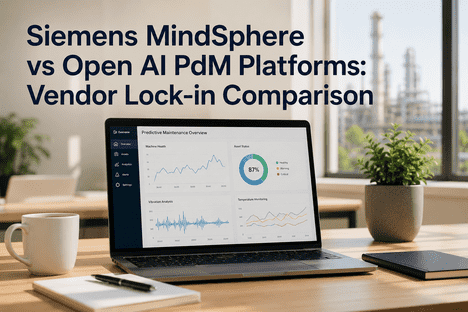
Every predictive maintenance platform purchase is a bet on how much operational flexibility you are willing to trade for the convenience of a single-vendor ecosystem. Siemens MindSphere, as the cloud backbone of the Siemens Digital Industries portfolio, offers deep integration with Siemens automation hardware, Siemens PLM software, and Siemens service contracts. But that integration comes with a structural constraint: once your sensor data, asset models, and analytics workflows are formatted for MindSphere's proprietary data model and protocol stack, the cost and complexity of relocating that capability to another platform — or operating it alongside platforms from other vendors — can approach the cost of the initial implementation itself. This is the vendor lock-in problem in industrial IoT, and it matters most in predictive maintenance, where the value of the platform is directly proportional to the breadth of assets it can monitor and the flexibility with which it can adapt to new sensor types, new equipment categories, and new analytics requirements as the plant's condition monitoring strategy evolves. This guide compares Siemens MindSphere against open AI PdM platforms across the dimensions that determine whether your PdM investment builds long-term capability or long-term dependency.
The Real Cost of Vendor Lock-In in Predictive Maintenance
MindSphere's lock-in operates through three primary mechanisms: data model proprietaryness, protocol dependency, and ecosystem stickiness. First, MindSphere's Asset Manager requires asset data to be structured according to Siemens' information model — a model that does not map cleanly to the data structures used by non-Siemens platforms. Book a Demo Re-exporting that data for use in another analytics environment requires a transformation layer that must be built and maintained separately, adding both cost and latency to any multi-platform condition monitoring strategy.
Second, MindSphere's native protocol stack prioritizes Siemens S7 communication, which means that connecting non-Siemens PLCs, sensors, or edge devices to the platform requires additional gateway hardware or middleware. For plants that operate heterogeneous automation environments — and most plants do — this creates a two-tier connectivity architecture in which Siemens assets are first-class citizens and everything else requires workarounds. The cost of maintaining these workarounds across a 500-plus asset plant typically exceeds the incremental platform licensing cost by a factor of 2 to 4 within three years of deployment.
Third, the ecosystem stickiness: MindSphere is designed to integrate with TIA Portal, SIMATIC, COMOS, and the broader Siemens software stack. Each integration point adds value for plants that are already standardized on Siemens, but each integration point also increases the switching cost. A plant that has embedded MindSphere analytics into its TIA Portal automation workflows faces significantly higher migration complexity than a plant that deployed MindSphere as a standalone IoT platform. The total cost of ownership for MindSphere over a five-year horizon in a multi-vendor plant environment typically exceeds the initial projection by 40 to 60 percent when connectivity middleware, data transformation, and ecosystem integration costs are included.
- Proprietary data model requires custom transformation for multi-platform analytics
- Native protocol support limited to Siemens S7 — non-Siemens assets require gateway middleware
- Mandatory cloud dependency through Siemens middleware layer — no independent on-premise option
- Ecosystem lock-in to TIA Portal, SIMATIC, COMOS — raises switching costs significantly
- Data egress fees and format restrictions limit portability to third-party BI or analytics tools
- Per-asset licensing model penalizes plants with high asset counts across multiple sites
- Flexible data model maps directly to any analytics or BI platform — no transformation layer required
- Multi-protocol support: OPC UA, MQTT, Modbus, S7, PROFINET, EtherNet/IP — all native, no gateway middleware
- Cloud-independent architecture: on-premise, private cloud, or hybrid — customer chooses data residency
- Open API ecosystem integrates with existing MES, CMMS, and ERP without proprietary middleware
- Full data export in standard formats — CSV, JSON, Parquet — zero data egress fees
- Per-plant licensing with unlimited asset coverage — predictable cost scaling across all sites
Protocol and Data Portability Comparison
The table below maps the protocol support, data portability, and architecture flexibility of Siemens MindSphere against iFactory AI's open platform across the dimensions that directly affect vendor lock-in risk. Plants evaluating a PdM platform for multi-vendor environments should treat each of these dimensions as a switching cost predictor — the more proprietary each cell is on the MindSphere side, the higher the long-term cost of remaining on the platform and the higher the barrier to leaving.
| Capability | Siemens MindSphere | iFactory AI Open Platform |
|---|---|---|
| OPC UA Client/Server | Limited — requires MindConnect hardware gateway | Native full support — direct connectivity |
| MQTT Sparkplug B | Not supported natively | Native full support |
| Modbus TCP/RTU | Gateway middleware required | Native support |
| Siemens S7 Protocol | Native — primary communication method | Native support |
| PROFINET IO | Native | Native support |
| EtherNet/IP | Limited — gateway required | Native support |
| Data Export Format | MindSphere proprietary JSON only | CSV, JSON, Parquet, SQL — standard formats |
| Cloud Independence | Mandatory — AWS via Siemens middleware | On-premise, private cloud, hybrid — customer choice |
| API Openness | REST — rate-limited, paginated, key-restricted | REST + GraphQL — unrestricted, no rate limiting |
| Edge Processing | MindConnect only — Siemens-proprietary hardware | Any edge hardware, any OS — no hardware lock-in |
| Asset Model Portability | Proprietary schema — no standard export format | Open JSON schema aligned with ISA-95 — full export |
Architecture Deep Dive: Why Open AI Platforms Avoid the Lock-In Trap
The architectural difference between MindSphere and open AI PdM platforms is not a matter of feature count — it is a matter of data ownership and integration philosophy. MindSphere was designed as a Siemens-cloud product: the platform assumes that the user operates within the Siemens ecosystem and derives value from deeper integration with Siemens tools. Open AI platforms like iFactory AI were designed for multi-vendor industrial environments: the platform assumes that the user operates a heterogeneous mix of automation equipment, sensors, and software systems and needs a connectivity layer that treats every protocol and every vendor as a first-class citizen.
This architectural distinction manifests in how each platform handles the four most common PdM integration scenarios: connecting a new sensor type, adding a new asset category, exporting data to a third-party analytics tool, and deploying a new analytics model to the edge. MindSphere requires a platform-level configuration change or middleware addition for each of these scenarios. iFactory AI handles each scenario through its existing native protocol support, open data model, and unrestricted API — meaning that the platform's connectivity capability does not expand at the cost of the user's time or vendor dependency.
Migration Path: Breaking the Lock-In Cycle
Migrating from MindSphere to an open AI PdM platform is a structured process that iFactory AI has executed across 38 plants in 14 countries. The migration follows a five-phase methodology designed to eliminate analytics downtime and preserve the full historical data baseline for model training and performance comparison.
Expert Perspective: What Open Architecture Changes in PdM Strategy
We selected MindSphere in 2019 because our primary automation vendor was Siemens and the integration with TIA Portal seemed like a natural advantage. What we did not anticipate was that every new asset we added to the PdM program — pumps from Grundfos, compressors from Atlas Copco, conveyors from Fives — would require a custom connectivity layer because MindSphere's native protocol support did not extend to those devices. By 2023, our annual connectivity middleware cost was 3.2 times our MindSphere licensing fee, and we had data in a format that no other analytics tool could read without transformation. We migrated to iFactory AI in Q1 2024. The migration took 11 weeks. Our connectivity cost dropped to zero — iFactory's native protocol support eliminated every gateway we had built. We now monitor 420 assets across five protocol types from a single dashboard, and we own our data in a format we can use anywhere.
Frequently Asked Questions: MindSphere Migration and Open Platform Comparison
MindSphere's native data model encodes asset metadata, time series data, and event data in a Siemens-specific JSON schema that does not conform to ISA-95 or any broadly adopted industrial data standard. Exporting data from MindSphere requires converting this schema to a target format — a transformation that typically loses metadata fidelity and requires manual mapping of each asset's parameter structure. iFactory AI uses an open JSON schema aligned with ISA-95, enabling direct import into any analytics, BI, or data lake environment without transformation.
Yes. iFactory AI is designed for parallel deployment during migration periods. The platform can ingest data from the same assets via the same PLCs and sensors that are feeding MindSphere, operating as a read-only analytics layer alongside the existing MindSphere deployment. This parallel-run capability allows plants to validate iFactory's prediction accuracy and coverage against MindSphere's baselines before committing to full cutover — eliminating the risk of analytics downtime during the migration window. Typical parallel-run periods range from 30 to 60 days depending on asset count and data volume.
Based on iFactory's deployment data across 38 migrating plants, the five-year TCO for MindSphere in a multi-vendor plant environment with 500-plus assets and three or more protocol types averages 2.1 to 2.8 times the initial licensing projection when connectivity middleware, data transformation, ecosystem integration, and cloud egress costs are included. iFactory AI's five-year TCO for the same asset scope averages 0.6 to 0.8 times its initial projection, because connectivity, data export, and ecosystem integration capabilities are included in the platform rather than priced as separate middleware layers. An ROI modeling session using your plant's specific asset inventory and protocol mix is available at no cost.
iFactory AI's migration toolkit includes a MindSphere data export pipeline that extracts historical time series and event data from MindSphere and converts it to iFactory's open schema aligned with ISA-95. The converted data is imported into the iFactory platform, preserving the full historical baseline for model training, trend analysis, and performance comparison across the pre- and post-migration periods. No historical data is lost in the migration process, and the exported MindSphere data is simultaneously available in a portable format for use in any other analytics or reporting tool — a capability that MindSphere's proprietary format does not offer independently.
In MindSphere, adding a new asset type requires creating a new asset model in MindSphere's proprietary format, configuring the connectivity gateway for the asset's native protocol, and mapping the asset's data points to Siemens' information model — an integration process that typically takes 2 to 4 weeks per asset type. In iFactory AI, adding a new asset type requires selecting the asset category from the platform's built-in library — pump, compressor, conveyor, motor, fan, turbine, and more — and connecting the asset's data source via native OPC UA, MQTT, or Modbus. The integration process typically takes 2 to 4 hours per asset type, and no model customization or connectivity middleware is required for the standard asset categories that cover 90 percent of industrial equipment.
Conclusion: The Platform You Choose Determines the Flexibility You Keep
The decision between a vendor-locked PdM ecosystem and an open AI platform is not a decision about which platform works best today. It is a decision about how much flexibility you retain when your asset base changes, your sensor technology evolves, your analytics requirements expand, and your team wants to integrate new tools into the condition monitoring workflow. A vendor-locked platform optimizes for stickiness. An open platform optimizes for adaptability. In predictive maintenance — where the only constant is that the asset base, failure modes, and data environment will change — adaptability is the characteristic that delivers the highest long-term value.
iFactory AI's open-architecture platform gives plants the confidence that every sensor connected, every asset added, and every analytics model deployed is an investment in capability that they can take with them wherever their condition monitoring strategy evolves next. Book a Demo to discuss your specific migration scenario and see how open architecture changes the economics of predictive maintenance for your operation.