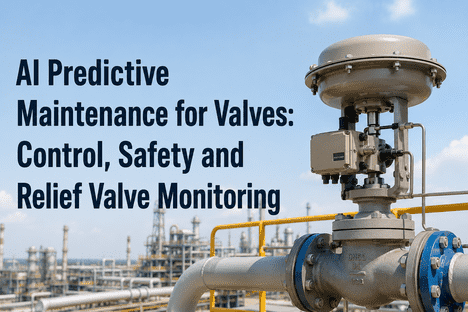
AI Predictive Maintenance for Valves: Control, Safety and Relief Valve Monitoring
By Daniel Carter on June 9, 2026
In process industries, valve failures account for approximately 36% of all process plant incidents — a single stuck control valve, leaking safety relief valve, or failing actuator can trigger a catastrophic process upset, unplanned shutdown, or safety event costing $250,000–$2,000,000 per hour in lost production and asset damage. Refineries, chemical plants, LNG terminals, and power generation facilities operate thousands of control valves, safety relief valves, and manual isolation valves, each subject to stem wear, seat erosion, packing degradation, actuator drift, and spring fatigue that traditional time-based inspection programs cannot detect. iFactory's predictive maintenance platform fuses valve travel time, actuator pressure, seat leakage acoustics, stem packing temperature, and partial stroke test data into machine learning models that forecast control valve sticking, PRV simmer and seat degradation, and actuator diaphragm failure 4-8 weeks in advance, enabling reliability teams to intervene before the valve fails. Book a Demo to see how iFactory connects your valve fleet data to predictive intelligence.
Predictive Maintenance · Valves & Actuators 2026
AI Predictive Maintenance for Valves: Control, Safety & Relief Valve Monitoring
Valve travel position monitoring · Seat leakage acoustic detection · Actuator pressure & spring degradation analysis · Stem packing & seal wear forecasting · All flowing into iFactory CMMS & Shift Logbook.
Why Reactive Valve Maintenance Fails in Process Plants
Valves are the most numerous active components in any process plant — a typical refinery operates 10,000–40,000 valves, each a potential leak path or control failure point. Control valves modulate flow thousands of times daily, accumulating stem packing wear, seat erosion, and positioner calibration drift. Safety relief valves — often unwitnessed for years between overhauls — may develop seat leakage or simmer at pressures below set point, leading to undetected fugitive emissions or insufficient relieving capacity during overpressure events. Actuator diaphragms degrade at variable rates depending on ambient temperature, cycle frequency, and supply air quality. Traditional preventive maintenance replaces valve packing and overhauls PRVs on a fixed calendar schedule — meaning problematic valves are serviced too late and healthy valves are over-maintained. iFactory's condition-based approach replaces the calendar with data-driven prediction, prioritizing the valves that actually need attention.
LIMITATIONS OF TIME-BASED VALVE MAINTENANCE IN PROCESS PLANTS
1
36% of process incidents linked to valves — ISA studies confirm valves are the single largest contributor to process safety events across refining, chemical, and oil & gas sectors
2
Sensor-blind between inspections — seat leakage, stem packing wear, and actuator pressure drift develop silently between annual PRV overhauls and control valve PM cycles
No fleet-wide prioritization — maintenance decisions made from the last valve alarm rather than population-wide degradation trends across process units and service classes
Three Valve Failure Categories iFactory Predicts
01
Control Valve Positioner, Stem & Packing Degradation Prediction
Control valve failures — sticking stems, positioner calibration drift, packing leakage, and actuator hysteresis — are the leading cause of process variability and unplanned downtime in continuous process plants. iFactory ingests valve travel position feedback, actuator pressure, stem temperature, cycle count, and partial stroke test trending data to train ML models that predict stem packing degradation, positioner failure, and actuator spring fatigue 4-8 weeks in advance with 70-80% accuracy. Plants running these systems report 20-25% reductions in control valve-related process upsets and unplanned maintenance events. Reliability engineers schedule packing adjustments and positioner recalibrations during planned turnarounds rather than responding to process excursion events that force emergency unit shutdowns. Book a Demo to see iFactory's control valve prediction models in production.
4-8 week lead time70-80% accuracy20-25% upset reduction
02
Safety Relief Valve Seat Leakage & Set Pressure Drift Forecasting
Safety relief valves are critical last-resort overpressure protection devices, yet most operate unwitnessed between turnaround intervals, allowing seat leakage, simmer, and set pressure drift to go undetected for years. iFactory monitors PRV acoustic signatures, downstream temperature, upstream pressure, and partial stroke test data to detect early-stage seat degradation, spring fatigue, and blowdown ring drift. One Gulf Coast refinery using iFactory's PRV monitoring detected simmer conditions on 12% of its critical service relief valves during the first 6 months — conditions that would have remained hidden until the next turnaround. The platform correlates acoustic anomalies with process conditions, differentiating benign thermal effects from genuine seat wear requiring intervention. Early detection enables planning relief valve rebuilds during scheduled outages rather than responding emergency overpressure events.
Actuator Diaphragm, Solenoid & Air Supply System Surveillance
Valve actuators — pneumatic diaphragm, piston, and electric — face variable process loads, ambient temperature shifts, and supply air quality issues that produce noisier operating data, challenging conventional fixed-threshold monitoring approaches. iFactory applies ensemble ML models that separate signal from noise in actuator pressure trends, solenoid valve cycle times, air consumption rates, and spring-return stroke timing data. While prediction accuracy in this category is lower (50-60%), the platform's continuous learning loop improves model precision over time as more operating data accumulates across startup, shutdown, and steady-state cycles. The Shift Logbook captures instrument technician-reported anomalies alongside sensor data — positioner calibration notes, packing adjustments, and actuator stroke tests — creating a richer training corpus for the prediction models. Book a Demo to see iFactory's complete valve predictive maintenance platform.
Ensemble ML modelsContinuous learning loopShift Logbook correlation
How iFactory Transforms Valve Fleet Telemetry Into Predictive Intelligence
iFactory is the AI software intelligence layer — not a valve manufacturer or sensor vendor. The platform integrates with existing valve telemetry from DCS/PLC position feedback, smart positioners (Emerson Fisher, Siemens, Neles, Azbil, SAMSON), PRV test bench data, acoustic sensors, valve historians, and CMMS systems already deployed across your plant. The Shift Logbook captures instrument technician shift reports, stroke test results, calibration records, and maintenance actions alongside the sensor stream, creating a unified data fabric for predictive model training.
Asset Class
Telemetry Sources
iFactory Prediction Output
Business Impact
Control Valves
Position feedback · actuator pressure · stem temp · cycle count · travel time
Sticking probability · packing wear score · positioner drift alert
Seat erosion index · packing degradation · torque trend anomaly
Fewer fugitive emissions incidents
Predictive Maintenance Use Cases for Valves
Control Valves
Stem, Positioner & Packing Degradation Prediction
Continuous
iFactory ingests valve travel position, actuator pressure, stem temperature, and cycle count data from each control valve in critical service. ML models trained on historical failure patterns predict stem packing degradation, positioner calibration drift, and actuator spring fatigue 4-8 weeks in advance. Predicted failures are assigned a confidence score and recommended intervention window. Maintenance planners schedule packing adjustments and positioner recalibrations during planned unit turnarounds, avoiding emergency valve replacements that cause unplanned process rate reductions. Every prediction event is logged in iFactory's Shift Logbook with full traceability to the sensor data that triggered the alert.
Seat Leakage, Simmer & Set Pressure Condition Monitoring
Continuous
Safety relief valves are mechanical devices that typically operate unwitnessed between turnaround intervals, making undetected seat leakage and simmer a persistent process safety risk. iFactory monitors acoustic emissions, upstream pressure trends, and downstream temperature to detect the ultrasonic signatures of seat leakage and simmer conditions before they compromise relieving capacity. The platform pinpoints the specific PRV and service class requiring intervention, differentiating benign thermal cycling effects from genuine seat wear. Alerts route directly to the reliability shift in the Shift Logbook with valve metadata, severity score, and recommended action timeline.
Detection Rate12% simmer detection in critical services
Pneumatic and electric valve actuators face variable ambient conditions, supply air quality fluctuations, and cycling loads that produce noisy sensor data — making failure prediction more challenging than for valve bodies themselves. iFactory applies ensemble ML models with a continuous learning loop that improves prediction precision as more operating data accumulates across process operating states. The Shift Logbook captures instrument technician-reported anomalies — diaphragm stiffness changes, solenoid coil resistance drift, spring-return timing deviation — alongside sensor data, creating a richer training corpus. The result is steadily improving prediction accuracy for actuator diaphragm rupture, solenoid valve sticking, and spring fatigue failure.
What iFactory Delivers for Valve Fleet Reliability
70-80%
Control valve & PRV failure prediction accuracy
4-8 week advance warning vs emergency shutdown
$250K-2M
Prevented loss per critical valve failure avoided
Lost production + asset damage + safety risk
20-25%
Fewer control valve-related process upsets
Sticking · hysteresis · packing degradation
36%
of process plant incidents involve valves
ISA data — targeted prediction reduces this share
FAQ
iFactory is the AI software intelligence layer — not a valve or sensor manufacturer. The platform integrates with smart positioners (Emerson Fisher, Siemens, Neles, Azbil, SAMSON), DCS/PLC position feedback, acoustic emission sensors, partial stroke test systems, valve historians, and CMMS platforms already deployed across your plant. Your facility selects the valve instrumentation; iFactory turns the data into predictive intelligence, maintenance alerts, and shift-ready work orders.
Model tuning typically requires 6-12 months of operation on a specific valve fleet to eliminate false positives, tune threshold parameters, and build maintenance team confidence. The platform's continuous learning loop improves precision over time as more failure and operating data accumulates. iFactory recommends starting with one valve type and one failure mode — such as control valve packing degradation or PRV seat leakage — proving value before expanding fleet-wide.
Yes. iFactory connects to SAP, Oracle, JDE, Microsoft Dynamics, and major CMMS platforms. The Shift Logbook captures instrument technician stroke test reports, calibration records, shift handover notes, and maintenance actions alongside sensor-generated predictions. Every prediction event, sensor reading, and maintenance action is recorded with full traceability for audit, compliance, and continuous model improvement.
Deploy iFactory for Valve Predictive Maintenance
AI-powered predictive maintenance platform connecting control valve, safety relief valve, actuator, and isolation valve telemetry into one unified intelligence layer — with ML-based failure prediction, Shift Logbook integration, CMMS workflow automation, and fleet-wide reliability analytics for process plants.