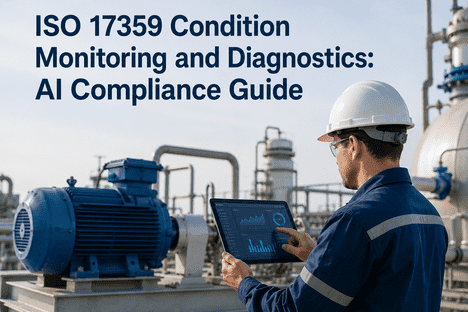
ISO 17359:2018 establishes the international benchmark for condition monitoring and diagnostics of machines — a structured framework encompassing equipment audit, failure modes and effects analysis (FMEA), alarm criteria setting, data acquisition, diagnostics, and prognosis. For reliability engineers and maintenance managers deploying AI-powered predictive maintenance, alignment with ISO 17359 is not optional: it is the documented compliance architecture that transforms ad-hoc sensor monitoring into a defensible, auditable condition management programme. Without this framework, AI predictions lack the standardised baseline data, repeatable measurement protocols, and structured alarm escalation that international standards require. iFactory's industrial AI platform, including its Shift Logbook and predictive maintenance engine, is purpose-built to operationalise each clause of the ISO 17359 workflow — from machine criticality audit through continuous data acquisition to AI-driven diagnostics and automated work order generation. Book a Demo to see how iFactory maps your condition monitoring programme to the ISO 17359 framework.
Is Your Predictive Maintenance Programme ISO 17359 Compliant?
Align your AI-driven condition monitoring with the international standard for machine diagnostics — from equipment audit and FMEA through data acquisition, analysis, and prognosis reporting.
What ISO 17359 Defines for Condition Monitoring Programmes
ISO 17359:2018 serves as the umbrella standard for the entire field of machinery condition monitoring and diagnostics. Rather than prescribing specific measurement techniques — those are covered in companion standards like ISO 13373-1 for vibration, ISO 18434 for thermography, and ISO 14830 for tribology — it establishes the general procedures, documentation requirements, and decision logic that any condition monitoring programme must follow to be considered compliant. The standard is structured as a cyclical six-step process: equipment audit and FMEA, cost-benefit analysis, monitoring strategy definition, data acquisition, data analysis and diagnostics, and corrective action with programme review. Each step references specific companion standards for execution detail. iFactory's AI engine operationalises this framework by automating the data acquisition, trend analysis, alarm evaluation, and diagnostic classification steps that are most labour-intensive under manual execution.
Equipment Audit & FMEA
Identify critical machines, gather design specifications and maintenance history, and conduct Failure Modes and Effects Analysis to catalogue potential failure modes per machine component.
Cost-Benefit & Feasibility
Evaluate monitoring feasibility per asset considering operational constraints, sensor access, and economic justification. Define which machines merit continuous vs periodic monitoring.
Monitoring Strategy Definition
Specify measurement locations, parameters (vibration, temperature, current), data collection frequency, baseline baselines, and initial alert/alarm criteria per machine type.
Data Acquisition & Trending
Execute routine data collection adhering to standardised procedures. Ensure repeatability by maintaining consistent operating conditions and documenting contextual metadata for every measurement.
Diagnostics & Classification
Transform collected data into actionable fault identification. Apply ISO 13379-1 diagnostic techniques — trend analysis, pattern recognition, and fault frequency identification against known failure modes.
Prognosis & RUL Estimation
Estimate remaining useful life from degradation trajectory models. Apply prognosis techniques defined in ISO 13381-1 to project fault progression and recommend intervention timing.
Corrective Action & Review
Generate work orders from diagnostic conclusions, document findings and actions taken, and feed outcomes back into the programme for continuous improvement of alarm criteria and monitoring strategy.
Training & Competency
Ensure personnel performing condition monitoring, diagnostics, and programme management possess documented training and competency aligned with ISO 18436 certification categories.
Where AI Predictive Maintenance Aligns with the ISO 17359 Workflow
AI-native predictive maintenance platforms like iFactory do not replace the ISO 17359 framework — they automate and enhance specific steps within it while maintaining full compliance with the standard's documentation, repeatability, and diagnostic rigour requirements. The most common misconception among reliability teams implementing AI is that the standard and the technology are competing methodologies. They are not. ISO 17359 defines what must be done; AI defines how it can be done at industrial scale with continuous 24/7 coverage instead of periodic manual measurement. The mapping below documents how iFactory operationalises each ISO 17359 clause through automated data ingestion, ML-based envelope spectrum analysis, and CMMS-native work order generation — ensuring that every prediction event is traceable to a standardised baseline, a documented measurement protocol, and a repeatable diagnostic classification. Managers who book a demo consistently find that their existing condition monitoring data — when connected through iFactory's AI layer — achieves ISO 17359 compliance they did not realise they were already capable of meeting.
| ISO 17359 Clause | Traditional Execution | iFactory AI Execution | Compliance Outcome |
|---|---|---|---|
| Clause 6: Equipment Audit | Manual asset register, spreadsheet-based criticality | Automated asset discovery with criticality scoring from maintenance history | Complete, current asset register in week 1 |
| Clause 7: FMEA | Workshop-based FMEA, static document | FMEA failure modes linked to AI fault frequency bands per asset | Living FMEA updated with every diagnostic event |
| Clause 8: Strategy Definition | Manual selection of measurement points, intervals, alarm thresholds | Auto-configuration from bearing catalogue PNs + IEEE benchmark baselines | Standardised strategy deployed per asset class |
| Clause 9: Data Acquisition | Periodic route-based collection (monthly/quarterly) | Continuous 24/7 accelerometer telemetry at configurable intervals | 100% data capture vs 0.001% periodic sample |
| Clause 10: Diagnostics | Manual envelope spectrum interpretation by certified analyst | Automated envelope spectrum analysis across BPFO/BPFI/BSF/FTF bands | 92%+ classification accuracy, every bearing, every hour |
| Clause 11: Prognosis | Generic L10 bearing life curves | Trajectory-based RUL from PRONOSTIA-trained degradation models | Machine-specific RUL with confidence intervals |
Essential ISO 17359 Compliance Documentation for AI-Driven Programmes
ISO 17359 mandates specific documentation across every stage of the condition monitoring lifecycle. When AI prediction platforms are introduced, the documentation burden does not disappear — it shifts from manual creation to automated generation. The standard's requirements for baseline data, measurement protocol documentation, alarm criteria justification, diagnostic evidence records, and corrective action traceability must all be satisfied regardless of whether the data is collected by a handheld route collector or a 24/7 accelerometer network. iFactory's Shift Logbook and CMMS integration automate this documentation layer, ensuring that every prediction event, sensor reading, and maintenance action is recorded with full traceability for audit and continuous model improvement. Book a Demo to see how iFactory generates ISO 17359-compliant documentation automatically.
Baseline Data and Initial Alarm Criteria
ISO 17359 Clause 8.10 requires baseline data acquisition when the machine is known to be in good operating condition. For AI platforms, this baseline is established during the first 7–14 days of continuous data collection, during which the model learns each asset's normal vibration envelope, temperature profile, and current signature. The initial alarm criteria required by Clause 8.9 are set from these asset-specific baselines combined with generic industry benchmarks (ISO 10816 for vibration velocity, ISO 20816 for bearing condition). iFactory automates the baseline capture and alarm threshold configuration process, generating documented baseline reports for every monitored asset.
Measurement Protocol and Traceability
Clause 8.8 requires documented measurement locations and Clause 8.7 requires full records of monitored parameters. For continuous AI monitoring, the measurement protocol must specify sensor type, mounting method (ISO 5348 compliant), sampling rate, signal processing parameters (FFT lines, window type, averaging), and data storage format. iFactory's sensor configuration interface enforces standardised protocol documentation per asset, with each measurement automatically tagged with the protocol version, sensor calibration date, and environmental conditions at time of capture.
Diagnostic Evidence and Classification Traceability
Clause 10 requires that all diagnostic conclusions be supported by evidence from the measured data linked to the specific failure modes identified in the FMEA. For AI diagnostics, this means every fault classification must reference the envelope spectrum data, specific fault frequency bands (BPFO, BPFI, BSF, FTF amplitudes), trending history, and the confidence score of the classification. iFactory captures and stores this evidence chain for every prediction event, making it available in the Shift Logbook for analyst review and audit verification.
Prognosis Record and Intervention Justification
Clause 11 addresses prognosis — the estimation of remaining useful life and the recommended intervention window. For AI-driven RUL estimation, the documentation must include the degradation model type (exponential, Weibull, or hybrid), the training dataset provenance (IEEE PRONOSTIA, IMS, field data), the current degradation trajectory against the model, and the confidence interval on the RUL projection. iFactory generates prognosis reports for every fault event, including the RUL estimate, the supporting degradation trend data, and the recommended intervention date range.
Work Order Feedback and Continuous Improvement
Clause 11 also requires that corrective actions and their outcomes be documented and fed back into the programme to improve alarm criteria and monitoring strategy. iFactory's CMMS integration closes this loop automatically: predicted faults generate work orders, the completed work order outcome (confirmed defect, severity, actual vs predicted failure stage) is captured, and the feedback is used as labelled training data to improve model accuracy for future predictions on similar assets.
Common Compliance Gaps When Deploying AI in ISO 17359 Programmes
Mills and plants pursuing ISO 17359 compliance through AI-enabled condition monitoring encounter a predictable set of implementation gaps. Understanding these gaps before deployment dramatically improves audit readiness and helps reliability teams allocate finite budgets more strategically across complex rotating equipment fleets. The most serious gaps are not technology limitations — they are documentation, traceability, and personnel competency shortfalls that can invalidate an otherwise technically sound AI condition monitoring programme during an ISO audit.
AI models detect anomalies, but without explicit linkage to the FMEA failure modes required by Clause 7, the diagnostic conclusion lacks the documented chain from observed symptom to root cause.
Clause 8.10 requires baseline data from known-good condition. AI models deployed without a structured baseline capture period cannot distinguish normal operating variation from early-stage degradation.
Generic alarm thresholds from equipment vendors do not satisfy Clause 8.9 requirements for documented, machine-specific alarm criteria based on baseline data and operating condition analysis.
Clause 10 requires all diagnostic conclusions to be supported by retained measurement data. AI platforms that do not persist raw waveform and envelope spectrum data cannot satisfy audit evidence requirements.
Clause 12 requires documented personnel training and competency. AI platforms require operators and analysts to demonstrate competency in both the technology and the ISO framework — often overlooked during deployment.
Clause 11 requires corrective action outcomes to feed back into programme improvement. Without CMMS integration, AI predictions generate alerts but never learn from the work order outcome.
"The most common finding in ISO 17359 compliance audits of AI-enabled condition monitoring programmes is not that the AI models are inaccurate — it is that the documentation framework around the predictions is incomplete. The forecast may be correct, but without the FMEA linkage, the baseline data reference, and the diagnostic evidence record, it cannot be cited as a compliant diagnostic conclusion. iFactory's approach of embedding the ISO 17359 workflow into the platform — from automated baseline capture through evidence-retaining diagnostics and closed-loop work order feedback — bridges the gap that trips up most AI deployments during audit."
ISO 17359 Compliance Gap Assessment for Your Condition Monitoring Programme
iFactory AI's reliability engineering team runs a focused compliance workshop against your existing condition monitoring programme, FMEA documentation, data acquisition protocols, and audit readiness. You leave with a documented gap analysis, a remediation roadmap, and a deployment plan for ISO 17359-compliant AI condition monitoring.
ISO Companion Standards Referenced by ISO 17359 for AI Implementation
ISO 17359 functions as the umbrella standard that directs users to specific companion standards for detailed execution of each condition monitoring step. For AI predictive maintenance platforms, these companion standards define the technical specifications that the AI models, sensor hardware, and diagnostic algorithms must satisfy. Deployment teams building ISO 17359-compliant AI programmes must ensure their platform's sensor specifications, data acquisition rates, diagnostic classification methods, and prognosis algorithms align with the requirements defined in each companion standard. The table below maps the companion standards referenced by ISO 17359 to their AI implementation requirements.
| Companion Standard | ISO 17359 Clause | Technical Requirement | AI Implementation |
|---|---|---|---|
| ISO 13373-1: Vibration CM | Clause 8–9 | Measurement locations, transducer mounting, FFT parameters, frequency range | AI models require accelerometer data at 0.5 Hz–10 kHz with envelope spectrum processing |
| ISO 13379-1: Diagnostics | Clause 10 | Data interpretation, diagnostic techniques, fault classification methodology | AI classifiers must produce per-fault-type labels with confidence scores linked to FMEA |
| ISO 13381-1: Prognosis | Clause 11 | RUL estimation methodology, prediction confidence, model validation | RUL models must document degradation model type, training data provenance, and CI |
| ISO 18436: Personnel Training | Clause 12 | CM personnel certification categories, competency requirements, recertification intervals | AI platform operators should hold ISO 18436 Category II+ certification in relevant CM discipline |
| ISO 10816: Vibration Evaluation | Clause 8.9 | Machine-specific vibration severity zones for alarm threshold setting | AI initial alarm thresholds must be calibrated to ISO 10816 zone boundaries per machine class |
| ISO 20816: Bearing CM | Clause 8–11 | Bearing-specific measurement and evaluation parameters for rolling element bearings | AI envelope spectrum analysis must target BPFO, BPFI, BSF, FTF per ISO 20816 guidelines |
ISO 17359 and AI Condition Monitoring — Common Questions Answered
Does an AI predictive maintenance platform need to be ISO 17359 certified?
ISO 17359 certifies processes — the condition monitoring programme and its execution — not products or software platforms. No AI platform can be "ISO 17359 certified" as a product. The compliance requirement is on the organisation operating the programme: the platform must enable the organisation to satisfy each clause's documentation, data acquisition, diagnostic, and corrective action requirements. iFactory is designed to operationalise ISO 17359 compliance by automating the data acquisition, baseline capture, alarm criteria configuration, diagnostic evidence retention, and closed-loop work order feedback that the standard requires.
Can AI fault classification replace manual diagnostics by certified vibration analysts under ISO 17359?
AI classification can automate the data interpretation step of Clause 10, but the standard requires that diagnostic conclusions be supported by documented evidence and that personnel possess documented competency. In practice, AI and certified analysts work in parallel: AI provides continuous 24/7 classification with 92%+ accuracy, flagging events that require analyst review; the analyst validates the AI classification for high-consequence decisions, and the AI model improves from the analyst's confirmed findings through the closed-loop feedback mechanism. This hybrid approach satisfies Clause 10's evidence requirements while achieving significantly higher detection coverage than periodic manual analysis alone.
How does continuous AI monitoring satisfy ISO 17359 data acquisition requirements?
Clause 9 requires data acquisition at prescribed intervals with repeatable measurement conditions. Continuous AI monitoring satisfies this requirement through permanently installed accelerometers at documented measurement locations per ISO 5348 mounting specifications. The AI platform acquires data at configurable intervals — typically every 30–60 seconds for critical assets and every 15–30 minutes for non-critical assets — with each measurement tagged with sensor ID, asset ID, operating condition metadata, and environmental context. This automated, documented data stream exceeds the standard's requirements by providing 100% measurement coverage versus the typical 0.001% coverage of monthly route-based collection.
What documentation must an AI condition monitoring programme maintain for ISO 17359 audit compliance?
The standard requires seven categories of documented evidence: equipment audit records and criticality register (Clause 6), FMEA with failure modes linked to monitored parameters (Clause 7), monitoring strategy including measurement locations, parameters, intervals, and alarm criteria (Clause 8), baseline data with known-good condition records (Clause 8.10), data acquisition logs with all measurement metadata (Clause 9), diagnostic evidence including waveform and spectrum data supporting each classification (Clause 10), and corrective action records with work order outcomes fed back into programme improvement (Clause 11). iFactory's Shift Logbook and CMMS integration automate the generation and retention of all seven categories.
How does iFactory handle the baseline data requirement for new assets being added to an existing programme?
When a new asset is added to iFactory's monitoring programme, the platform initiates a structured baseline capture period — typically 7–14 days of continuous data collection during which the model learns the asset's normal vibration envelope, temperature profile, and current signature across its full operating range (various speeds, loads, temperatures). During this baseline period, alarms are set to advisory-only mode; no work orders are generated. Once the baseline is established and documented per Clause 8.10, the asset transitions to active monitoring with machine-specific alarm criteria automatically configured from the baseline data combined with ISO 10816 and ISO 20816 zone boundaries. The baseline data is retained in the asset's permanent record and can be recalled for comparison during subsequent audit cycles.
What ISO standards are referenced by ISO 17359 for AI-driven vibration analysis?
ISO 17359 references multiple companion standards that directly inform AI-driven vibration analysis implementation. ISO 13373-1 defines vibration measurement procedures including transducer selection, mounting locations, and FFT parameter specification — the technical foundation for AI model input data. ISO 13379-1 defines diagnostic data interpretation and classification techniques — the methodology AI classifiers must follow for compliant fault identification. ISO 13381-1 defines prognosis and RUL estimation — the framework for AI degradation trajectory modelling. ISO 10816 defines overall vibration severity evaluation zones for alarm threshold setting. ISO 20816 provides bearing-specific measurement and evaluation parameters. AI platforms must ensure their sensor specifications, data acquisition rates, diagnostic classification methods, and prognosis algorithms align with all applicable companion standard requirements. iFactory's pre-configured bearing library, envelope spectrum processing, and PRONOSTIA-trained RUL models are grounded in these companion standards.
Deploy an ISO 17359-Compliant AI Condition Monitoring Programme
iFactory connects your existing accelerometers, PLC telemetry, and CMMS into a unified AI layer that operationalises every ISO 17359 clause — from equipment audit and baseline capture through automated diagnostics and closed-loop work order feedback. Purpose-built for industrial rotating equipment fleets in steel, cement, chemical, and power generation environments.