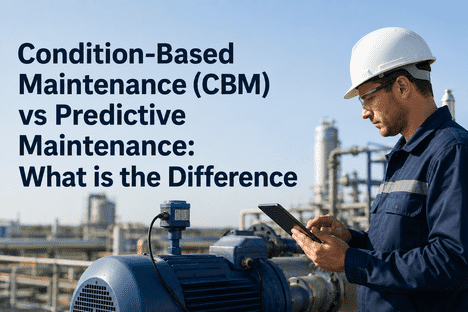
Condition-Based Maintenance (CBM) vs Predictive Maintenance: What is the Difference
By Christopher Hayes on June 11, 2026
Condition-based maintenance (CBM) and predictive maintenance (PdM) are frequently used interchangeably in industrial reliability discussions, yet they represent fundamentally different approaches to maintenance decision-making — one reactive to measured thresholds, the other proactive against forecasted trajectories. CBM triggers a work order when a sensor reading crosses a preset threshold: vibration exceeding ISO 10816 alert levels, bearing temperature rising above 90°C, or oil particle count breaching ISO 4406 cleanliness limits. PdM, by contrast, uses machine learning models trained on historical failure data to predict when those thresholds will be crossed — often weeks before conventional CBM alarms activate. The distinction matters because plants operating purely with CBM still absorb emergency failures between threshold crossings, while plants operating with PdM convert those emergencies into planned interventions. iFactory AI's industrial software platform, including its Shift Logbook and predictive maintenance engine, enables reliability teams to bridge from threshold-based CBM to AI-native PdM without replacing existing CMMS or condition monitoring infrastructure. Book a Demo to see how iFactory connects your existing CBM data streams to predictive intelligence.
ISO 17359 · Condition Monitoring · 2026
Condition-Based Maintenance vs Predictive Maintenance: What Is the Difference
Threshold-based CBM triggers alerts at failure thresholds. AI-native PdM predicts when thresholds will be crossed — extending planning windows, eliminating emergency repairs, and evolving maintenance from reactive to forecast-driven.
Condition-based maintenance, formalised in ISO 17359, evaluates asset health against predetermined threshold values: vibration velocity limits per ISO 10816, bearing temperature ceilings per manufacturer specifications, oil cleanliness per ISO 4406, and thermal image temperature differentials. When a reading crosses the threshold, a work order triggers. The limitation is structural: CBM detects that a threshold has already been crossed — not that it is about to be crossed. By the time vibration amplitude reaches the ISO 10816 alarm threshold, a bearing spall has already propagated through Stage 2 and into Stage 3 degradation, leaving days rather than weeks for intervention. The four specific ceilings of threshold-based CBM are well documented in reliability engineering research.
01
Threshold Blindness Between Readings
CBM evaluates condition at discrete measurement intervals — weekly vibration routes, monthly oil samples, quarterly thermography surveys. Faults that initiate and progress between readings remain invisible until the next measurement, creating a detection gap that can span weeks for slowly progressing failure modes.
Gap: Discrete vs Continuous
02
Late-Stage Detection Only
ISO 10816 velocity thresholds were designed for imbalance and misalignment detection, not early bearing fault identification. A developing inner race spall shows minimal overall velocity change until 48 hours before catastrophic failure — too late for planned intervention or spare parts procurement.
Gap: Late vs Early
03
No Remaining Useful Life Projection
CBM answers one question: "Has the threshold been crossed?" It cannot answer the more operationally valuable question: "How much time remains before functional failure?" Without RUL estimates, maintenance teams cannot optimise shutdown timing or parts ordering.
Gap: Reactive vs Predictive
04
Single-Variable Blindness
CBM typically evaluates each measurement channel independently — vibration on one axis, temperature on another, oil particle count on a third. Cross-correlation patterns that reveal developing faults before any single variable crosses its threshold are invisible to threshold-based analysis.
Gap: Single-variable vs Multi-variate
CBM vs Predictive Maintenance: The Core Difference
The distinction between condition-based and predictive maintenance is not about sensor hardware, data collection frequency, or software platform — it is about the decision logic applied to condition data. CBM applies threshold logic: "If vibration > X, then alert." Predictive maintenance applies trajectory logic: "Vibration is trending toward X at rate Y — estimated time to threshold is Z days — recommended action: pre-order bearing, schedule replacement during next planned outage." Both approaches use the same sensor data. The difference is what the data tells you about the future.
Capability
Condition-Based Maintenance
Predictive Maintenance (AI)
Decision trigger
Measurement crosses preset threshold
Model forecasts future threshold crossing
Detection timing
After threshold exceeded (late-stage)
Weeks before threshold is reached
RUL estimation
Not available
Degradation trajectory-based projection
False alarm rate
Low (thresholds are conservative)
Moderate initial, decreasing with training
Planning horizon
Hours to days
Days to weeks
Data requirement
Single measurement point per asset
Historical failure data + continuous telemetry
Maintenance cost profile
Emergency repairs + some planned
Predominantly planned interventions
Three Approaches to Maintenance Decision-Making
Maintenance strategy exists on a spectrum from fully reactive to fully predictive. Most plants operate a blend of all three approaches across different asset classes. Understanding where each approach fits is the first step toward a coherent modernisation strategy.
R
Reactive Maintenance (Run-to-Failure)
No condition monitoring. Assets operate until functional failure occurs. Repairs are unplanned, emergency-response events. Cost per event is 3–5× higher than planned maintenance due to overtime, expedited shipping, and production losses. Appropriate only for non-critical, easily replaceable assets where redundancy exists.
Cost multiplier: 3–5× vs planned
C
Condition-Based Maintenance (Threshold)
Assets are monitored via periodic or continuous measurements against preset thresholds. Work orders trigger when thresholds are crossed. Detects failure after it has progressed to a measurable level. Reduces emergency events by 30–50% compared to reactive. The most common approach in plants with established vibration, oil analysis, or thermography programs.
Emergency reduction: 30–50%
P
Predictive Maintenance (AI/ML)
Continuous telemetry feeds ML models that forecast degradation trajectories and estimate time-to-failure. Work orders generated automatically with fault type, severity stage, RUL projection, and recommended action. Further reduces emergency events by another 40–60% beyond CBM alone. Requires data infrastructure investment and model maturation period.
Emergency reduction: 70–85% total
E
Evolution Path: CBM → PdM
Most plants transition through an intermediate phase where CBM thresholds remain active as safety nets while PdM models train on accumulated data. For 6–12 months, both systems run in parallel. As model confidence reaches production-grade thresholds, PdM predictions become the primary decision layer, with CBM thresholds serving as backup verification.
Transition timeline: 6–12 months
The Keep / Retire / Transform / Replace Decision Matrix
Modernisation discipline starts with a clear classification of every maintenance data and workflow artifact in your current operation. Each falls into one of four categories. Getting the classification right in the first planning session saves months of debate during implementation.
Keep
Core maintenance system foundations
Existing CMMS work order engine
Parts inventory and procurement system
ERP financial integration
Existing sensor and accelerometer infrastructure
Vibration database and historical records
Established reliability infrastructure with no business case to replace. AI predictive layer writes predictions and work order recommendations to these existing systems through API integration.
Retire
Manual threshold management layers
Manual threshold-setting spreadsheets
ISO 10816-only alarm logic
Paper-based condition monitoring logs
Email-based alarm notification workflows
Standalone vibration analysis reports
Replaced by automated PdM model outputs and Shift Logbook integration. 80–90% reduction in manual data review effort.
Transform
Analysis and decision workflows
Bearing health scoring
Fault frequency amplitude trending
RUL dashboard reporting
Shift handover for asset status
Cross-correlation analysis across sensor types
Become AI model invocations grounded in continuous telemetry. Intelligence upgraded via iFactory Shift Logbook and predictive engine.
Replace
Alert and notification layer
Legacy alarm threshold gateways
Manual escalation workflows
Email-based condition alerts
Paper-based shift logs
Standalone condition monitoring reports
Event-driven AI alert engine with RUL context replaces manual notification. Automated work order creation in CMMS with full traceability.
Want this matrix applied to your specific asset classes and current CBM infrastructure in a working session? Book a Demo to walk through every asset class and prioritise your CBM-to-PdM migration path.
Three Deployment Paths for the CBM-to-PdM Transition
Same starting point, three valid destinations. The right path depends on asset criticality, current sensor coverage, data infrastructure maturity, and organisational readiness for AI-driven maintenance decisions. Plants that select the wrong path spend 12 months in pilot evaluation. Plants that select the right path deploy in 8–14 weeks.
Path A
Shadow Mode Coexistence
8–10 weeks
AI predictive models run alongside existing CBM thresholds in shadow mode for 4–6 weeks. Predictions logged for analyst review but no work orders generated. Existing CBM thresholds remain as primary alarm layer. Teams compare PdM predictions against actual outcomes before approving cutover.
Best fit
Risk-averse reliability teams · first AI deployment · critical assets requiring full validation before trust
Wk 1–3 Data federation + model training
Wk 4–8 Shadow mode prediction validation
Wk 9–10 CMMS integration go-live
Path B
Blended Threshold + Prediction
10–12 weeks
PdM predictions become primary decision layer. CBM thresholds retained as backup verification for anomaly confirmation. Work orders generated from PdM predictions route through Shift Logbook for operator and analyst review before CMMS entry.
Best fit
Mature reliability programs · moderate digital transformation appetite · assets with clear failure history data
Wk 1–3 Discovery · matrix · prioritisation
Wk 4–9 Deploy AI prediction layer
Wk 10–12 Mobile UX + Shift Logbook cutover
Path C
Full Predictive Modernisation
12–14 weeks
CBM threshold-only monitoring retired. Full AI-native predictive maintenance platform deployed across all monitored asset classes. Legacy alarm layers replaced by model-driven prediction engine with automated RUL estimates, work order generation, and sparing recommendations.
Best fit
Large asset fleets (1000+ monitored points) · siloed legacy CBM systems · strategic platform consolidation goal
Wk 1–4 Full asset inventory + data readiness
Wk 5–11 Parallel build + model maturation
Wk 12–14 Cutover + legacy sunset
Find the Right CBM-to-PdM Path for Your Plant in a 90-Minute Workshop
iFactory AI's reliability practice runs a focused workshop against your specific asset classes, existing CBM infrastructure, CMMS configuration, and data readiness. You leave with a defended path recommendation, a 10-week deployment plan, and a cost reduction projection grounded in your actual failure history.
How iFactory Bridges the Gap Between CBM and Predictive Maintenance
iFactory AI is the software intelligence layer that connects existing condition monitoring infrastructure — vibration sensors, temperature probes, oil analysis labs, thermal cameras, accelerometers, and SCADA telemetry — to AI-native predictive models. The platform does not replace your existing CBM tools, sensors, or CMMS. It adds the trajectory-based prediction layer that threshold-based CBM was never designed to deliver: continuous telemetry ingestion, multi-variate pattern recognition, degradation trajectory modelling, and automated work order generation with RUL evidence. The Shift Logbook unifies operator observations, inspection findings, and AI-generated predictions into a single operational record that improves model accuracy with every maintenance event recorded.
01
Threshold-to-Trajectory Migration
Capability:
"Can the platform ingest existing CBM thresholds and convert them into prediction model training boundaries?"
Existing ISO 10816 vibration thresholds, bearing temperature limits, and oil analysis alert levels become the initial training labels for PdM models. The platform learns the sensor value trajectories that precede threshold crossings, converting static CBM limits into dynamic prediction points.
02
Multi-Variate Correlation Engine
Capability:
"Does the platform correlate vibration, temperature, oil analysis, and process data into unified asset health scores?"
CBM monitors each variable independently. PdM requires cross-correlation across measurement channels. The platform fuses vibration envelope spectra, bearing temperature trends, oil particle counts, and motor current draw into a single degradation trajectory per asset, detecting patterns no single threshold can identify.
03
Show-Me Mode Validation
Capability:
"Can the platform run in shadow mode alongside existing CBM thresholds before taking over primary alerting?"
Critical for risk-averse teams. Shadow mode logs PdM predictions alongside CBM threshold alerts for 4–6 weeks without triggering work orders. Reliability teams compare model outputs against actual outcomes before approving the transition to primary decision layer.
04
Work Order Generation with Evidence
Capability:
"Does the platform generate CMMS-native work orders with fault type, severity stage, RUL estimate, and recommended action?"
CBM alerts say "bearing vibration is elevated." PdM work orders say "inner race fault detected at 92% confidence — BPFI sidebands present at 5.4× RPM — estimated RUL 14 days — recommended action: pre-order bearing, schedule during next planned outage." Actionable specificity is the difference.
05
RUL Estimation from Degradation Trajectories
Capability:
"Which degradation models power RUL estimates — generic curve fits or benchmark-validated trajectory models?"
RUL estimates from generic L10 bearing life curves ignore actual degradation trajectory. The platform uses exponential degradation models validated against IEEE PRONOSTIA and IMS bearing run-to-failure datasets, projecting time-to-threshold from real amplitude trends rather than theoretical life calculations.
No. The platform federates existing sensor data — accelerometers, RTDs, oil analysis results, thermal images, motor current signals — through standard API and OPC-UA connectors. Existing CMMS, vibration software, and ERP remain in place. PdM intelligence is an added layer, not a replacement.
Ready to score your current CBM infrastructure against this six-capability framework? Run a readiness assessment with our team and get a structured migration plan tailored to your asset fleet.
The ROI Math — What the CBM-to-PdM Transition Delivers
The business case for migrating from threshold-based CBM to AI-native predictive maintenance is built on three measurable outcomes: fewer emergency repairs, longer planning horizons, and lower total maintenance cost per asset. Plants completing the transition report consistent improvements across four key metrics within the first two quarters post-deployment.
−50–70%
Unplanned failure reduction
AI PdM detects degradation 2–4 weeks before threshold crossing. Emergency replacements shift to planned service during scheduled windows with pre-positioned spares, eliminating production-impacting breakdowns.
−20–35%
Total maintenance cost reduction
Condition-based replacement at the optimal point in the degradation curve eliminates both premature overhauls and late-stage emergency repairs, reducing average cost per intervention by 40–60%.
3-5×
Planning horizon extension
Planning windows expand from hours or days under CBM to weeks under PdM. Maintenance teams gain time for parts procurement, labour scheduling, and production coordination without overtime premiums.
6–9 mo
Typical ROI payback
Full investment recovery through unplanned failure reduction, maintenance cost optimisation, and extended asset life. Plants with 500+ monitored points typically achieve payback within two quarters.
Expert Perspective
"The most persistent misconception in industrial maintenance modernisation is that condition-based maintenance and predictive maintenance are points on the same technology spectrum — that CBM is simply a less mature version of PdM and that a plant naturally evolves from one to the other as it adds more sensors and more data. This framing is incorrect and leads to years of underperforming investments. CBM and PdM are architecturally different decision layers. CBM answers one question: 'Has this measurement crossed its threshold?' PdM answers a fundamentally different question: 'When will this measurement cross its threshold, given its current trajectory and historical failure patterns of similar assets?' The sensor hardware is the same. The data ingestion frequency may be the same. But the decision logic — threshold comparison versus trajectory projection — produces completely different operational outcomes. Plants that understand this difference deploy PdM in 10–12 weeks as an overlay on existing CBM infrastructure. Plants that treat PdM as 'more CBM' spend 12–18 months building sensor networks without changing the decision layer."
— Reliability Engineering Practice, 2026 industry insight
10–12 wk
typical hybrid deployment with pre-configured PdM models
80–90%
reduction in manual threshold analysis effort
Zero rip
of existing CMMS, sensors, or condition monitoring software required
Conclusion: The CBM-to-PdM Decision Has Three Right Answers
Condition-based maintenance is not failing — it is hitting a decision-logic ceiling that threshold-based analysis cannot cross. CBM tells you when a measurement has exceeded a limit. Predictive maintenance tells you when it will exceed that limit, how much time remains for intervention, and what specific action is required. Both approaches use the same sensor data, the same CMMS, and the same maintenance team. The difference is the decision layer: threshold comparison versus trajectory projection. The modernisation conversation has three valid answers depending on organisational risk tolerance, asset criticality mix, and data infrastructure maturity — shadow mode coexistence (8–10 weeks), blended threshold-plus-prediction (10–12 weeks), or full predictive modernisation (12–14 weeks). All three keep existing CMMS and sensor infrastructure intact. All three reduce unplanned failures by 50–70% within the first quarter of full deployment. The decision worth making in 2026 is not whether to add predictive intelligence to your CBM program — it is which of the three migration paths fits your plant's specific reliability context. Walk through your current CBM infrastructure and PdM readiness with our team.
Run the CBM-to-PdM Readiness Assessment Built for Your Asset Fleet
iFactory AI's reliability practice runs a 90-minute readiness assessment against your real asset classes, existing CBM thresholds, sensor coverage, and CMMS configuration. You leave with a defended path recommendation, the decision matrix applied to your fleet, and a cost reduction projection grounded in your maintenance history.
What is the fundamental difference between CBM and predictive maintenance?
The fundamental difference is decision logic. Condition-based maintenance triggers action when a measured parameter crosses a predefined threshold — vibration exceeds ISO 10816 limits, bearing temperature rises above 90°C, oil particle count breaches ISO 4406 limits. Predictive maintenance uses machine learning models trained on historical failure data to forecast when those thresholds will be crossed, providing advance warning measured in days or weeks rather than hours. Both use the same sensor data; the difference is threshold comparison versus trajectory projection.
Does implementing predictive maintenance require replacing existing CBM sensors and software?
No. Production-grade PdM platforms integrate with existing condition monitoring infrastructure — accelerometers, temperature probes, oil analysis labs, thermal cameras, motor current transducers — through standard API, OPC-UA, and Modbus connectors. The same sensor data that currently feeds CBM threshold dashboards also feeds PdM degradation models. Existing CMMS, vibration software platforms, and ERP systems remain in place. PdM intelligence is an added decision layer, not a replacement of existing systems.
How long does a typical CBM-to-PdM transition take?
Deployment timeline depends on the chosen migration path. Shadow mode coexistence (Path A) takes 8–10 weeks, during which PdM models run alongside existing CBM thresholds for validation. Blended threshold-plus-prediction (Path B) takes 10–12 weeks, with PdM becoming the primary decision layer and CBM thresholds retained as backup. Full predictive modernisation (Path C) takes 12–14 weeks, retiring threshold-only monitoring entirely. All three paths include a model maturation period of 6–12 months during which prediction accuracy improves as more data and maintenance outcomes accumulate.
Can predictive maintenance operate alongside existing ISO 17359 condition monitoring programs?
Yes, and this is the recommended deployment approach. ISO 17359 provides the framework for condition monitoring strategy, measurement point selection, and threshold-setting methodology. PdM adds the trajectory-based prediction layer that alerts teams before thresholds are reached. During the transition, existing ISO 17359 thresholds remain active as safety verification, while PdM models generate advance warnings 2–4 weeks before those thresholds would be crossed. After 6–12 months of parallel operation, most teams retire threshold-only alarming and rely entirely on PdM predictions for primary decision-making.
What is the ROI of migrating from CBM to predictive maintenance?
Plants completing the transition report 50–70% reduction in unplanned failures, 20–35% reduction in total maintenance cost per asset, and a planning horizon extension from hours or days under CBM to 2–4 weeks under PdM. Typical ROI payback is 6–9 months for plants with 500+ monitored condition points. The primary ROI driver is the conversion of emergency repairs — which cost 3–5× more than planned interventions — into scheduled maintenance events with pre-positioned spare parts and optimised labour allocation.