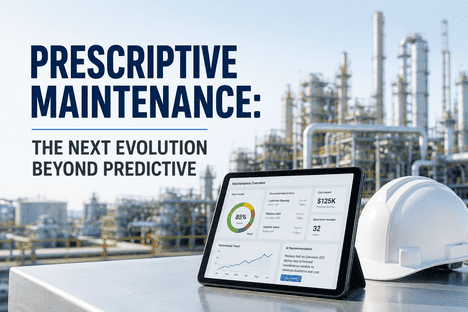
Prescriptive Maintenance: The Next Evolution Beyond Predictive
By Daniel Carter on June 11, 2026
Predictive maintenance answers one question: when will failure occur? Prescriptive maintenance answers the question that follows: what should we do about it, when should we do it, and which resources should we allocate? The distinction marks the next evolution in industrial AI — moving from failure prediction to decision recommendation. While predictive maintenance models forecast degradation trajectories and estimate remaining useful life, prescriptive maintenance adds an optimisation layer that evaluates alternative intervention strategies — repair now versus replace at the next outage versus extend operation with increased monitoring — against weighted criteria including maintenance cost, production impact, labour availability, spare parts lead time, and risk tolerance. The output is not an alert but a recommended action plan with projected outcomes for each alternative. iFactory AI's industrial software platform, including its Shift Logbook and predictive maintenance engine, enables reliability teams to deploy prescriptive maintenance decision logic that closes the loop from sensor telemetry to optimised work order. Book a Demo to see how iFactory applies prescriptive AI across rotating equipment fleets and production-critical assets.
Prescriptive Maintenance: The Next Evolution Beyond Predictive
Failure prediction tells you when. Prescriptive intelligence tells you what to do, when to act, and which resources to deploy — closing the decision loop from sensor telemetry to optimised maintenance intervention with projected cost and risk outcomes.
Why Prediction Without Prescription Creates a Decision Gap
Predictive maintenance platforms have demonstrated that AI models can forecast bearing failures 2–4 weeks in advance with 85–92% accuracy. Yet many plants running PdM still absorb unplanned failures because the prediction alone does not answer the operational questions that follow: should the bearing be replaced immediately, during the next planned outage, or managed through increased monitoring frequency? What is the cost comparison between early replacement and the risk of extended operation? Is the correct replacement bearing in stock, and is the certified technician available this week or next? These are not prediction questions — they are optimisation questions. Without a prescriptive layer that evaluates alternatives against current constraints and recommends the optimal action, PdM predictions generate alerts that still require manual analysis and decision-making, recreating the same human-dependent bottleneck that periodic condition monitoring faced. Gartner's prescriptive analytics research identifies this decision gap as the primary barrier to full AI value realisation in maintenance operations.
01
Prediction Without Action Guidance
PdM alerts report "bearing failure expected in 18 days" but do not recommend whether to replace immediately, schedule for next outage, or extend monitoring. Maintenance teams must manually evaluate options, recreating the decision delay PdM was meant to eliminate.
Gap: Alert vs Recommendation
02
Static Constraint Blindness
PdM evaluates asset health against degradation trajectories but ignores dynamic operational constraints — current production schedule, spare parts availability, technician workload, and budget windows. An optimal decision Tuesday may be suboptimal Friday after schedule changes.
Gap: Static vs Dynamic
03
Single-Outcome Framing
PdM presents one forecast: the predicted failure date. Prescriptive maintenance presents decision alternatives with projected outcomes — "replace now: cost $4,200, 0% failure risk" versus "run to next outage: cost $800, 23% failure risk." Teams need alternatives, not forecasts.
Gap: Single vs Comparative
04
No Learning From Decisions
PdM models learn from failure events. They do not learn from the decisions made in response to predictions — whether the recommended action was taken, how the asset responded, or whether the timing was optimal. Prescriptive systems close this feedback loop.
Gap: Open-loop vs Closed-loop
Prescriptive vs Predictive: The Core Difference
Prescriptive maintenance is not a replacement for predictive maintenance — it is an additional intelligence layer that sits on top of PdM and transforms its output from information into action. Both layers use the same sensor data, the same degradation models, and the same CMMS infrastructure. The difference is the decision logic applied after the prediction is generated: PdM stops at "when." Prescriptive answers "what, when, and how."
Cost, labour, parts, production schedule, risk tolerance
Work order output
"Replace bearing within 14 days"
"Replace bearing on Oct 15 night shift: $4,200, 2 techs, part #SKF-6310 in stock, 0% failure risk"
Feedback integration
Failure events only
Decision outcomes, timing accuracy, cost variance
ROI measurement
Failure reduction rate
Cost per decision vs alternatives not taken
Four Decision Types Prescriptive Maintenance Optimises
Every predictive maintenance alert triggers a decision. The prescriptive layer classifies each decision into one of four types and applies the appropriate optimisation model — each with distinct input requirements, constraint sets, and output formats.
R
Replace vs Repair Decisions
When a predicted failure triggers a maintenance action, the prescriptive model evaluates replace versus repair by comparing total cost — parts, labour, downtime impact, and expected remaining life of each option. For assets near end of design life, replacement may dominate. For mid-life assets with localised damage, targeted repair may be optimal. The recommendation includes cost comparison and risk assessment for each alternative.
Decision driver: Lifecycle cost comparison
T
Timing Optimisation
Given a predicted failure window and a production schedule, the prescriptive model identifies the optimal intervention time — balancing the cost of earlier replacement (parts not fully utilised) against the risk of later intervention (probability of failure before scheduled action). The recommendation specifies the optimal date, shift, and duration with projected cost and risk for acting earlier, on schedule, or later.
Decision driver: Production schedule + risk
S
Resource Allocation
When multiple predicted failures overlap in a planning window, the prescriptive model allocates constrained resources — technician hours, spare parts, specialised tooling, and outage slots — across competing interventions to minimise total production impact. The model considers technician skill requirements, part lead times, and task dependencies to generate a prioritised intervention schedule.
For non-critical assets or assets with redundancy, the prescriptive model explicitly evaluates whether the lowest-cost strategy is to let the asset fail and replace on failure. The recommendation includes the expected cost of failure — including secondary damage probability, production impact, and replacement cost — versus the cost of preventive intervention. This prevents over-maintenance of low-criticality assets.
Decision driver: Criticality + redundancy
The Keep / Retire / Transform / Replace Decision Matrix
Modernisation discipline for prescriptive maintenance begins with classifying every current maintenance decision artifact in your operation. Each falls into one of four categories. Getting the classification right in the first planning session prevents the most common failure mode in prescriptive AI deployment: applying optimisation to decision types that should be retired or replaced entirely.
Keep
Core decision infrastructure
Existing CMMS work order engine
Parts inventory and procurement system
ERP financial integration
Predictive maintenance model outputs
Maintenance planner expertise
Established decision infrastructure. Prescriptive layer writes optimised recommendations to these systems through standard API integration without replacing existing workflows.
Retire
Manual decision analysis
Spreadsheet-based cost comparison
Manual risk assessment worksheets
Email-based decision approval loops
Paper intervention timing logs
Standalone decision registers
Replaced by automated prescriptive optimisation. 70–80% reduction in manual decision analysis effort with consistent, auditable recommendation logic.
Transform
Decision workflows
Intervention timing selection
Resource allocation across alerts
Replace vs repair analysis
Risk-weighted decision scoring
Shift handover for pending decisions
Become prescriptive model invocations with constraint-aware optimisation. Intelligence upgraded via iFactory Shift Logbook and prescriptive engine.
Replace
Decision notification layer
Manual decision escalation chains
Email-based approval workflows
Paper-based decision registers
Standalone cost justification forms
Post-event decision reviews
AI prescriptive engine with automated alternative evaluation and recommendation replaces manual decision notification. Faster, auditable, with outcome tracking.
Want this matrix applied to your current maintenance decision processes in a working session? Book a Demo to walk through every decision type and prioritise your prescriptive maintenance deployment.
Three Deployment Paths for Prescriptive Maintenance
Same PdM foundation, three prescriptive destinations. The right path depends on decision complexity, organisational readiness for AI-recommended actions, and existing optimisation maturity. Plants that pick the right path deploy prescriptive capabilities in 8–14 weeks on top of existing PdM infrastructure.
Path A
Recommendation Shadow Mode
8–10 weeks
Prescriptive optimisation runs alongside existing manual decision processes. Recommendations logged in Shift Logbook for planner review but not routed to CMMS. Teams compare prescriptive recommendations against actual decisions to validate optimisation logic before cutover.
Best fit
Organisations with established PdM · risk-averse decision culture · first prescriptive deployment
Wk 1–3 Decision taxonomy + constraint mapping
Wk 4–7 Shadow mode recommendation validation
Wk 8–10 CMMS integration go-live
Path B
Advisory Prescriptive
10–12 weeks
Prescriptive recommendations become primary decision input. Recommendations include alternatives with projected cost, risk, and resource requirements. Planners retain approval authority with one-click accept/modify/reject workflow in Shift Logbook.
Best fit
Mature PdM programs · moderate AI trust level · clean constraint data available
Wk 1–3 Discovery · matrix · constraint sourcing
Wk 4–9 Deploy prescriptive engine
Wk 10–12 Shift Logbook + planner workflow cutover
Path C
Closed-Loop Prescriptive Automation
12–14 weeks
Prescriptive engine generates optimised work orders directly in CMMS with no manual approval step for defined asset classes and decision types. Planners monitor by exception. Feedback from decision outcomes continuously retrains optimisation models.
Best fit
Large asset fleets · high PdM maturity · strategic automation goal · clean constraint and cost data
Wk 1–4 Full decision inventory + optimisation models
Wk 5–11 Parallel validation + planner training
Wk 12–14 Automated cutover + exception monitoring
Find the Right Prescriptive Path for Your Maintenance Decisions in a 90-Minute Workshop
iFactory AI's reliability practice runs a focused workshop against your specific decision types, existing PdM outputs, CMMS configuration, and constraint data availability. You leave with a defended path recommendation, a 10-week deployment plan, and a cost reduction projection grounded in your decision history.
How iFactory Closes the Decision Loop From Prediction to Prescription
iFactory AI is the software intelligence layer that extends predictive maintenance outputs into prescriptive decision recommendations. The platform ingests PdM model outputs — fault type, severity stage, RUL estimate, confidence score — and evaluates them against current operational constraints pulled from CMMS, ERP, and production scheduling systems. The prescriptive engine generates ranked intervention alternatives with projected cost, resource requirements, risk probability, and production impact for each option. The Shift Logbook captures the recommended decision, the alternative chosen, and the outcome, creating a continuous feedback loop that improves both predictive accuracy and prescriptive optimisation over time. iFactory does not replace your existing PdM models, CMMS, or planning workflows — it adds the decision optimisation layer that transforms predictions into actions.
01
Multi-Alternative Decision Framework
Capability:
"Does the platform generate ranked alternatives with projected cost, risk, and resource requirements for each option?"
Prescriptive optimisation evaluates repair now, schedule next outage, extend monitoring, and run-to-failure as distinct alternatives. Each includes projected total cost, failure probability during the intervention window, labour hours required, and parts needed — enabling informed decision-making.
02
Constraint Integration From CMMS and ERP
Capability:
"Does the platform ingest real-time constraint data — production schedule, parts availability, technician calendar, budget windows — from existing systems?"
Prescriptive recommendations are only as good as the constraint data they optimise against. The platform integrates with CMMS for work order history and labour schedules, ERP for parts inventory and procurement lead times, and production systems for outage windows and throughput targets.
03
Risk-Weighted Optimisation Models
Capability:
"Does the platform apply risk-weighted optimisation — balancing intervention cost against failure probability and consequences?"
The prescriptive engine uses decision theory models — expected value analysis, minimax regret, and constrained optimisation — to rank alternatives by weighted criteria. Risk tolerance parameters can be adjusted per asset class, production criticality, or organisational policy.
04
Decision Outcome Feedback Loop
Capability:
"Does the platform track decision outcomes and use them to improve both prediction and prescription models?"
Every decision — whether the prescriptive recommendation was accepted, modified, or rejected — feeds back into model training. If a recommended timing was overridden and the asset failed earlier than predicted, both the PdM and prescriptive models are updated to improve future recommendations.
05
Resource-Constrained Scheduling
Capability:
"When multiple predicted failures compete for limited resources, does the platform generate a prioritised intervention schedule?"
The platform applies constrained resource optimisation — technician availability, parts lead times, tooling requirements, and outage slot allocation — to generate a prioritised schedule across all active prescriptive recommendations. Conflicts are surfaced with recommended resolution paths.
No. The prescriptive layer integrates with existing PdM model outputs through standard API connectors. Existing CMMS, ERP, and production scheduling systems remain in place. Prescriptive optimisation is an added decision layer, not a replacement of existing infrastructure.
Ready to score your current decision processes against this six-capability framework? Run a prescriptive readiness assessment with our team and get a structured deployment plan tailored to your asset fleet and decision culture.
The ROI Math — What Prescriptive Maintenance Delivers Beyond Predictive
Organisations already running predictive maintenance have reduced unplanned failures by 50–70%. Prescriptive maintenance captures the remaining value by optimising the decisions made in response to those predictions — reducing the cost per intervention, extending asset life through optimal timing, and eliminating the hidden cost of suboptimal decisions that PdM alone cannot address.
−15–25%
Additional maintenance cost reduction
Beyond PdM savings, prescriptive optimisation reduces cost per intervention by 15–25% through optimal timing, resource allocation, and replace-vs-repair decisions that manual planning cannot match consistently.
−30–50%
Decision cycle time reduction
Time from PdM alert generation to optimised work order release drops from hours or days to minutes. Maintenance planners shift from analysis to exception-based approval of AI-recommended actions.
+10–20%
Asset life extension beyond PdM alone
Optimal intervention timing — replacing assets at the right point in the degradation curve rather than at the first PdM alert — extracts 10–20% additional useful life without increasing failure risk.
3–6 mo
Incremental ROI payback
For organisations with existing PdM deployment, incremental prescriptive investment typically achieves payback within two quarters through combined cost reduction, asset life extension, and planner productivity gains.
Expert Perspective
"The most persistent misconception in industrial maintenance AI is that predictive maintenance is the final destination — that once you can forecast failure with high accuracy, the hard work is done. This framing causes organisations to leave 30–40% of potential value on the table. A prediction without a prescription is just a better-informed manual decision process. The real step change occurs when the prediction feeds an optimisation engine that evaluates repair versus replace versus run-to-failure against current production schedules, parts availability, technician calendars, and budget constraints — then generates a specific, timed, resourced work order recommendation. Gartner's analysis of prescriptive analytics adoption shows that organisations adding prescriptive optimisation on top of existing predictive capabilities achieve 2–3× greater total cost reduction than organisations that stop at prediction alone. The architectural decision isn't PdM-or-prescriptive — it's PdM-plus-prescriptive, where prediction tells you when and prescription tells you what."
— Prescriptive Maintenance Practice, 2026 industry insight
10–12 wk
prescriptive deployment on existing PdM infrastructure
70–80%
reduction in manual decision analysis effort
Zero rip
of existing PdM models, CMMS, or planning workflows required
Conclusion: The Prescriptive Decision Is Not Whether — It Is When and How
Predictive maintenance has proven its value: organisations with mature PdM programs routinely reduce unplanned failures by 50–70% and convert emergency repairs into planned interventions. But PdM alone leaves a decision gap — the interval between receiving a failure forecast and determining the optimal action, timing, and resource allocation. Prescriptive maintenance closes this gap by adding a constraint-aware optimisation layer that evaluates alternatives, projects outcomes, and generates specific, actionable work order recommendations. The question is no longer whether prescriptive capability adds value — the evidence from Gartner prescriptive analytics research and early adopter case studies is clear. The question is which deployment path fits your organisation's decision maturity: recommendation shadow mode (8–10 weeks), advisory prescriptive with planner approval (10–12 weeks), or closed-loop automation with exception-based monitoring (12–14 weeks). All three paths keep existing PdM models, CMMS, and planning workflows intact. All three reduce maintenance cost per intervention by an additional 15–25% beyond PdM savings alone. Walk through your current decision processes and prescriptive readiness with our team.
Run the Prescriptive Maintenance Readiness Assessment Built for Your Operation
iFactory AI's reliability practice runs a 90-minute readiness assessment against your real decision types, existing PdM outputs, constraint data availability, and CMMS configuration. You leave with a defended path recommendation, the decision matrix applied to your operation, and a cost reduction projection grounded in your maintenance decision history.
What is the difference between predictive and prescriptive maintenance?
Predictive maintenance uses machine learning models to forecast when a failure will occur, typically expressed as a remaining useful life estimate or a predicted failure date. Prescriptive maintenance adds an optimisation layer that evaluates multiple intervention strategies — repair now, replace during next outage, extend monitoring with increased frequency, or run to failure — against current operational constraints and recommends the optimal action with projected cost, risk, and resource requirements. PdM answers "when." Prescriptive answers "what, when, and how."
Do I need predictive maintenance in place before implementing prescriptive?
Production-grade prescriptive maintenance requires predictive model outputs as input — fault type, severity stage, RUL estimate, and confidence score. For organisations without existing PdM deployment, iFactory recommends deploying PdM first (Path A: 6–8 weeks) and adding the prescriptive layer once predictive accuracy reaches production grade (typically 6–12 months after initial PdM deployment). For organisations with mature PdM programs, prescriptive capability can be deployed directly in 10–14 weeks as an overlay on existing prediction outputs.
What data does prescriptive maintenance require beyond predictive model outputs?
Prescriptive optimisation requires constraint data from three sources: production schedule (outage windows, throughput targets, criticality rankings), resource availability (technician skills and calendars, spare parts inventory and lead times, specialised tooling), and cost parameters (labour rates, part costs, production loss cost per hour, failure consequence costs). Most of this data already exists in CMMS, ERP, and production scheduling systems — the prescriptive layer integrates with these existing data sources through standard API connectors.
Can prescriptive maintenance recommend run-to-failure as the optimal strategy?
Yes, and this is one of its most valuable capabilities. For non-critical assets or assets with built-in redundancy, the lowest-cost strategy is sometimes to let the asset fail and replace on failure. The prescriptive model evaluates the expected cost of failure — including secondary damage probability, production impact, and replacement cost — versus the cost of preventive intervention. For assets where the cost of prevention exceeds the expected cost of failure, the model recommends run-to-failure with increased monitoring frequency to minimise secondary damage.
How does iFactory's prescriptive maintenance integrate with existing CMMS workflows?
iFactory's prescriptive engine generates optimised work order recommendations that include the recommended action, optimal timing, required resources, and projected cost. These recommendations are written to the existing CMMS through standard API integration. The Shift Logbook captures the recommended decision, the alternative selected by the planner, and the outcome — creating a continuous feedback loop that improves both predictive and prescriptive model accuracy. Existing CMMS work order approval workflows, parts reservation processes, and scheduling boards remain unchanged; the prescriptive layer provides higher-quality input to these established processes.