In 2023, a London-based supplier called AOG Technics was discovered to have forged Authorised Release Certificates for CFM56 engine parts — the same engines that power the Airbus A320 and Boeing 737. At least 70 counterfeit certificates and 50 different part types were involved before the UK Serious Fraud Office executed a raid. The parts had entered the supply chain through the same gap that has always existed in aviation maintenance: documentation that transfers without verification, paper records that can be duplicated, and no persistent digital link between a part's origin and its installed position on an airframe. Blockchain closes that gap permanently. By creating an immutable, cryptographically verified record for every maintenance event and parts transaction, blockchain ensures that what is written about an aircraft's history can be trusted — not because of the organisation that wrote it, but because of the mathematics that secured it.
$2.4B
Annual Cost of Aviation
Maintenance Fraud Globally
520K
Unapproved Parts Installed
on US Aircraft Annually
174+
FAA Incidents Linked to
Unapproved Parts
34%
FAA Enforcement Cases
Involving Falsified Records
The Record-Keeping Problem That Costs Billions
Aviation maintenance records are the legal foundation of airworthiness. Every part installed on an aircraft must be traceable from its OEM origin through every distributor, repair station, and installation event for the entire life of the aircraft — often 25 to 30 years. The problem is that the current infrastructure for managing these records has not kept pace with the complexity of the supply chain or the sophistication of those who seek to exploit its gaps.
Part history is scattered across OEM systems, distributor databases, airline maintenance logs, and MRO paper files. No single view of the full lifecycle exists. Auditors spend 72+ hours compiling documentation for a single review.
2
Paper-Based Vulnerabilities
Authorised Release Certificates, 8130-3 tags, and maintenance sign-offs remain predominantly paper-based. These documents can be forged, duplicated, or altered with commodity office equipment. The AOG Technics case proved this at scale.
3
No Persistent Provenance
When a part moves through multiple supply chain tiers, its documentation chain is only as strong as the weakest transfer point. A single lost paper tag or unverified digital handoff breaks traceability permanently, rendering the part un-installable.
FAA civil penalties for documentation deficiencies at Part 139 airports average $34,000 per finding, regardless of whether any actual safety lapse occurred. 62% of audit non-conformances stem from documentation gaps, not equipment failures.
How Blockchain Creates a Trusted Chain of Custody
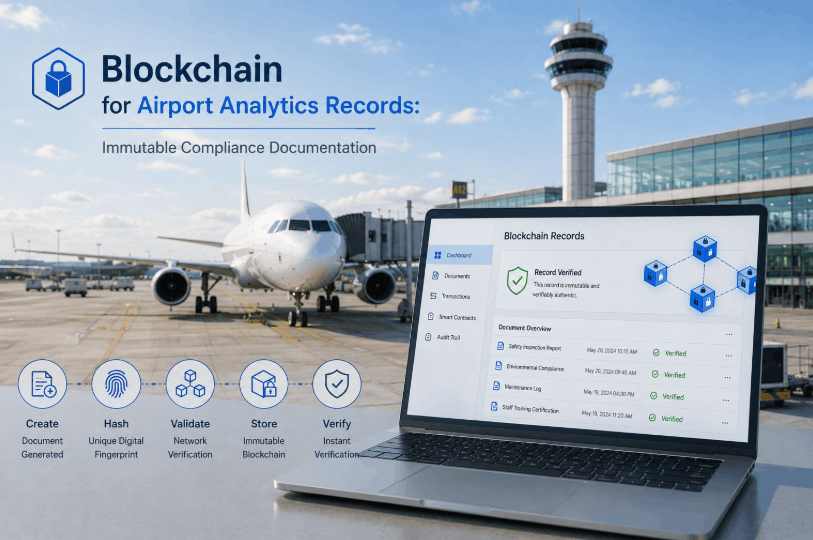
A blockchain-anchored maintenance ledger records every event as a cryptographically sealed block linked to all previous blocks. No single party controls the data. No record can be altered retroactively. Every participant — OEM, distributor, MRO, airline, regulator — sees the same immutable history. Here is how each layer of the aviation maintenance record challenge is addressed.
Every maintenance action — inspection, repair, part removal, installation — is written as a block on the chain. Once confirmed by network consensus, no participant can alter or delete it. Retroactive changes are mathematically impossible without detection.
Replaces paper logbooks and editable PDFs that can be lost, altered, or backdated. FAA AC 120-78B explicitly recognises electronic recordkeeping as equivalent to paper when systems meet integrity standards.
Each technician, inspector, and organisation holds a verified digital identity on the blockchain. Maintenance entries are cryptographically signed, providing non-repudiable proof of who performed what action and when.
EASA's 2023 guidelines on electronic documents and signatures established the regulatory framework for blockchain-based identity verification in maintenance records.
Every part receives a unique digital identifier at OEM manufacture. Each transfer of custody — distributor to MRO, MRO to airline, installation to removal — is recorded on-chain, creating a complete lifecycle record from birth to retirement.
AFI KLM E&M and Parker Aerospace already use blockchain to track hundreds of thousands of Boeing 787 parts, demonstrating the model works at scale.
04
Smart Contract Compliance
Smart contracts automate compliance verification. Before a part is installed, a smart contract autonomously checks its blockchain record against regulatory requirements — confirming OEM pedigree, inspection currency, and airworthiness status before permitting installation.
Converts compliance from a manual review process into an automated gate that prevents non-conforming parts from entering the aircraft at the system level.
iFactory Blockchain Records Module
Every Part Has a History. Blockchain Makes It Verifiable.
iFactory's Blockchain Records Module anchors every maintenance event, parts transaction, and inspection sign-off to an immutable ledger — creating a tamper-proof chain of custody from OEM to retirement that satisfies the most demanding FAA, EASA, and ICAO audit requirements.
Blockchain in Production: Three Implementations That Prove the Model
Blockchain for aviation maintenance records is not a lab experiment. The technology is deployed at scale across major MRO networks, airline fleets, and OEM supply chains. These three implementations demonstrate the model in operation with measurable outcomes.
Lufthansa Technik — Blockchain MRO Platform
Lufthansa Technik deployed a blockchain-based MRO platform to centralise and digitise aircraft component history across its global network. The system creates a permanent, immutable record of part lifecycle events — inspections, removals, installations, and repairs — eliminating the fragmented paper-based documentation that previously required time-consuming manual verification and produced inconsistent audit results.
Outcome
Real-time part traceability across global MRO network; reduced audit preparation time from days to minutes
AFI KLM E&M + Parker Aerospace — Boeing 787 Parts Blockchain
AFI KLM E&M and Parker Aerospace jointly operate a blockchain-based platform to track hundreds of thousands of Boeing 787 fleet parts. The system provides real-time traceability across the entire supply chain, from OEM manufacture through distribution, MRO processing, and installation. The shared blockchain ledger gives both the MRO provider and the airline immediate visibility into part status and history.
Outcome
Reduced repair turnaround times; improved supply chain demand planning through real-time visibility
SITA MRO Blockchain Alliance — Industry-Wide Consortium
The SITA-led MRO Blockchain Alliance brings together airlines, lessors, OEMs, MRO providers, and technology companies including Cathay Pacific, HAECO Group, Ramco Systems, and Willis Lease Finance. The alliance operates a shared blockchain network for tracking and tracing aircraft parts across organisational boundaries — demonstrating that blockchain works not just within a single enterprise but across competing industry participants.
Outcome
Cross-organisational part traceability; shared immutable record reduces dispute resolution time between Alliance members
The Regulatory Landscape: FAA, EASA, and the Push Toward Digital Records
Aviation regulators have not only accepted blockchain-based records — they have actively created the regulatory framework that enables them. EASA's 2023 guidelines on electronic documents and signatures explicitly mention blockchain as a technology for immutable record keeping. FAA Advisory Circular 120-78B provides the compliance pathway for electronic signatures and recordkeeping systems. IATA is working with EASA on a study to assess blockchain implementation in airworthiness management. The regulatory direction is clear: digital, verifiable, distributed record systems are the future of aviation compliance documentation.
AC 120-78B
Electronic signatures, recordkeeping, and manual systems — provides standards for digital documentation that blockchain systems satisfy.
Electronic Records Guidelines
Explicitly references blockchain for decentralised, tamper-proof digital ledgers; defines electronic signature assurance levels for maintenance.
Digital Records Initiative
Industry standards for aircraft electronic records; EASA study partnership on blockchain in airworthiness management.
Safety Audit Framework
Global standards for aviation safety; accepting digital documentation as primary evidence in USOAP audits.
Records Deep-Dive
See How an Immutable Maintenance Ledger Works for Your Fleet
iFactory's Blockchain Records Module integrates with your existing CMMS to anchor every work order, inspection, and parts transaction to a tamper-proof ledger — giving your compliance team an audit trail that satisfies the most rigorous regulatory scrutiny. Book a demo to see the full record lifecycle.
Counterfeit Parts: The Risk That Drives Adoption
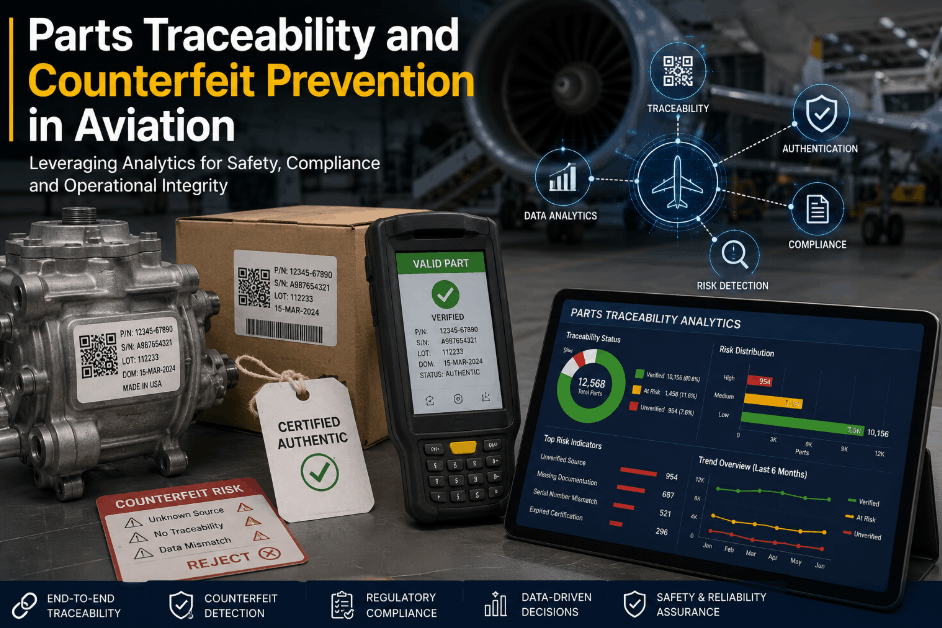
The single most compelling use case for blockchain in aviation maintenance is counterfeit parts prevention. Of the approximately 26 million aircraft parts installed annually on US civil aviation aircraft, an estimated 2% are potentially counterfeit — 520,000 suspect components per year. Each represents a potential failure point that entered the supply chain because documentation could not be reliably verified at the point of installation. Blockchain closes this gap by making part authentication instantaneous and irrefutable.
We spent eighteen months trying to patch our parts verification process with better paperwork and more training. It did not move the needle. The issue was structural — we were trying to catch fraud with systems designed to trust documentation. Blockchain changed the model entirely. The question shifted from 'is this certificate real?' to 'is this part on the ledger?' That distinction matters because one relies on human verification and the other relies on mathematics. We have not had a single unapproved part incident since we deployed the blockchain ledger across our supply chain.
— Director of Supply Chain Quality, Global MRO Network — 14,000+ parts tracked on-chain
Frequently Asked Questions
The 520,000 Unapproved Parts Installed Each Year Enter Through a Documentation Gap. Blockchain Closes It.
iFactory's Blockchain Records Module anchors every maintenance action and parts transaction to an immutable ledger — creating a provable chain of custody that satisfies FAA, EASA, and ICAO requirements while eliminating counterfeit parts exposure from your supply chain.