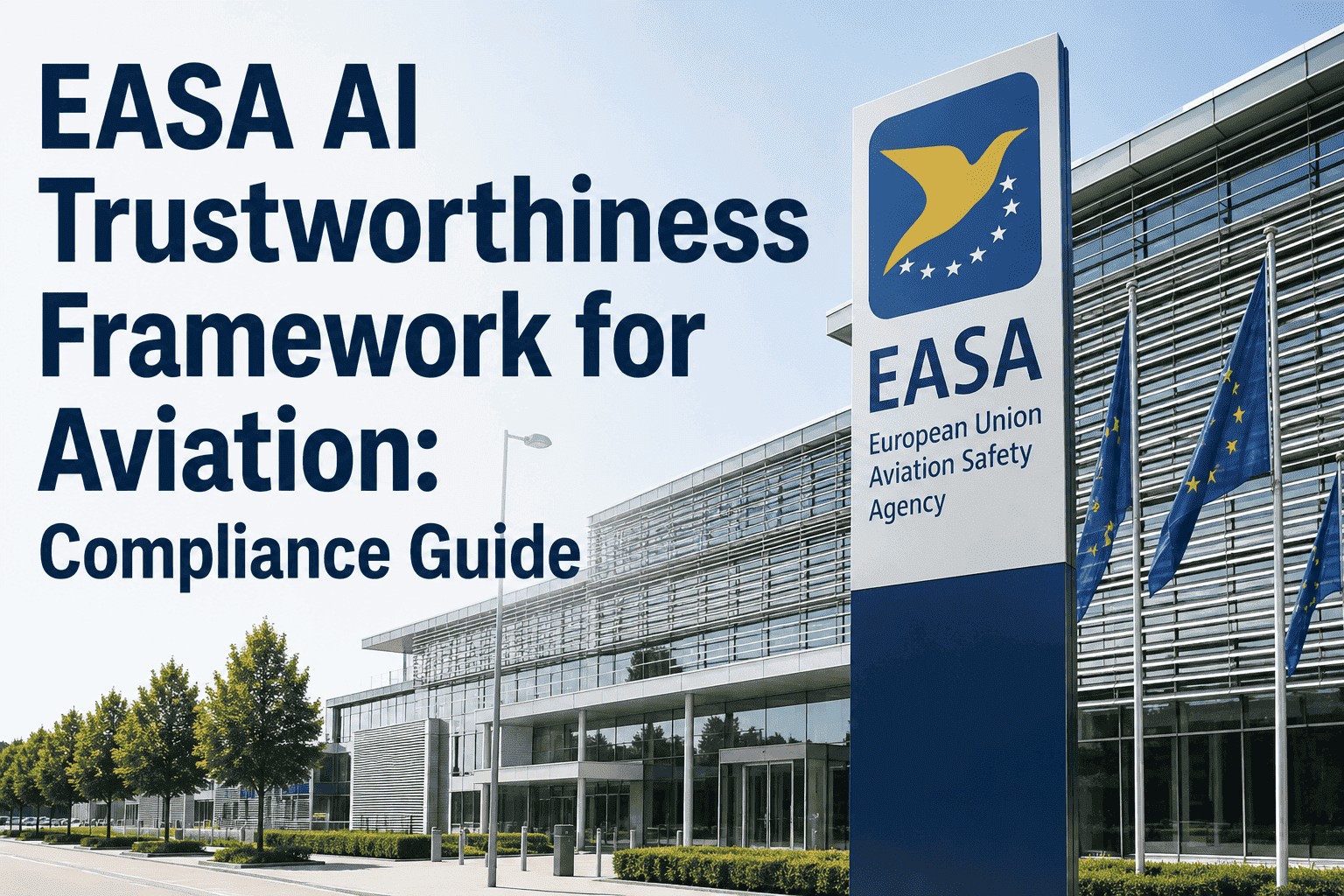
EASA has published its first regulatory proposal on artificial intelligence in aviation, setting the stage for how AI systems in MRO will be certified, monitored, and audited under the EU AI Act. This article covers the seven dimensions of AI trustworthiness, the Level 1 and Level 2 ML approval framework, key compliance deadlines, and practical steps your organisation can take to achieve audit readiness. Whether you are deploying predictive maintenance, AI-driven diagnostics, or computer vision for aircraft inspection, this guide provides the regulatory roadmap you need to prepare for EASA AI compliance before the enforcement deadlines arrive.
The 7 Dimensions of AI Trustworthiness
EASA defines seven interconnected dimensions that form the backbone of AI trustworthiness. Each dimension scales with the criticality of the AI system — from low-risk support tools to safety-critical decision systems.
Robustness
AI systems must maintain performance under edge cases, sensor noise, and environmental variation without degradation.
Explainability
Decisions and predictions must be interpretable by human operators and certification authorities alike.
Transparency
Capabilities, limitations, and failure modes of AI systems must be clearly documented and communicated.
Human Oversight
Meaningful human control must be maintained — human-in-the-loop for Level 1, human-on-the-loop for Level 2.
Data Quality
Training data must be complete, representative, and free from harmful bias or labelling errors.
Reliability
AI systems must deliver consistent, repeatable results within defined operational design domains.
Safety
AI functions must not introduce unacceptable risk to aircraft, personnel, or the operating environment.
Level 1 vs Level 2 ML Approval: The Compliance Gap
EASA's framework introduces a tiered approach to ML application approval based on the level of human involvement and system criticality. Understanding where your application falls is the first step toward compliance.
complexity
scales up
The EASA AI trustworthiness framework is not an optional add-on — it is the regulatory baseline for every ML application that touches airworthiness. The organisations that begin their compliance journey now will be the ones setting the standard when enforcement arrives.
— EASA AI Programme Team, NPA 2025-07 Publication StatementRegulatory Timeline: Key Deadlines for Compliance
The EU AI Act phases in over 2025-2027. Understanding the timeline is critical for planning your compliance roadmap and avoiding last-minute gaps.
KPI Dimensions: What EASA Requires vs What AI Delivers
EASA's DS.AI framework defines detailed technical requirements across multiple trustworthiness dimensions. AI monitoring transforms how these are measured and documented.
How the EU Compliance Module Serves Both Sides
iFactory's EU Compliance Module bridges the gap between EASA's trustworthiness requirements and your daily MRO operations — creating value for both compliance teams and operations managers.
Frequently Asked Questions
Common questions about EASA AI trustworthiness and EU AI Act compliance for aviation MRO operations.
Yes, with a phased approach. High-risk AI systems placed on the market before 2 August 2026 are subject to the rules only if they undergo significant design changes from that date onwards. Systems placed on the market after that date must comply from the outset. If your MRO already uses AI for predictive maintenance or fault diagnosis, you should begin documenting your compliance posture now, as retroactive requirements may apply during modification or recertification cycles.
Book a DemoLevel 1 ML applications are divided into two sub-levels: Level 1A (human-assisted) where the AI system provides recommendations but the human retains full decision-making authority, and Level 1B (human-AI cooperation) where the AI performs defined tasks under human supervision. Level 2 covers human-AI teaming where the AI system can act autonomously within its operational design domain while the human retains fallback authority. The certification requirements scale with each level, with Level 2 requiring the most extensive learning assurance documentation and continuous monitoring.
Contact UsNon-compliance with EU AI Act requirements for high-risk AI systems can result in administrative fines of up to 3% of the organisation's global annual turnover or EUR 15 million, whichever is higher. Additionally, national market surveillance authorities can order the withdrawal or recall of non-compliant AI systems. For aviation MROs operating under EASA jurisdiction, non-compliance may also affect your Part 145 or CAMO approvals, creating cascading operational and regulatory consequences.
Book a DemoiFactory's EU Compliance Module automatically generates audit-ready documentation including AI system performance logs, data lineage records, human oversight trails, and change management reports. It maps directly to EASA's AI trustworthiness dimensions and the W-shaped development process defined in ED-324/ARP6983. The module integrates with existing CMMS, M&E, and SMS platforms to create a single source of truth for all AI-related compliance evidence, reducing audit preparation time by up to 70%.
Contact UsUnder the EU AI Act, AI systems that are safety components of products covered by EU product safety legislation (including aviation) are classified as high-risk if they require third-party conformity assessment. In aviation MRO, this includes AI systems used for predictive maintenance of safety-critical components, fault diagnosis and decision support for maintenance actions, AI-driven inspection and defect detection, and any AI system that directly influences airworthiness determinations. The EASA framework provides specific guidance on risk classification for each use case under DS.AI.130.
Book a Demoifactoryapp.com · Contact Us · Book a Demo