Digital twin technology is transforming aviation fleet management by creating real-time virtual replicas of physical aircraft assets — enabling maintenance teams, fleet planners, and MRO operations to predict failures, simulate interventions, and optimize the entire aircraft lifecycle before a single wrench is turned. For fleet managers operating under FAA compliance mandates, aging fleet pressures, and rising MRO costs, the gap between reactive maintenance and twin-driven predictive intelligence is measured in millions of dollars annually. This implementation roadmap breaks down every phase of deploying a digital twin aviation fleet strategy — from initial data architecture to AI-driven analytics integration — so your organization can move from concept to operational twin in a structured, measurable sequence. If you want to see how iFactory's digital twin integration platform accelerates this journey for real aviation operators, book a demo today.
Build Your Aviation Digital Twin with iFactory
iFactory's AI-driven digital twin integration platform gives aviation fleet managers the real-time virtual aircraft models, predictive analytics engine, and MRO workflow intelligence needed to eliminate unplanned downtime and optimize fleet availability across every tail number.
What Is a Digital Twin in Aviation Fleet Management?
A digital twin in aviation is a continuously updated virtual model of a physical aircraft — synchronized in real time with onboard sensor data, flight cycle records, maintenance history, environmental exposure logs, and structural health monitoring streams. Unlike static CAD models or historical maintenance databases, a live aircraft digital twin evolves with every flight hour, every anomaly event, and every maintenance action, creating a dynamic intelligence layer that reflects the current and predicted future state of each airframe and its critical systems. For fleet management, the value is not in any single aircraft twin but in the aggregated fleet simulation digital twin environment, where patterns invisible at the individual aircraft level become statistically significant signals that drive planning decisions across the entire operation — such as identifying that a specific APU bleed valve variant fails at a 40% higher rate on routes with sustained high-altitude operations above FL380.
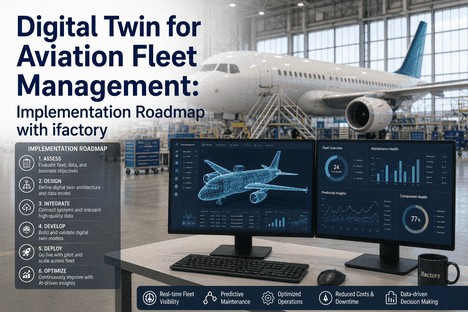
Digital Twin Aviation Fleet Implementation Roadmap: Five Phases
Implementing a digital twin aviation fleet program requires a phased approach that builds data infrastructure before analytical capability, and analytical capability before operational integration. Organizations that attempt to deploy a full twin environment in a single initiative consistently underperform those that follow a disciplined phase-gate model. Fleet managers evaluating their readiness should book a demo with iFactory to walk through a live fleet maturity assessment before committing to a deployment timeline.
Fleet Data Architecture and Source Integration
The foundational phase establishes the data pipeline connecting every aircraft data source — ACARS, QAR/FDR streams, AMM-linked maintenance records, component serialized history, engine health monitoring (EHM) outputs, and airframe load monitoring data — into a unified ingestion layer that defines the data taxonomy for the virtual aircraft model, determining which parameters are required for structural twins, propulsion twins, and cross-system correlation inputs. Without a correctly structured data architecture at this phase, subsequent twin layers will be built on incomplete sensor coverage that degrades predictive model accuracy in production.
Virtual Aircraft Model Construction and Validation
Phase two constructs the core digital twin model for each aircraft type in the fleet — mapping physical system hierarchies to their virtual counterparts and establishing the mathematical models that govern how the twin responds to operational inputs, including aerodynamic performance models, structural fatigue accumulation algorithms, component degradation curves, and system interdependency maps that simulate cascading failure scenarios. Model validation against known historical events is mandatory before any twin output is used in operational decision-making — a twin that cannot accurately retrospectively model a documented failure has no predictive credibility.
Real-Time Synchronization and Anomaly Detection Activation
With validated models operational, phase three activates the live synchronization layer that continuously updates each aircraft digital twin with real-time telemetry and configures anomaly detection thresholds — the conditions under which the twin's predicted system state diverges from the actual observed state by a margin that warrants investigation. Threshold configuration requires calibration against false positive rates acceptable to maintenance operations without creating alert fatigue, and teams implementing this phase should book a demo with iFactory to benchmark threshold logic against real fleet anomaly datasets before going live.
MRO Digital Twin Integration and Work Order Intelligence
Phase four connects the fleet digital twin environment to MRO operations — enabling the twin to drive work order generation, task card sequencing, parts demand forecasting, and hangar visit planning so that when the twin identifies that a hydraulic actuator will reach end-of-life tolerance within 340 flight hours, that signal automatically generates a sourcing event in the supply chain, a slot reservation in the maintenance schedule, and a task card pre-population in the MRO platform before the aircraft ever enters the hangar.
Fleet-Level Simulation and Strategic Planning Integration
The final phase elevates the aircraft lifecycle digital twin from an operational tool to a strategic planning asset — enabling scenario simulation for network planning decisions such as modeling how retirement of an aging airframe subtype affects reserve coverage, how a proposed route expansion changes fatigue accumulation rates on specific structural zones, or how a shift in average utilization from 8.2 to 9.6 block hours per day affects component replacement frequency and annual MRO budget requirements. Digital twin ROI in aviation is realized most completely at this phase, where simulation replaces estimation in fleet planning decisions carrying multi-year financial consequences.
Core Components of an Aviation Digital Twin Architecture
A production-grade fleet management digital twin is not a single technology — it is a layered architecture of interconnected components that each perform a specific function within the twin ecosystem. Understanding these components prevents organizations from investing in partial solutions that deliver twin outputs without the underlying infrastructure needed to make those outputs operationally actionable.
Standardized connectors for ACARS, ARINC 429/664, QAR download pipelines, AMOS/TRAX/Mxi MRO system APIs, engine OEM health monitoring feeds, and airframe OEM structural data portals — normalized into a unified aviation data schema.
Mathematical representations of structural fatigue, aerodynamic performance degradation, engine thermodynamic cycles, landing gear load accumulation, and hydraulic system pressure decay — calibrated against fleet-specific operational history.
Machine learning models trained on historical failure events that identify pre-failure signatures in multi-parameter time-series data — surfacing anomalies that physics-based models alone cannot detect from patterns in operational context data.
The real-time data pipeline that continuously updates each virtual aircraft model with live telemetry, post-flight download data, and maintenance event records — maintaining twin state accuracy within defined latency thresholds.
The computational layer that runs forward-projection models, what-if scenario analyses, fleet utilization simulations, and maintenance interval optimization calculations across the full fleet twin environment.
The workflow layer that translates twin outputs into actionable decisions — work orders, parts orders, schedule recommendations, and planning alerts — delivered to the right operational stakeholder at the right time.
Digital Twin ROI in Aviation: Measuring Value Across the Fleet Lifecycle
Quantifying digital twin ROI in aviation requires tracking value creation across three distinct horizons: immediate operational savings from reduced unplanned maintenance events, medium-term efficiency gains from optimized MRO scheduling and parts inventory, and long-term strategic value from improved fleet planning accuracy and extended aircraft lifecycle management — and organizations that measure only the first horizon consistently undervalue their twin investment while missing the executive-level business case that sustains program funding. Reliability leads building their case should book a demo to access iFactory's aviation digital twin ROI calculator.
| Value Category | Measurement Metric | Typical Range | Time to Realization |
|---|---|---|---|
| AOG Event Reduction | AOG events per 1,000 flight hours | 25–40% reduction | 6–12 months post-activation |
| MRO Labor Efficiency | Wrench-turn hours per C-check | 12–18% reduction | 12–18 months |
| Parts Inventory Optimization | Carrying cost per tail per year | $18K–$45K annual savings | 9–15 months |
| Component Life Extension | Average component retirement hours vs. limit | 8–14% life extension | 18–36 months |
| Fleet Utilization Rate | Block hours per aircraft per day | 0.3–0.7 BH/day improvement | 12–24 months |
| Fuel Burn Optimization | Kg fuel per flight hour vs. baseline | 1.2–2.8% improvement | 6–18 months |
Twin-Based Analytics for MRO Planning: Closing the Loop Between Prediction and Execution
The highest-value application of twin-based analytics planning in aviation MRO is the elimination of the gap between when a failure risk is identified and when a maintenance action is physically executed — a gap that in conventional maintenance programs can span weeks, during which the aircraft continues to accumulate risk, parts remain unordered, and hangar slots remain unallocated. With a live aircraft digital twin driving MRO planning, that gap closes to hours: when the fleet simulation digital twin identifies a trending vibration anomaly on the No. 2 engine fan stage, the analytics layer automatically calculates projected hours to threshold exceedance, triggers a sourcing event, identifies the next compatible maintenance window, and pre-populates the task card so the maintenance team receives a pre-staged work package rather than an emergency AOG call. Teams wanting to see this workflow live should book a demo with iFactory's aviation integration team.
Condition-Based Maintenance Triggering
Twin anomaly signals replace fixed interval inspections for eligible component classes, allowing maintenance actions to be triggered by actual condition rather than calendar time — extending component utilization while reducing unnecessary maintenance exposure.
Hangar Visit Optimization
Fleet twin data enables the bundling of multiple pending maintenance actions into a single optimized hangar visit — reducing total visit count per aircraft annually and eliminating the cost and disruption of repeat short-interval visits for individually triggered findings.
Predictive Parts Demand Forecasting
Twin-projected component replacement timelines across the full fleet feed directly into supply chain demand planning, enabling parts to be positioned at the correct base with sufficient lead time to eliminate AOG-driven purchase premiums that routinely run 40–80% above standard pricing.
Regulatory Compliance Documentation
Every maintenance action driven by twin analytics generates an automatically structured compliance record — linking the originating sensor data, the twin's diagnostic chain, the regulatory basis for the action, and the completed task documentation into an audit-ready package for FAA, EASA, and IATA ISAGO purposes.
Common Digital Twin Implementation Failures in Aviation — and How to Avoid Them
Aviation digital twin programs fail at a high rate not because the technology is immature, but because implementation approaches consistently underestimate the data quality, organizational change management, and integration complexity requirements that determine whether a twin environment delivers operational value or becomes an expensive visualization tool that no one uses in day-to-day operations.
Launching Without a Data Quality Baseline
Organizations begin twin construction before auditing the completeness and accuracy of their historical maintenance records — resulting in twin models calibrated against incomplete component history data that produce failure predictions with confidence intervals too wide to drive operational decisions.
Twin Outputs Not Connected to Workflow Systems
The twin produces accurate predictions delivered to a dashboard viewed by analysts — but never connected to the CMMS, MRO platform, or supply chain system where actions are actually initiated. The insight exists; the operational response does not.
Attempting Full Fleet Twin Deployment Simultaneously
Organizations attempt to deploy twins across every aircraft type and every system domain in a single program phase — overwhelming implementation resources, delaying operational value, and creating a program that is technically incomplete across all areas rather than fully operational in targeted high-value domains.
No Maintenance Team Adoption Strategy
Twin systems generate recommendations that experienced maintenance engineers dismiss because they do not understand the model logic, distrust algorithm-driven findings, or were not involved in the validation process that established twin credibility — creating a tool that technically works but is operationally ignored.
iFactory Digital Twin Integration: Purpose-Built for Aviation Fleet Intelligence
iFactory's digital twin integration platform is designed specifically for the data complexity, regulatory compliance requirements, and operational urgency that characterize aviation fleet management environments — delivering pre-built connectors for the major MRO platforms, a validated aviation data schema aligned with ATA chapter structure, and an AI-driven analytics engine trained on aviation-specific failure mode patterns rather than requiring extensive customization from a general-purpose IoT platform.
Real-time visibility across every aircraft in the fleet — current twin health status, active anomaly flags, upcoming predicted maintenance windows, and fleet-level utilization analytics in a single operational view.
Multi-parameter anomaly detection models that surface pre-failure signals across engine, airframe, avionics, and hydraulic system domains — with configurable sensitivity thresholds and false positive rate controls.
Bi-directional API integration with AMOS, TRAX, Mxi Maintenix, and RAMCO — enabling twin predictions to automatically generate work orders, task cards, and parts demands without manual transcription.
Scenario modeling tools that allow fleet planners to simulate utilization changes, route modifications, fleet composition shifts, and maintenance program adjustments against twin-projected outcomes before committing resources.
Automatic documentation of twin-driven maintenance actions aligned with FAA Part 121/145, EASA Part-M, and CAMO regulatory frameworks — generating audit-ready records at the point of decision, not after the fact.
Failure pattern intelligence identified on one aircraft type or route profile is automatically evaluated for applicability across similar assets in the fleet — propagating reliability improvements at enterprise scale.
Digital Twin Aviation: Frequently Asked Questions
How long does a full aviation fleet digital twin implementation take?
A phased implementation typically spans 12–24 months from data architecture design to full fleet operational twin activation. Organizations that begin with a targeted single aircraft type or system domain can achieve operational proof-of-value within 4–6 months, significantly accelerating the business case for full fleet expansion.
What data sources are required to build a viable aircraft digital twin?
At minimum: ACARS or equivalent telemetry stream, QAR/FDR download data, structured maintenance records with component serial number tracking, engine health monitoring outputs, and fleet-level operational data including route profiles and environmental exposure. Structural health monitoring data significantly enhances airframe twin quality but is not required for initial deployment on propulsion and systems domains.
How does a digital twin differ from existing aircraft health monitoring (AHM) systems?
Traditional AHM systems monitor current system state and alert on threshold exceedances — they are reactive. A digital twin uses the current state as an input to a predictive model that simulates future system behavior under projected operational conditions, enabling intervention before threshold exceedance occurs. The twin also enables scenario simulation and planning functions that AHM systems do not support.
Can digital twin outputs be used as the basis for maintenance program deviations with regulators?
Yes, under specific regulatory frameworks. The FAA's Aviation Rulemaking Advisory Committee has published guidance on data-driven maintenance program optimization, and several major carriers have obtained ETOPS extensions and maintenance interval adjustments supported by digital twin analytics evidence. EASA's AltMOC pathways similarly support twin-based maintenance program justification with appropriate validation documentation.
What KPIs should fleet managers track to measure digital twin program performance?
Track five core metrics: AOG events per 1,000 flight hours before and after twin activation, unscheduled removal rate for components under predictive monitoring, MRO cost per flight hour for twin-managed aircraft versus non-twin fleet, parts emergency purchase rate, and mean time between unplanned maintenance events per aircraft type.
Ready to Deploy a Digital Twin Across Your Aviation Fleet?
iFactory's aviation digital twin integration platform delivers the real-time virtual aircraft models, AI-driven predictive analytics, MRO workflow intelligence, and fleet simulation capabilities that move fleet management from reactive maintenance to twin-powered operational excellence — built specifically for the data complexity and regulatory demands of commercial and business aviation operations.