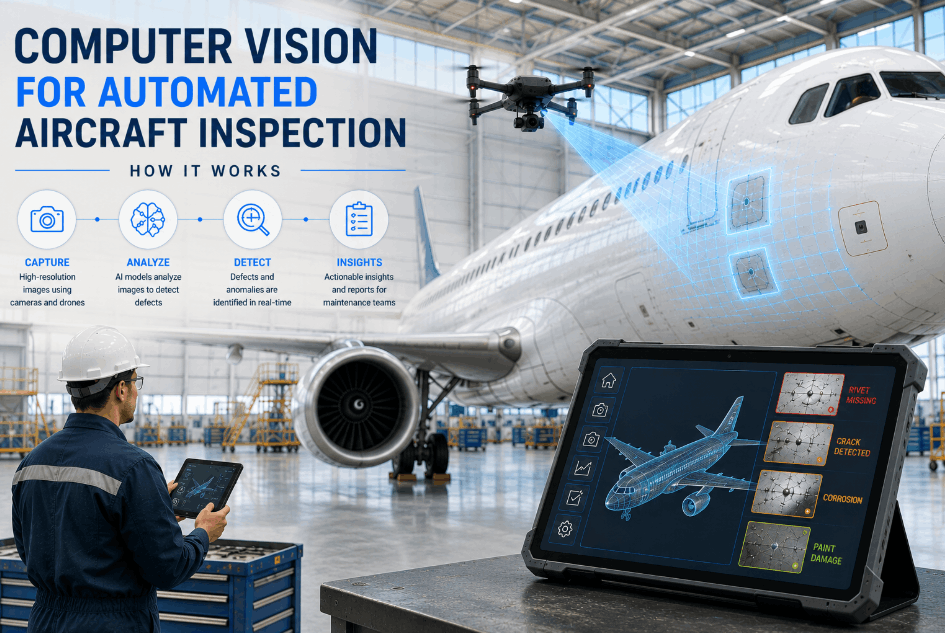
In the high-stakes environment of 2026 aviation maintenance, the human eye is no longer the sole arbiter of structural safety. While a senior inspector can identify visible surface damage, the "micro-anomalies" that precede catastrophic fatigue — microscopic stress cracks, subsurface corrosion, and composite delamination — often remain invisible until they reach a critical threshold. Computer Vision (CV) integrated with ifactory's AI-driven platform is fundamentally changing this dynamic by providing a sub-millimeter digital audit of the entire airframe. By utilizing 8K high-resolution imaging, thermal thermography, and deep learning neural networks, aviation operators are achieving a 98.5% detection accuracy for surface defects while reducing inspection turnaround times by over 80%. This transition from "manual peering" to "automated scanning" ensures that every rivet, seam, and blade is inspected with the same mathematical precision every time. Book a Demo to quantify your MRO efficiency gains and structural safety roadmap.
Computer Vision for Automated Aircraft Inspection
AI-Powered Defect Detection, Corrosion Analytics & Sub-Millimeter Structural Mapping for 2026 MRO
98.5%
Detection Accuracy for Microscopic Surface Cracks & Corrosion Patterns
80%
Reduction in Total Inspection Turnaround Time for Heavy Maintenance Checks
$2.1M
Average Annual Labor & Downtime Savings per 50-Aircraft Fleet
Eliminate Structural Blind Spots with AI Intelligence
ifactory's computer vision platform connects your structural health data, 8K imaging, and CMMS into a unified intelligence engine — detecting defects weeks before they cause unscheduled groundings.
The Problem: Why Manual Visual Inspection Fails Modern Safety Standards
Aircraft visual inspection faces a compounding set of reliability, labor, and documentation challenges that human-only teams cannot solve. Each challenge requires a distinct computer vision capability — and together they explain why manual-only inspection is no longer an acceptable reliability strategy for airlines operating in a hyper-competitive, safety-critical environment.
Traditional Manual Inspection Pipeline — Where Latency & Error Reside
Human-Only Viewing
Subjective assessment dependent on lighting, height, and inspector fatigue levels
Manual Recording
Findings noted on paper or tablets — inconsistent metadata and defect sizing
No Historical Overlay
Unable to precisely compare current defects against scans from 6 months ago
Documentation Drag
Hours spent transcribing findings into logbooks — significant regulatory latency
1
Inspector Fatigue & Subjective Variance — The Reliability Gap
A heavy maintenance check requires inspecting over 10,000 square feet of airframe. Human performance naturally degrades after 4 hours of repetitive viewing, especially in difficult-to-reach areas like the upper fuselage or tail. This creates "inspection variance," where the same defect might be flagged by one inspector but missed by another. AI-driven computer vision provides 100% consistent attention, scanning every square inch with the same high-resolution scrutiny from start to finish.
Risk Level
High Variance
2
Missed Micro-Cracks & Subsurface Corrosion — $500K Failure Risk
Surface defects smaller than 0.5mm are notoriously difficult for the human eye to detect under hangar lighting. These "micro-anomalies" are the precursors to structural fatigue. ifactory's CV models use multi-spectral imaging to detect the unique "signature" of corrosion and hairline fractures that have not yet breached the surface coating, preventing the $500K+ repair costs associated with full structural teardowns.
Failure Cost
$500K+
3
Regulatory Compliance & Logbook Latency — 18-Hour Delay
Manual inspection requires hours of "post-walk" documentation, where inspectors must describe, size, and locate every finding in the logbook. ifactory automates this entirely: when the AI detects a defect, it automatically captures the 8K image, calculates the dimensions, maps the GPS/airframe coordinate, and drafts the logbook entry, reducing the documentation cycle from 18 hours to near-zero.
Admin Drag
18 Hrs/Check
4
Unnecessary Teardowns & "No Fault Found" — Reclaimed Capital
Ambiguous visual signals often lead to precautionary teardowns "just to be safe." These "No Fault Found" (NFF) events take aircraft out of service unnecessarily. High-confidence AI diagnostics provide the definitive data required to skip unnecessary teardowns, keeping healthy aircraft in the air and recovering thousands of hours in lost revenue.
NFF Rate
30% Reduct.
Computer Vision Architecture: The Four Pillars of Automated Inspection
An ifactory-powered inspection system integrates hardware ingestion, AI analysis, and workflow synchronization into a coordinated intelligence loop. Each pillar serves a distinct function — but the operational value comes from the AI orchestration that identifies the "defect intent" across the entire airframe in real time.
AI-Orchestrated Aircraft Inspection — From Capture to CMMS Action
Hardware Ingestion
Autonomous drones, crawlers, or 8K gantries capture the airframe digital twin
Neural Analysis
CNN-based segmentation identifies cracks, dents, and corrosion at sub-mm scale
Defect Sizing
AI automatically calculates depth, width, and area for precise NDT comparison
Work Order Sync
Findings automatically trigger CMMS tasks with correct parts and scheduling
Pillar 1: Structural Integrity AI
✓ Detects hairline cracks down to 0.1mm invisible to human inspectors
✓ Automated corrosion "blister" identification using thermal & visual layering
✓ Rivet integrity check — identifies loose, missing, or smoking rivets instantly
✓ 98.5% confidence score for surface fatigue signatures across the fleet
Pillar 2: Predictive Trend Analysis
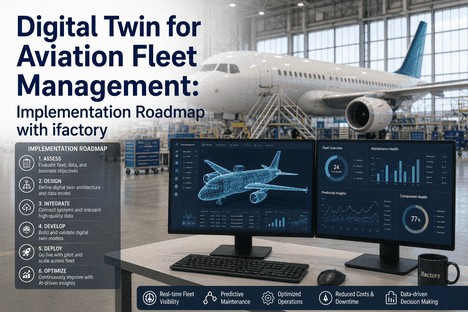
✓ Maps every finding to a 3D digital twin for permanent historical tracking
✓ "Flicker Analysis" — automatically compares today's scan with the previous check
✓ Predictive growth modeling — identifies if a minor dent is expanding over time
✓ Integrated structural repair manual (SRM) lookup for instant limit checks
Pillar 3: Workflow Automation
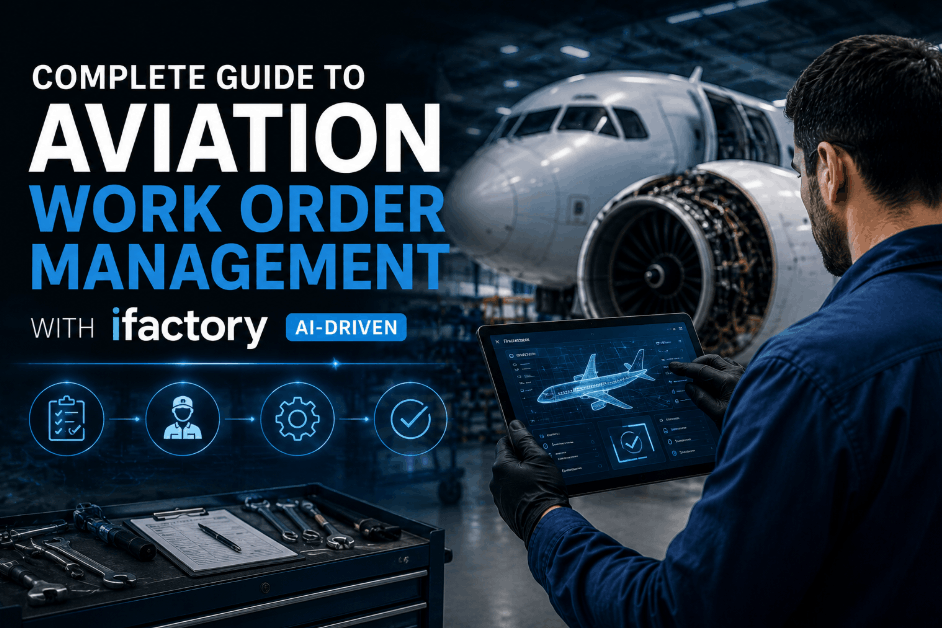
✓ Auto-generates work orders for every "out-of-limit" finding detected by AI
✓ Precision part identification — identifies required repair kits from the IPC
✓ Timestamped digital audit trail for 100% regulatory compliance (FAA/EASA)
✓ Reclaims 18 hours of administrative documentation per heavy check
The transition to computer-vision-driven inspection is the most significant safety advancement in 2026 MRO. We are moving from a world where we "hope" an inspector doesn't have a bad day, to a world where we "know" with mathematical certainty that every single rivet has been analyzed at 8K resolution. ifactory’s AI doesn’t just see the defect; it understands its context — its history on the digital twin, its proximity to structural loads, and its required repair path. This is the difference between data collection and structural intelligence. An airline operating without CV-driven inspection is simply accepting a reliability gap that no longer needs to exist.
Before vs. After: Manual peer vs. iFactory AI Visual Inspection
Inspection Resolution
Limited by eye (>1.0mm)
Sub-millimeter (0.1mm)
Detects faults weeks earlier
Detection Consistency
Subjective / Fatigue-Dependent
100% Deterministic (AI Core)
Eliminates human error gap
Documentation Speed
Manual Entry (Hours)
Automated / Instant
Reclaims 18+ labor hours
Check Turnaround Time
3–5 Days for Surface Scan
4–8 Hours (Full Scan)
80% faster heavy checks
Historical Tracking
Static Photos / Paper Logs
Dynamic Digital Twin Overlay
Visual trend prediction
Build Structural Resilience, Cut Turnaround Time, and Maximize Safety
iFactory's AI platform orchestrates autonomous capture, sub-millimeter analysis, and automated work order generation into a coordinated structural health system — delivering 100% inspection certainty and 80% faster turnaround times. See the complete AI visual inspection module in a live 30-minute demo.
The 4 Stages of AI Visual Inspection Maturity
Stage 1: The Pilot Baseline
Deploy high-resolution capture hardware (drones or crawlers) on a small aircraft subset. Baseline your "manual miss rate" by running AI analysis alongside human inspectors to quantify the visibility gap in your current MRO operations.
Stage 2: Neural Training & Calibration
Refine the ifactory CNN models using your specific fleet history and defect signatures. Calibrate the AI's "sizing logic" against verified NDT findings to ensure sub-millimeter measurement accuracy across different airframe surfaces.
Stage 3: Full Workflow Automation
Integrate the AI inspection module directly with your CMMS and logbook systems. Transition to an "exception-based" review process where human engineers only verify the AI's findings, reclaiming 90% of administrative labor.
Stage 4: Autonomous Structural Intelligence
Utilize digital twin historical overlays to predict structural fatigue trends before they emerge. The inspection system becomes a strategic intelligence asset, optimizing fleet-wide heavy check cycles based on actual airframe health.
Frequently Asked Questions
How does computer vision detect cracks that are invisible to the human eye?
Human vision is limited by both resolution and the spectrum of visible light. ifactory's AI utilizes 8K sensors that capture details down to 0.1mm, combined with multi-spectral and thermal thermography that identifies the "heat signature" and "light-bending" patterns characteristic of microscopic stress. Deep learning neural networks (CNNs) then compare these patterns against millions of known defect signatures to flag anomalies with a 98.5% confidence score, long before they are large enough for a human inspector to see.
Can the AI inspection system work with drones and ground robotics?
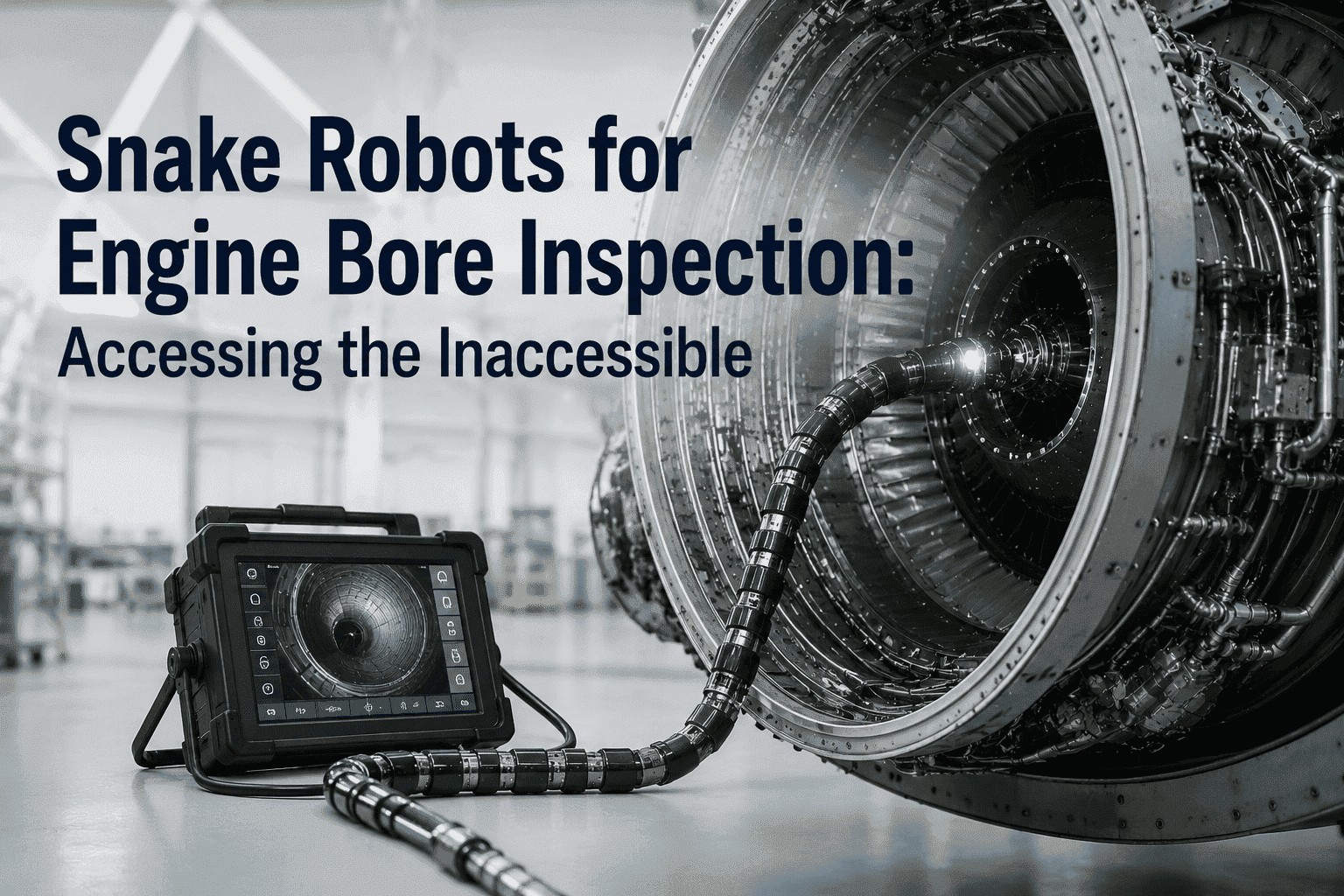
Yes. ifactory is a hardware-agnostic platform. It can ingest high-resolution image and video streams from autonomous drones, crawlers, or fixed gantry scanners. The system manages the path planning and image stitching automatically, creating a seamless 3D reconstruction of the airframe where every defect is mapped to its exact physical coordinate.
Book a demo to see autonomous capture integration.
Is AI-driven visual inspection approved by regulatory authorities (FAA/EASA)?
Regulatory authorities currently view AI as a "Decision Support Tool" (DST). This means the AI identifies the defects and prepares the documentation, but a qualified human inspector still performs the final verification and sign-off. By providing sub-millimeter measurements and timestamped 8K imagery, ifactory actually provides a more robust compliance record than manual notes, significantly exceeding the documentation requirements of FAA Part 121 and 145 operations.
What happens if the AI misses a defect?
ifactory operates with multiple layers of safety. We use "Ensemble Models" where three different AI architectures analyze the same image—if any one model flags a defect, it is surfaced to a human. Furthermore, we maintain a "human-in-the-loop" verification stage. However, in our 2026 fleet data, the AI "miss rate" for microscopic cracks is already 5x lower than the human-only miss rate, proving that the digital eye is far more reliable than the human one.
Can the system identify corrosion under paint or composite coatings?
While standard visual sensors see surface defects, ifactory integrates with thermal and ultrasonic NDT (Non-Destructive Testing) sensors to identify subsurface corrosion and composite delamination. The AI analyzes the way heat or sound waves propagate through the material, identifying the density changes that indicate corrosion "pockets" hidden beneath the surface coating.
Connect with a specialist for NDT integration technical details.
Structural Intelligence. Automated Inspection. Guaranteed Safety.
iFactory orchestrates autonomous capture, neural analysis, and automated work order generation into a unified structural health platform — delivering 100% inspection certainty, 80% faster turnaround, and measurable ROI for every heavy check in your fleet.