The aviation maintenance, repair, and overhaul (MRO) sector is undergoing its most significant technological shift since the introduction of jet engines. In 2026, the integration of artificial intelligence is no longer a forward-looking experiment; it is the core operational reality for airlines achieving top-tier fleet availability. From predictive engine health monitoring to computer-vision-driven visual inspections, AI is systematically eliminating the human-latency bottlenecks that have historically driven unscheduled AOG (Aircraft-on-Ground) events and inflated operating costs. ifactory's AI Feature Suite provides a unified platform that connects every facet of the MRO lifecycle — including telemetry, inventory, and documentation — into a single intelligent ecosystem. To see how ifactory's AI-driven analytics transform your hangar operations, Book a Demo with our aviation digital transformation team today.
Lead the Fleet Intelligence Revolution with ifactory AI
ifactory's aviation AI suite connects your flight data, manual libraries, and warehouse systems into a unified intelligence engine — reducing MTTR and maximizing asset revenue across your entire global network.
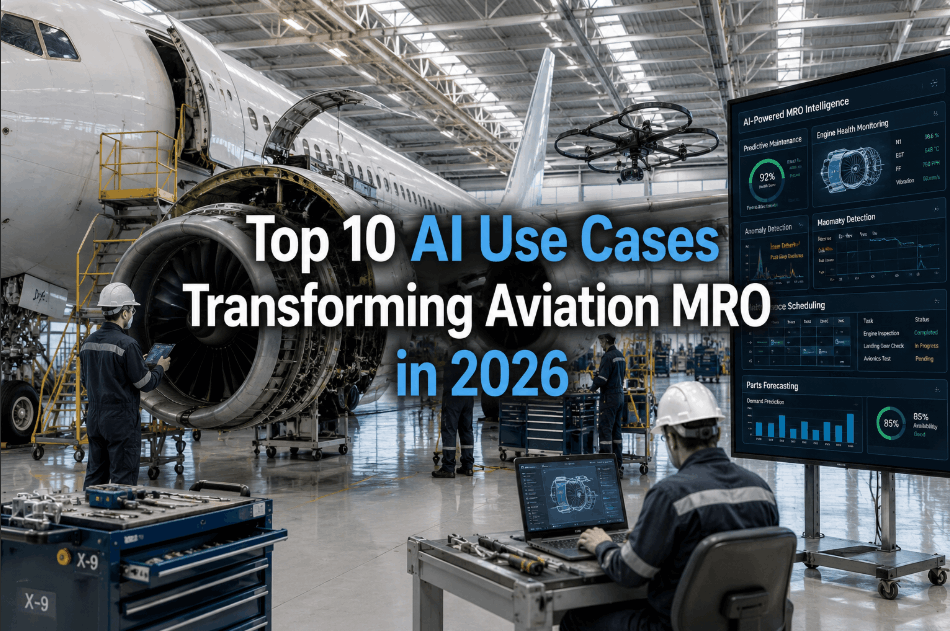
The Top 10 AI Use Cases Transforming Aviation MRO in 2026
The most impactful AI applications in aviation focus on the "Information Gap"—the delay between a mechanical anomaly occurring and a maintenance action being taken. By deploying high-resolution machine learning models directly into the flight data stream, ifactory allows operators to see failure signatures that are invisible to legacy threshold-based monitoring. These ten use cases represent the full spectrum of a modern, AI-driven MRO strategy. If your team is still reacting to faults rather than predicting them, your reliability program has a structural blind spot — and booking a demo is the fastest way to understand the competitive advantage of predictive intelligence.
Predictive Fleet Health & AOG Prevention
Machine learning algorithms analyze real-time ACARS and FDR telemetry to identify the subtle "clustering" of minor anomalies that precede major component failures. By identifying these patterns weeks in advance, ifactory reduces unscheduled AOG events by up to 40%, allowing repairs to happen during routine overnight checks rather than at the departure gate.
Condition-Based Engine Lifing (HoW)
AI transforms engine MRO from a calendar-based discipline to a condition-based science. By monitoring EGT margins and vibration harmonics in real-time, the platform allows operators to extend "Time-on-Wing" for healthy turbines while prioritizing those showing genuine degradation, recovering millions in asset capital that is typically lost through premature overhauls.
Automated Visual Inspection (Computer Vision)
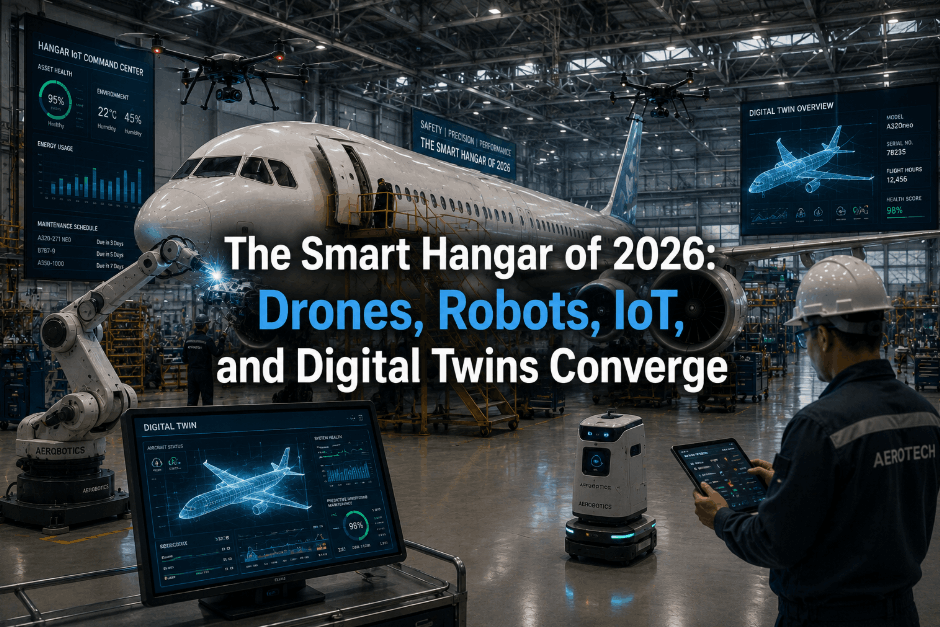
Integrating computer vision with ground robotics and drones allows for the automated inspection of fuselages, wings, and landing gear. ifactory's CV models identify lightning strikes, bird impacts, and structural fatigue significantly faster and more accurately than manual walk-arounds, reducing heavy maintenance check times by over 18 hours per aircraft.
Generative AI Troubleshooting Copilot
Natural language AI assistants (Copilots) allow mechanics to query their fleet and technical manuals simultaneously. By performing "Retrieval-Augmented Generation" (RAG), the system surfaces the exact troubleshooting path from the AMM/IPC in seconds, reducing documentation search time by 90% and improving First-Time Fix Rates (FTFR).
Intelligent Parts Forecasting & Inventory Optimization
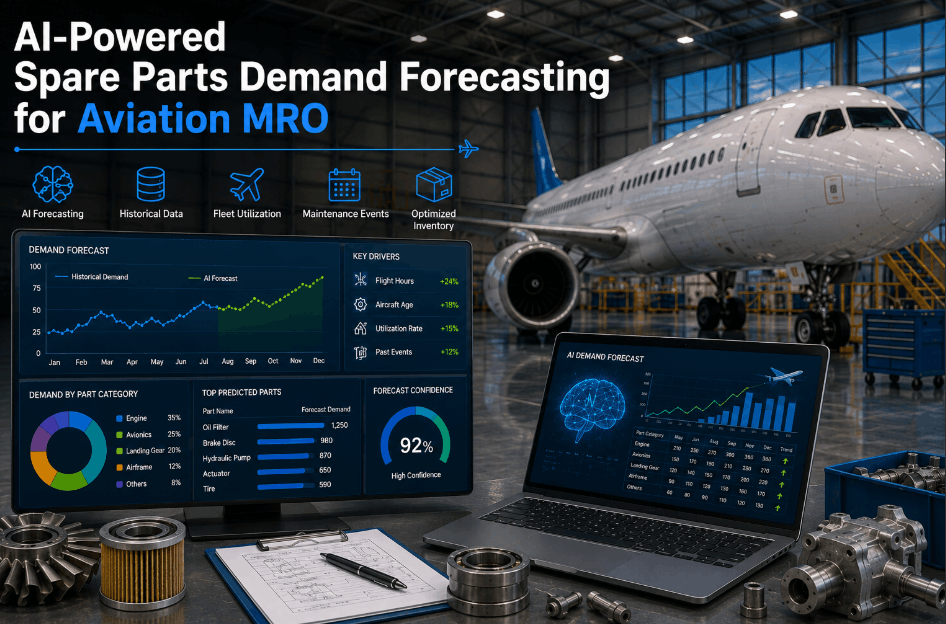
AI correlates maintenance predictions with warehouse stock levels to forecast parts demand with surgical precision. This ensures that high-risk components are already staged at the hub before a predictive fault is flagged, eliminating the "wait-for-parts" delays that account for 25% of all MRO turnaround latency.
Dynamic Hangar Slot Optimization
AI-driven scheduling models analyze thousands of variables—including technician availability, part lead times, and fleet reliability scores—to optimize hangar utilization. This ensures that every bay is occupied by the aircraft with the highest operational risk, maximizing revenue-per-slot across the entire maintenance network.
Digital Twin Stress Mirroring
Every airframe is mirrored in a digital twin that simulates mechanical fatigue based on actual flight routes and environmental exposure. This allows for individualized maintenance scheduling that maximizes the safe operating lifespan of each specific aircraft while identifying fleet-wide structural risks early.
Automated Compliance & Logbook Drafting
ifactory utilizes NLP to assist technicians in drafting FAA/EASA compliant logbook entries. By automatically populating repair data from the digital work order into the compliance record, the system ensures technical precision and reduces "documentation drag" by up to 50% per task.
Tribal Knowledge Digitization & Capture
Machine learning ingests decades of historical maintenance logs to digitize the "tribal knowledge" of senior engineers. This creates a permanent intelligence layer that helps junior technicians identify complex, non-routine faults based on historically successful repair signatures.
Fuel Efficiency & Carbon Analytics Optimization
AI correlates engine health with fuel burn variance to optimize overall fleet carbon footprints. By identifying engines that are "burning dirty" due to internal degradation or sensor drift, ifactory allows for targeted washes and repairs that reclaim up to 2.5% in total fuel efficiency.
MRO Operational Impact: AI-Driven vs. Legacy Maintenance
| Maintenance Dimension | Legacy Manual Approach | ifactory AI-Driven Approach | Operational Efficiency |
|---|---|---|---|
| Troubleshooting Latency | 4–8 Hours (Manual Manual Search) | <15 Minutes (AI Copilot Analysis) | 85% Improvement in Speed |
| Unscheduled AOG Rate | High (Reactive/Threshold Alarms) | Ultra-Low (Predictive Clustering) | 40% Reduction in Groundings |
| Parts Inventory Costs | High (Precautionary Stockpiling) | Optimized (Demand-Based Stock) | 20% Reduction in Carrying Costs |
| Technical Documentation | Paper/PDF (Search Dependent) | Digitized (Contextual & Searchable) | 90% Reduction in Search Time |
| Work Order Accuracy | Variable (Technician Dependent) | Standardized (AI-Guided Path) | 35% Improvement in FTFR |
The Technical Architecture of AI-Driven MRO
Implementing the top 10 AI use cases requires a robust, high-performance data architecture that can bridge the gap between legacy aircraft sensors and modern cloud/edge intelligence. ifactory provides this unified architecture, ensuring that every AI model is grounded in real-time truth. Understanding the layers of this architecture is critical for CTOs and Directors of Maintenance who are planning their 2026 digital roadmap.
High-Speed Ingestion Layer
The system must ingest ACARS, FDR, and sensor data at scale, processing millions of packets per hour. ifactory’s ingestion layer normalizes disparate data formats into a unified "Fleet Pulse" stream, ready for immediate AI inference.
Edge AI Inference Nodes
To reduce latency for gate decisions, we deploy physical GPU nodes (NVIDIA H100) directly at primary hubs. This allows the AI to "think" locally, providing diagnostic results to mechanics in milliseconds without waiting for cloud round-trips.
Aviation-Specific LLM (RAG)
Our generative AI is not a general-purpose model. It is a specialized industrial agent trained on aviation technical English, ensuring that it understands the nuances of AMMs, IPCs, and complex structural repair manuals.
Vector-Based Manual Libraries
We transform your entire technical library into a vector database. This allows the AI to perform semantic searches, finding the exact paragraph of a manual based on the "meaning" of a fault code rather than just keyword matching.
Secure "Private Air" Networking
For data security, ifactory can operate on a "Private Air" network—a secure, end-to-end encrypted channel that keeps your fleet telemetry and maintenance records isolated from the public internet, meeting the highest IT security standards.
Bi-Directional CMMS Integration
AI insights are useless if they don't trigger actions. Our platform features bi-directional integration with major CMMS/ERP systems, automatically creating work orders and reserving parts based on predictive signals.
Building an AI Maturity Roadmap for Aviation MRO
Data Ingestion & Telemetry Unification
Consolidate all data streams—ACARS, FDR, QAR, and CMMS—into a single high-speed ingestion layer. ifactory’s open API architecture ensures that your legacy systems are connected to the AI engine, creating the baseline for predictive visibility.
Predictive Baseline Training
Utilize 12–24 months of historical maintenance data to train the ML models on your fleet's specific failure patterns. This step customizes the AI to recognize the unique behavioral quirks of your specific engine and airframe configurations.
Hangar-Level Edge AI Deployment
Deploy physical GPU nodes at your primary hubs to allow for zero-latency AI inference. This ensures that critical diagnostic decisions can be made at the gate in milliseconds, keeping your fleet in the air and on schedule.
Closed-Loop MRO Automation
Integrate AI predictions directly with work order generation and parts ordering. When the AI "sees" a fault, the system "acts" by staging the part and reserving the technician, completing the loop from data to decision to action.
Continuous Intelligence Optimization
Establish a weekly review of AI-driven reliability metrics with fleet leadership. Use ifactory’s advanced reporting tools to demonstrate program ROI, identify emerging risk areas, and refine the predictive models for further performance gains.
Frequently Asked Questions: AI in Aviation MRO
Is AI adoption in MRO compliant with FAA and EASA regulations?
Yes. ifactory’s AI suite is designed as a Decision Support System. All final airworthiness certifications and maintenance releases are still performed by authorized human technicians. The AI provides the diagnostic intelligence and documentation support required to make those decisions faster and more accurately.
How long does it take to see ROI from an AI implementation?
Most operators see measurable ROI within the first 60–90 days, typically driven by the prevention of a single major AOG event or the optimization of a heavy maintenance turnaround cycle. Full platform payback is consistently achieved within 12–14 months.
Can ifactory’s AI suite work with legacy aircraft and systems?
Absolutely. Our open API architecture and specialized ingestion layers are designed to bridge the gap between legacy FDR/ACARS data and modern AI analytics. We can provide predictive health monitoring for any airframe that generates basic telemetry data.
How does the "AI Copilot" prevent incorrect repair recommendations?
We use a Retrieval-Augmented Generation (RAG) architecture that restricts the AI to only provide information found in your officially approved manual library (AMM, IPC, SB). Every recommendation includes a direct citation from the manual for human verification.
What is the main advantage of "On-Premise" AI for airlines?
Data privacy and latency. By deploying AI nodes directly at your hubs, we ensure that your sensitive fleet data never leaves your secure network and that troubleshooting results are delivered in milliseconds, which is critical for quick turnaround windows.
How does AI handle non-routine findings during a heavy check?
AI assists in the immediate assessment of non-routine findings by correlating the defect with historical repair data and the AMM. It provides the technician with the most likely root cause and the required parts list instantly, preventing the non-routine finding from blowing out the project timeline.
Can AI assist in MRO labor capacity planning?
Yes. ifactory’s AI models analyze your predicted maintenance workload against your current technician certifications and shift patterns. It identifies "labor bottlenecks" weeks in advance, allowing you to rebalance shifts or authorize overtime before the workload peak hits the hangar.
What is the impact of AI on airframe residual value?
Aircraft with a continuous, data-backed digital health history (enabled by AI digital twins) consistently command higher residual values and lease-end returns. The transparent, immutable record of engine health and structural stress provides buyers and lessors with a level of certainty that manual logbooks cannot match.
Turn Your Hangar Data Into a Strategic Asset
ifactory's aviation AI suite integrates your fleet data, technician expertise, and MRO logistics into a unified intelligence engine — maximizing reliability and reclaiming millions in operational revenue.