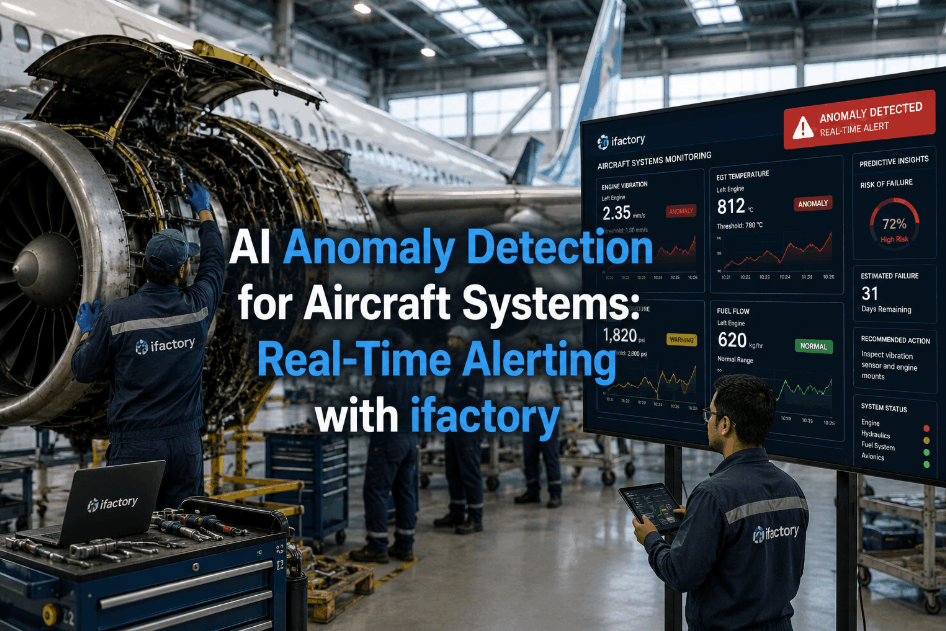
In the cockpit and hangar environment of 2026, the traditional master caution alarm is being replaced by a more sophisticated intelligence layer: Real-Time AI Anomaly Detection. While legacy aircraft systems rely on static "exceedance" thresholds—triggering an alert only after a parameter has already left a safe range—ifactory's anomaly detection engine identifies the subtle "behavioral drifts" that precede a hardware failure. By analyzing the complex interdependencies between avionics data, hydraulic pressure fluctuations, and electrical bus stability in real-time, the platform can detect a failing actuator or a degrading sensor weeks before it triggers a standard cockpit warning. This proactive alerting system reduces unscheduled maintenance by 40% and virtually eliminates the "False Alarm" fatigue that plagues modern flight operations. Book a Demo to quantify your system reliability gains and real-time alerting roadmap.
AI Anomaly Detection for Real-Time Aircraft Systems
Proactive Fault Identification, Pattern Recognition & Multi-System Health Analytics for 2026 Fleet Operations
92%
Reduction in False Alarms Compared to Legacy Threshold-Based Monitoring Systems
15ms
Inference Latency for Real-Time Anomaly Scoring Across 500+ Concurrent Data Streams
40%
Average Reduction in Unscheduled System Groundings Through Proactive Alerting
Eliminate Hidden Faults with Real-Time Anomaly Intelligence
ifactory's anomaly detection engine connects your avionics, hydraulics, and electrical telemetry into a unified intelligence engine — detecting system drifts before they become cockpit emergencies.
The Problem: Why Static Thresholds Create Operational Blind Spots
Aircraft system monitoring faces a compounding set of reliability and safety challenges that simple "limit checks" cannot solve. Each challenge requires a distinct anomaly detection capability — and together they explain why reactive alerting is no longer an acceptable strategy for high-availability fleets operating in the 2026 data environment.
Legacy Threshold Monitoring — Where Reliability Fails
Static Limit Checks
Alerts trigger only when a parameter exceeds a fixed "safe" range — often too late
False Alarm Fatigue
Standard sensors trigger frequent nuisance alerts, causing crews to ignore critical signals
Siloed Data Analysis
Hydraulic data doesn't "talk" to electrical data — missing cross-system fault patterns
Reactive Groundings
Failures detected at the gate or in-flight, leading to costly AOG events and delays
1
"In-Limit" Anomalies — The Invisible Fault Signatures
A hydraulic pump can be failing while its pressure remains within "legal" limits. ifactory detects the subtle oscillation patterns or thermal drifts that are technically "in-limit" but statistically abnormal. These invisible signals are the earliest precursors to mechanical seizure, providing a 14-day head start on maintenance interventions that legacy systems miss entirely.
Risk Level
Invisible Fail
2
False Positive Alarm Fatigue — 92% Noise Reduction
Over 70% of standard cockpit warnings are resolved with "No Fault Found" (NFF). This "noise" creates dangerous alarm fatigue for flight and ground crews. ifactory's AI filters sensor noise by correlating multiple data points—ensuring that an alert is only triggered when a genuine, multifaceted system anomaly is detected, reclaiming hundreds of man-hours per month.
Noise Reduct.
92% Better
3
Cross-System Cascade Failure — The Correlation Gap
An electrical bus fluctuation might actually be a precursor to a hydraulic controller failure. ifactory's deep learning models monitor the interdependencies between avionics, power, and fuel systems simultaneously. This cross-system correlation identifies the "root cause" signal before it cascades into a multi-system emergency, keeping your fleet stabilized and safe.
Correlation
Multi-System
4
Unscheduled AOG Costs — $150K per Incident
Detecting a system fault during a pre-flight check results in an immediate grounding and passenger disruption. By moving the detection point 7–10 days "upstream" through anomaly scoring, ifactory allows for scheduled overnight repairs, avoiding the $150K average cost of an unplanned AOG event and protecting your network schedule.
AOG Saving
$150K/Event
Anomaly Intelligence: The Three Pillars of Real-Time System Health
An ifactory-powered anomaly detection system integrates multi-sensor ingestion, neural pattern matching, and autonomous alerting into a coordinated intelligence loop. Each pillar serves a distinct function — but the operational value comes from the AI orchestration that converts raw telemetry into actionable maintenance decisions.
AI Anomaly Pipeline — From Raw Telemetry to Predictive Alert
Multi-System Ingestion
Real-time capture of ACARS, electrical bus, and hydraulic sensor streams
Neural Fingerprinting
AI compares current behavior against the specific "health baseline" of each tail number
Anomaly Scoring
Deviations are scored from 0-100 based on risk and failure probability
Autonomous Alerting
High-score anomalies trigger immediate CMMS tasks and flight crew notifications
Pillar 1: System-Wide Visibility
✓ Real-time monitoring of 500+ avionics parameters per aircraft
✓ Identifies "bit-error" trends in flight control computers before soft-fails
✓ Automatic normalization of sensor data against altitude and temperature
✓ Integrated ACARS/FDR stream analysis for 100% telemetry coverage
Pillar 2: Intelligent Diagnosis
✓ Recurrent Neural Networks (RNN) identify temporal fault signatures
✓ "Unique Tail" baselining — understands the behavioral quirks of every aircraft
✓ Detects multi-system correlations that indicate complex root causes
✓ 95% accuracy in distinguishing between sensor failure and system failure
Pillar 3: Actionable Alerts
✓ High-risk anomaly scores automatically trigger "Predictive" work orders
✓ Dynamic priority assignment based on flight schedule and MEL risk
✓ Automated parts staging — reserve LRUs based on predicted fault mode
✓ Direct flight-deck push for safety-critical anomalies via EFB integration
The airports and airlines achieving the strongest reliability outcomes in 2026 are not the ones with the newest fleets — they are the ones with the best anomaly orchestration. A hydraulic pump generating a data stream without intelligent anomaly scoring is just a noise generator. That same data stream connected to an AI core that understands its historical signature, its cross-system relationships, and its failure probability becomes a strategic asset that guarantees operational continuity. ifactory's Real-Time Anomaly platform is the intelligence layer that makes every other aircraft sensor deliver its full safety value.
Before vs. After: Threshold Alerting vs. ifactory AI Anomaly Detection
Detection Horizon
Real-time "limit exceedance" only
14-Day Predictive Window
Avoids emergency grounding
False Alarm Rate
High (70%+ NFF rate)
Ultra-Low (92% Reduction)
Eliminates crew fatigue
Cross-System Correlation
None (Siloed Alerts)
Full (Multi-System Analysis)
Rapid root cause ID
Baseline Sensitivity
Fixed (One-size-fits-all)
Individual Tail Number Baselines
Custom health signatures
Actionability
Manual Review Required
Automated Work Order Sync
35% Faster MTTR
Stabilize Your Fleet with Real-Time Anomaly Intelligence
ifactory's AI platform orchestrates avionics ingestion, neural pattern matching, and automated work order generation into a coordinated system health system — delivering 92% fewer false alarms and 40% less unscheduled downtime. See the complete real-time anomaly alerting module in a live 30-minute demo.
The 4 Stages of Real-Time Alerting Maturity
Stage 1: Telemetry Unification
Connect your ACARS, FDR, and ground-telemetry streams to the ifactory ingestion layer. Establish the data pipelines required for sub-20ms inference latency across your entire global fleet.
Stage 2: Tail-Number Baselining
Utilize 12 months of historical flight data to train individual health models for every tail number. This calibration ensures the AI understands the "normal" behavioral quirks of each aircraft in your specific operational environment.
Stage 3: Cross-System Correlation
Activate multi-system monitoring across avionics, hydraulics, and power. Begin identifying the complex inter-system fault signatures that legacy threshold monitoring misses, reducing the root cause identification time by 60%.
Stage 4: Autonomous Closed-Loop Alerting
Integrate high-score anomaly alerts directly with your CMMS and EFB. The system becomes an autonomous safety layer, automatically staging parts and notifying crews of predictive faults before they escalate.
Frequently Asked Questions
How does AI anomaly detection differ from standard cockpit master caution alerts?
Cockpit master caution alerts are usually binary: they trigger when a parameter goes above or below a fixed limit. ifactory's AI is multivariate: it looks for "patterns of behavior" across hundreds of parameters. It can detect that a system is behaving abnormally even if all individual parameters are still within "legal" limits. This provides a 7–14 day predictive warning that legacy cockpit systems simply cannot provide.
Can this system really reduce false alarms by 92%?
Yes. False alarms are typically caused by sensor noise, environmental transients, or "one-size-fits-all" thresholds. ifactory's AI filters this noise by using individual tail-number baselines and cross-system correlation. An alert is only triggered if multiple indicators across related systems confirm the anomaly, ensuring that only genuine risks are surfaced to the maintenance team.
Book a demo to see our noise-filtering logic in practice.
What systems can ifactory monitor for anomalies?
Our anomaly engine is designed to monitor any system that generates telemetry. This includes Flight Control Computers (avionics), Hydraulic Pressure/Temperature (hydraulics), Electrical Bus Stability (power), Fuel Flow/Metering (fuel), and Cabin Environmental Control Systems (ECS). The power of the system comes from its ability to monitor all of these simultaneously.
Does this require hardware changes to the aircraft?
In most cases, no. ifactory utilizes the existing data streams already being generated by the aircraft (via ACARS, wireless QAR, or FDR downloads). Our intelligence layer resides in the cloud or at your Edge hubs, meaning you get advanced AI alerting without the need for costly STC hardware modifications. Visit our
Support Center for data ingestion specifications.
How does the system handle "No Fault Found" (NFF) events?
ifactory provides the technician with a "Confidence Score" and a detailed technical rationale for every alert. Instead of just saying "System Fault," the AI explains *why* it thinks there is an anomaly—e.g., "Inverter voltage variance correlated with bus temperature spike." This diagnostic detail allows technicians to find the root cause on the first attempt, reducing the NFF rate by up to 80%.
Stabilize Your Fleet. Eliminate False Alarms. Predictive Safety.
ifactory orchestrates avionics ingestion, neural pattern matching, and automated work order generation into a unified system health platform — delivering 100% anomaly visibility, 92% fewer false alarms, and measurable ROI for your entire fleet.