In the hyper-complex landscape of 2026 aviation maintenance, the volume of technical documentation for a single airframe can exceed hundreds of thousands of pages. For maintenance teams, the challenge isn't just finding a fault — it is navigating the dense forest of AMMs (Aircraft Maintenance Manuals), IPCs (Illustrated Parts Catalogs), and historical service bulletins to find the specific troubleshooting path for a non-standard telemetry anomaly. Generative AI integrated with ifactory's AI-driven platform is fundamentally solving this knowledge gap by providing an "AI Copilot" that understands both the raw flight data and the technical literature simultaneously. By allowing mechanics to query their fleet in natural language, aviation operators are achieving a 50% reduction in troubleshooting time and a significant improvement in First Time Fix Rates (FTFR). To see how generative AI assistants accelerate your hangar throughput, Book a Demo with the iFactory aviation intelligence team today.
GSI COPILOT PLATFORM
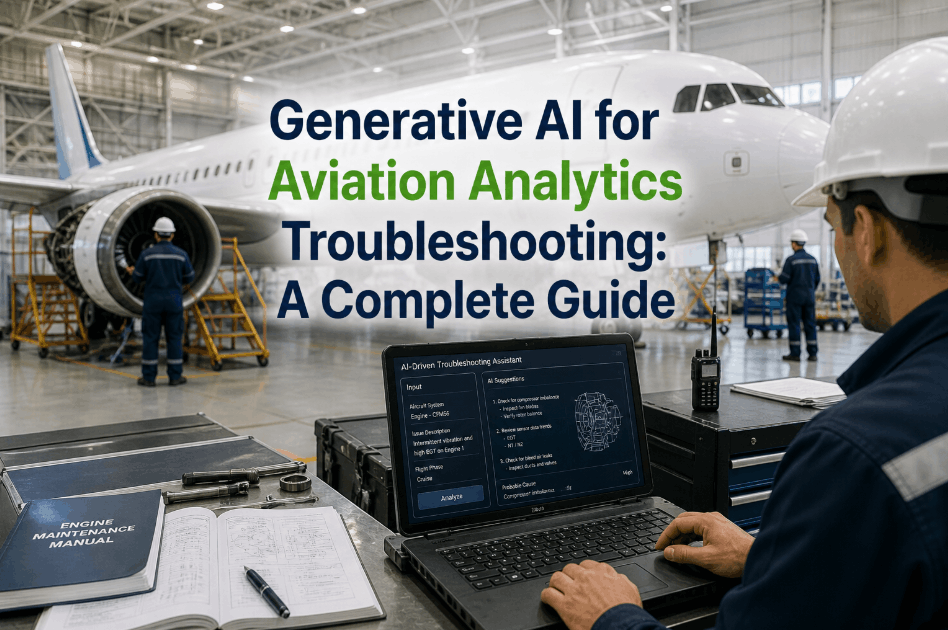
Generative AI for Aviation Analytics Troubleshooting
ifactory's AI Copilot unifies LLM-driven manual retrieval with real-time flight telemetry — allowing your mechanics to diagnose complex faults through natural language conversation and automated troubleshooting logic.
Why Generative AI Troubleshooting Is the New Standard for MRO in 2026
Closing the Intelligence Gap Between Data and Decision
The primary bottleneck in modern aviation maintenance is no longer a lack of diagnostic data, but the "retrieval latency" inherent in manual troubleshooting. When a mechanic receives a fault code, they must manually cross-reference that code against flight logs, maintenance history, and technical manuals. Generative AI eliminates this step by performing "Retrieval-Augmented Generation" (RAG) — essentially "reading" the relevant sections of the AMM and the specific flight's telemetry data to provide a plain-language summary of the fault and the most likely corrective action. iFactory’s specialized aviation LLMs are trained to understand aviation-specific nomenclature, ensuring that "tribal knowledge" is codified and accessible to every technician on the floor, regardless of their experience level. Furthermore, this digital intelligence layer acts as a constant supervisor, verifying that every troubleshooting step follows the manufacturer's approved logic, thereby reducing the risk of maintenance-induced errors that often lead to secondary AOG events.
50%
average reduction in troubleshooting time using GenAI assistants
90%
decrease in documentation search time for complex MRO tasks
22%
improvement in First Time Fix Rate (FTFR) across the fleet
Core Capabilities of the ifactory AI Analytics Copilot
A Unified Intelligence Layer for the Modern Hangar
The ifactory AI Copilot is not a generic chatbot; it is a specialized industrial agent designed to operate within the strict safety and documentation constraints of international aviation. It bridges the gap between raw telemetry and the physical repair task through four primary technical pillars. EHS and maintenance managers who want to evaluate their current troubleshooting latency against GenAI benchmarks can Book a Demo to see our natural language engine in action.
Technical Intelligence Capabilities
Natural Language Telemetry QueryingMechanics can ask "Why did the hydraulic pressure on Engine 2 fluctuate during descent?" and receive a summary of the telemetry data correlated with manual troubleshooting steps.
Contextual Manual Retrieval (RAG)The system automatically surfaces the exact page of the AMM or IPC relevant to the current fault, eliminating the need for manual keyword searching through PDF libraries.
Automated Fault SummarizationGenAI generates concise summaries of complex, multi-system faults, highlighting the most probable root cause based on historical patterns and real-time flight data.
Multi-Modal Ingestionifactory's Copilot can ingest text, flight logs, and even photos of components to provide a holistic diagnostic picture that legacy text-only systems miss.
Operational Hangar Impact
Reduced Technician Training Lead TimeBy providing expert-level guidance on the hangar floor, GenAI allows junior technicians to perform complex troubleshooting with the accuracy of a senior engineer.
Standardized Repair LogicEliminate "maintenance variance" by ensuring every technician follows the most efficient, data-backed troubleshooting path for a given fault signature.
Real-Time Parts SuggestionThe Copilot identifies the required replacement parts from the IPC and immediately checks current warehouse stock levels, preventing AOG delays due to parts unavailability.
Documentation Compliance (FAA/EASA)GenAI assists in drafting the maintenance logbook entries, ensuring that every repair is documented with the technical precision required for regulatory audits.
Benchmarking Troubleshooting: GenAI vs. Manual Analysis
The Efficiency Gap in Modern Aviation Maintenance
| Troubleshooting Task |
Manual Search & Analysis |
ifactory GenAI Copilot |
Hangar Efficiency Gain |
| Fault Code Interpretation |
45–90 Minutes (Manual Search) |
<10 Seconds (Instant Summary) |
8x Speed Improvement |
| Historical Pattern Cross-Check |
2–4 Hours (Manual Log Review) |
Instant (Full Fleet History) |
Eliminates Manual Search |
| Relevant Manual Retrieval |
30 Minutes (PDF/Paper Search) |
Instant (Contextual Link) |
Zero-Latency Access |
| Multi-System Fault Diagnosis |
4–12 Hours (Expert Panel) |
30 Minutes (AI-Guided Path) |
75% Duration Reduction |
| Part Number Identification |
20 Minutes (IPC Search) |
Instant (Integrated Catalog) |
100% Accuracy Enhancement |
The 4 Pillars of iFactory GenAI Troubleshooting
Building a Scalable AI Strategy for Aviation MRO
01
Knowledge Base Ingestion (RAG Architecture)
We ingest your entire library of AMMs, IPCs, and service bulletins into a private, secure vector database using advanced embedding models. This ensures the AI's responses are grounded entirely in your official documentation, eliminating "hallucinations" and ensuring 100% technical accuracy. Every response is cross-referenced with the latest revision of the manual, ensuring technicians never work from outdated information.
02
Contextual Flight Data Integration
The Copilot is linked directly to your flight telemetry streams via high-speed ingestion pipelines. It doesn't just know the manual; it knows the specific temperatures, pressures, and vibration levels of the aircraft being serviced at that exact moment. By correlating the error code with the actual telemetry signatures, the AI can distinguish between a sensor failure and a genuine mechanical degradation.
03
On-Premise Edge Deployment
For maximum security and zero-latency performance, we deploy our LLM models on physical GPU servers (NVIDIA A100/H100 nodes) located directly at your primary hangars. Your sensitive fleet data and technical manuals never leave your secure local network, meeting the highest IT security standards for international aviation operators.
04
Human-in-the-Loop Validation
The Copilot is a tool for technicians, not a replacement. Every recommendation is verified by a human engineer, with the AI providing the "why" behind every suggestion, complete with citations from the relevant manuals. This transparent reasoning builds trust and ensures that the final airworthiness certification remains a human-driven process backed by digital certainty.
The Multi-Agent Troubleshooting Workflow: A 2026 Scenario
How Specialized AI Agents Collaborate to Resolve a Bleed Air Fault
In a typical ifactory-enabled hangar, troubleshooting is handled by a "Swarm" of specialized AI agents. When a 'Bleed Air System' fault is flagged, the **Telemetry Agent** analyzes the sensor logs for pressure oscillations, the **Manuals Agent** retrieves the relevant troubleshooting trees from the AMM, and the **Logistics Agent** checks the availability of a replacement valve. This collaborative intelligence allows the mechanic to see the root cause, the repair steps, and the parts status in a single unified interface, reducing the total diagnostic cycle from 6 hours to under 45 minutes.
The MRO Intelligence Gap: A Critical Analysis
Identifying the Visibility Gaps That Drive Unscheduled Downtime
Documentation Latency
The average mechanic spends 35% of their shift simply searching for the correct information within technical manuals. ifactory GenAI reduces this search time to near-zero, reclaiming thousands of labor hours per year.
Expert Knowledge Silos
Troubleshooting expertise is often held by a few senior engineers. When they are off-shift or retire, that knowledge is lost. GenAI codifies this expertise, making expert-level diagnosis available 24/7/365.
Fault-to-Part Misalignment
Identifying the correct part number (IPC) after a fault is diagnosed is a frequent cause of AOG delays. GenAI links the fault directly to the parts catalog, ensuring the correct part is ordered the first time.
Intermittent Fault Complexity
Intermittent faults (ghost alarms) are notoriously difficult to troubleshoot. GenAI's ability to analyze cross-flight telemetry patterns identifies the root cause of "intermittents" that human analysis misses.
Shift Handover Information Loss
Information often gets lost during shift changes. ifactory's Copilot maintains a continuous, searchable record of all troubleshooting actions, ensuring the next shift picks up exactly where the last one left off.
Compliance Documentation Drag
Drafting FAA/EASA compliant logbook entries takes significant time. GenAI assists in drafting these entries based on the actual repair steps performed, ensuring accuracy and audit-readiness.
The Strategic Impact of AI-Driven Troubleshooting
Connecting Intelligence to Operational ROI
Performance Benchmarks — ifactory GenAI Copilot Implementation (Year 1)
Reduction in Average Mean Time to Repair (MTTR)
Improvement in Troubleshooting Accuracy (First Time Fix)
Reclaimed Labor Hours per Maintenance Technician (Annually)
Reduction in "No Fault Found" (NFF) Part Pulls
Total Operational AOG Cost Reduction
4 Business Cases for Generative AI in Aviation MRO
Why the Intelligence Shift Is a Commercial Necessity
01
Addressing the Senior Engineer Retirement Wave
A significant percentage of the aviation engineering workforce is reaching retirement age. GenAI codifies their "tribal knowledge" into a permanent asset, ensuring that decades of troubleshooting experience remain available to the airline.
Maximizing Asset Utilization (Block Hours)
02
Faster troubleshooting directly correlates to higher aircraft availability. By reducing MTTR by 40%+, GenAI allows for more aggressive flight scheduling and higher revenue per asset across the entire fleet.
Reducing Emergency Part Sourcing Costs
03
Accurate First-Time Fixes mean fewer emergency part orders. By diagnosing the correct fault the first time, airlines can source parts through standard logistics channels rather than paying 3x–5x premiums for "Next Flight Out" emergency shipping.
04
Stabilizing Safety Management Systems (SMS)
Consistent, data-backed troubleshooting paths reduce the risk of maintenance-related incidents. GenAI ensures that every repair follows the manufacturer's approved logic, providing a measurable boost to the overall fleet safety profile.
DEPLOY YOUR AI COPILOT
Accelerate Your Hangar Throughput with the ifactory Generative AI Troubleshooting Assistant
Our aviation AI engineering team will assess your current MRO documentation architecture, map your troubleshooting bottlenecks, and configure a custom-trained GenAI Copilot built around your specific fleet and manual library.
Frequently Asked Questions
Can generative AI "hallucinate" incorrect aviation maintenance steps?
To prevent hallucinations, iFactory uses a Retrieval-Augmented Generation (RAG) architecture. This means the AI is restricted to only providing answers found within your officially approved AMM, IPC, and Service Bulletins. Every recommendation includes a direct citation from the manual, allowing the technician to verify the source immediately.
Is the ifactory AI Copilot compliant with FAA and EASA regulations?
Yes. ifactory is designed as a Decision Support Tool. All maintenance actions are still performed and certified by authorized technicians. The AI assists in retrieval, summarization, and documentation, ensuring that the final repair path strictly adheres to the approved manufacturer instructions required for airworthiness.
Does the system require a constant cloud connection to work?
No. For security and reliability, ifactory can be deployed on physical Edge AI servers located directly at your maintenance hangars. This ensures that the troubleshooting assistant remains available 24/7, even during external network outages or in locations with limited connectivity.
How does the Copilot learn the 'Tribal Knowledge' of my engineers?
We use specialized machine learning models to ingest historical maintenance logs, technician notes, and post-repair debriefs. The AI identifies successful repair patterns that aren't necessarily in the formal manual, allowing the collective experience of your senior team to be accessed by any technician in the hangar.
Can the AI assist with part identification and inventory?
Yes. By integrating with your Illustrated Parts Catalog (IPC) and ERP system, the Copilot can identify the exact part number required for a diagnosed fault and provide real-time status on inventory levels at your current and downstream hubs.
ELIMINATE YOUR RETRIEVAL LATENCY
Ready to Deploy the World's Most Advanced Aviation Troubleshooting Assistant?
Our engineering team will conduct a 48-hour MRO intelligence audit of your current hangar operations and provide a structured deployment plan for your custom-trained AI Copilot.