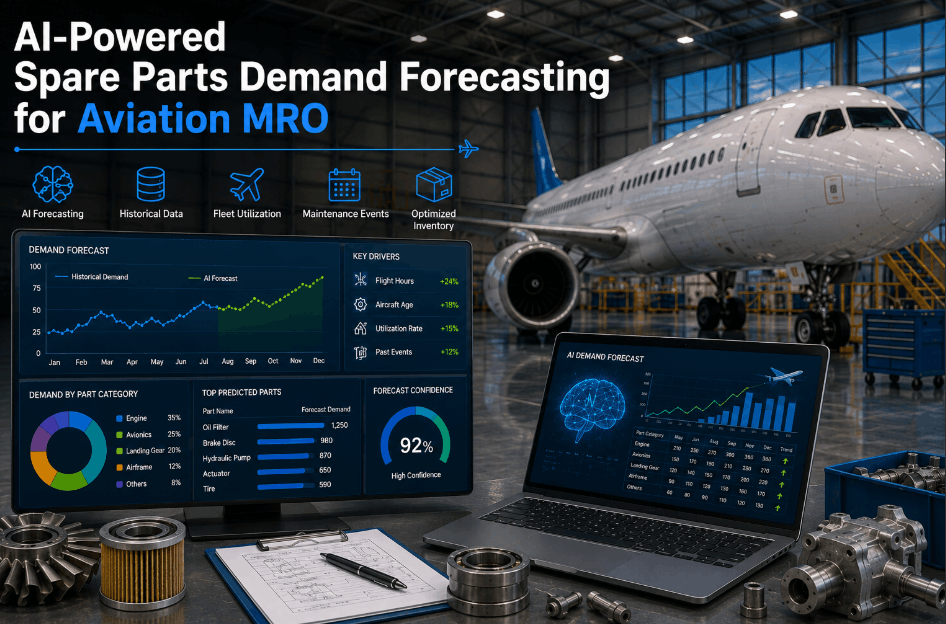
In the high-stakes environment of 2026 aviation maintenance, the difference between a profitable flight schedule and a multi-million dollar "Aircraft on Ground" (AOG) event often comes down to the availability of a single, low-cost spare part. Traditional inventory management—reliant on static Min/Max levels and historical averages—is fundamentally incapable of accounting for the volatility of modern global supply chains or the specific wear-and-tear patterns of individual airframes. AI-powered spare parts demand forecasting represents a paradigm shift, moving the industry from reactive stocking to proactive intelligence. By analyzing a multivariate dataset that includes real-time flight telemetry, global lead-time fluctuations, fleet-wide component degradation models, and even meteorological trends, ifactory's forecasting engine predicts parts consumption weeks before the actual failure occurs. Book a Demo to quantify your inventory carrying cost savings and stockout prevention roadmap.
The Crisis of Reactive Inventory Management
Why Traditional Min/Max Models Fail in 2026 Aviation MRO
The aviation supply chain has become too complex for spreadsheet-based forecasting. When maintenance planners rely on historical averages, they inevitably fall into the "inventory trap": they carry too much capital-intensive stock for components that aren't failing, while simultaneously suffering stockouts for critical parts that are undergoing accelerated wear due to specific route intensities or environmental conditions. A single grounded wide-body aircraft can exceed $150,000 per hour in lost revenue and passenger re-accommodation. AI-driven demand modeling ensures that stock rotation is synchronized with actual fleet maintenance cycles, minimizing both AOG risk and capital tie-up.
Furthermore, the "bullwhip effect" in aviation logistics often leads to panic-buying during minor supply disruptions, creating artificial shortages and driving up procurement costs. iFactory's AI dampens this volatility by providing a "Single Source of Truth" for demand, allowing procurement teams to negotiate better long-term contracts based on verified predictive data rather than reactive anxiety. This shift from "Just-in-Case" to "Just-in-Time" inventory is the hallmark of a world-class MRO operation in 2026.
The 5 Pillars of AI Spare Parts Forecasting
Engineering a Proactive Supply Chain with Multivariate Analytics
Successful inventory optimization is not just about knowing when a part was last used; it is about understanding the underlying engineering and operational drivers of demand. iFactory integrates telemetry, logistics, and procurement into a unified intelligence engine that evolves with your fleet's operational profile.
Forecasting Tiers: A Risk-Adjusted Implementation Roadmap
Sequencing AI Adoption Across Component Categories
Not every part category requires the same forecasting depth. Successful implementation sequences categories based on their impact on AOG risk, capital intensity, and data availability. Most MROs begin with high-turnover consumables to validate the AI engine before expanding to complex rotatables and high-value life-limited parts. This phased approach allows the AI to learn from high-frequency data before tackling the low-frequency, high-value components where precision is critical.
Inventory Visibility: Manual vs. AI-Driven Tracking
Quantifying the Intelligence Advantage of iFactory AI
What separates MROs achieving 95% service levels from those still struggling with part shortages? It is the transition from periodic manual reconciliation to continuous, AI-driven program visibility. ifactory provides a unified intelligence layer that sits on top of your existing ERP, delivering real-time insights into future demand and capital risks. This transparency allows management to make data-driven decisions about fleet expansion, base closures, or vendor consolidation.
| Forecasting Metric | Manual Legacy Systems | iFactory AI Platform | Improvement Factor |
|---|---|---|---|
| Forecasting Logic | Static Historical Averages | Multivariate Neural Networks | Handles Nonlinear Volatility |
| AOG Prevention | Reactive (Post-Failure) | Proactive (30-60 Day Warning) | 4-6× Earlier Intervention |
| Capital Allocation | Broad "Safety Stock" Buffers | Precision Probabilistic Levels | 15-20% Capital Release |
| Lead Time Analysis | Manual Supplier Estimates | Global Market Sensing AI | Continuous Accuracy |
| Part Traceability | Paper-Based Binders | Digital Birth Certificates | Instant Audit Access |
| Procurement Workflow | Manual PO Drafting | Autonomous ERP Sync | 10-14× Faster Execution |
| Shipping Optimization | Reactive Expedited Freight | Pre-emptive Cargo Consolidation | 30% Reduction in Freight Cost |
Dynamic Lead Time Sensing in Global Aviation Logistics
Predicting Supply Chain Delays Before They Ground Your Fleet
In the volatile global economy of 2026, OEM lead times are no longer static. A geopolitical shift, a port strike, or a materials shortage can turn a 2-week lead time into a 6-month delay overnight. iFactory's AI engine continuously monitors global logistical signals—including vessel tracking, freight lane congestion, and OEM production updates—to adjust your reorder points in real-time. This "Dynamic Safety Stock" adjustment ensures that your inventory levels rise and fall in anticipation of supply chain friction, providing a level of resilience that static Min/Max models cannot match.
Frequently Asked Questions
How does AI forecasting handle "unpredictable" component failures?
While no failure is 100% predictable, ifactory uses "Neural Clustering" to group aircraft with similar operational profiles. By analyzing failures across thousands of tail numbers globally, the system identifies the "probabilistic signature" of a failure, allowing you to stock it before the event occurs. The system essentially "learns" from the entire world's fleet, not just yours.
Can the system integrate with our existing ERP (SAP, AMOS, Trax)?
Yes. ifactory is designed to be an intelligence layer that sits on top of your existing systems. We provide pre-built, bi-directional connectors for all major aviation maintenance platforms. We don't replace your ERP; we make it smarter by pushing optimized Purchase Requisitions and stocking levels directly into your current approval workflows.
How does the system handle part interchangeability and PMA parts?
iFactory ingests your entire IPC (Illustrated Parts Catalog) and cross-reference tables. When the primary part is unavailable or has a long lead time, the AI identifies suitable PMA (Parts Manufacturer Approval) or interchangeable alternates. It then suggests the most cost-effective and available option, ensuring your maintenance floor never stops for lack of a specific P/N when an alternate is on the shelf.
What data security measures are in place for our fleet telemetry?
Security is paramount. iFactory uses SOC2 Type II compliant infrastructure and end-to-end encryption for all telemetry data ingested from ACARS or flight recorders. Your data is siloed and used only to optimize your specific fleet models. We provide detailed audit logs and role-based access control (RBAC) to ensure your sensitive operational data remains secure and private.
How does AI forecasting reduce logistical expedited shipping costs?
A significant portion of MRO inventory spend goes toward "Next Flight Out" (NFO) shipping for AOG parts. By predicting demand 30-60 days in advance, iFactory allows you to use standard sea or road freight for replenishment. Most customers report a 30-40% reduction in expedited shipping costs within the first year of operation.
How long does it take to see measurable ROI from AI forecasting?
Initial gains from identifying excess and obsolete stock for liquidation are typically captured within 60-90 days. Most customers achieve their target 35% reduction in carrying costs and a minimum 20% reduction in AOG hours within the first 12 months of full deployment. The system pays for itself by preventing just 2-3 major AOG events.