Blockchain technology is redefining how airport operations manage maintenance records, compliance documentation, and parts traceability — and aviation authorities are paying close attention. For Airport Operations Directors, Compliance Managers, and MRO executives navigating the twin pressures of regulatory scrutiny and supply chain complexity, the ability to create immutable, tamper-proof maintenance records is no longer a technology experiment — it is an operational necessity. Traditional airport analytics record systems are vulnerable to human error, retroactive modification, and audit gaps that cost airports millions in compliance failures and vendor disputes. This guide examines how blockchain for airport maintenance records creates verifiable, permanent compliance documentation that withstands regulatory examination, strengthens vendor accountability, and delivers a new standard of parts traceability across the aviation supply chain. To see how iFactory integrates blockchain-backed compliance tracking into your operations, book a demo today.
Build an Immutable Compliance Record Architecture for Your Airport
iFactory's AI-driven compliance tracking platform integrates blockchain-backed maintenance documentation, parts traceability, and vendor accountability tools — purpose-built for aviation operational environments demanding absolute record integrity.
Why Immutable Airport Maintenance Records Are a Regulatory Imperative
Aviation regulatory bodies — the FAA, EASA, ICAO, and national civil aviation authorities — impose some of the most stringent record-keeping requirements of any industry. Every maintenance action, parts installation, inspection result, and airworthiness directive compliance verification must be documented, traceable, and defensible. The problem is that traditional digital maintenance records are not inherently tamper-proof — they can be altered, deleted, or reconstructed, and regulators increasingly demand proof that the records presented during audits reflect what actually happened, not what someone recorded after the fact. Aviation compliance leaders exploring this capability routinely choose to book a demo to understand how blockchain integration works within existing CMMS and ERP architectures.
How Blockchain Creates Immutable Aviation Maintenance Records: The Technical Architecture
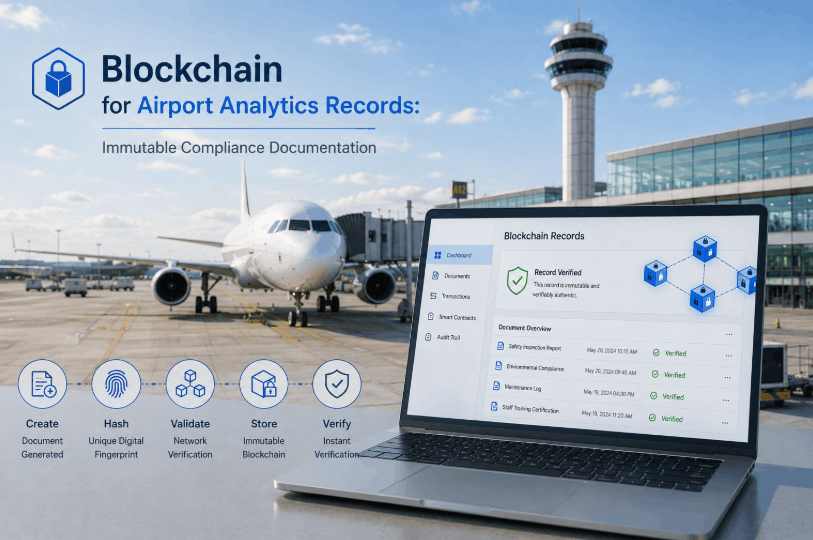
Understanding blockchain's value for airport analytics traceability requires clarity on how the underlying architecture differs from conventional database systems. The distinction is not merely technical — it is the foundation of the compliance defensibility that aviation authorities now demand.
Record Creation & Hashing
Every maintenance action, parts installation, or inspection result generates a digital record that is cryptographically hashed — producing a unique fingerprint of that specific data at that specific moment. Any subsequent modification produces a completely different hash, making alterations immediately detectable.
Block Formation & Chain Linkage
Hashed records are grouped into blocks, each containing the hash of the preceding block — creating a cryptographic chain where altering any historical record invalidates every subsequent block. This structure makes retroactive falsification of maintenance documentation computationally infeasible.
Distributed Ledger Consensus
The blockchain is replicated across multiple nodes — airport operators, regulatory authorities, MRO providers, and parts suppliers — with consensus mechanisms ensuring all participants hold an identical, verified record history. No single party can alter the ledger without detection by all other participants.
Smart Contract Enforcement
Smart contracts automatically enforce compliance rules — triggering alerts when maintenance intervals are exceeded, blocking parts installation without verified provenance documentation, and generating regulatory submissions when defined compliance milestones are reached. Compliance enforcement becomes automated, not dependent on human review.
Blockchain Parts Tracking: Eliminating Counterfeit Components from the Aviation Supply Chain
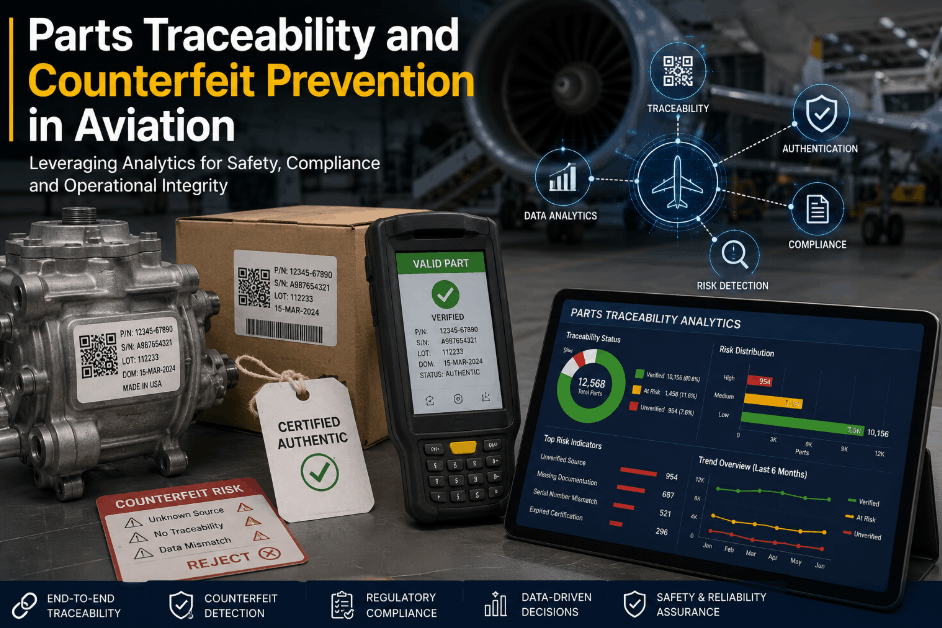
The aviation supply chain counterfeit parts problem costs the global industry an estimated $4.5 billion annually — and the consequences extend far beyond financial loss. Unapproved parts installed on aircraft or ground support equipment create direct safety risks, regulatory violations, and catastrophic liability exposure. Blockchain parts tracking provides the infrastructure to verify component authenticity at every stage of the supply chain. Airport operations teams interested in deploying this level of supply chain traceability can book a demo to see how iFactory's blockchain integration connects parts procurement records directly to analytics work order documentation.
Paper certificates of conformity, manufacturer data records, and shipping documents. Easily forged, difficult to verify, and frequently missing at point of installation.
Electronic parts records in maintenance management systems. Searchable and reportable, but records can be modified retroactively without detection — not audit-proof.
Cryptographically sealed parts records with full supply chain provenance. Every installation, transfer, and inspection permanently recorded and independently verifiable by regulators and operators.
Blockchain Vendor Accountability: Transforming Airport Procurement Compliance
Airport analytics programs typically involve dozens of vendors — parts suppliers, MRO contractors, calibration service providers, ground equipment manufacturers, and technology platform operators. Managing vendor compliance obligations across this ecosystem using traditional contract management and manual documentation creates accountability gaps that regulators find during audits and that procurement teams discover only after expensive disputes.
Automated Contract Performance Verification
Smart contracts on the aviation blockchain automatically verify vendor performance against contractual SLAs — tracking parts delivery timelines, maintenance response windows, calibration certification currency, and warranty claim validity. Performance data is recorded immutably, eliminating disputes over whether contractual obligations were met.
MRO Certification Traceability
Blockchain aviation compliance ledgers maintain real-time records of MRO provider certifications — FAA repair station approvals, EASA Part-145 authorizations, and technician license currency. Smart contracts block maintenance task assignments to contractors whose certifications have lapsed, preventing the compliance violations that create regulatory exposure.
Warranty & Recall Management
Complete blockchain parts tracking enables automated identification of all installed components subject to manufacturer recalls or warranty claims. When a parts defect is announced, the digital analytics ledger immediately identifies every affected installation across the fleet — enabling rapid corrective action rather than manual searches through disconnected maintenance records.
Sustainability & ESG Supply Chain Compliance
Aviation sustainability reporting requirements increasingly demand traceability of environmental certifications throughout the supply chain — materials sourcing, end-of-life component disposal, and emissions offset verification. Blockchain aviation supply chain records provide the immutable documentation trail that ESG auditors and sustainability reporting frameworks require.
Blockchain vs. Traditional Airport Compliance Documentation: A Capability Comparison
The business case for blockchain aviation compliance integration must be grounded in a clear-eyed comparison of what existing documentation systems can and cannot deliver. Aviation compliance directors who evaluate this comparison consistently identify audit defensibility and parts traceability as the two capabilities where the gap between traditional systems and blockchain-integrated platforms is largest and most financially consequential. Compliance directors who want to quantify the audit risk reduction opportunity in their specific environment frequently book a demo to walk through a structured gap analysis with iFactory's aviation compliance specialists.
| Compliance Capability | Traditional Documentation | Blockchain-Integrated Platform | Compliance Impact |
|---|---|---|---|
| Record Tamper-Proofing | Database records modifiable by system administrators | Cryptographic hash makes any modification instantly detectable | Eliminates retroactive falsification risk |
| Parts Provenance Verification | Paper certificates, often incomplete or unverifiable | Complete blockchain supply chain record from manufacturer to installation | Eliminates counterfeit component risk at point of installation |
| Vendor Certification Currency | Manual certificate tracking in spreadsheets or CMMS fields | Smart contract automated monitoring with real-time lapse alerts | Zero expired certification exposure during audits |
| Regulatory Audit Response | 3–10 days to compile required records across systems | Instant cryptographically verified audit package generation | 68% reduction in audit preparation labor |
| Multi-Party Record Access | Separate records maintained by each party; reconciliation disputes common | Single shared immutable ledger accessible to all authorized parties | Eliminates inter-party record discrepancy disputes |
AI-Driven Blockchain Integration: Combining Predictive Analytics with Immutable Records
Blockchain provides record integrity — but it does not, by itself, provide operational intelligence. The most advanced airport compliance platforms combine blockchain's immutable record architecture with AI-driven analytics that extract actionable insights from the compliance data the ledger contains. This combination delivers capabilities that neither technology achieves independently.
Predictive Maintenance Triggered by Verified Records
AI-driven predictive maintenance models are only as reliable as the data they are trained on. When maintenance history records are stored on a blockchain ledger — with every entry cryptographically verified — the AI model trains on data it can trust completely, rather than records that may have been modified, omitted, or reconstructed from memory. This produces demonstrably more accurate failure prediction models and measurably lower rates of unplanned equipment downtime.
Anomaly Detection Across the Compliance Ledger
AI analytics applied to blockchain maintenance records can identify compliance anomalies that human reviewers would never detect at scale — patterns of maintenance actions that deviate from approved procedures, vendors whose parts failure rates exceed expected baselines, or inspection intervals that consistently drift from mandated schedules. These insights drive compliance program improvements that reduce regulatory risk continuously, not just at audit time.
Automated Regulatory Submission from Verified Data
Combining blockchain record integrity with AI-driven reporting automation enables airports to generate regulatory submissions directly from the compliance ledger — with mathematical certainty that the data has not been altered between collection and submission. This eliminates the manual reconciliation step that currently consumes the majority of compliance reporting labor and introduces the risk of human transcription errors.
Asset Lifecycle Value Optimization
Complete blockchain asset tracking records — capturing every maintenance event, parts replacement, and condition assessment across an asset's full operational life — enable AI-driven lifecycle cost modeling of unprecedented accuracy. Airports can make capital replacement decisions based on verified operational history rather than estimated averages, optimizing asset lifecycle value and reducing unnecessary early replacement costs.
Implementing Blockchain for Airport Maintenance Records: A Phased Deployment Roadmap
Blockchain aviation compliance implementation is not an all-or-nothing undertaking. A phased deployment approach allows airports to build blockchain record integrity capabilities progressively — starting with the highest-risk compliance areas and expanding as the platform demonstrates value. This approach minimizes implementation risk while delivering early ROI that builds organizational support for broader deployment.
Phase 1: Critical Parts Traceability (Months 1–3)
Deploy blockchain parts tracking for life-limited components and airworthiness directive-affected equipment — the highest regulatory risk categories. Integrate with existing parts procurement workflows to begin building immutable provenance records without disrupting current operations. Establish the consensus network with key MRO providers and regulators.
Phase 2: Maintenance Work Order Integration (Months 4–7)
Extend the blockchain compliance ledger to capture all maintenance work orders, inspection results, and corrective action documentation. Connect CMMS and ERP systems to write maintenance records directly to the ledger in real time. Activate smart contract vendor certification monitoring for all active MRO contractors.
Phase 3: AI Analytics & Regulatory Reporting (Months 8–12)
Deploy AI-driven analytics on the verified blockchain data set — activating predictive maintenance models, anomaly detection, and automated regulatory report generation. Complete integration with regulatory authority nodes to enable direct submission of blockchain-verified compliance documentation. Launch full airport audit trail blockchain program review with all stakeholders.
"Our previous maintenance records system gave auditors everything they asked for — but we could never prove with absolute certainty that the records hadn't been edited after the fact. During our first EASA compliance review after deploying our blockchain-integrated platform, the auditor specifically noted that our cryptographic record integrity was the first time they had seen a verifiably tamper-proof maintenance archive at an airport of our scale. That distinction alone justified the investment."
Frequently Asked Questions: Blockchain for Airport Maintenance Records
Does the FAA or EASA officially recognize blockchain maintenance records for compliance purposes?
Both the FAA and EASA have issued guidance acknowledging digital records as acceptable for airworthiness documentation, provided they meet integrity and accessibility requirements. Blockchain records that can demonstrate cryptographic tamper-proofing and complete audit trail integrity align with these requirements. Several major aviation regulators are actively developing formal guidance on blockchain aviation compliance record standards.
How does blockchain parts tracking differ from existing barcode or RFID tracking systems?
Barcode and RFID systems track the physical location of components — they record where a part is, but do not create an immutable record of what happened to it or cryptographically verify that the record has not been altered. Blockchain parts tracking creates a permanent, tamper-proof provenance record for each component that is independently verifiable by all parties in the supply chain, including regulators — a fundamentally different and far more defensible standard of documentation.
What happens to existing maintenance records when transitioning to a blockchain platform?
Historical maintenance records from existing CMMS platforms can be migrated to the blockchain ledger with their original timestamps preserved. While migrated records cannot achieve the same cryptographic integrity as natively recorded blockchain entries, the migration creates a unified searchable archive while all new records going forward benefit from full immutability. Most airports maintain their legacy CMMS in parallel for the first 12–24 months after blockchain deployment.
How does blockchain integration affect our existing MRO vendor relationships?
Blockchain vendor accountability systems require MRO providers to participate in the shared ledger as nodes — gaining access to the same verified parts traceability and certification data that the airport operator uses. Most MRO providers welcome this transparency, as it protects them from disputes over work they performed correctly and enables them to demonstrate their compliance performance to other airport clients. Vendor onboarding to a blockchain compliance network typically requires 4–8 weeks of technical integration work.
What is the typical implementation cost for an airport blockchain compliance platform?
Implementation costs vary significantly with airport size, integration complexity, and the number of vendor nodes required. Mid-sized commercial airports typically invest between $180K and $600K in initial blockchain compliance platform deployment, with annual platform costs of $80K–$200K. The ROI case is typically anchored in avoided regulatory penalties, reduced audit preparation labor, and the elimination of a single counterfeit parts incident — each of which individually can exceed the full multi-year platform cost.
Ready to Build an Immutable Compliance Record Foundation for Your Airport?
iFactory's compliance tracking platform integrates blockchain-backed maintenance documentation, AI-driven parts traceability, and vendor accountability analytics into a single architecture — giving airport operations and compliance teams the record integrity that modern regulatory environments demand.