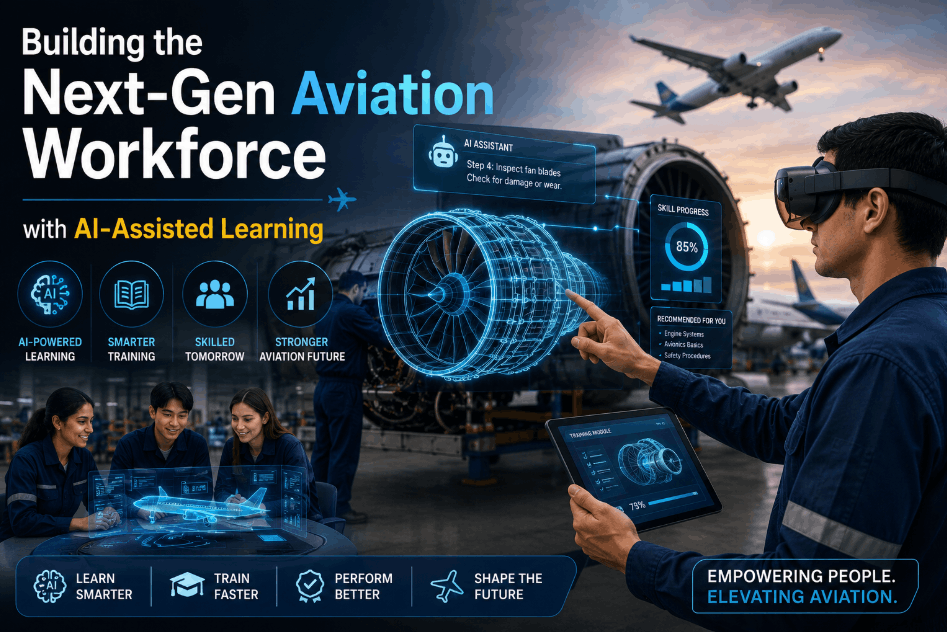
The aviation maintenance industry is facing a critical inflection point. As experienced Aircraft Maintenance Technicians (AMTs) approach retirement, the knowledge gap they leave behind threatens safety, compliance, and operational continuity across MRO facilities worldwide. AI-assisted aviation training is emerging as the most viable solution — not just to fill headcount, but to build a next-gen MRO workforce that learns faster, certifies sooner, and performs consistently from day one. To see how an integrated AI learning platform can transform your technician pipeline, you can book a demo and review live onboarding benchmarks from active MRO partners.
Is a Knowledge Vacuum Slowing Your MRO Growth?
Accelerate technician certification and bridge the generational knowledge gap with AI-powered learning modules built for aviation compliance.
Why the Aviation MRO Industry Faces an Accelerating Talent Shortage
The generational knowledge gap in MRO is not a future problem — it is actively draining productivity today. According to industry projections, the commercial aviation sector will require over 650,000 new maintenance technicians globally over the next two decades. The compounding challenge is not just the volume of hires needed, but the depth of expertise required. An AMT license demands years of documented experience, structured mentorship, and regulatory compliance under FAA or EASA frameworks. Traditional classroom-based technician certification AI-driven programs alone cannot close this gap at scale.
AI-assisted learning platforms change the equation fundamentally. By delivering adaptive, role-specific training modules that respond to each technician's progress in real time, these platforms can compress a 36-month certification pathway into a significantly shorter journey — without compromising regulatory integrity. Facilities using digital learning MRO frameworks report up to 40% faster time-to-competency for new hires, directly translating into faster return on human capital investment. Managers looking to book a demo can see personalized training roadmap generation in action.
Adaptive Learning Paths
AI tutoring analytics map each technician's existing skills and dynamically adjust coursework difficulty, pacing, and subject sequencing to minimize time-to-certification.
Regulatory Alignment
Training modules are continuously updated to reflect FAA, EASA, and OEM documentation changes, ensuring every AMT trainee works from current, compliant materials at all times.
Knowledge Transfer Engine
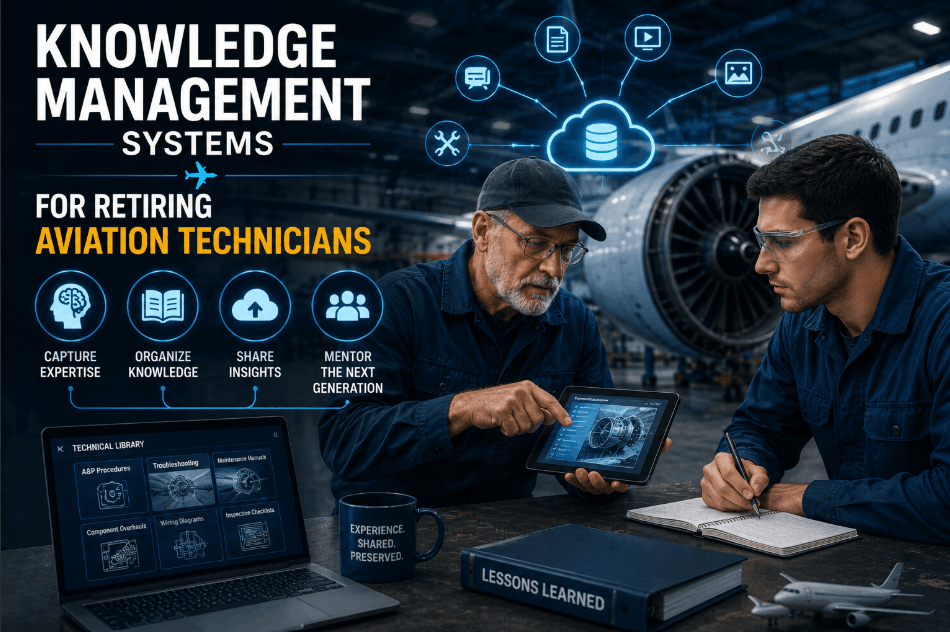
Structured capture of expert technician insights transforms undocumented tribal knowledge into searchable, reusable training assets before retiring AMTs exit the facility.
Performance Analytics
Real-time dashboards track each learner's competency progression, flag at-risk trainees early, and provide instructors with actionable intervention data at every stage.
Traditional AMT Training vs. AI-Assisted Accelerated Certification
The operational gap between legacy classroom training and AI learning platform analytics is measurable at every stage of the certification pipeline. The comparison below illustrates how an integrated smart training platform restructures the MRO workforce development lifecycle — from initial onboarding to full task authorization.
| Training Phase | Traditional Timeline | AI-Assisted Target | Platform Feature | Workforce Impact |
|---|---|---|---|---|
| Initial Onboarding | 4 – 8 Weeks | < 2 Weeks | Adaptive Module Assignment | High |
| Core AMT Curriculum | 18 – 36 Months | 12 – 18 Months | AI Tutoring & Gap Analysis | High |
| Practical Task Sign-Off | Variable / Supervisor | Sensor-Validated | Digital Competency Logging | High |
| Recurrent Training | Annual Classroom | Continuous Micro-Learning | Smart Refresh Alerts | Medium |
| Knowledge Retention | Tribal / Informal | Structured & Searchable | AI Knowledge Base | Strategic |
5-Stage Roadmap to Deploying AI-Assisted Aviation Training at Scale
Deploying an accelerated AMT training platform is not a one-size-fits-all exercise. Each MRO facility operates with unique fleet types, regulatory frameworks, and workforce demographics. The roadmap below provides a structured deployment sequence that minimizes disruption while maximizing early ROI. Organizations ready to begin can book a demo to receive a facility-specific deployment assessment.
Competency Baseline Assessment
Map the current skill distribution across your technician population. AI analytics identify clusters of high-risk competency gaps — particularly in aging aircraft systems — to prioritize training content development.
Expert Knowledge Capture Sprint
Before senior AMTs retire, structured interview protocols and AI-assisted documentation tools extract their experiential knowledge into searchable, reusable training assets for the next generation.
Adaptive Curriculum Build
The platform generates personalized learning paths for each enrolled technician, integrating OEM manuals, regulatory directives, and facility-specific procedures into a single, coherent training environment.
Supervised Practical Validation
Digital task cards guide trainees through hands-on maintenance operations while sensor and inspection data automatically logs task completion evidence for regulatory sign-off and audit trails.
Continuous Learning Loop
Post-certification, AI micro-learning modules maintain currency with regulatory amendments, new aircraft introductions, and evolving best practices — ensuring your workforce never stagnates after initial qualification.
Why Traditional Aviation Training Programs Fail the Next Generation
Many MRO organizations invest significantly in training infrastructure but still struggle to build a sustainable, high-performance workforce. The failure points are predictable and addressable with the right smart training aviation architecture.
Static training programs ignore individual learning speeds, prior experience, and task-specific exposure history — wasting time for advanced learners and overwhelming novices.
Paper-based sign-off systems create audit vulnerabilities and make it nearly impossible to prove competency in remote regulatory inspections or fleet-wide compliance reviews.
When senior AMTs retire without structured knowledge transfer, decades of fault-diagnosis expertise, workaround procedures, and fleet-specific insights vanish permanently from the organization.
Annual classroom recurrence intervals are too long to maintain currency with rapid regulatory amendments, new service bulletins, and evolving airworthiness directives.
When training logs exist across paper files, disconnected LMS platforms, and supervisor memory, workforce managers cannot generate a real-time view of fleet-wide authorization coverage.
Without AI analytics, workforce planners cannot anticipate where critical skill shortages will emerge before they create operational disruption or unairworthy maintenance events.
Bridging these gaps requires more than a new LMS. It requires a purpose-built AI-powered certification ecosystem designed specifically for MRO regulatory and operational demands. If your facility is ready to modernize technician development, book a demo to see how the platform maps directly to your fleet and workforce profile.
Build a Future-Ready Aviation Maintenance Workforce Today
Deploy adaptive AI training modules across your entire technician population and reduce time-to-certification by up to 40% without compromising regulatory compliance.
Frequently Asked Questions: AI-Assisted Aviation Workforce Development
How does AI-assisted training differ from a standard Learning Management System?
A standard LMS delivers static content to all learners equally. An AI-assisted platform analyzes each technician's task history, assessment performance, and knowledge gaps in real time — dynamically adjusting curriculum sequencing, difficulty, and content depth for every individual, resulting in measurably faster and more durable competency development.
Can the platform integrate with existing FAA or EASA compliance documentation?
Yes. The platform ingests OEM manuals, Airworthiness Directives, Service Bulletins, and facility-specific work procedures to build regulatory-aligned training content that stays current as documentation is updated — eliminating the manual curriculum maintenance burden from your training team.
What is the typical ROI timeline for deploying an AI aviation training platform?
Most facilities report measurable improvements in trainee progression speed within the first 60 days. Full ROI — measured by reduction in time-to-certification, decrease in on-the-job errors, and audit-readiness improvement — typically materializes within 6 to 9 months of full deployment. You can book a demo to review our MRO-specific ROI modeling tool.
How does the platform address knowledge transfer from retiring senior technicians?
The platform includes structured knowledge capture workflows — guided interview protocols, video annotation tools, and AI-assisted documentation templates — that convert a retiring AMT's experiential knowledge into searchable training assets before they leave, permanently preserving institutional memory in a usable digital format.
Is the platform suitable for multi-facility MRO operations?
Absolutely. The platform is architected for enterprise-scale deployment with centralized curriculum governance, facility-specific customization layers, and cross-facility competency benchmarking — giving workforce directors a unified view of training compliance and skill readiness across every location simultaneously.