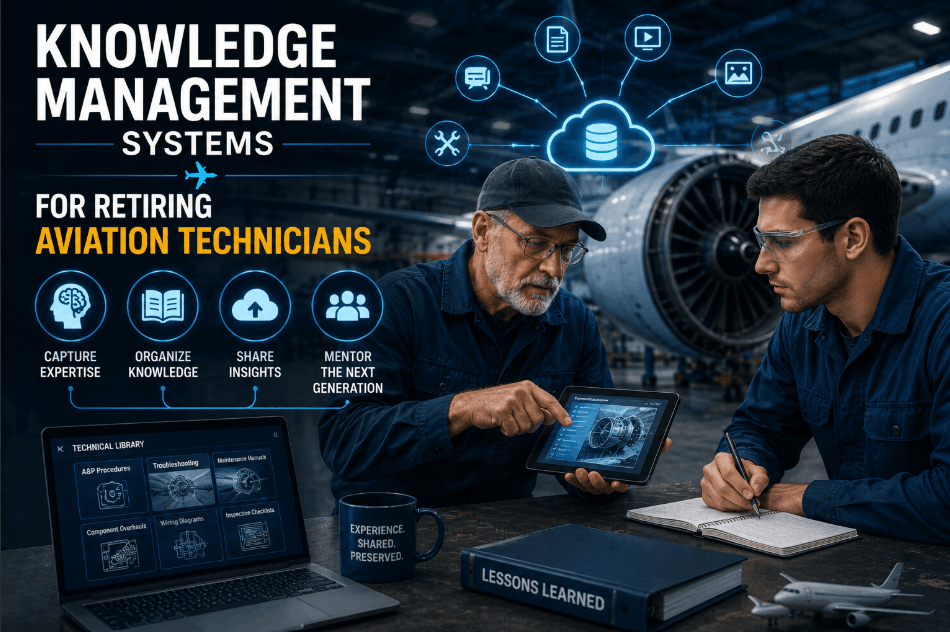
Every year, hundreds of senior Aircraft Maintenance Technicians walk out of MRO facilities for the last time — carrying with them 20, 30, or even 40 years of fault-diagnosis intuition, undocumented workarounds, fleet-specific anomaly patterns, and institutional memory that no technical manual has ever captured. This is the tribal knowledge crisis in aviation maintenance, and it is accelerating. Without a structured knowledge management aviation system, the retirement of one master AMT can silently degrade an entire facility's troubleshooting capability for years. To understand how AI-powered knowledge capture can protect your most critical operational intelligence, you can book a demo and see our knowledge extraction methodology applied to real MRO scenarios.
Are Decades of Expert Knowledge Walking Out Your Door at Retirement?
Capture and preserve retiring aviation technician expertise using AI-powered knowledge extraction integrated with your MRO operations platform.
Why Aviation MRO Faces an Irreversible Institutional Memory Crisis
The aviation maintenance sector is in the grip of a demographic shift with no historical parallel. The Baby Boomer cohort of AMTs — who joined the workforce during the jet age expansion of the 1970s and 1980s — is now retiring at a pace that outstrips replacement hiring in virtually every major MRO market. What makes this crisis uniquely dangerous is that it is not simply a headcount problem. The knowledge these technicians carry is, by definition, undocumented. It lives in their hands, their pattern-recognition instincts, and their memory of every unusual failure mode they diagnosed on a specific tail number over three decades of work.
Structured knowledge transfer aviation programs that rely on mentorship alone are insufficient at scale. A retiring AMT typically has 18 to 24 months of planned retirement runway — far too short to transfer operational wisdom through informal apprenticeship to the depth that will actually prevent future failures. AI knowledge extraction analytics changes the capture equation by systematically drawing out, structuring, and indexing expert knowledge at a speed and depth that human-only transfer programs cannot match. For organizations that want to see this in practice, book a demo to walk through a live knowledge capture session simulation.
AI-Guided Expert Interviews
Structured protocol sessions use AI-assisted questioning to systematically surface tacit knowledge — fault patterns, diagnostic shortcuts, and system anomalies — that experts hold implicitly and rarely articulate without prompting.
Searchable Knowledge Base
Captured expertise is automatically indexed, tagged by aircraft type, system, ATA chapter, and failure mode — making it instantly searchable by junior technicians facing unfamiliar fault scenarios on the hangar floor.
Failure Pattern Library
AI correlates expert-described fault signatures with historical maintenance records, building a probabilistic failure pattern library that surfaces the most likely root causes for recurring fault codes on specific airframes.
Video-Annotated Procedures
Complex maintenance procedures are captured on video with AI-generated step annotations, creating rich visual training assets that communicate subtle technique nuances that written manuals systematically fail to convey.
The True Cost of Lost Institutional Memory in MRO Operations
The operational and financial cost of institutional memory MRO loss is rarely calculated until it is already felt — in the form of extended troubleshooting times, repeat defect events, and junior technician errors that an experienced AMT would have prevented instinctively. The comparison below quantifies the operational difference between a facility with structured knowledge preservation and one that relies on hope that departing experts will transfer what they know informally.
| Operational Area | After Expert Retirement (No KM) | With AI Knowledge Base | Recovery Mechanism | Risk Level |
|---|---|---|---|---|
| Fault Diagnosis Speed | 2–4x longer for complex faults | Pattern-matched in minutes | AI Failure Pattern Library | Critical |
| Repeat Defect Rate | Increases 30–50% without tribal knowledge | Structural root cause access | Indexed Expert Insights | Critical |
| Junior Technician Onboarding | No experienced mentor available | AI-guided knowledge access | Expert Interview Library | Critical |
| Unusual Fault Resolution | Escalation to OEM (costly, slow) | In-house expert knowledge search | Video-Annotated Procedures | High |
| Fleet-Specific Anomaly Awareness | Lost on expert departure | Permanently documented | AI Knowledge Extraction | High |
| Training Content Quality | Generic OEM manuals only | Facility-specific expert content | Structured Knowledge Capture | Medium |
How AI-Powered Knowledge Extraction Works for Retiring Aviation Technicians
Effective expert knowledge digitization in MRO requires a methodology that overcomes the fundamental challenge of tacit knowledge: experts often do not know what they know. The extraction process must actively surface the implicit diagnostic frameworks, heuristic patterns, and experiential filters that senior AMTs apply unconsciously. The following knowledge capture protocol is designed specifically for aviation maintenance environments and can be initiated during a technician's final 12 to 24 months of employment. Organizations ready to implement this can book a demo to receive a customized expert knowledge audit for their most at-risk departing personnel.
Expert Knowledge Risk Assessment
Identify the highest-risk knowledge holders in your workforce — senior AMTs within 3 years of retirement who hold unique expertise in specific aircraft types, systems, or fault categories that no other active technician can replicate. Prioritize capture by operational risk exposure.
Structured Interview Sprint
AI-assisted interview sessions guide the expert through structured knowledge domains — system-by-system troubleshooting patterns, most challenging fault scenarios encountered, fleet-specific anomalies, and tool or technique innovations developed through experience. Sessions are recorded and automatically transcribed.
Maintenance Task Video Capture
For complex or nuanced maintenance procedures where written descriptions are inadequate, the expert performs the task with video capture and running verbal commentary. AI annotation layers add step-by-step breakdowns, safety callouts, and technique highlights to the raw footage.
AI Structuring and Indexing
Captured content is processed through the platform's knowledge structuring engine — automatically categorized by ATA chapter, aircraft type, fault classification, and skill level — and cross-referenced against the facility's historical maintenance records to validate and enrich the expert's descriptions with data context.
Living Knowledge Base Integration
Structured knowledge assets are published to the facility's searchable knowledge base, where they remain accessible to all authorized technicians post-retirement. The platform tracks usage patterns to identify which knowledge assets are most frequently accessed, guiding ongoing content enrichment priorities.
Why Conventional Knowledge Transfer Methods Fail Aviation MRO
Most MRO organizations acknowledge the knowledge preservation aviation challenge but rely on approaches that are fundamentally inadequate for the depth and complexity of expert AMT knowledge. Understanding why conventional methods fail is essential for making the case for a structured AI knowledge base investment. If you want to benchmark your current knowledge retention approach, book a demo to walk through our knowledge risk assessment framework.
A one-to-one apprenticeship model transfers knowledge to exactly one junior technician per retiring expert — leaving the broader workforce with no structured access to the captured expertise once the mentorship period ends.
End-of-career exit interviews conducted in the final weeks of employment capture only a fraction of an expert's operational knowledge — by the time most organizations act, the retirement date has already passed.
Generic OEM maintenance manuals document standard procedures but never capture the facility-specific, fleet-specific, and tail-number-specific anomalies that experienced local technicians have learned through years of operational exposure.
Asking retiring AMTs to write down what they know produces disorganized, context-free documents that future technicians cannot search effectively — the knowledge is technically preserved but practically inaccessible when it matters most.
Expert knowledge captured in isolation — without linkage to the facility's historical maintenance records, repetitive defect patterns, and fleet reliability data — loses the contextual anchoring that makes it actionable for future diagnostics.
Static knowledge capture exercises produce documents that are accurate at capture time but drift rapidly out of relevance as aircraft configurations change, new service bulletins are issued, and operational practices evolve — without a living update mechanism.
Preserve Every Year of Expert Knowledge Before It Retires With Them
Deploy AI-powered knowledge extraction now — before your highest-risk expert retirements remove irreplaceable institutional memory from your MRO operation permanently.
Frequently Asked Questions: Aviation Knowledge Management Systems
How long does it take to capture a retiring expert's knowledge using the AI extraction process?
A comprehensive knowledge capture engagement for a single senior AMT typically spans 8 to 12 structured sessions over 3 to 6 months, producing hundreds of indexed knowledge assets. The timeline is ideally initiated 12 to 18 months before the planned retirement date — providing sufficient runway for validation, gap-filling sessions, and knowledge base integration before the expert departs.
How is captured knowledge kept current after the expert leaves?
The knowledge base module includes an active maintenance workflow: platform algorithms monitor maintenance records for new fault patterns that may contradict or extend captured knowledge assets, triggering review flags for designated knowledge stewards. Junior technicians who access and apply knowledge assets can submit accuracy annotations, creating a community-maintained accuracy layer that evolves the knowledge base continuously.
Can the platform integrate with existing CMM or technical documentation libraries?
Yes. The knowledge base module integrates with Component Maintenance Manual libraries, OEM technical documentation repositories, and the facility's MRO management system. Expert knowledge assets are cross-linked to relevant regulatory documentation — so a technician searching for a fault solution sees both the expert's experiential guidance and the applicable manual reference simultaneously. You can book a demo to see this integrated documentation view in action.
Is captured expert knowledge accessible to technicians at remote or outstations facilities?
Absolutely. The knowledge base is cloud-hosted with role-based access control, making expert knowledge assets available to authorized technicians at any connected facility — including line maintenance outstations where access to experienced mentors is typically most limited. Offline access modes ensure usability even in hangar environments with intermittent connectivity.
What ROI metrics should MRO directors expect from a knowledge management investment?
The most measurable ROI indicators are reduction in average troubleshooting time for complex faults (typically 25–40% within 12 months), decrease in repeat defect events (often 20–35% as root cause knowledge becomes accessible), and reduction in OEM technical support escalations. Longer-term ROI includes accelerated junior technician competency development and significant reduction in the cost impact of future expert retirements.