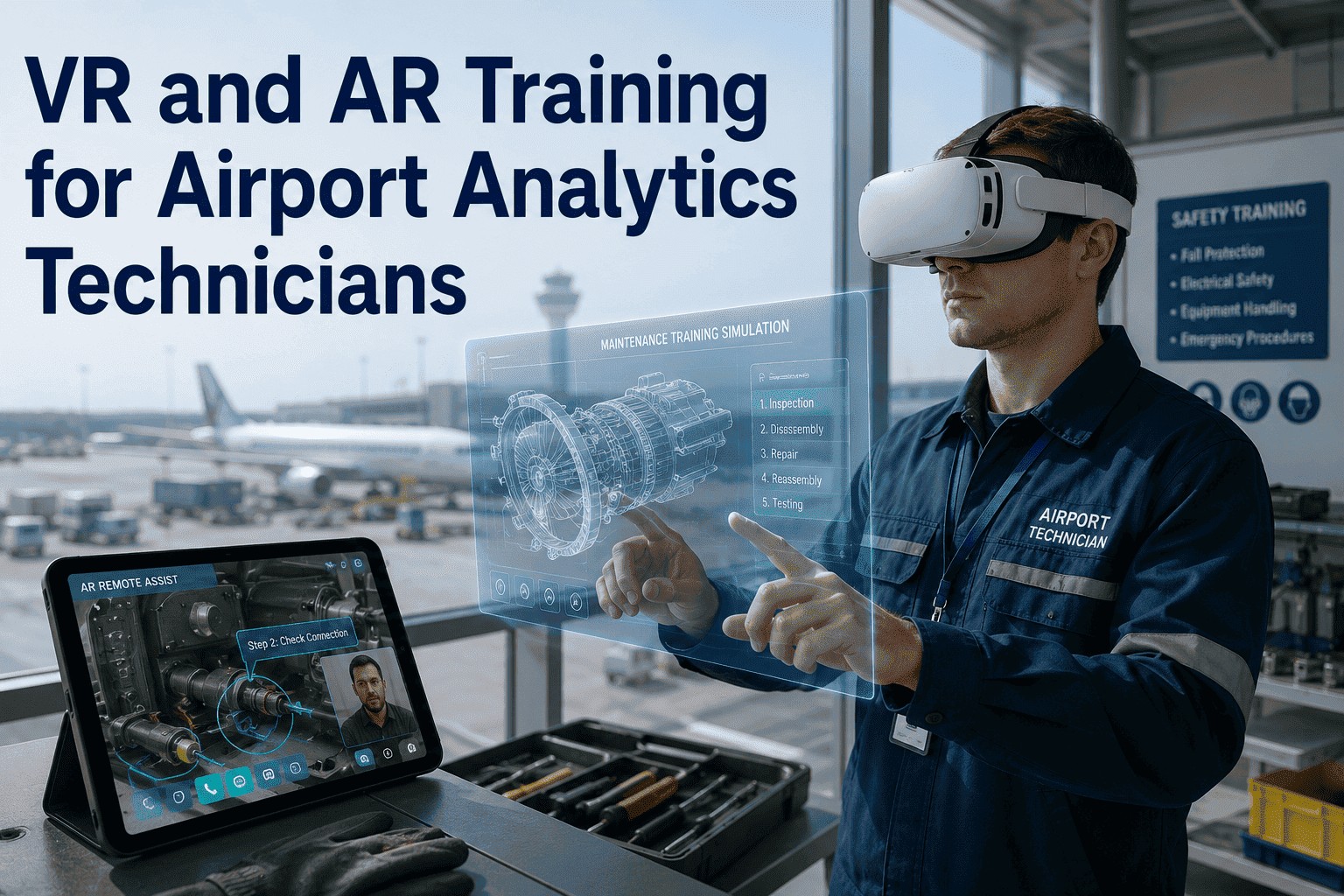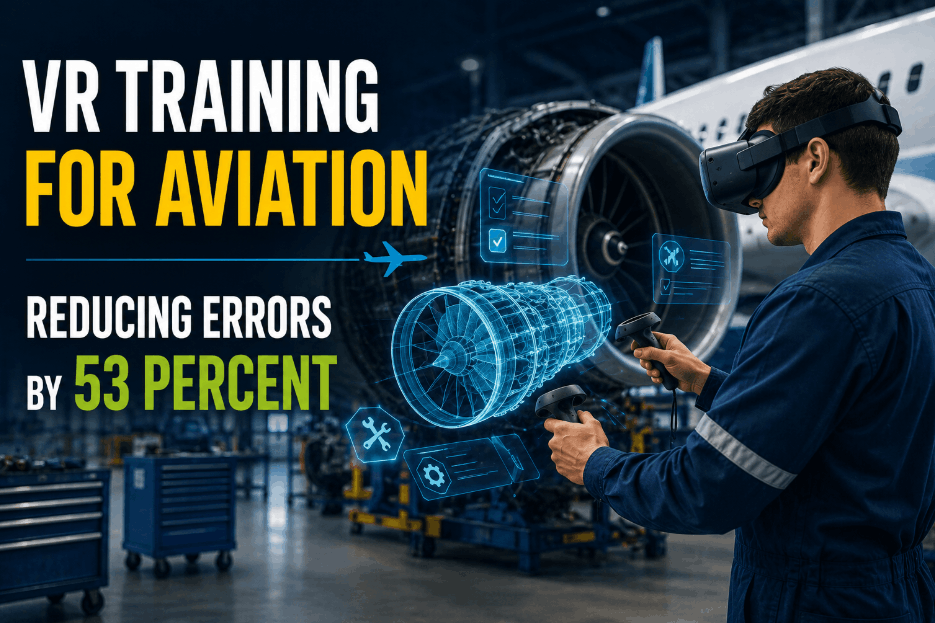
VR training for aviation analytics is transforming how MRO technicians acquire, practice, and master the complex skills required for modern aircraft maintenance — delivering a 53% reduction in procedural errors compared to traditional classroom and on-the-job training methods. Virtual reality MRO training creates fully immersive, risk-free simulation environments where technicians can perform engine removals, avionics diagnostics, structural inspections, and emergency procedures on photorealistic digital twin aircraft models without risk to airworthiness, equipment, or personal safety. As the aviation technician shortage intensifies and new aircraft type complexity grows, simulation-based training aviation is no longer an experimental investment — it is the foundational capability that separates MRO operators who can scale certified competency at speed from those constrained by traditional training infrastructure. Book a Demo to see how iFactory's VR Training Integration delivers measurable technician upskilling VR outcomes across connected aviation maintenance operations.
Immersive VR Training Integration for Aviation MRO Technicians
iFactory's VR Training Integration delivers virtual reality aircraft simulation, digital twin training environments, and analytics-tracked competency development built for aviation MRO operators who need to reduce errors, accelerate certification, and scale technical skills across distributed maintenance teams.
Why Virtual Reality is Redefining Competency Development in Aviation MRO
The case for VR training aviation analytics rests on a fundamental insight about how technical competency develops in high-stakes maintenance environments: procedural proficiency requires repeated, contextually accurate practice that traditional training methods cannot deliver at scale. Classroom instruction builds declarative knowledge — technicians can describe procedures — but not the procedural fluency and spatial awareness that zero-defect aircraft maintenance requires. On-the-job training provides genuine practice but at the cost of time on revenue-generating aircraft, supervision burden on senior technicians, and exposure to real airworthiness consequences from trainee errors. Immersive technician training through virtual reality eliminates this trade-off by providing practice environments that are simultaneously fully realistic, infinitely repeatable, safely consequence-free, and analytics-instrumented — capturing every action, hesitation, and error for performance analysis that traditional training cannot generate. The 53% error reduction achieved by VR-trained technicians is not an anomaly — it is the predictable outcome of dramatically higher quality practice volume delivered through immersive MRO learning platforms purpose-built for aviation maintenance competency development.
The Six Core Limitations of Traditional Aviation Technician Training That VR Solves
Understanding why error reduction VR training delivers such consistent and significant performance improvements requires examining the specific deficiencies of conventional aviation training methods that immersive simulation addresses. MRO training managers who Book a Demo with iFactory consistently identify these same limitations as the bottlenecks constraining their technician development programs — bottlenecks that virtual reality architecture is structurally designed to overcome.
Aircraft Access Constraints for Training Purposes
Revenue aircraft cannot be removed from service for extended training periods, limiting hands-on practice to scheduled maintenance events when trainees can work under supervision. Virtual reality aircraft simulation provides unrestricted access to photorealistic aircraft models — trainees can practice engine removal, hydraulic system bleeding, avionics removal-installation, and structural repair procedures on-demand without competing with revenue maintenance schedules or requiring physical aircraft availability.
Inability to Practice High-Risk Procedures Safely
Certain maintenance procedures — fuel system work, high-energy electrical systems, composite repair requiring heat treatment, engine test cell operations — carry significant safety risk that limits trainee practice opportunities even in supervised environments. Digital twin training platforms allow technicians to perform these high-risk procedures hundreds of times in photorealistic simulation before attempting them on actual aircraft, building the procedural fluency that prevents the hesitations and errors that cause incidents in live environments.
Inconsistent Training Quality Across Instructors and Locations
Traditional on-the-job training quality varies significantly by instructor — different technicians demonstrate procedures differently, emphasize different safety steps, and evaluate trainee performance against different standards. VR training aviation analytics platforms deliver standardized procedure instruction derived from approved maintenance data — every technician at every maintenance base practices the same approved procedure sequence, with the same safety check requirements, measured against the same performance standards regardless of geographic location or instructor availability.
No Performance Analytics from Traditional Training Delivery
Classroom and OJT training generates minimal objective performance data — written test scores and supervisor assessments provide coarse measurements that cannot identify which specific procedural steps a technician struggles with or predict where errors are likely to occur in live maintenance. Immersive MRO learning platforms capture microsecond-resolution performance data — task completion time, error location and type, hesitation patterns, and procedure deviation frequency — that enables precision-targeted remediation rather than generalized repeat training.
Geographic Training Infrastructure Constraints
Physical training facilities — mock-up aircraft, tooling labs, and classroom infrastructure — require significant capital investment and are fixed in location, creating access barriers for technicians at remote maintenance bases, line stations, and smaller regional facilities. VR MRO training systems are deployable to any location with adequate headset hardware, enabling consistent high-quality training delivery to distributed maintenance teams without replicating expensive physical infrastructure at each location served.
Slow Type Rating Progression for New Aircraft Platforms
Fleet transitions to new aircraft types create training demand spikes that traditional type rating programs — dependent on simulator availability and access to new aircraft during early delivery periods — struggle to meet at the scale and speed that operational deployment requires. AR VR analytics training platforms can begin type-specific training on new aircraft models months before physical aircraft arrive, using OEM-provided digital twin data to build technician familiarity with new systems, procedures, and tooling requirements ahead of revenue service entry.
iFactory VR Training Integration: Architecture and Capabilities
iFactory's VR Training Integration platform connects immersive simulation environments with the analytics infrastructure, maintenance data systems, and competency management frameworks that MRO operators need to convert VR training investment into measurable certification and performance outcomes. The platform is not a standalone simulation tool — it is a training analytics system that uses VR as the competency development delivery mechanism while maintaining full integration with existing maintenance management, HR, and regulatory compliance workflows. Aviation training managers can Book a Demo to see how the VR Training Integration connects with their specific aircraft types, maintenance programs, and training administration infrastructure.
Photorealistic Digital Twin Aircraft Training Environments
High-fidelity digital twin training environments built from OEM technical data, aircraft CAD models, and approved maintenance documentation create simulation experiences accurate enough for regulatory training credit — technicians interact with components at correct dimensional scale, with physically accurate tool access constraints, correct connector and fastener configurations, and system behavior models that respond to trainee actions as real aircraft systems would.
Real-Time Performance Analytics and Competency Progression Tracking
Every training session generates a complete performance dataset — task completion sequence, error events with procedural context, time-on-task measurements, and safety check compliance rates — that feeds into individual competency profiles showing progression toward certification authorization milestones. Training managers see aggregate performance trends across their technician population, identifying systemic training gaps that require curriculum adjustment and individual technicians who need targeted remediation before live maintenance authorization.
Rare and Emergency Scenario Training Without Real-World Exposure Risk
Simulation-based training aviation's most powerful advantage over traditional methods is the ability to train technicians on rare but critical scenarios — discovering hidden structural damage during inspection, identifying misrigged flight controls, responding to fuel system contamination, or working through electrical smoke events — with training frequency that real-world occurrence rates could never provide. Regular exposure to high-consequence scenarios in safe simulation environments builds the recognition and response patterns that prevent incidents when these conditions are encountered in live maintenance.
Maintenance System Integration and Regulatory Compliance Documentation
VR training completion records integrate directly with maintenance management systems, automatically updating technician training logs, generating regulatory-compliant training completion documentation, and triggering authorization workflow approvals when competency thresholds are reached. This closed-loop integration eliminates the manual training record administration that consumes training department capacity while ensuring that VR training outcomes translate immediately into updated authorization profiles that scheduling systems can act on.
VR vs. Traditional Aviation MRO Training Methods: Comparative Analysis
| Training Dimension | Classroom and OJT | iFactory VR Training Integration | Performance Outcome |
|---|---|---|---|
| Error Rate Reduction | Dependent on OJT quality; no systematic error pattern analysis | Analytics-identified procedural errors eliminated through targeted simulation repetition | 53% reduction in live maintenance procedural errors post-VR training |
| Knowledge Retention | 20% retention after 30 days for lecture-based instruction | 87% retention through immersive learning with spaced repetition scheduling | 4× improvement in procedure recall accuracy at 90-day assessment |
| Training Throughput | Limited by aircraft access, instructor availability, and facility capacity | Unlimited concurrent sessions; 24/7 availability independent of aircraft schedule | 3–4× increase in technician training volume per training department FTE |
| New Type Rating Speed | 18–24 months from enrollment to first authorized maintenance task | Pre-type-delivery training begins months before aircraft arrival; 4× acceleration | First authorized maintenance 6–8 months earlier per technician per type transition |
| Training Location Flexibility | Fixed facility; travel cost and time for distributed technician populations | Deployable to any maintenance base, line station, or remote facility | 60% reduction in per-technician training delivery cost for distributed teams |
| Regulatory Documentation | Manual training record completion; paper or disconnected digital files | Automated record generation with MRO system integration and audit trail | Zero manual record administration; instant regulatory-ready documentation |
Implementing VR Training in Aviation MRO: From Pilot to Fleet-Wide Deployment
Successful analytics training VR deployment follows a structured implementation pathway that begins with high-impact use case identification — typically complex task types with high error rates or rare maintenance scenarios — and scales through measured competency improvement outcomes before committing to full fleet coverage. MRO operators who have achieved the strongest VR training ROI begin with three to five high-frequency maintenance task types, establish baseline performance metrics before deployment, and use post-training error rate data to demonstrate ROI before expanding to additional aircraft types and task categories. iFactory's implementation methodology supports this staged approach, with pre-built simulation scenarios for common maintenance task types and accelerated content development capabilities for operator-specific procedures. Training administrators can Book a Demo to review implementation timelines and integration requirements for their specific MRO environment and fleet composition.
Training Gap Assessment and High-Impact VR Use Case Identification
Pre-deployment training analytics identify the specific maintenance task types, aircraft systems, and technician population segments where simulation training will deliver the highest error reduction and competency acceleration outcomes — ensuring that VR training investment targets the procedures with the greatest safety and operational impact rather than defaulting to the simplest simulation scenarios to implement.
Phased Rollout with Baseline Measurement and Performance Benchmarking
Pilot deployment to a defined technician cohort with before-and-after error rate measurement establishes the empirical ROI foundation that justifies fleet-wide expansion investment. Performance benchmarking against pre-VR baseline error data, type rating progression timelines, and training delivery cost per competency milestone creates the business case documentation that secures continued investment and identifies the highest-value expansion priorities for subsequent deployment phases.
Fleet-Wide VR Training Infrastructure and Continuous Content Development
Scaling from pilot to fleet-wide VR training deployment requires a content development infrastructure that keeps simulation scenarios current with aircraft modifications, airworthiness directive compliance updates, and evolving maintenance procedures. iFactory's content management platform enables MRO training departments to update simulation scenarios directly from approved maintenance data sources — maintaining training accuracy without external simulation vendor dependency for every procedure revision.
Frequently Asked Questions: VR Training for Aviation MRO
How does VR training achieve a 53% reduction in aviation maintenance errors?
The 53% error reduction from VR training results from three compounding mechanisms: substantially higher quality practice volume (technicians can perform procedures dozens of times before live authorization vs. once or twice with OJT), analytics-driven identification and elimination of specific error patterns that traditional training cannot detect, and superior procedural memory encoding through immersive spatial learning that activates the same neural pathways as physical task performance — unlike classroom instruction which encodes only verbal memory. The combination of more practice, better-targeted remediation, and higher-quality memory formation produces consistently superior performance outcomes compared to any non-immersive training modality.
Can VR training count toward FAA and EASA regulatory training credit requirements?
VR simulation training can qualify for regulatory training credit under FAA and EASA frameworks when simulation environments meet fidelity requirements and training programs are administered under approved training organization structures. The specific credit available depends on the task type, the fidelity level of the simulation environment, and the applicable regulatory authority requirements for the maintenance function being trained. iFactory's VR Training Integration is designed with regulatory documentation requirements built into the completion record architecture, supporting training program approval applications with the data formats and audit trail structures that regulatory authorities require.
What hardware is required to deploy VR training in MRO facilities?
Current-generation standalone VR headsets — including devices with sufficient processing power for high-fidelity aviation simulation — provide the hardware foundation for most MRO VR training deployments without requiring tethered PC infrastructure. Facility network requirements for training analytics data upload are minimal. The capital cost per training station has declined significantly in recent years, and iFactory's deployment model includes hardware specification guidance that matches hardware investment to the training intensity and throughput requirements of each maintenance base's technician population.
How is VR training content kept current with aircraft modifications and procedure updates?
iFactory's VR Training Integration includes a content management system that allows training administrators to update simulation scenario procedure steps, safety requirements, and tooling specifications directly from approved maintenance data sources — including OEM service bulletin incorporations, airworthiness directive compliance updates, and operator-specific procedure variations. Automated content review workflows flag simulation scenarios that reference procedures affected by maintenance documentation revisions, ensuring that technicians always train on the most current approved procedures rather than discovering procedure changes during live maintenance.
What is the typical ROI timeline for VR training investment in aviation MRO?
Most MRO operators achieve positive ROI on VR training investment within 18–24 months, driven primarily by error-related rework cost reduction, training delivery cost savings from reduced aircraft access and instructor time requirements, and type rating acceleration that brings new certifications to productive deployment faster. Operators with high training volumes — large technician populations, frequent type transitions, or distributed maintenance networks with significant travel costs for centralized training — typically achieve ROI within 12 months as volume spreads fixed simulation infrastructure cost across a larger training population.
Reduce Errors by 53% with iFactory's VR Training Integration
iFactory's VR Training Integration delivers immersive digital twin simulation, real-time performance analytics, and automated regulatory documentation — giving aviation MRO operators the technician upskilling infrastructure needed to build certified competency at scale, accelerate type rating progression, and eliminate the procedural errors that create safety and compliance risk in live aircraft maintenance.