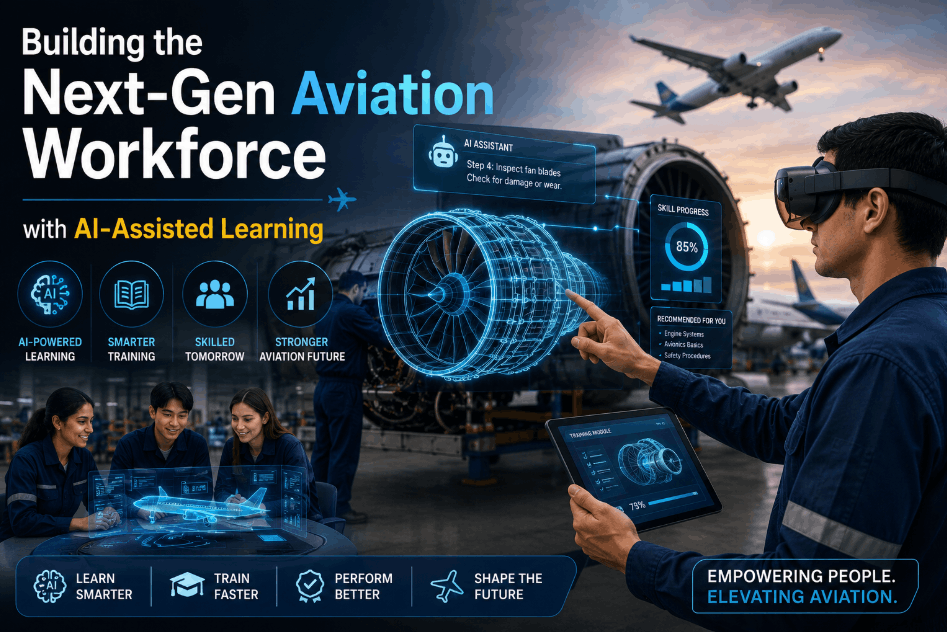
An aviation maintenance technician signs off work that keeps aircraft airworthy. Every diagnostic decision, every torque value, every procedural step draws on training completed days, months, or years earlier. Yet the majority of MRO organizations still deliver that training through passive slide decks, PDF manuals, and one-way video modules — formats that produce average knowledge retention of just 10 to 20 percent after 30 days. The next generation of technicians, raised on interactive digital experiences, expects more. And the data shows that when they get it — through gamified, scenario-driven learning — retention climbs beyond 74 percent, qualification time drops by 41 percent, and first-task procedural errors fall by up to 60 percent.
Engaging the Next Generation of Technicians
Why Traditional Formats Fail Modern Maintenance Teams
The Ebbinghaus Forgetting Curve applies directly to aviation maintenance training. Without active retrieval practice and scenario repetition, technicians lose approximately 80 percent of training content within 30 days of a classroom session — and then sign off critical tasks on that degraded knowledge base. The numbers are consistent across MRO environments worldwide.
Four Core Mechanics That Drive Engagement and Retention
Gamification applies the structural mechanics of game design — not for entertainment, but for measurable learning outcomes. In aviation maintenance training, this replaces passive consumption with active, competitive, and self-directed skill development.
What Gamified Training Delivers in Practice
Traditional LMS vs Gamified Training — At a Glance
| Dimension | Traditional LMS / Classroom | Gamified Training With iFactory |
|---|---|---|
| Knowledge Retention (30 days) | 10-20% average across cohorts | 74-90% with active retrieval and scenario practice |
| Module Completion Rate | Below 60% in most MRO environments | 94%+ with progress scoring and peer competition |
| Time to Task Qualification | Standard cohort schedule — 6 to 12 weeks | 41% faster with scenario-driven competency mapping |
| Competency Visibility | Completion certificates only — no gap data | Live dashboards by technician, system, and site |
| Regulatory Evidence | Paper or PDF records — manual audit assembly | Digital sign-off packages generated in minutes |
| Technician Engagement | Passive consumption — low self-direction | 82% of technicians self-direct 30+ min daily |
From Contract to First Gamified Module in Weeks
Common Questions About Gamified Aviation Training
Does gamification compromise the seriousness of safety-critical training? ▼
No. Gamification does not reduce training to entertainment — it restructures how information is delivered, practiced, and reinforced. Points are awarded for correct procedure execution, not speed alone. Badges verify demonstrated competency, not participation. Scenario exercises embed the same technical content as slide decks but force active retrieval and decision-making, which produces measurably higher retention. Regulators including FAA, EASA, GCAA, and CASA accept gamified training formats as long as competency demonstration and completion documentation meet their standards. iFactory's Gamified Training Module generates timestamped, digitally signed records for every module completion, scenario score, and badge award — exceeding standard regulatory evidence requirements.
How does gamified training reduce procedural errors in practice? ▼
The mechanism is repetition with immediate feedback. In a traditional classroom, a technician hears a procedure once, observes a demonstration, and then attempts it on an aircraft days or weeks later. In a gamified scenario module, the technician executes the procedure step by step in a simulated environment — and every incorrect action triggers real-time corrective feedback. They can repeat the scenario until they achieve a perfect score before ever touching an aircraft. This builds procedural fluency in a risk-free environment. MROs using simulation-based gamified training report up to 60% fewer procedural errors at first task execution compared to technicians trained exclusively on static LMS content.
Can gamified training integrate with existing regulatory compliance requirements? ▼
Yes. iFactory's Gamified Training Module is designed for compliance from the ground up. Every module completion, scenario score, badge award, and recurrency sign-off is stored with timestamp and digital signature, linked to individual technician records and task authorization history. Automated recurrency tracking flags expiring qualifications at 60, 30, and 14 days and assigns gamified refresher modules automatically by aircraft type, system category, and regulatory requirement — with zero manual scheduling overhead. The platform generates regulatory evidence packages for FAA, EASA, GCAA, and CASA in minutes, not hours of manual document assembly before an audit.