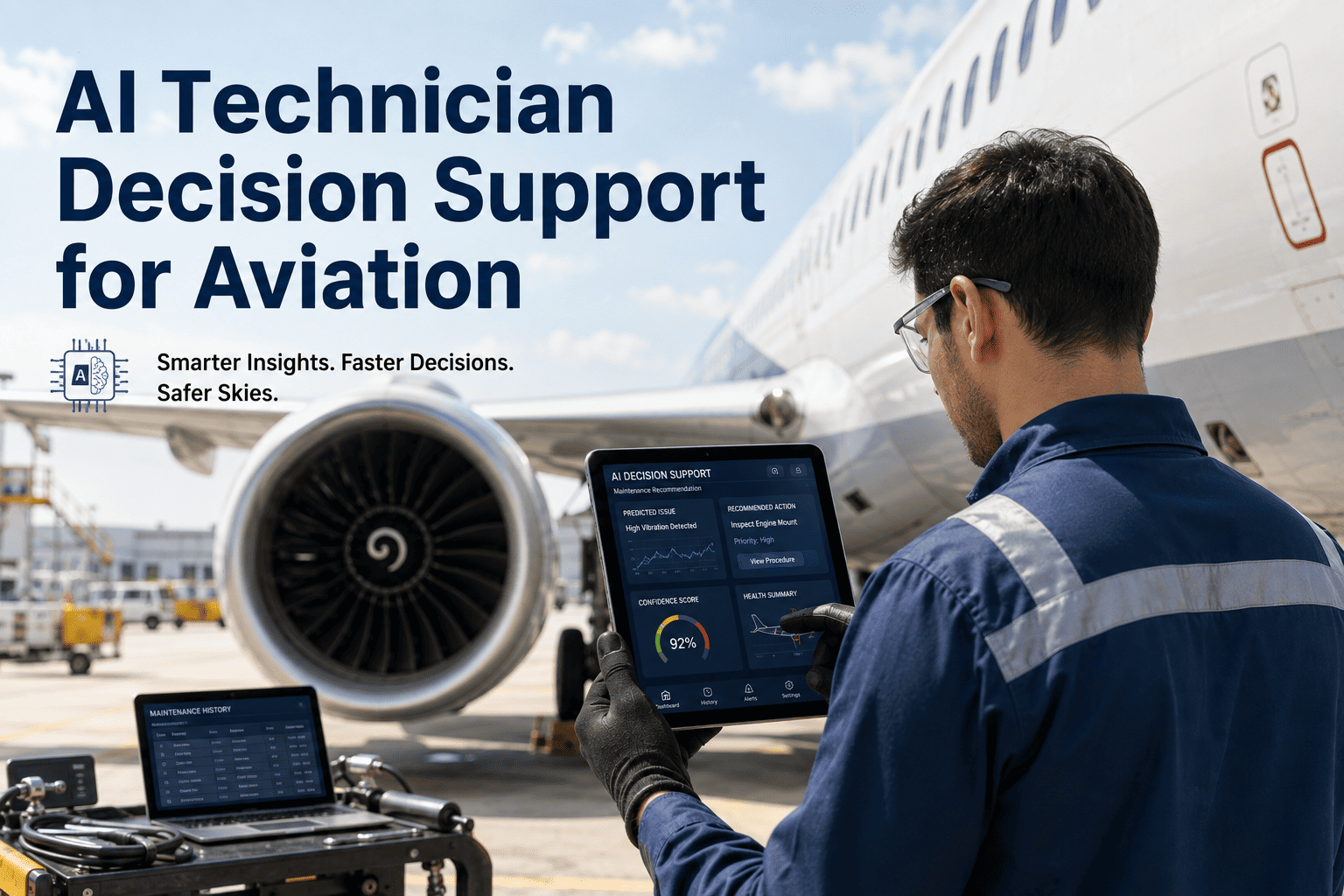
The promise of AI-augmented analytics in aviation safety is undeniable. Predictive models spot patterns across maintenance logs, flight data, and hazard reports that no human team could correlate. But there is a paradox the industry rarely discusses: the more capable the AI, the greater the human factors risk. Automation complacency, automation bias, cognitive load shift, and skill degradation are not theoretical concerns. They are empirically documented threats that emerge when AI-driven decision support is deployed without deliberate human factors engineering. This article examines why human factors determine whether AI-augmented analytics makes your operation safer or introduces new vulnerabilities, and how to design for human-machine teaming that preserves critical human judgment.
Human Factors in AI-Augmented Aviation Analytics
The Smarter Your AI Gets, the More You Need to Watch for Complacency
AI-augmented analytics can process millions of safety data points in seconds. But studies show that without deliberate human factors design, operators over-rely on AI recommendations, miss contradictory cues, and lose the manual pattern-recognition skills that catch what the model cannot see. Here is how to build analytics that augment judgment instead of replacing it.
41-65%
error rate increase when aviation professionals follow incorrect AI recommendations without questioning them, according to controlled studies on automation bias in time-critical aviation decision support
28%
of correct AI recommendations rejected by experienced practitioners because the system lacked transparency and explainability tailored to their expertise level
3x
higher likelihood of over-reliance when AI decision support is presented as a single recommendation rather than a range of options with supporting evidence
80%
of maintenance-related events involve failure to follow procedures, a human factors challenge that AI analytics tools can either mitigate or worsen depending on interface design
The Complacency Trap: Why More AI Can Mean Less Safety
Automation complacency is not about lazy operators. It is a predictable cognitive response to highly reliable automation. When an AI analytics system is correct 95% of the time, the human brain naturally downweights the effort of verification. NASA and FAA research on human-machine teaming confirms that the strategy of allocating tasks to machines that they are good at can leave humans without the ability to perform their tasks or intervene when required, thereby setting humans up to fail and degrading system safety.
AI Recommendations Without Human Factors Design
Operator accepts AI output without verification
Cognitive vigilance decreases over time
Manual pattern-recognition skills atrophy
AI misses novel pattern - no one catches it
Latent safety risk escalates undetected
AI Analytics With Human Factors Engineering
AI surfaces evidence alongside recommendations
Operator maintains active verification role
Cognitive skills reinforced through structured review
AI flags anomalies - human applies contextual judgment
Risk identified with human-AI complementary insight
Three Human Factors Risks That AI-Augmented Analytics Introduces
Research from EASA, the FAA Human Factors Division, ICAO, and NASA consistently identifies three categories of human factors risk when AI analytics is layered onto safety workflows. Each risk is manageable, but only when deliberately designed for from the start.
Risk 1
Automation Bias and Over-Reliance
When an AI system presents a risk score, trend alert, or maintenance recommendation, the human tendency is to accept it as correct. Studies in aviation decision support show that operators presented with AI-generated recommendations exhibit errors of commission (following incorrect advice) at rates exceeding 60% in time-critical scenarios. The bias intensifies when the AI has been historically reliable. Pilots and maintenance engineers begin to treat probabilistic AI outputs as deterministic truth, skipping the cross-verification steps that would catch model blind spots. This is not a training gap. It is a cognitive phenomenon that must be addressed through interface design that requires active engagement rather than passive consumption.
Risk 2
Cognitive Load Shift and Decision Fatigue
AI analytics does not remove cognitive workload. It shifts it. Instead of spending mental energy on pattern recognition, the operator now spends it on interpreting probabilistic outputs, evaluating confidence scores, and deciding whether to trust or override the AI. This meta-cognitive load can be as draining as the original task. ICAO's Human Performance Manual (Doc 10151) identifies sustained cognitive demand from digital systems as a source of fatigue distinct from physical tiredness. The operator who spends a shift evaluating AI alerts rather than directly engaging with data arrives at the end of the day cognitively depleted, making them more vulnerable to missing the next critical signal.
Risk 3
Skill Degradation and Lost Contextual Awareness
The most insidious risk of AI-augmented analytics is that it works well most of the time. When the AI is correct shift after shift, the operator's own pattern-recognition pathways weaken from disuse. Research shows that automation does not simply eliminate tasks but often shifts them, creating new monitoring and cognitive integration responsibilities. The FAA's human factors guidance for AI/ML integration explicitly warns that users may fail to develop accurate mental models of system capabilities and limitations when AI presents its conclusions concurrent with their first viewing of data. When the novel, edge-case scenario finally arrives, the operator lacks the practiced intuition to recognise that the AI is wrong.
AI-Augmented Analytics: With and Without Human Factors Safeguards
The difference between AI that makes your safety team smarter and AI that makes them complacent comes down to deliberate human factors integration at every stage of the analytics pipeline.
Risk Presentation
Single risk score or recommendation displayed as output
Risk score with supporting evidence, data sources, and confidence indicators
Operator Role
Passive recipient of AI-generated insights
Active verifier who reviews evidence before accepting or rejecting
Explainability
Black-box output with no rationale for recommendations
Context-aware explanations surfaced only when operator needs to verify or document
Workload Impact
Shifts cognitive load to interpretation of opaque AI outputs
Reduces cognitive load through structured evidence presentation and verification cues
Training Approach
Training focused on how to use the AI tool interface
Training covers AI boundary conditions, known biases, and structured override protocols
Skill Retention
Manual analysis skills atrophy from disuse
Deliberate practice loops maintain operator pattern-recognition capabilities
The iFactory Approach: Human Factors Built into the Analytics Layer
iFactory SMS Integration Module was designed with the principle that AI analytics should augment human judgment, not bypass it. Every feature in the platform is built around the human factors research that shows how operators actually interact with decision-support systems in high-stakes environments.
01
Evidence-Backed Risk Presentation
Every AI-generated risk score is accompanied by the specific data points, source systems, and confidence metrics that produced it. Operators verify before acting, maintaining the cognitive engagement that prevents automation complacency.
02
Context-Aware Explainability
Explanations are surfaced when the operator needs them for verification or documentation, not dumped as constant noise. This prevents the cognitive overload that occurs when AI attempts to explain every recommendation in high-tempo operations.
03
Confidence Transparency
AI predictions include confidence ranges and data quality scores for each contributing source. Operators build accurate mental models of when to trust and when to scrutinise, reducing both over-reliance and under-utilisation.
04
Structured Override Protocols
When an operator disagrees with an AI recommendation, the platform captures the rationale and feeds it back into model training. Every override strengthens both the AI and the organisation's understanding of emerging risk patterns.
05
Leading Indicator Alerts
Configurable threshold alerts keep operators in the verification loop without creating alert fatigue. Alerts are tiered by severity and supported by trend visualisations that reinforce pattern-recognition skills.
06
Continuous Competency Feedback
The platform tracks verification accuracy over time, surfacing personalised insights that help safety managers identify where additional training or process adjustments may be needed to maintain effective human-machine teaming.
Frequently Asked Questions
Does AI-augmented analytics actually increase the risk of automation complacency in safety teams?
Yes, when deployed without human factors safeguards. Multiple independent studies in aviation decision support have demonstrated that operators interacting with highly reliable AI systems exhibit measurable increases in over-reliance and decreases in independent verification behaviour over time. This is not a reflection on the operator. It is a predictable cognitive response to automation that has been documented across aviation, healthcare, and process control domains. The solution is not to avoid AI but to design analytics platforms that actively maintain human cognitive engagement through evidence presentation, structured verification workflows, and confidence transparency.
How does iFactory prevent automation bias compared to other SMS analytics platforms?
Get In Touch
iFactory embeds human factors design principles at every layer of the analytics stack. Risk scores are never presented as single numbers without supporting evidence. Every alert includes traceability to source data, confidence indicators, and data quality metrics. The interface is designed to require active verification rather than passive consumption. Unlike platforms that treat the operator as a reviewer of finished AI conclusions, iFactory treats the operator as a partner in the analysis process, surfacing evidence, highlighting uncertainty, and capturing override rationale to continuously improve both the AI and the operator's mental model of system behaviour.
What does the research say about the right level of AI explainability for maintenance and safety teams?
Research from the FAA, NASA, and EASA consistently finds that the optimal level of AI explainability depends on context, task criticality, and user expertise. In time-critical operational contexts, detailed explanations can increase cognitive load and slow response times. In documentation and review contexts, detailed explanations improve trust and decision quality. iFactory implements context-aware explainability that adapts the depth of explanation to the operational context, task criticality, and user role, surfacing detailed evidence during review workflows and concise confidence indicators during time-sensitive operations.
Can AI analytics still add value if operators are trained to question it?
Absolutely. Research shows that AI analytics delivers the highest safety value precisely when operators are trained and equipped to question it. The concept of appropriate reliance means the operator uses AI to augment their cognitive capacity while maintaining the ability to detect when the AI is operating outside its boundary conditions. iFactory supports this through confidence scoring, data quality indicators, and structured override workflows that treat operator verification as a feature, not a bug. Organisations that train for active engagement with AI analytics consistently outperform those that treat AI outputs as authoritative.
How long does it take to see the human factors benefits of the iFactory approach?
Organisations typically report measurable improvements in operator verification rates and reduction in automation bias indicators within 8 to 12 weeks of deployment. The platform's competency feedback loop helps safety managers identify where additional human factors training or process adjustments are needed. Over 6 to 12 months, organisations see sustained improvements in appropriate reliance behaviour, with operators developing accurate mental models of when to trust and when to scrutinise AI-generated insights. The result is not just safer decision-making but more confident teams who understand the strengths and limitations of their analytics tools.
Human Factors Analytics
AI Should Make Your Team Smarter, Not Complacent
iFactory SMS Integration Module delivers AI-augmented analytics built on human factors research. Every recommendation comes with evidence, every alert includes confidence transparency, and every operator stays in the verification loop. Connect your existing safety systems to AI-driven analytics without replacing anything your team already trusts.
Trusted by airline engineering teams, MRO compliance departments, and ground handling operators across the UK, EU, Middle East, Asia-Pacific, and the Americas.