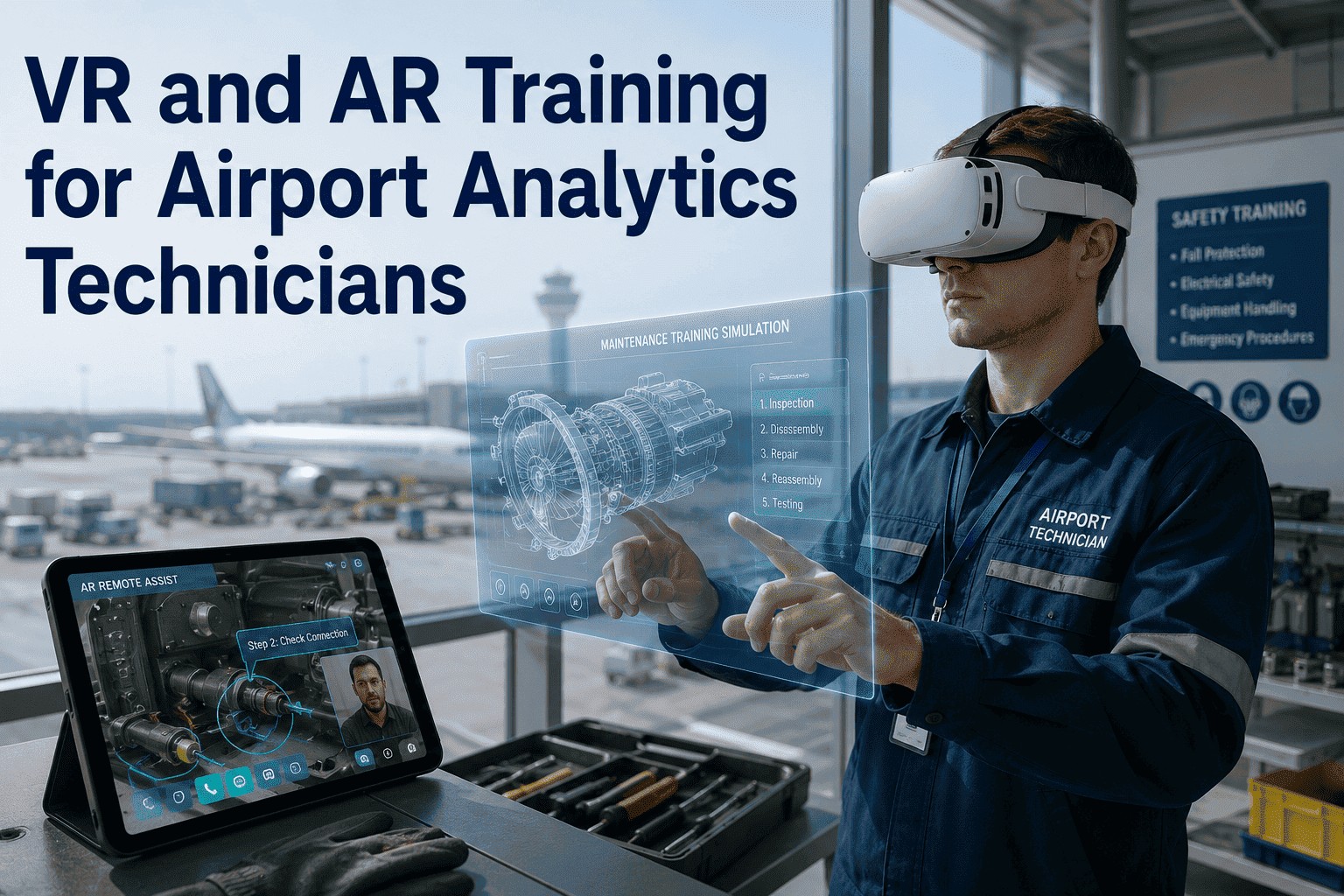
A technician walks into a hangar bay wearing a pair of smart glasses that weigh less than the safety glasses they replace. As they approach the aircraft, the heads-up display activates: the engine serial number is recognized automatically, the relevant task card appears in their field of view, and a 3D wireframe overlay shows exactly which access panel needs to be opened. They do not reach for a tablet, flip through a binder, or call a supervisor for confirmation. They extend a hand, and the system responds to their gesture, advancing through the procedure step by step. This is not a pilot program or a technology demonstration. It is the current state of wearable technology deployed in aviation maintenance operations, and it is changing how technicians work, how data is captured, and how quickly aircraft return to service.
Equip Your Technicians with Hands-Free Wearable Technology
iFactory Wearable Device Integration. Smart glasses, haptic gloves, biometric sensors. One platform.
$821M
Smart glasses industrial market value in 2026, growing at 24.7% CAGR
30%
Average reduction in maintenance and repair time with AR wearables
88%
First-pass accuracy achieved by Boeing technicians using AR guidance
58%
of enterprises are now integrating smart glasses into operations
Three Wearable Categories Reshaping the Hangar Floor
Wearable technology in aviation maintenance falls into three functional categories, each addressing a distinct gap in how technicians access information, interact with equipment, and stay safe in the hangar environment. The most effective deployments combine devices from multiple categories into a unified wearable ecosystem connected through a common data platform.
How Wearables Change the Workflow
The difference between a technician with a tablet and a technician with a wearable is not the device form factor. It is the elimination of every transition between looking at the aircraft and looking at a screen. A wearable keeps the information in the technician's line of sight, keeps both hands available for work, and keeps the data stream flowing continuously from the moment the task starts to the moment it is signed off.
Traditional Workflow
Technician reads task card from paper or tablet, locates part on aircraft, performs work, sets down tools to document findings on device or paper, picks back up, continues. Each documentation break adds 2 to 4 minutes per step. Cumulative effect across a 12-task sequence adds 30 to 50 minutes of non-value-added screen time per work order.
Wearable-Enabled Workflow
Technician looks at the aircraft, sees the task card overlaid on the component. Performs work with both hands. Voice commands capture findings. Gestures advance steps. Haptic gloves record torque and angle data. Sign-off is completed hands-free the moment the task ends. Zero documentation breaks. Every data point captured at task speed.
Measured Impact: What the Numbers Show
Operational data from aerospace manufacturers and MRO operators who have deployed wearable technology reveals consistent improvements across task accuracy, completion time, technician onboarding, and safety incident frequency.
Task Completion Time
20-30%
Faster task completion with AR-guided procedures
First-Pass Accuracy
88%
First-time accuracy vs industry baseline of 60-65%
Technician Onboarding
50%
Faster ramp-up for new technicians using AR training and guidance
Safety Incidents
35%
Fewer ergonomic and fatigue-related incidents with biometric monitoring
The Data Pipeline: From Wearable Sensor to Maintenance Record
Wearable devices generate structured and unstructured data that must be captured, validated, and mapped to the correct maintenance record. iFactory's integration layer handles this pipeline automatically.
1
Device Data Ingestion
Smart glasses stream gaze points, voice notes, and photo captures. Haptic gloves send torque curves and position coordinates. Biometric wearables transmit heart rate and ambient exposure logs. All data is normalized into a common format at the ingestion layer.
2
Work Order Mapping
Each data point is correlated with the active work order, task card step, and component serial number. The system uses the technician's gaze point and task context to determine which record to attach the data to, eliminating manual sorting.
3
Compliance Record Update
Structured data populates the compliance record: torque values are entered into the fastener log, inspection photos are attached to the task card, and biometric safety data is written to the shift report. The audit trail is complete without any keyboard input from the technician.
Frequently Asked Questions
Yes. Industrial-grade smart glasses are designed and tested for harsh environments. Models from RealWear, Vuzix, and Microsoft HoloLens are rated IP54 to IP66 for dust and water ingress, can withstand drops from 2 meters onto concrete, and operate in temperature ranges from -10 to 50 degrees Celsius. Many are certified for use in hazardous environments with ATEX Zone 2 or Class I Division 2 ratings. The devices are built with ruggedized housings, scratch-resistant optics, and hot-swappable battery systems that support multiple shift operations. Standard commercial smart glasses are not suitable for hangar environments; only devices with industrial certification should be deployed.
Industrial smart glasses support multiple input modalities that technicians can switch between based on the task and environment. Voice control uses noise-cancelling microphones that filter out hangar background noise and require the technician to speak at normal conversational volume, not shouting. Gesture controls use the glasses' cameras to recognize hand movements within the field of view without requiring the technician to look at their hands. Some models support a small wired or wireless control pod that can be clipped to a belt or vest and operated by touch without looking. Technicians typically use voice for data entry, gestures for navigation, and the control pod for confirmations in noisy environments.
Industrial haptic gloves equipped with force sensors and inertial measurement units can measure applied torque within plus or minus 3 percent of a calibrated torque wrench and rotation angle within plus or minus 1 degree. The gloves require an initial calibration step for each technician's hand size and grip strength, which takes approximately two minutes. The calibration establishes a baseline that the onboard processor uses to convert grip force to torque values. For critical fasteners where regulatory certification requires a calibrated torque wrench reading, the glove data serves as a verification layer alongside the tool reading, but does not replace the calibrated tool. For non-critical fasteners and general assembly work, the glove data is accurate enough to serve as the primary torque record.
Biometric wearables monitor heart rate variability, skin temperature, and movement patterns to detect early signs of heat stress, fatigue, or physical overexertion before the technician is aware of them. The system compares each technician's real-time biometric data against their personal baseline, not a population average, which reduces false alerts. When the system detects sustained deviation above a configurable threshold, it sends an alert to the technician's smart glasses display and simultaneously notifies the shift supervisor. In deployments at MRO facilities in Middle Eastern and Southeast Asian operations where ambient hangar temperatures regularly exceed 40 degrees Celsius, biometric monitoring has reduced heat-related incidents by over 40 percent and improved shift-end productivity by reducing fatigue-driven slowdowns.
Industrial smart glasses typically provide 4 to 8 hours of continuous mixed-use battery life depending on the model, display brightness, wireless connectivity, and processing load. Most industrial models use hot-swappable battery systems: the battery is mounted on a belt pack or the headset band and can be replaced without powering down the device. Operators deploying smart glasses across a shift schedule typically provide two batteries per device plus a charging station, allowing continuous operation across back-to-back shifts. The iFactory wearable integration platform monitors device battery levels and notifies technicians when a battery swap is needed, preventing mid-task power loss. Some newer models support pass-through charging that allows the device to run while connected to a USB-C power source during break periods.
iFactory's wearable integration platform supports Vuzix M400 and M4000, RealWear Navigator 500 and HMT-1Z1, Microsoft HoloLens 2, and standard Bluetooth-enabled biometric sensors using the Bluetooth Health Device Profile. For devices not on the supported list, iFactory provides an SDK and API documentation that allows custom integration. The platform handles data normalization, work order mapping, and compliance record population regardless of the device brand, as long as the device can output structured data via Bluetooth, Wi-Fi, or USB. iFactory's engineering team typically completes custom wearable integrations in one to three weeks, depending on the device's data output format and documentation quality.
iFactory Wearable Device Integration
Turn Wearable Data into Maintenance Records. Automatically.
iFactory connects smart glasses, haptic gloves, and biometric wearables directly to work orders, task cards, and compliance documentation. Data from every device is captured, mapped, and recorded without manual entry. Supports Vuzix, RealWear, Microsoft HoloLens, and Bluetooth biometric sensors. Trusted by MRO operators across the UK, EU, Middle East, and Asia-Pacific for hands-free maintenance documentation that reduces task time, improves accuracy, and enhances technician safety.
Deploy a wearable pilot in two weeks.