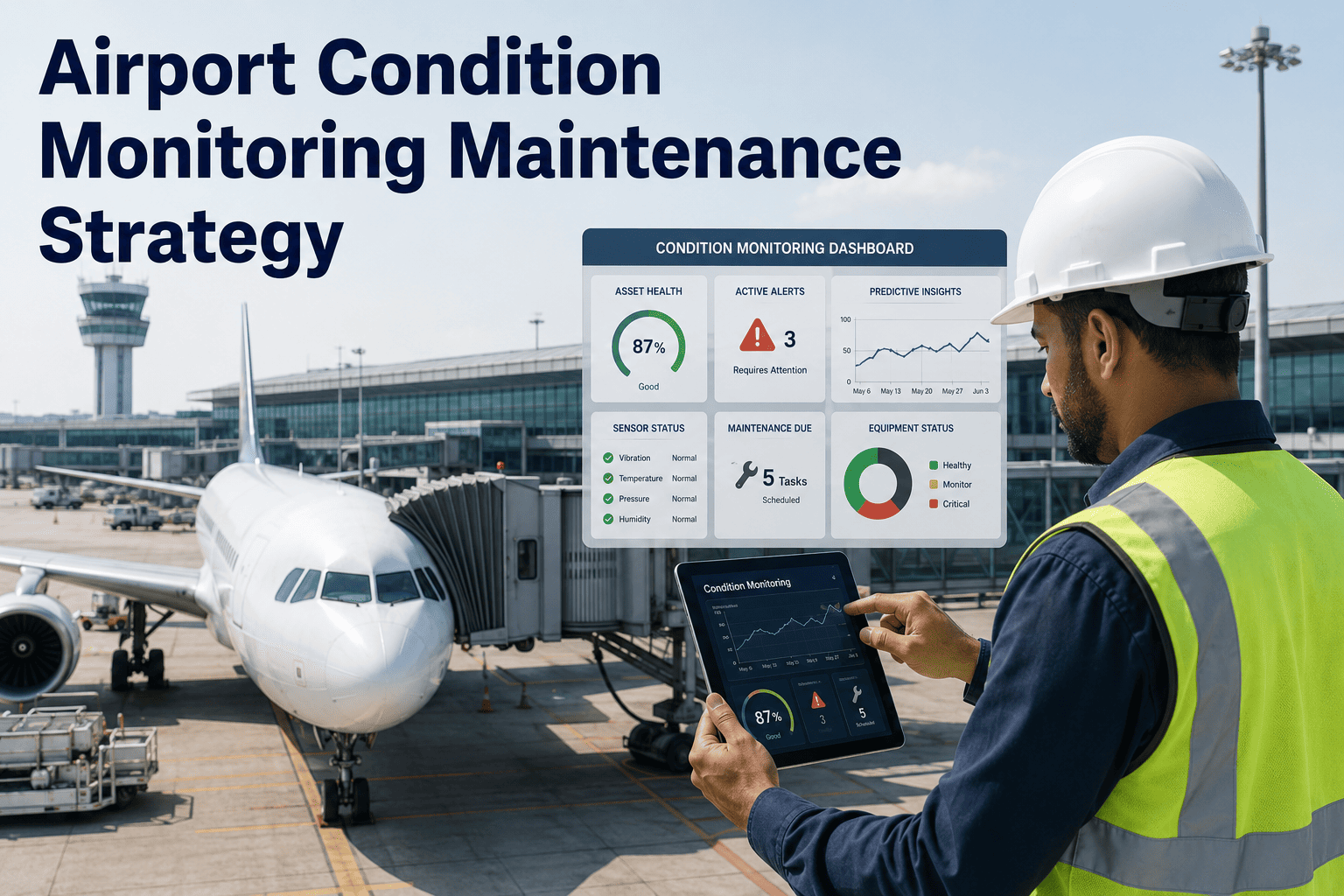
Aircraft maintenance today stands at a crossroads. The fixed-interval framework that has governed airline engineering for over six decades — A-checks every 400 flight hours, C-checks every 18 months, component overhauls at rigid calendar thresholds — was designed for an era when the only data point available was the Hobbs meter. In 2025, a single long-haul aircraft generates more than 10 terabytes of sensor data per flight across engines, landing gear, flight controls, hydraulics, and pressurisation systems. The gap between the data already being collected and the maintenance decisions still being made on fixed intervals represents the largest single source of avoidable cost in modern airline operations. iFactory CBM Analytics Module bridges that gap by transforming raw sensor data into actionable maintenance intelligence, enabling airlines and MROs to move beyond fixed intervals toward true condition-based maintenance scheduling.
iFactory CBM Analytics Module
Moving Beyond Fixed Intervals: The Condition-Based Maintenance Strategy for Modern Aircraft
Every aircraft flying today generates terabytes of health data per flight. Most operators still schedule maintenance using interval tables written decades before that data existed. iFactory CBM Analytics Module turns real-time sensor data into optimised maintenance decisions that reduce costs by up to 46%, extend component life, and eliminate unnecessary inspections.
The Evolution of Maintenance Strategy
The aviation industry has progressed through four distinct maintenance eras. Each represented a leap in efficiency and safety. The fifth is the condition-based era, and it is the first to be driven by the aircraft itself rather than by statistical averages.
Era 1
Reactive Maintenance
Pre-1960s
Fix what breaks after it breaks. No planning, no prediction, no cost control. Unscheduled downtime was the norm and dispatch reliability was poor. Every failure was a surprise.
Era 2
Hard Time Maintenance
1960s-1980s
Fixed intervals for component replacement regardless of actual condition. Engines removed at set flight hours even when perfectly healthy. Safe but wasteful. Parts discarded with 60-80% useful life remaining.
Era 3
On-Condition Maintenance
1980s-2010s
Scheduled inspections determine condition. Tasks performed only when wear exceeds thresholds. Reduced waste but still required physical teardown and visual checks. High labour cost per inspection event.
Era 4
Predictive Analytics
2010s-2020s
Sensor data analysed offline to forecast failures days or weeks ahead. Reduced unscheduled events but insights were retrospective and often arrived too late for optimal planning.
Era 5
Condition-Based Maintenance
Present-Future
Real-time health data drives every maintenance decision. Tasks triggered by actual component condition, not calendar thresholds. Individual aircraft treated uniquely based on its own operational history and degradation profile.
From Raw Sensor Data to Optimised Maintenance: The Four-Layer CBM Architecture
Condition-based maintenance is not a single technology. It is a stack of capabilities that transforms raw aircraft data into confident maintenance decisions. Each layer depends on the one below it, and the value multiplies at every step.
Layer 4
Action & Optimised Scheduling
Maintenance tasks triggered by actual condition data, not fixed intervals. Work orders auto-generated when component health crosses defined thresholds. Hangar slots, parts, and labour pre-positioned for the predicted intervention window.
▼
Layer 3
Diagnosis & Prognosis
Machine learning models compare real-time sensor signatures against known failure modes. Remaining useful life calculated per component per aircraft. Anomaly detection flags deviations before they become faults.
▼
Layer 2
Data Fusion & Normalisation
Sensor data from engine monitoring, landing gear health, flight control feedback, cabin pressurisation, and structural monitoring merged into a unified aircraft health record. Data from different systems normalised to common taxonomies.
▼
Layer 1
Sensor & Data Acquisition
Continuous ingestion of onboard sensor data via ACARS, wireless streaming, or post-flight offload. Engine parameters, vibration signatures, temperature profiles, pressure readings, and cycle counts captured from every flight.
46%
reduction in maintenance cost for monitored components when switching from fixed-interval to condition-based scheduling, validated across airline fleet studies
35%
fewer operational disruptions through predictive fault detection, with false positive rates below 1% in production CBM deployments
700M
euros in potential annual savings for the European aviation sector alone through widespread CBM adoption
96%
on-time scheduling of monitored component interventions using CBM-optimised planning models, versus 60-70% under fixed-interval regimes
The Transition Roadmap: Four Phases from Fixed Intervals to Full CBM
Moving from a fixed-interval maintenance programme to condition-based operations is not a single project. It is a phased journey that builds capability incrementally, with each phase delivering measurable returns that fund the next.
Phase 1
Baseline Assessment
Duration: 2-3 Months
Audit existing maintenance programme against CBM feasibility criteria. Identify components with highest potential for interval extension or task substitution. Review sensor coverage, data availability, and engineering team readiness. Prioritise non-critical systems with gradual degradation profiles.
Objective: Identify target components for initial CBM deployment
Phase 2
Data Infrastructure & Integration
Duration: 3-6 Months
Connect all sensor data streams into a unified health analytics platform. Establish data normalisation layer. Build baseline health models using historical data. Set threshold definitions for monitored parameters. iFactory CBM Analytics Module provides pre-built connectors for common aircraft data sources and fleet management systems.
Objective: Single source of truth for all aircraft health data
Phase 3
Validation & Certification Alignment
Duration: 6-12 Months
Run CBM models in parallel with existing fixed-interval programme. Validate predictions against actual findings. Build confidence data for regulatory engagement. Document accuracy rates, false positive metrics, and safety case. Work with authority under FAA Notice 8900.634 or EASA equivalent for maintenance credit.
Objective: Demonstrated reliability of CBM predictions
Phase 4
Full Scale Deployment
Duration: Ongoing
Transition approved components from fixed-interval to condition-based scheduling. Expand CBM coverage across additional systems and aircraft types. Integrate CBM-driven work orders into MRO planning and execution workflows. Continuous model improvement through feedback loop from actual maintenance outcomes.
Objective: CBM as default maintenance strategy for target components
The Analytics That Power the Transition
Raw sensor data has value only when analytics transform it into decisions. iFactory CBM Analytics Module applies three categories of analytical models that together form a complete condition-based maintenance intelligence layer.
01
Descriptive Analytics
What has happened? Continuous health dashboards showing real-time parameter trends for every monitored component. Historical comparison across fleet to identify outliers. Automated alerting when readings exceed statistical norms. Baseline library of normal operating ranges for each aircraft type and configuration.
02
Diagnostic Analytics
Why has it happened? Root cause correlation between sensor signatures and known failure modes. Fault isolation down to LRU level. Pattern matching against historical failure events across the fleet. Confidence scoring for each diagnosis with traceable evidence chain from sensor to conclusion.
03
Predictive Analytics
What will happen and when? Remaining useful life projections per component using ensemble models. Degradation trajectory mapping with confidence intervals. Optimal intervention window calculation balancing cost of early replacement against risk of operational disruption. Fleet-level demand forecasting for parts and labour planning.
Your aircraft are already collecting the data. iFactory CBM Analytics Module gives you the analytics, workflow, and compliance framework to turn that data into maintenance decisions that reduce costs and improve reliability. Start your CBM transition today.
iFactory CBM Analytics Module Capabilities
iFactory CBM Analytics Module is designed for the specific requirements of aviation maintenance operations: regulatory compliance, multi-source data integration, and seamless connection to existing MRO workflows.
01
Multi-Aircraft Data Ingestion
Ingest sensor data from any aircraft type through standard interfaces. ACARS, wireless streaming, post-flight media offload, and manual entry all supported. Automatic type recognition and parameter mapping to the analytics engine.
02
Health Baseline Modelling
Build statistical health baselines per component per aircraft type. New aircraft auto-calibrate within first 50 flight hours. Deviations scored against fleet-wide norms with configurable threshold sensitivity per system criticality level.
03
RUL Prediction Engine
Ensemble of physics-based and data-driven models for remaining useful life estimation. Predictions updated every flight cycle with confidence bands. Optimal intervention window calculated balancing cost, risk, and operational schedule constraints.
04
Anomaly Detection & Alerting
Real-time anomaly detection across all monitored parameters. Three-tier alert severity: advisory, caution, and warning. False positive suppression through multi-model cross-validation. Every alert linked to the sensor data that triggered it for audit trail completeness.
05
Regulatory Compliance Framework
Built to support FAA Notice 8900.634 and EASA CBM guidance. Complete audit trail from sensor reading to maintenance decision. Model accuracy reporting for authority engagement. Configurable safety margins for credit-approved and non-approved tasks.
06
MRO Workflow Integration
CBM-triggered work orders auto-populated in the maintenance planning system. Parts pre-positioning based on predicted intervention windows. Technician assignments aligned with predicted task duration. Closure feedback loop improves model accuracy after every intervention.
Frequently Asked Questions
What is the difference between condition-based maintenance and predictive maintenance in aviation?
Predictive maintenance uses historical data and analytics to forecast when a failure might occur, typically expressed as remaining useful life. Condition-based maintenance makes actual maintenance decisions based on real-time health data from the aircraft. In practice, CBM includes predictive analytics as one of its layers, but CBM is broader: it encompasses the entire workflow from sensor data acquisition through diagnosis, prognosis, decision support, task execution, and compliance documentation. iFactory CBM Analytics Module includes both predictive and prescriptive capabilities within a single CBM framework.
Can CBM replace all fixed-interval maintenance tasks?
Not immediately and not universally. Regulatory bodies currently limit CBM credits to non-critical tasks and components with measurable degradation profiles. Safety-critical tasks with sudden failure modes may always require interval-based backup. The realistic path is a hybrid model where CBM progressively replaces tasks with the highest waste-to-value ratio, while interval-based safety nets remain for systems where prediction confidence cannot be demonstrated at the required level. iFactory CBM Analytics Module supports both approaches within a single planning framework, enabling operators to manage the transition at their own pace.
How does iFactory ensure the reliability of CBM predictions?
iFactory CBM Analytics Module uses an ensemble modelling approach combining physics-based degradation models with machine learning trained on fleet-wide operational data. Every prediction includes a confidence interval derived from model accuracy history, sensor quality metrics, and data recency. Predictions are cross-validated across multiple models before triggering alerts or work orders. False positive suppression logic reduces nuisance alerts to below 1%. The system continuously validates its own accuracy by comparing predictions against actual maintenance findings and retraining models when drift is detected.
What data infrastructure is needed to implement CBM with iFactory?
iFactory CBM Analytics Module connects to existing aircraft data sources without requiring hardware modification. Standard interfaces include ACARS gate-downlinks, wireless streaming where available, post-flight media offload, and manual data import. The platform normalises data from different aircraft types and sensor configurations into a unified health record. For operators without existing sensor infrastructure, iFactory can integrate with retrofit sensor packages and third-party monitoring systems. The typical deployment timeline from connection to first CBM-driven decision is 8-12 weeks for a standard narrow-body fleet.
How does iFactory support regulatory compliance for CBM?
iFactory CBM Analytics Module is designed to support compliance with FAA Notice 8900.634 for Integrated Aviation Health Management and equivalent EASA guidance. The platform maintains a complete, tamper-evident audit trail from each sensor reading through every analytical transformation to the final maintenance decision and task completion record. Model accuracy reports can be generated directly for authority review. Configurable safety margin thresholds allow operators to apply different confidence requirements for credit-approved versus advisory-only tasks. The system architecture supports step-by-step regulatory progression from advisory CBM through to full maintenance credit applications.
iFactory CBM Analytics Module
The Future of Aircraft Maintenance Is Condition-Based
Every aircraft in your fleet is already generating the data you need to move beyond fixed intervals. iFactory CBM Analytics Module gives you the analytics engine, workflow integration, and regulatory framework to turn that data into a more efficient, more reliable maintenance programme. From first sensor connection to full CBM deployment.
Trusted by airline engineering teams, MRO compliance departments, and ground handling operators across the UK, EU, Middle East, Asia-Pacific, and the Americas.