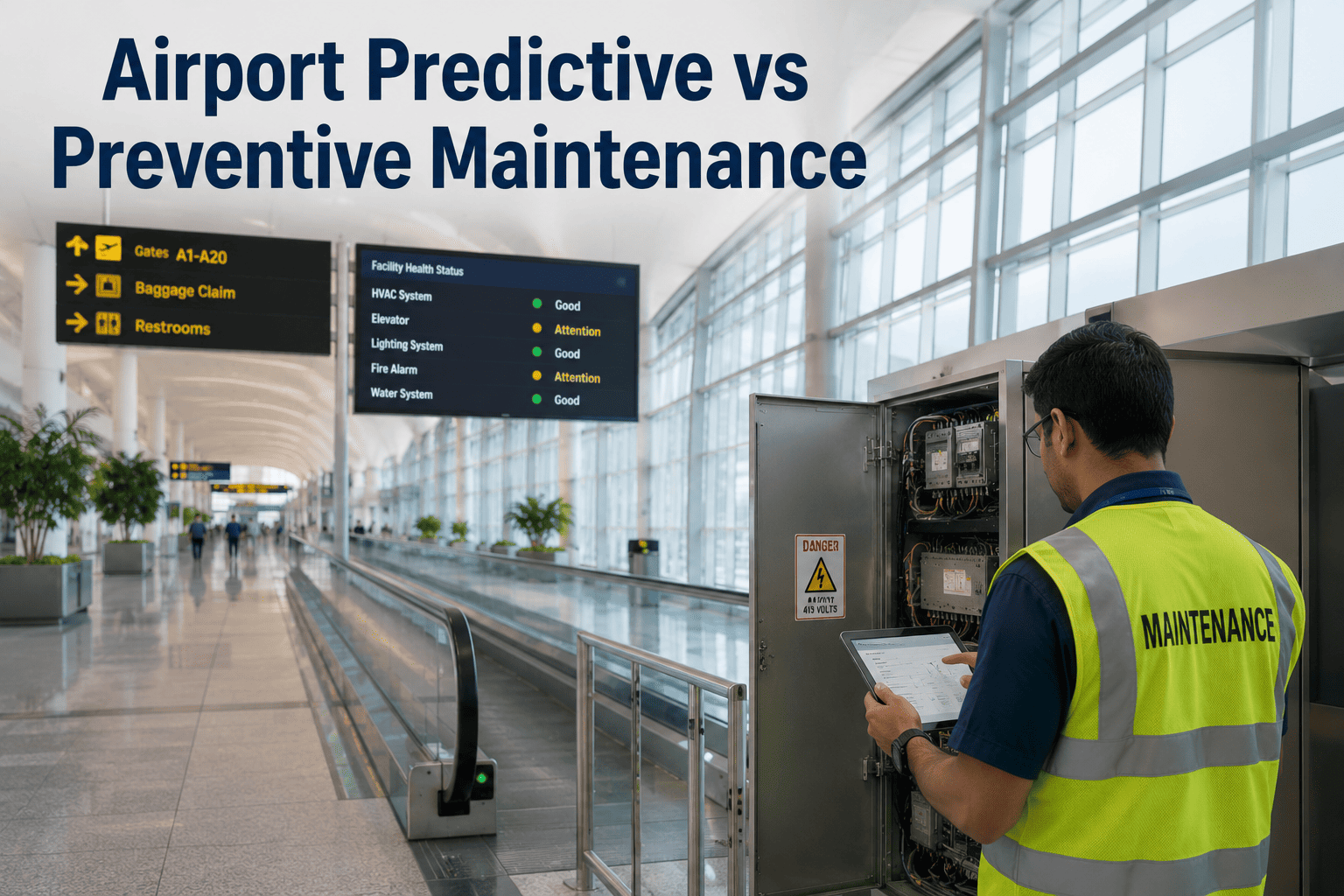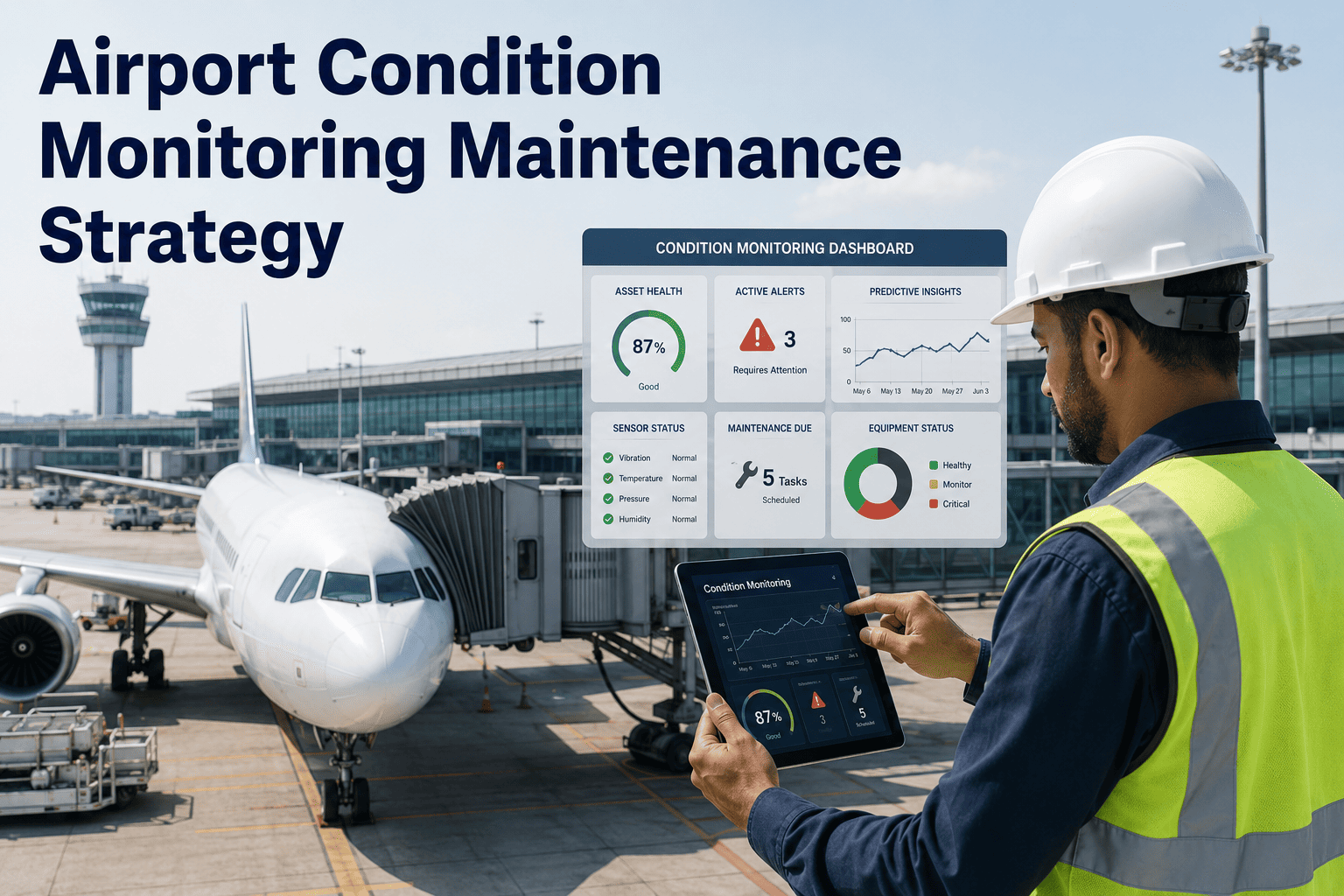
Airport maintenance departments have operated on fixed preventive maintenance schedules for decades. Every chiller gets serviced every 3,000 hours. Every baggage conveyor motor gets bearings inspected every six months. Every boarding bridge gets a full mechanical check annually regardless of how much it has been used, how it has been loaded, or what its actual condition data says. This approach was designed for an era before sensors, before AI, and before real-time equipment health data existed. Today, fixed PM at a major airport wastes an estimated 30 to 40 percent of its maintenance budget replacing components that still had significant remaining life, while simultaneously missing failures that develop between scheduled intervals. Book a demo to see how iFactory helps airports transition from fixed schedules to condition-based maintenance without disrupting ongoing operations.
iFactory monitors actual equipment condition in real time, calculates health scores for every asset, and triggers maintenance only when the data says it is needed.
The P-F Curve: Why Fixed Schedules Miss What Condition Monitoring Catches
Every equipment failure follows a detectable deterioration pattern. The P-F curve plots this pattern by showing equipment condition against time. Point P is where a potential failure first becomes detectable through monitoring. Point F is where the failure becomes functional, meaning the equipment can no longer perform its job. The interval between P and F is the actionable window where maintenance can prevent the failure. The visualization below shows how fixed PM and condition-based maintenance interact with this window differently.
Fixed PM vs Condition-Based Maintenance: Four Operational Differences
The shift from fixed PM to condition-based maintenance is not a minor scheduling adjustment. It changes the fundamental logic of how maintenance decisions are made, how budgets are spent, how failures are prevented, and how maintenance resources are allocated across the airport.
Maintenance is triggered by calendar dates, runtime hours, or cycle counts written into the CMMS at installation. A chiller gets serviced every 3,000 hours whether it ran at 40 percent load or 95 percent load, whether the condenser tubes are clean or fouling, whether the compressor is drawing nominal current or trending upward. The schedule has no awareness of actual equipment condition.
Maintenance is triggered by measured equipment condition crossing a predetermined threshold. The same chiller gets serviced when its condenser approach temperature rises 2 degrees above baseline, its compressor current draw increases 8 percent above the learned profile, or its refrigerant charge level drops below the optimal range. The schedule is driven by what the equipment is actually doing, not what the calendar says.
Costs are distributed evenly across the schedule but include significant waste. Components are replaced on schedule even when they have 40 to 60 percent remaining life, creating premature parts consumption that inflates material costs. At the same time, failures that develop between scheduled intervals generate expensive emergency repairs, overtime labor, and operational disruption costs that the fixed schedule was supposed to prevent but could not.
Parts are replaced only when condition data indicates they are approaching end of life, eliminating premature replacement waste by 30 to 50 percent. Emergency repair costs drop sharply because degradation is detected and addressed in the P-F window before it becomes a functional failure. Total maintenance spend typically decreases 20 to 35 percent while equipment reliability increases simultaneously, a combination that fixed PM cannot deliver.
Failures are prevented only if they happen to develop at a rate that aligns with the scheduled inspection interval. A bearing that degrades over 8 months will be caught by a 6-month inspection. The same bearing degrading over 4 months will be missed entirely, resulting in an unexpected failure between inspections. Fixed PM has no ability to adapt to varying degradation rates across different equipment, operating conditions, or seasonal load patterns.
Failures are prevented regardless of degradation rate because monitoring is continuous. A fast-degrading bearing triggers an alert in weeks. A slow-degrading bearing is monitored until its trend indicates approaching end of life. The system adapts to each asset individually, accounting for its age, load history, operating environment, and maintenance history. The detection window is always the full P-F interval, not a random subset determined by calendar timing.
Maintenance resources are spread evenly across all assets according to the schedule, which means technicians spend significant time inspecting and servicing equipment that is in perfectly good condition. At a large airport with hundreds or thousands of maintained assets, this means 30 to 40 percent of maintenance labor hours are consumed by work that produces no operational value because the equipment did not need attention at that moment.
Maintenance resources are concentrated on assets that actually need attention, as indicated by their condition data. Technicians spend less time on routine inspections of healthy equipment and more time on targeted repairs of degrading equipment. The same team handles more high-value work in the same number of hours, and the work is planned rather than reactive, which means it gets done faster, with the right parts, during optimal scheduling windows.
Equipment Health Scores: What Real Condition Data Looks Like
A condition-based maintenance program expresses equipment health as a single composite score that combines multiple sensor signals into one number your maintenance team can act on. The ring gauges below show example health scores for four common airport equipment types, along with the specific signals that drive each score. A score above 80 is healthy. A score between 60 and 80 warrants monitoring and planning. A score below 60 triggers immediate maintenance action.
Chiller Plant
Condenser approach temperature is 1.2 degrees above baseline. Compressor efficiency is within 2 percent of nameplate. Refrigerant charge level is stable. No immediate action required.
Baggage Conveyor Motor
Motor current draw has increased 11 percent over the last 45 days. Vibration amplitude at the drive-end bearing is trending upward. Bearing temperature is 8 degrees above the learned normal range. Plan bearing replacement within 14 days.
Boarding Bridge
Drive motor current is stable and within 1 percent of baseline. Wheel bearing vibration is nominal. Level sensor accuracy is within calibration spec. No degradation signals detected across any monitored parameter.
Terminal Air Handling Unit
Supply air temperature drift has exceeded 3 degrees from setpoint. Fan motor current is 15 percent above baseline. Filter differential pressure is 40 percent above normal indicating filter loading. Immediate filter replacement and fan inspection needed.
The Cost Math: Fixed PM vs Condition-Based for Three Airport Assets
The transition to condition-based maintenance is not a theoretical exercise. The cost blocks below show the actual annual maintenance cost comparison for three common airport equipment types, broken down by cost category. These figures are based on iFactory deployments at mid-size to large airport facilities where fixed PM data was available for direct before-and-after comparison.
iFactory builds a live health score for every monitored asset in your facility, showing your team exactly which equipment needs attention and which can wait.
Which Airport Equipment to Move to Condition-Based Maintenance First
Not all airport equipment is equally suited for an immediate transition to condition-based maintenance. The priority matrix below maps equipment types by two factors: the operational impact of an unplanned failure on the left axis, and the feasibility of implementing condition monitoring on the bottom axis. Equipment in the upper-right quadrant should move to CBM first because the combination of high failure impact and high monitoring feasibility delivers the fastest and most measurable return on the transition investment.
Boarding bridges, escalators, elevators
Chillers, AHUs, baggage conveyor motors
Specialized test equipment, fire suppression
Terminal lighting, domestic water pumps
Parking ventilation, cooling tower fans
Landscaping, non-critical HVAC zones
Office HVAC zones, non-passenger areas
Backup office systems
Non-essential decorative systems
Your 5-Phase Transition from Fixed PM to Condition-Based Maintenance
Moving an airport maintenance department from fixed schedules to condition-based triggers does not happen overnight, and it should not. The phased approach below ensures that each phase delivers measurable value before the next phase begins, building organizational confidence and technical capability progressively rather than through a high-risk big-bang transition.
Catalog every maintained asset in the airport facility and rank each one by failure impact, operational criticality, regulatory requirement, and current maintenance cost. This ranking determines which assets move to condition-based monitoring first, ensuring the transition starts with the highest-value targets rather than spreading resources evenly across the entire fleet from day one.
Install condition monitoring sensors on the highest-criticality assets identified in Phase 1. Sensor selection is driven by the specific failure modes each equipment type exhibits. Vibration sensors for rotating equipment, temperature and pressure sensors for HVAC systems, current monitors for electrical distribution, and position sensors for moving equipment like boarding bridges. Installation is coordinated with scheduled maintenance windows to avoid operational disruption.
Run the monitoring system in data-collection mode for a period sufficient to establish normal behavior baselines for each asset across varying operating conditions, load levels, and seasonal patterns. Machine learning models are trained on this baseline data to recognize what normal looks like for each specific piece of equipment, creating the reference against which all future degradation will be measured.
Activate automated work order generation for the Phase 1 assets, replacing their fixed PM schedule entries with condition-triggered maintenance. Fixed PM intervals for these assets are removed from the CMMS and replaced by iFactory health score thresholds that generate work orders when condition data indicates the need. Maintenance planners validate the first wave of condition-based work orders against their own inspection data to confirm prediction accuracy before fully trusting the system.
Expand condition-based monitoring to the next tier of assets from the criticality ranking, repeating Phases 2 through 4 for each batch. As the fleet coverage grows, aggregate data from all monitored assets enables portfolio-level optimization of maintenance budgets, spare parts inventory, and technician scheduling. The maintenance department transitions from a calendar-driven operation to a fully data-driven operation where every maintenance dollar is spent on work that is justified by actual equipment condition.
Frequently Asked Questions
What is the difference between predictive maintenance and condition-based maintenance?
The terms are closely related but distinct. Condition-based maintenance is the operational philosophy where maintenance decisions are driven by measured equipment condition rather than fixed schedules. It answers the question of when to perform maintenance based on what the sensors and data say. Predictive maintenance is the analytical method that makes condition-based maintenance possible, using machine learning models to analyze condition data, detect degradation patterns, and estimate when maintenance will be needed. In practice, iFactory provides the predictive analytics layer that enables your maintenance operation to function as a condition-based program. You can think of condition-based maintenance as the strategy and predictive maintenance as the technology that executes it. Book a demo to see both the strategy and technology applied to your airport equipment.
How do we determine the P-F interval for our specific airport equipment?
The P-F interval is not a fixed number that you look up in a table. It varies by equipment type, failure mode, operating conditions, and maintenance history. The most reliable way to determine it is through continuous monitoring, where the AI platform observes the actual degradation curve for each asset and measures the time between when a degradation signal first becomes detectable and when the equipment reaches a failure state. For equipment where historical failure data exists, iFactory can analyze that data to estimate P-F intervals before live monitoring begins. For equipment without historical data, the platform establishes P-F intervals during the baseline learning period by correlating detected degradation signals with subsequent maintenance findings. Over time, the P-F intervals become increasingly accurate as more data is collected from each asset. Contact support to discuss P-F interval analysis for your equipment types.
Can condition-based maintenance run alongside our existing fixed PM schedule during transition?
Yes, and this is the recommended approach. During the transition period, both systems operate in parallel. Fixed PM schedules continue to generate work orders as they always have, while the condition monitoring system runs in shadow mode, generating predictions that are compared against actual equipment condition during scheduled maintenance visits. This parallel operation period serves two purposes. First, it validates prediction accuracy without trusting the system to make maintenance decisions until the models have proven themselves on your specific equipment. Second, it provides a direct before-and-after comparison that demonstrates the cost savings and reliability improvements of condition-based maintenance to leadership, building the organizational confidence needed to fully retire fixed PM intervals for monitored assets.
What sensors are needed to implement condition-based maintenance at an airport?
The sensor requirements depend entirely on which equipment types you are moving to condition-based maintenance and which failure modes you need to detect. For HVAC equipment, temperature sensors, pressure transducers, and current monitors are typically sufficient. For rotating equipment like motors, fans, and pumps, vibration sensors are the primary diagnostic tool. For electrical distribution equipment, temperature sensors on switchgear and current monitors on circuits provide the core data. For moving equipment like boarding bridges and baggage systems, position sensors and motor current monitors cover the critical failure modes. In many cases, a significant portion of the needed data is already available from your existing BMS, SCADA, or equipment controllers, and iFactory can ingest that data directly without requiring new sensor installations. Book a demo to get a sensor requirement assessment for your specific equipment fleet.
How do we justify the CBM investment to airport leadership and finance teams?
The justification rests on three measurable financial drivers that can be quantified before any investment is made. First, parts waste reduction: analyze your current PM work orders to identify how many component replacements were performed on parts that still had remaining life based on inspection findings. This number, typically 30 to 40 percent of PM parts spend, is a direct cost saving that condition-based maintenance captures immediately. Second, emergency repair elimination: count your unplanned maintenance events over the past 12 months and calculate the total cost including overtime, emergency parts procurement, and operational impact. CBM targets a 70 to 90 percent reduction in these events. Third, labor efficiency: calculate the percentage of PM labor hours spent on equipment that was found to be in good condition during the inspection. These hours are redirected to productive work under CBM. Presenting these three numbers, drawn from your own maintenance records, creates a business case that finance teams can evaluate without relying on vendor projections. Book a demo and we can help you build this analysis using your actual maintenance data.
Talk to iFactory about running a condition-based maintenance assessment on your highest-criticality airport equipment before your next budget cycle.