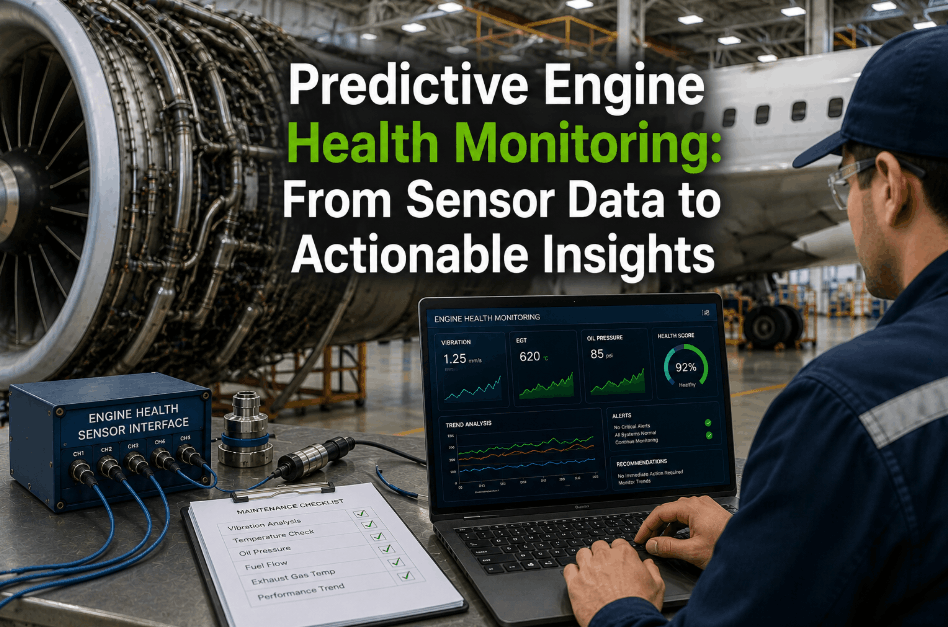
Every aircraft in commercial service today transmits data. ACARS messages stream engine parameters, fault codes, flight phase transitions, and system health indicators from 35,000 feet to ground stations multiple times per flight. A single modern aircraft generates 2,000 to 4,000 ACARS messages per flight cycle. For a fleet of 50 aircraft operating 2 flights per day, that is up to 146 million messages per year. The challenge is not data availability. It is data utilization. Most airlines review ACARS data reactively — mechanics check messages after the aircraft lands, fault codes sit in inboxes for hours, and trend shifts go unnoticed until they become failures. iFactory's ACARS data integration module ingests every message in real time, applies AI-driven predictive models, and converts raw telemetry into actionable maintenance intelligence before the aircraft touches down. The global predictive airplane maintenance market reached $4.8 billion in 2024 and is projected to grow to $15.2 billion by 2030 at 21.4% CAGR (Strategic Market Research). Airlines that invest in ACARS-to-predictive analytics integration today will define the maintenance efficiency standard for the next decade.
The ACARS Data Stream Pipeline
How Aircraft Telemetry Flows from Sensors to Predictive Alerts — Without Human Intervention
The path from an engine vibration sensor at 35,000 feet to a predictive work order on a mechanic's tablet involves five distinct stages. Each stage must be optimized for speed, accuracy, and reliability. A breakdown at any point means the insight arrives too late — after the aircraft has already been grounded unscheduled.
ACARS Message Intelligence Hub
Four Categories of Aircraft Messages That Feed Predictive Maintenance Models
Not all ACARS messages carry equal predictive value. iFactory's AI engine classifies incoming messages into four intelligence categories, each with specific model types and alert thresholds. Understanding what each category enables helps maintenance teams prioritize integration effort by expected ROI.
Before & After: ACARS Data Utilization
Traditional Manual Processing vs iFactory AI-Driven Predictive Analytics
The difference between traditional ACARS data handling and iFactory's AI-driven approach is not incremental. It is a fundamental change in maintenance operational capability. Every metric shown below is drawn from published industry benchmarks and validated implementations.
Predictive Maintenance Impact Metrics
Measurable Gains from ACARS-Integrated AI Analytics Across Fleet Operations
Research published in 2025 validates that AI models trained on ACARS sensor data deliver measurable improvements across every dimension of maintenance performance. The bars below show the documented impact range from fleet-level implementations.
Integration Architecture: ACARS to iFactory AI Engine
Four-Layer Stack That Connects Airborne Telemetry to Maintenance Workflow
iFactory's ACARS integration architecture is designed for minimal latency, maximum reliability, and full regulatory compliance. Each layer handles a specific function in the data-to-action pipeline, with redundancy at every stage to ensure no message is lost and every alert is actionable.
ACARS Integration Rollout Timeline
Four Phases from Pilot to Full Fleet Coverage
iFactory's ACARS integration follows a phased rollout designed to deliver value at each stage while minimizing operational disruption. Each phase includes specific milestones, deliverables, and go/no-go decision points.
Frequently Asked Questions
What ACARS message formats does iFactory support?
iFactory supports all standard ACARS message formats including ARINC 618 (character-oriented), ARINC 619 (binary), and ARINC 620 (data link processing). The ingestion engine automatically detects message format and applies the correct parsing rules per aircraft type. For operators using proprietary message formats or custom-defined parameters, iFactory provides a message template configuration tool that allows engineering teams to define parsing rules without custom development. The platform also supports ADS-C (Automatic Dependent Surveillance-Contract) messages transmitted via ACARS for position and trajectory data.
How long does it take to train predictive models on our fleet's ACARS data?
Initial model training requires 6 to 12 months of historical ACARS data to establish reliable baselines and validate prediction accuracy against known maintenance events. iFactory's automated training pipeline processes the data, identifies the most predictive parameters, and produces initial models within 3 to 4 weeks of receiving the complete dataset. Model accuracy improves over time as more data is ingested. Operators typically see 80% of target prediction accuracy within the first 3 months of live deployment, reaching 94%+ accuracy within 6 to 9 months as the models accumulate fleet-specific failure pattern data.
Can iFactory integrate with our existing ACARS service provider?
Yes. iFactory integrates with all major ACARS service providers including ARINC (Collins Aerospace), SITA, and regional data link service providers. The integration uses standard ACARS message forwarding protocols and requires no changes to your existing aircraft equipment or service provider contract. iFactory provides the ACARS message receiver endpoint configuration, and your service provider routes a copy of your fleet's downlink messages to the iFactory ingestion engine. The setup is typically completed within 1 to 2 weeks of provider coordination. Redundant feeds from multiple providers are supported for high-availability deployments.
Does iFactory's ACARS module work with older aircraft that have limited ACARS capability?
Yes. iFactory's ACARS integration is designed to work with aircraft of all generations, from classic ACARS-equipped aircraft transmitting basic OOOI and fault messages to next-generation aircraft with full-flight data streaming. For older aircraft with limited ACARS parameter sets, iFactory's AI models are trained to extract maximum predictive value from available data points — even a minimal set of engine performance parameters can provide 2 to 4 weeks of advance warning for common failure modes. As aircraft are upgraded or replaced, the platform automatically adjusts to the expanded data stream without reconfiguration.
How does iFactory handle data security and proprietary ACARS message content?
iFactory processes ACARS data through a dedicated, isolated ingestion pipeline with encryption at rest (AES-256) and in transit (TLS 1.3). The platform supports both cloud and on-premise deployment options to meet data sovereignty requirements. ACARS data is never shared across customer tenants — each operator's data is stored in an isolated database instance. iFactory's access control framework restricts message visibility to authorized personnel based on role and scope. For operators with classified or proprietary message content, the on-premise deployment option ensures all ACARS data remains within the operator's network boundary. Security architecture undergoes annual third-party penetration testing.
What is the ROI timeline for implementing ACARS-driven predictive maintenance?
Based on deployments across fleet sizes from 15 to 200 aircraft, operators typically achieve positive ROI within 6 to 12 months of full deployment. The primary drivers are unscheduled maintenance reduction (40.5% fewer outages), labor productivity gains (20% improvement), and extended component life through condition-based replacement instead of schedule-based replacement. For a 50-aircraft fleet, the combined savings from reduced AOG events, lower parts consumption, and improved mechanic utilization typically range from $1.2M to $2.8M annually. The integration cost including iFactory subscription, ACARS feed setup, and model training is typically recovered within the first 8 to 10 months.