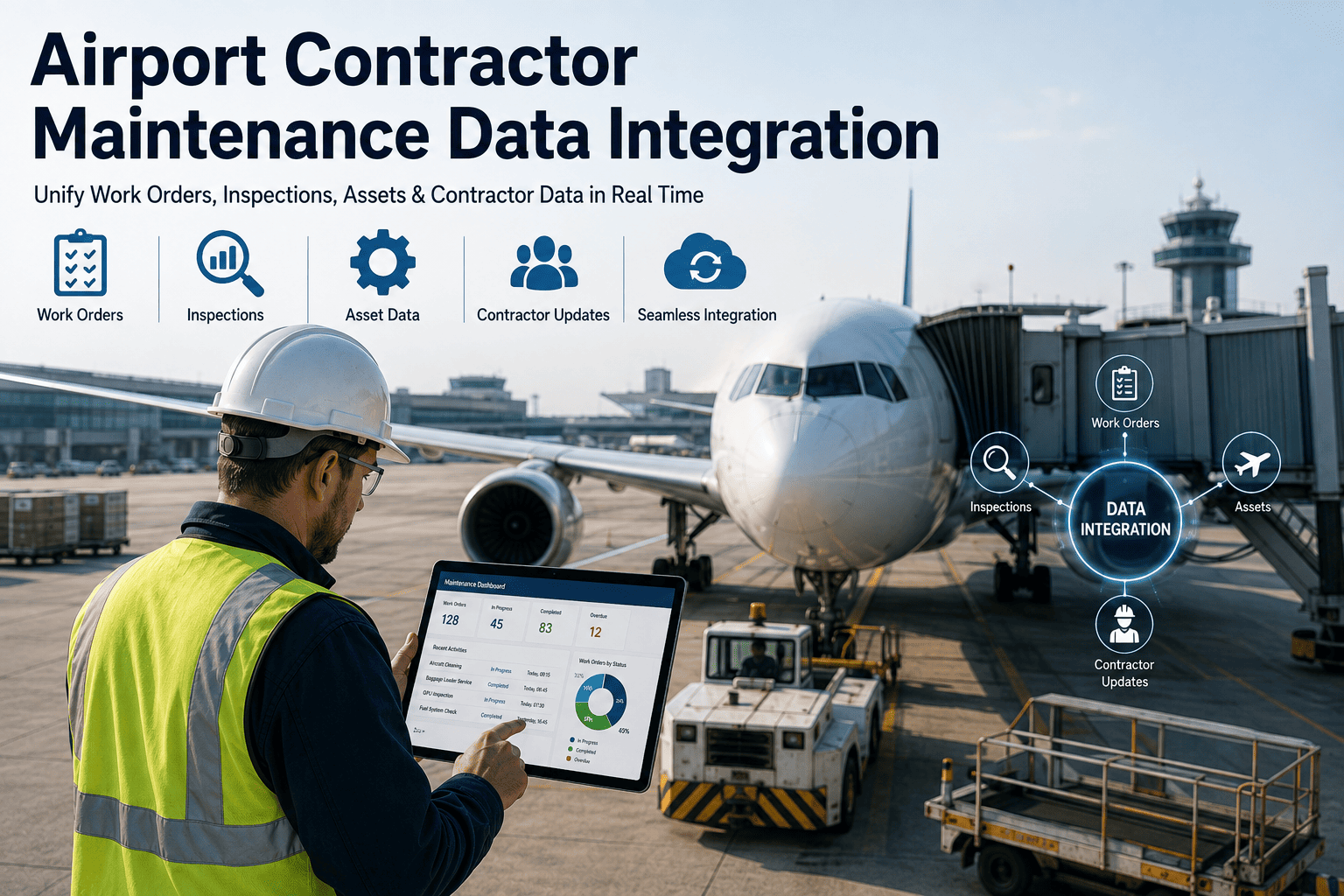
A single jet bridge falls under electrical, hydraulic, structural, and fire safety inspection codes at the same time, and at most airports, the contractor handling each of those disciplines reports back in a different format: one emails a PDF, another logs hours on a paper sheet, a third has its own portal nobody else can see into. Specialist contractors now handle 40 to 60 percent of total airport maintenance scope, and airports typically manage 120 or more active vendor contracts at any given time, yet most of that work still gets tracked the same fragmented way it always has. Seeing what a single connected contractor record looks like against your own vendor list takes about 30 minutes.
Every Contractor Reports Differently. Your Asset Data Shouldn't Have To
Unify contractor work orders, inspections, service reports, and SLA performance with your own asset records in one platform, so a jet bridge's full maintenance picture is never split across six vendors' inboxes and a filing cabinet.
One Asset, Several Contractors, And No Single Place That Sees All Of Them Together
A large hub airport typically carries 120 or more active vendor contracts spanning HVAC, electrical, vertical transportation, fire suppression, cleaning, and groundside equipment, and each one tends to arrive on its own terms: its own reporting cadence, its own file format, its own definition of what counts as "complete." None of that is a contractor problem specifically, it's a structural one. Nobody assigned every vendor the same system, so nobody gets the same data back, and the asset sitting at the center of it all, whether that's a jet bridge, a baggage carousel, or an HVAC unit, ends up with its maintenance history scattered across exactly as many silos as it has contractors touching it.
Work Order Issued
A contractor is dispatched, often verbally or by email, with no structured record created at the point of assignment.
Service Delivered
The contractor completes the work and reports back in whatever format their own internal system produces.
Report Filed Separately
A PDF lands in an inbox, a paper log gets filed, a portal update goes unseen by anyone outside that one relationship.
Asset History Fragmented
Nobody can pull one complete maintenance record for the asset without manually reconciling every contractor's separate trail.
The Gap Isn't Just Inconvenient — It's Measurable Money And Risk
Every one of these numbers traces back to the same root cause: nobody has one place to check contractor-reported work against what actually happened on the asset. Invoices go unverified because there's no clean way to cross-reference billed hours against approved scope. SLA breaches go unnoticed because nobody's watching a single dashboard, they're watching six separate inboxes. And asset condition decisions get made on incomplete history, because half of what happened to that asset lives in a contractor's own filing system instead of yours.
This compounds fastest at the exact moment it matters most: root cause analysis after a failure. When an asset breaks down and three different contractors have touched it over the preceding year, figuring out what actually happened, and whether the failure was preventable, means chasing down three separate service histories in three separate formats before anyone can even start the analysis. By the time that reconstruction is finished, the operational pressure to get the asset back in service has usually already forced a decision to be made without it.
Regulators Expect One Answer, Not Six Contractors' Worth Of Partial Ones
FAA and TSA audits don't care that six different vendors touched an asset under six different reporting systems, they expect a coherent, producible record for that asset when asked. Preparing for those audits under a fragmented contractor model means reconciling information from multiple databases, spreadsheets, and inboxes under deadline pressure, which raises the risk of incomplete or mismatched records right when the stakes are highest. A single jet bridge alone can fall under electrical, hydraulic, structural, and fire safety codes simultaneously, and the CMMS layered on top of that has to satisfy every one of those regulatory stacks without the maintenance team building three separate reporting systems to do it.
The credential side carries its own version of the same risk. Every contractor operating in a secured zone needs a valid access badge, current insurance certificate, and role-specific training documentation, and manual tracking across a dozen or more separate vendor relationships routinely misses expiry dates. An expired credential that nobody caught because it lived in one contractor's own file, not the airport's system, is exactly the kind of gap an unannounced inspection is built to find.
None of this is a criticism of the contractors themselves. Most vendors report accurately within their own system, on their own schedule, in the format their business runs on. The mismatch happens at the boundary, in the handoff between what a contractor produces and what the airport actually retains and can retrieve later. A well-run electrical contractor and a well-run fire suppression vendor can each be doing excellent work and still leave the airport with two incompatible records of what happened, on two different assets, with no shared structure connecting either one back to the airport's own asset registry.
Five Data Types, One Record Per Asset
Unifying contractor data isn't about forcing every vendor onto identical software. It's about pulling what each one produces into the same structured record against the asset they're servicing, so the full picture exists in one place regardless of which contractor generated which piece of it.
Work Orders And Scope
Every job issued to a contractor, with the approved scope captured at assignment rather than reconstructed after the fact.
Inspection And Service Reports
Whatever format the contractor's own system produces, whether PDF, paper, or portal export, tied back to the specific asset and date.
SLA Performance Data
Response time, completion time, and recall rate tracked continuously against contract terms, not reviewed only when a problem surfaces.
Credential And Compliance Status
Access badges, insurance certificates, and training records tracked centrally instead of inside each vendor's own file.
Unified Asset Record Returned
Every contractor's contribution to an asset's history sits in one place, searchable and audit-ready without manual reconciliation.
Stop Reconciling Six Vendor Inboxes To Answer One Asset Question
iFactory pulls every contractor's work orders, inspections, and service reports into the same record as your own asset data, so the full maintenance picture is visible in one place instead of scattered across every vendor relationship you manage.
Same Vendors, Same Work — A Very Different Ability To See It
Unifying contractor data doesn't change who does the work or how many vendors are on contract. It changes whether anyone can actually see what all of them are doing, together, against the same asset, without reconstructing it by hand every time a question comes up.
The table below reflects the same set of vendor relationships evaluated two different ways, not two different sets of contractors. Nothing about switching from fragmented to unified tracking changes who's doing the electrical work or how the fire suppression vendor runs their quarterly tests. What changes is whether that work becomes part of one searchable, verifiable asset history, or whether it stays exactly where it's always been: inside that one contractor's own records, invisible to everyone else who might need it later.
| What's Being Tracked | Fragmented Contractor Data | Unified Asset Integration |
|---|---|---|
| Work Order Issuance | Often verbal or by email, with no structured record at assignment | Logged centrally with approved scope captured at the moment of dispatch |
| Invoice Verification | Manual cross-referencing between contractor invoices and work order approvals | Automatic three-way match between approved scope, reported work, and invoice |
| SLA Breach Detection | Frequently unnoticed for 72+ hours across scattered vendor reporting | Tracked continuously against contract terms as work orders close |
| Audit Preparation | Multi-day reconciliation across databases, spreadsheets, and inboxes | Complete asset record producible on demand, per FAA or TSA request |
| Vendor Performance Review | Anecdotal, based on whichever issues happened to get escalated | Objective scorecard across response time, completion rate, and cost variance |
Some Contractor Categories Generate More Disconnected Data Than Others
Every contractor relationship carries some version of this problem, but a handful of categories tend to produce the widest gap between what's actually happening and what's visible to airport operations, simply because of how many separate vendors typically touch the same asset class.
Vertical Transportation
Elevators, escalators, and moving walkways are frequently serviced by a specialist vendor whose reporting rarely integrates with the airport's broader asset system.
Fire Suppression And ARFF Support
Life-safety systems carry the strictest documentation requirements and the least tolerance for a report that only lives in one contractor's own file.
HVAC And Building Systems
Multi-terminal HVAC contracts often split across several vendors by zone, each with a separate service history for what is functionally one connected system.
Groundside And Baggage Equipment
High-cycle mechanical assets serviced by both in-house staff and outside specialists, splitting one asset's maintenance history across two different tracking approaches.
What these four categories share isn't the type of equipment, it's the number of separate hands touching a single functional system. A multi-terminal HVAC contract split by zone across four vendors means four separate service histories for what passengers and operations staff experience as one connected climate system, and reconstructing a single failure's root cause across that split can mean pulling records from four different sources before the actual pattern becomes visible.
Unify The Data Without Forcing Every Contractor Onto New Software
The realistic path here doesn't start by asking 120 vendors to adopt a new system. It starts by connecting the reporting each one already produces into a single structured record, so the unification happens on the airport's side rather than depending on every contractor to change how they work.
Start by mapping every active vendor and contractor relationship into the platform, importing existing contract terms, SLA thresholds, and credential expiry dates as the foundation. From there, connect each contractor's existing reporting format, whether that's email, PDF, or a vendor portal, so their service reports land against the correct asset record automatically instead of requiring manual entry. Once every vendor's data is flowing into the same structure, SLA tracking, invoice matching, and audit-ready records become standing features of the system rather than a reconstruction project every time someone needs them. Vendors keep operating exactly as they do today, the difference is entirely in how their output gets captured on the airport's side.
Data ownership is worth being explicit about early in this process, since it's usually the first question a vendor relationship manager will ask. Unifying contractor data doesn't mean the airport takes over a vendor's internal systems or workflow, it means the airport retains its own copy of what that vendor reports, structured against its own assets, rather than depending entirely on the vendor's own records surviving and remaining accessible. That distinction tends to resolve most vendor hesitation quickly, since it's a request for a copy of their existing output, not a demand that they change how they run their business.
Common Questions From Airport Facilities And Operations Directors
Bring Every Contractor's Data Into The Same Record As Your Own Assets
iFactory unifies work orders, inspections, service reports, and SLA performance from every vendor into one connected system built for airport maintenance operations. Book a demo and see your own contractor data in one place for the first time.