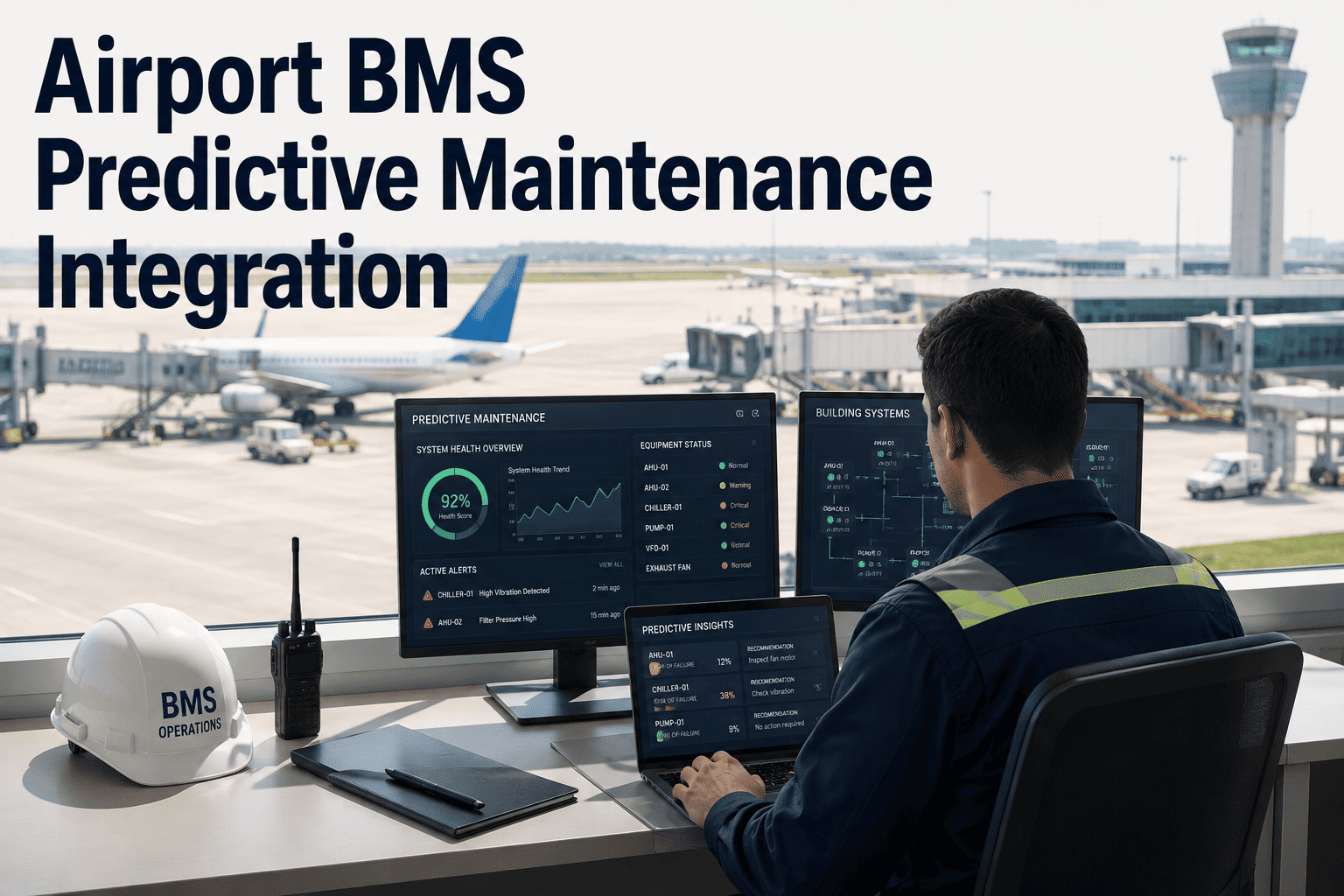
A major airport terminal generates over 50,000 data points per minute from its building management system. Temperature readings, pressure sensors, flow rates, motor current draws, valve positions, and equipment status signals pour in from HVAC plants, electrical distribution panels, baggage handling systems, and lighting controls across every concourse and gate area. The BMS sees all of it in real time. The maintenance team sees almost none of it until something breaks, an alarm fires, and a work order is manually created. The gap between what the BMS knows and what maintenance acts on is where thousands of dollars in preventable equipment failures hide every month. Book a demo to see how iFactory bridges that gap by turning BMS data into predictive maintenance actions.
Connect your building management system to predictive maintenance workflows that detect equipment degradation, auto-generate work orders, and stop facility failures before passengers notice.
Your BMS Sees Everything. Your Maintenance Team Sees Almost Nothing.
The building management system at a mid-size to large airport captures an enormous volume of operational data every minute of every day. The problem is not data collection. The problem is that the vast majority of that data never reaches a human being or an analytical system that could use it to prevent equipment failure. The funnel below illustrates the typical data utilization rate at an airport where BMS and maintenance operate as separate systems with no predictive integration layer between them.
The Airport Subsystems Drowning in Unused BMS Data
Every major building subsystem in an airport terminal feeds data into the BMS, but that data rarely flows back out to the maintenance teams responsible for keeping those systems running. The four subsystems below represent the highest-impact integration targets where connecting BMS data to predictive maintenance produces the fastest and most measurable return.
Air Handling and Chiller Plants
Chillers, air handling units, cooling towers, and VAV box networks generate thousands of temperature, pressure, flow, and current data points. Supply air temperature drift, condenser approach temperature rise, compressor current imbalance, and fan motor vibration all appear in the BMS data stream weeks before a unit fails. Without integration, these trends sit in the BMS historian unread until the unit trips on a safety lockout and terminal temperature starts climbing toward passenger complaint thresholds. iFactory ingests these signals directly from the BMS, builds equipment-specific prediction models, and generates work orders for the exact failure mode detected, whether that is a refrigerant leak, a condenser tube fouling event, or a bearing degradation pattern on a supply fan motor.
Power Distribution and UPS Systems
Switchgear temperature, transformer winding temperatures, UPS battery bus voltage, circuit breaker trip counters, and power factor correction data flow through the BMS from electrical monitoring systems. Transformer overtemperature trends, breaker contact resistance drift, and UPS battery string imbalance all develop gradually and are fully visible in the BMS data long before they cause a failure event. Without integration, these electrical degradation signals are treated as informational readings rather than maintenance triggers. iFactory correlates electrical BMS data with load patterns and ambient conditions to predict transformer overload risk, identify failing breaker contacts, and flag UPS battery strings that will not survive a real transfer event, routing predictions directly to electrical maintenance teams with specific remediation recommendations.
Baggage Handling System Controls
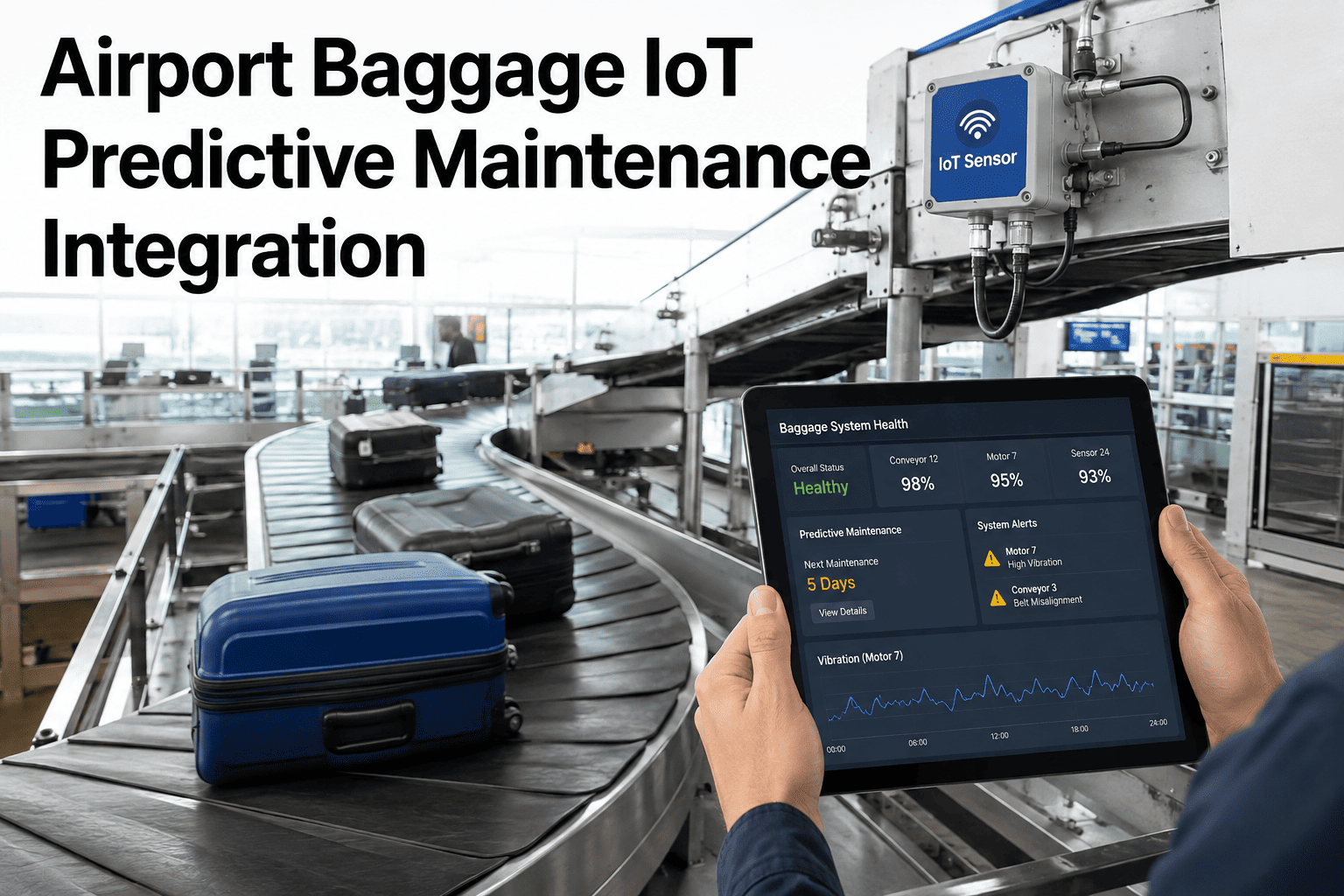
Baggage handling systems are among the most mechanically complex and operationally critical subsystems in any airport terminal. Conveyor motor current draws, divert sensor actuation counts, belt tension sensor readings, and PLC communication status data are available from the BHS control system but rarely reach the mechanical maintenance team in a form that enables proactive intervention. A conveyor motor drawing increasing current over weeks is a bearing wear signal that, if acted on, prevents a conveyor jam that diverts hundreds of bags and delays dozens of flights. iFactory connects to BHS control systems via OPC-UA or Modbus, monitors motor performance trends, sensor degradation patterns, and mechanical wear indicators, and predicts specific failure modes like motor bearing failure, belt misalignment, or divert actuator fatigue before they cause operational disruption.
Lighting, Plumbing, and Fire Safety Systems
Terminal lighting control systems, domestic water booster pumps, sanitary waste pumps, and fire suppression system monitoring panels all feed status and performance data into the BMS. Lighting fixture failure rates by zone, pump pressure trends, and fire alarm panel communication errors are all predictive signals when tracked over time. A rising fixture failure rate in a gate area indicates a driver circuit or power supply degradation that will eventually take out an entire lighting zone. Water booster pump pressure cycling frequency increasing over weeks indicates a check valve or pressure tank problem that will lead to a complete loss of water pressure to upper terminal levels. iFactory ingests these lower-frequency but high-consequence signals alongside the high-volume HVAC and electrical data, ensuring that facility-wide subsystems are not the forgotten corner of the predictive maintenance program.
From Siloed Data to Predictive Action: The Integration Stack
Connecting BMS data to maintenance action requires more than a data export. It requires a structured integration stack that moves data through four distinct layers, each adding capability that the previous layer alone cannot provide. The architecture below shows how iFactory sits between your existing BMS and your existing CMMS without replacing either system, adding the predictive intelligence layer that neither was designed to provide.
Predicted failures generate automated work orders in your CMMS with the specific failure mode, affected equipment, recommended repair, and estimated failure window attached. Risk-scored alerts reach the right maintenance team based on equipment criticality and subsystem ownership. Parts are pre-staged based on the predicted failure mode, eliminating the parts-sourcing delay that turns a planned repair into an extended outage. The loop from data to action closes here.
Machine learning models trained on each equipment type detect anomalies by comparing current behavior against learned baselines. Models correlate signals across subsystems, such as linking a chiller efficiency drop to a concurrent cooling tower fan vibration increase, to identify root causes rather than just symptoms. Health scores are calculated per asset, and failure windows are estimated with specific failure mode classification, turning raw BMS data into maintenance-ready intelligence.
iFactory connects to each BMS and subsystem via native protocols including OPC-UA, BACnet/IP, Modbus TCP, and REST APIs. Data from Honeywell EBI, Siemens Desigo, Johnson Controls Metasys, Schneider EcoStruxure, and standalone IoT sensors is normalized into a unified data model. Timestamps are aligned across systems, sampling rates are harmonized, and noise is filtered to create a clean, correlated data stream that the prediction layer can analyze effectively.
Your existing building management system, SCADA platforms, fire alarm panels, lighting controllers, baggage handling system PLCs, electrical power monitoring systems, and any standalone IoT sensors you have deployed. This layer already exists in your airport today. iFactory does not replace it or modify it. It simply reads the data these systems are already generating and makes it available to the layers above.
iFactory integrates with the BMS platforms and CMMS systems you already have, adding the AI prediction layer that neither provides on its own.
What Changes When BMS Data Reaches the Maintenance Team
The most tangible difference between a connected and disconnected BMS-to-maintenance workflow is response time and planning capability. The two scenarios below trace the same chiller degradation event through two different operational models, showing how the same equipment problem produces radically different outcomes depending on whether BMS data reaches the maintenance team before or after the failure occurs.
The reactive path waits for the equipment to announce its own failure. The predictive path catches the degradation signal from BMS data, classifies the failure mode, estimates the remaining useful life, and schedules the repair before the failure occurs. The equipment never goes offline. Passengers never notice. The difference is not marginal. It is the difference between a maintenance event and a maintenance emergency.
Integration Readiness Assessment
Most airports already have several of the building blocks required for BMS-to-maintenance integration. The assessment below maps the six key capabilities needed for a fully operational predictive integration, along with their typical availability status across the industry. Review each item against your own infrastructure to understand where you stand and what gaps iFactory would fill.
Modern BMS platforms from Honeywell, Siemens, Johnson Controls, and Schneider all support OPC-UA, BACnet/IP, or REST API data export. If your BMS was installed or updated in the last 10 years, this capability almost certainly exists and simply needs to be enabled and configured.
Your computerized maintenance management system, whether it is IBM Maximo, SAP PM, or a specialized aviation CMMS, needs a way to receive work orders from an external system. Most enterprise CMMS platforms have API capabilities, but they may not be configured or may require middleware for integration.
This is the capability that almost no airport has built in-house and that iFactory provides. Machine learning models that ingest BMS data, learn equipment-specific behavior, detect anomalies, and output failure predictions with estimated time windows are not a feature of any standard BMS or CMMS platform.
Some airports have basic automation rules, such as auto-generating a work order when a BMS alarm persists for more than 30 minutes. These rules-based approaches catch acute failures but cannot detect the gradual degradation that predictive models identify weeks in advance.
Linking a chiller efficiency drop to a cooling tower fan vibration increase, or connecting a rising conveyor motor current to a belt tension sensor drift, requires a data model that spans multiple BMS subsystems. This cross-subsystem correlation is rare in practice and is a core capability of the iFactory integration layer.
Most BMS platforms retain historical data for 30 to 90 days by default. Predictive model training benefits from longer histories when available, but iFactory can begin generating predictions within the first few weeks of live data ingestion even without deep historical archives.
Frequently Asked Questions
Does iFactory replace our existing BMS or CMMS platform?
No. iFactory is designed to sit between your existing BMS and your existing CMMS as an integration and intelligence layer, not a replacement for either system. Your BMS continues to handle real-time building control, alarm management, and operator interfaces exactly as it does today. Your CMMS continues to manage work orders, inventory, and maintenance scheduling. iFactory reads data from the BMS, runs predictive analytics, and writes work orders into the CMMS. Both systems remain fully operational in their existing roles, and your operators and maintenance teams continue using the interfaces they already know. Book a demo to see how iFactory connects to your specific BMS and CMMS platforms.
Which BMS platforms does iFactory integrate with?
iFactory integrates with all major airport BMS platforms including Honeywell EBI/Enterprise Buildings Integrator, Siemens Desigo CC, Johnson Controls Metasys, Schneider Electric EcoStruxure Building Operation, and Distech Controls. Integration is protocol-based rather than platform-specific, meaning iFactory connects through standard industry protocols including OPC-UA, BACnet/IP, Modbus TCP, and REST APIs. If your BMS supports any of these protocols, which virtually all modern systems do, integration does not require a custom development project. Contact support to confirm integration compatibility with your specific BMS version and configuration.
How long does it take to go from BMS connection to live predictive maintenance?
The typical timeline from initial BMS data connection to live predictive work order generation is four to eight weeks. The first two weeks are spent establishing data connectivity, normalizing the data streams, and confirming data quality across all integrated subsystems. The next two to four weeks are the baseline learning period where AI models build equipment-specific behavior profiles from live data. Once baselines are established, predictions begin flowing in shadow mode where they can be validated against actual equipment conditions before being trusted to auto-generate work orders. Most airports see their first actionable predictions within six weeks of project kickoff, with prediction accuracy improving continuously as the models accumulate operational data across seasonal variations and load patterns.
Will this increase the number of work orders our team has to handle?
It will change the type of work orders, not necessarily increase the total volume. Today, your team handles a mix of emergency work orders triggered by failures and planned work orders driven by calendar-based schedules. With iFactory integration, emergency work orders decrease because failures are predicted and addressed before they occur, while calendar-based work orders are replaced by condition-based work orders that are generated only when actual degradation is detected. The net effect at most facilities is a reduction in total work order volume combined with a dramatic shift from reactive to planned work, which is easier to schedule, requires fewer parts emergencies, and causes far less operational disruption. Your team spends less time firefighting and more time executing planned maintenance during optimal windows.
What is the return on investment for BMS-to-maintenance integration?
ROI comes from three primary sources that compound over time. First, avoided equipment failures: a single prevented chiller failure during summer peak season can save $20,000 to $100,000 in emergency repair costs, temporary cooling equipment rental, and passenger experience impact. Second, energy savings: predictive maintenance keeps HVAC equipment operating at peak efficiency rather than the degraded efficiency that precedes most failures, typically reducing HVAC energy consumption by 5 to 15 percent. Third, labor optimization: shifting from reactive to planned maintenance reduces overtime costs, eliminates emergency callout premiums, and allows maintenance managers to schedule work during low-demand periods rather than reacting to failures at the worst possible time. For a mid-size to large airport terminal, these three value streams typically deliver full payback within the first 12 to 18 months of operation. Book a demo to model the ROI specific to your terminal systems and maintenance costs.
Talk to iFactory about connecting your airport BMS to predictive maintenance workflows before your next terminal facility review.