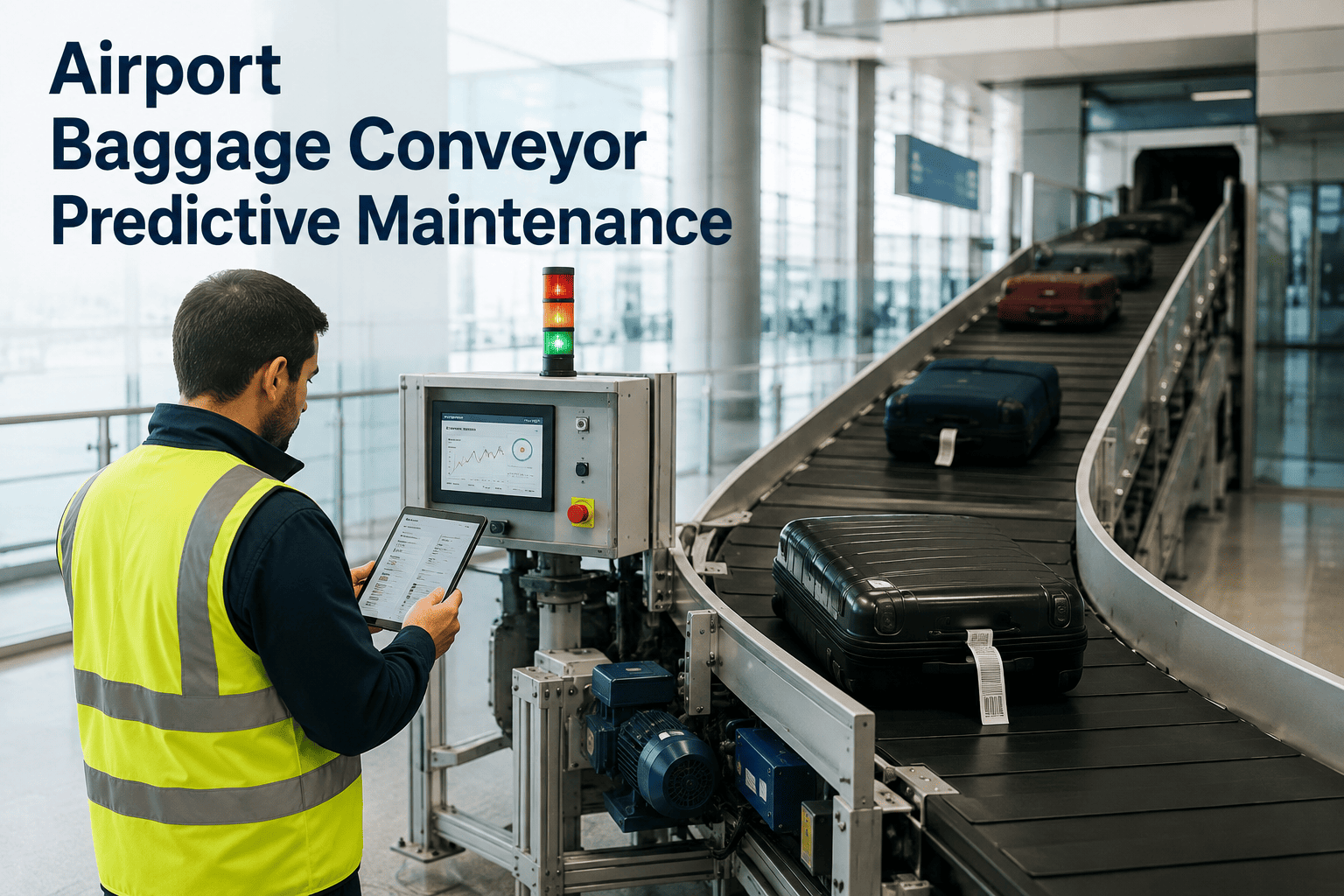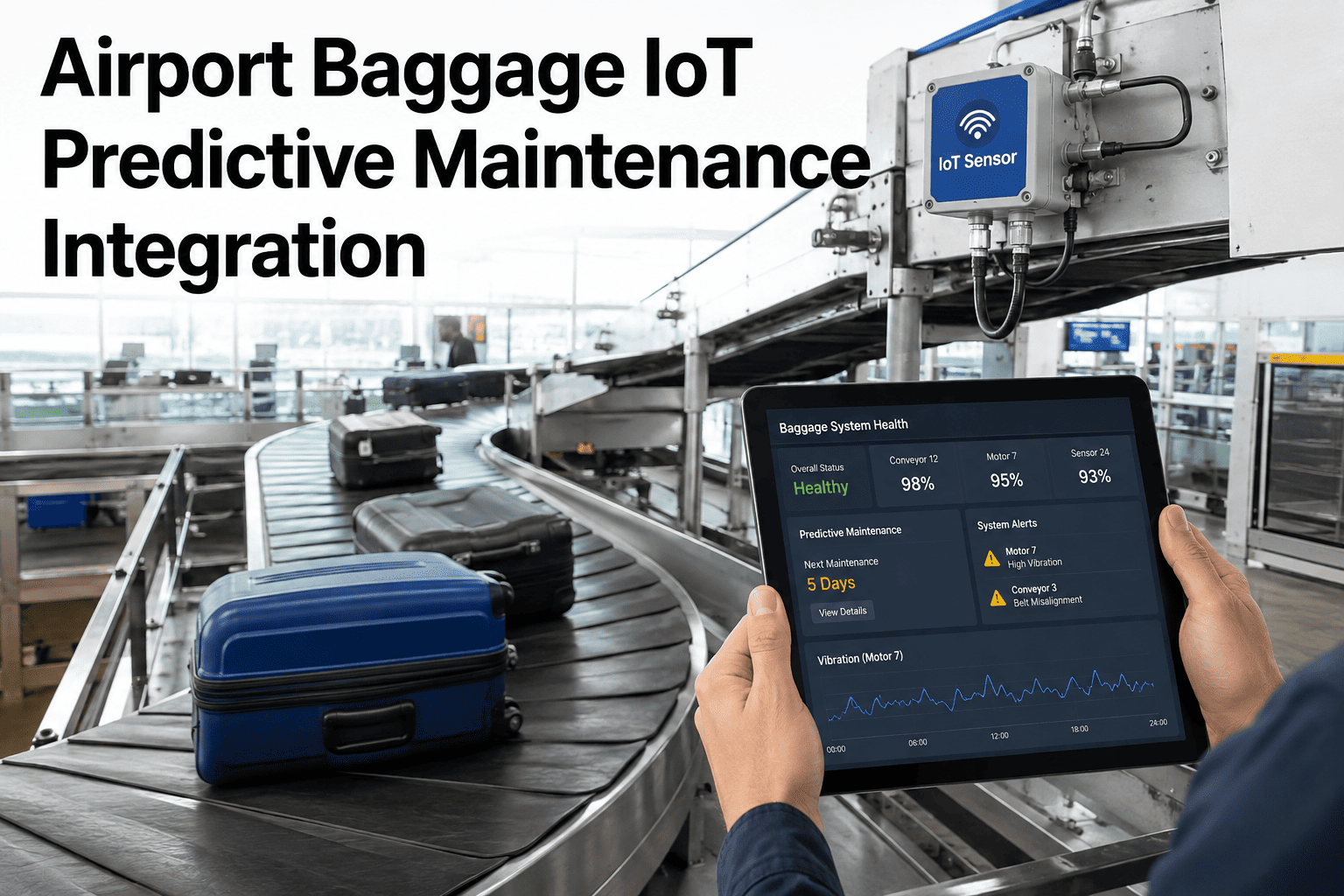
A typical major airport baggage handling system stretches across 10 to 15 kilometers of conveyor belts, sortation equipment, screening machines, and make-up carousels. Every meter of that system has motors, bearings, sensors, and actuators generating operational data. The BHS control system reads that data to keep bags moving. What it does not do is forward that data to the maintenance team in a form that predicts which motor is going to fail next week or which divert actuator is showing the early signs of fatigue that will cause a mis-sort next month. The sensors are already installed. The data is already flowing. The gap is between what the BHS control system sees and what maintenance is allowed to act on. Book a demo to see how iFactory bridges that gap for airport baggage systems specifically.
iFactory connects BHS sensor data to predictive maintenance workflows that catch conveyor motor degradation, bearing wear, and divert failures before bags pile up at the sort.
The Linear System Where One Jam Stops Everything
A baggage handling system is not a collection of independent machines. It is a single linear process where a failure at any point backs up bags upstream, diverts them to manual handling, and creates a cascade of delays that can take hours to clear. The journey map below shows the typical BHS path and the specific failure hotspots at each stage that predictive maintenance targets.
Incline conveyor motors and merge belts. Failure hotspot: motor bearing wear from continuous start-stop cycles during peak check-in surges.
EDS and CTX machine feed conveyors. Failure hotspot: roller bearing contamination from belt debris and uneven loading from screening rejects.
Tilt tray, cross-belt, or push-bar sorters. Failure hotspot: divert actuator fatigue, tray bearing wear, and encoder drift causing mis-sorts.
Carousel drive motors, turntable bearings, and bag presentation actuators. Failure hotspot: drive motor overheating and turntable bearing wear under uneven load.
Make-up to aircraft bulk loading conveyors. Failure hotspot: belt tracking issues from continuous directional changes and outdoor exposure at remote stands.
The Components That Actually Fail in a Baggage System
Baggage system failures are not random. They concentrate in a small number of component types that endure the highest mechanical stress, the most frequent cycling, and the harshest operating conditions. The panels below break down the five most failure-prone component categories in a typical BHS, the specific failure modes that develop, and the sensor signals that predictive maintenance uses to catch each one before it causes a jam or mis-sort.
Conveyor Drive Motors
Drive motors are the most numerous and most failure-prone components in any BHS. A major hub airport operates 500 to 1,200 individual conveyor motors, each running under variable load conditions depending on bag volume, belt loading, and downstream congestion. The dominant failure mode is bearing degradation, which progresses through a predictable pattern of increasing vibration, rising temperature, and escalating current draw. Motor winding insulation degradation is a secondary failure mode that develops more slowly but produces catastrophic failure when it reaches end of life. Both modes produce clear leading indicators in the motor current signature and vibration spectrum that BHS PLCs already measure but do not analyze for maintenance purposes. iFactory reads these signals directly from the BHS control system, builds per-motor degradation models, and predicts remaining useful life for each drive motor in the system, enabling bearing replacements to be scheduled during planned downtime windows instead of as emergency responses to conveyor stoppages.
Divert Actuators and Sort Mechanisms
Sortation diverters are the highest-impact single-point failures in a BHS because a single faulty diverter mis-sorts every bag assigned to that destination until it is repaired. Tilt tray diverters experience pivot bearing fatigue, solenoid degradation, and tray balance drift. Cross-belt sorters face pusher pad wear, belt tracking issues, and actuator timing drift. Push-bar sorters suffer from bar tip wear, guide rail degradation, and air cylinder seal fatigue. All of these failure modes develop gradually through hundreds of thousands of actuation cycles, and all produce measurable changes in actuation timing, current draw profiles, and mechanical play that the sortation PLC monitors for real-time control but does not trend for predictive purposes. iFactory captures the actuation cycle data from the sortation PLC, measures timing drift and current profile changes for each individual diverter, and predicts when specific actuators will fall outside the tolerance window that produces correct sorts.
Conveyor Belt and Roller Assemblies
Belts and rollers fail through a combination of mechanical wear, contamination, and misalignment. Belt tracking drift causes edge damage and eventual tear. Roller bearing contamination from dust, belt debris, and cleaning chemicals causes progressive roughness and seizure. Impact roller damage at transfer points creates flat spots that propagate vibration into the belt structure. These are slow-developing failure modes that produce measurable signals, including belt tracking position drift, roller rotation speed variation, and vibration amplitude changes at specific roller positions. The challenge is that a BHS has thousands of individual rollers, making manual inspection impractical as a primary detection method. iFactory monitors roller vibration and belt tracking data from the sparse sensor set that BHS systems typically install, uses anomaly detection to flag rollers or belt sections showing degradation patterns, and directs maintenance attention to the specific roller or belt section that needs attention rather than requiring full-system manual inspection.
Encoder and Positioning Systems
Baggage handling systems depend on precise position encoding to track bags through the sortation process. Encoders on drive shafts, photoeyes at merge points, and RFID readers at sort destinations all contribute to the position data that determines which bag goes where. Encoder failure or drift causes mis-sorts that are difficult to diagnose because the mechanical system appears to be functioning correctly while the position data silently drifts out of calibration. Encoder bearing wear, optical contamination, and electrical connection degradation all produce detectable signals including pulse count variation, signal-to-noise ratio degradation, and position readout jitter. iFactory monitors encoder signal quality metrics alongside the position data they produce, detecting encoder degradation before the drift becomes large enough to cause mis-sorts. This is a failure mode that purely mechanical maintenance programs almost never catch because the encoder appears functional during visual inspection while its output accuracy is degrading.
PLC and Communication Infrastructure
The BHS control network itself is a maintenance target that is often overlooked. PLC communication faults, network switch degradation, and fieldbus connection intermittent failures cause sporadic equipment behavior that looks like mechanical problems but has an electrical root cause. A conveyor that periodically stops for no apparent reason, a diverter that occasionally fails to fire, or a photoeye that intermittently drops bags from the tracking system are often symptoms of communication degradation rather than mechanical failure. iFactory monitors PLC communication health metrics, network traffic patterns, and fieldbus error rates to distinguish between genuine mechanical failures and control system degradation, directing maintenance resources to the actual root cause rather than sending technicians to troubleshoot mechanical systems that are functioning correctly but receiving unreliable control signals.
The IoT Sensors You Already Have That Nobody Watches for Maintenance
One of the most overlooked facts about airport baggage system predictive maintenance is that the majority of sensors needed for prediction are already installed and already generating data. They were installed by the BHS OEM for real-time control purposes, and they perform that function well. What they do not do is feed their data into a maintenance analytics system. The inventory below maps the sensor types that exist in a typical BHS, what they measure, and the critical gap between what the BHS control system does with that data and what predictive maintenance needs from it.
iFactory connects to your BHS control system via OPC-UA or Modbus, reads the sensor data your PLCs already collect, and predicts motor, bearing, and divert failures before they jam your sort.
Connecting BHS Sensor Data to Predictive Maintenance
The integration pathway below shows how iFactory moves data from the BHS control system through each processing stage to the point where a maintenance technician receives a specific, actionable work order with the failure mode, affected component, and recommended repair already identified. Each stage in the pathway adds capability that the previous stage alone cannot provide.
BHS Control System Connection
iFactory connects to the BHS PLC network via OPC-UA or Modbus TCP, reading motor current, actuator status, encoder signals, temperature readings, and equipment运行状态 in real time without modifying the BHS control logic or adding load to the control network.
Signal Extraction and Normalization
Raw PLC data is parsed, timestamp-aligned, and normalized into a unified data model. Motor current signatures are separated by motor ID. Diverter actuation cycles are extracted and timestamped. Encoder pulse patterns are captured per encoder. The result is a clean, structured data stream organized by equipment component rather than by PLC address.
Per-Component Baseline Learning
AI models learn the normal behavior profile for each individual motor, diverter, encoder, and roller section. A motor that always runs at 85 percent load has a different baseline than one that cycles between 30 and 100 percent. The models account for load patterns, time of day, seasonal variation, and bag volume to build component-specific normal behavior that seasonal and load-based variation does not corrupt.
Degradation Detection and Failure Prediction
Models continuously compare current behavior against learned baselines to detect degradation. Rising motor current at constant load indicates bearing wear. Increasing diverter actuation time indicates pivot fatigue. Encoder jitter increasing indicates bearing or optical degradation. When an anomaly is confirmed, the model estimates the failure window and classifies the specific failure mode.
Maintenance Work Order Delivery
Predicted failures generate work orders in the CMMS with the component ID, failure mode classification, estimated failure window, and recommended repair procedure attached. The maintenance planner sees not just "motor 447 needs attention" but "motor 447 drive-end bearing degradation, estimated 10-18 days to failure, recommended: replace drive-end bearing with part number X during next planned BHS shutdown window."
Failure Prediction by BHS Component Type
The table below maps each major BHS component to its primary failure modes, the sensor signals that reveal them, the AI detection method iFactory applies, the typical lead time between first detection and functional failure, and the operational consequence if the failure is not predicted and prevented.
| Component | Failure Mode | Detection Signal | AI Method | Lead Time | If Unpredicted |
|---|---|---|---|---|---|
| Drive Motor | Bearing wear | Current rise, vibration increase, temperature rise | Multi-signal trend correlation | 14-28 days | Conveyor stoppage |
| Drive Motor | Winding insulation | Current imbalance, temperature drift | Phase current pattern analysis | 21-45 days | Motor replacement |
| Divert Actuator | Pivot bearing fatigue | Actuation time increase, current profile change | Cycle timing trend analysis | 7-21 days | Mis-sort cascade |
| Divert Actuator | Solenoid degradation | Actuation current drop, timing drift | Current profile comparison | 14-30 days | Mis-sort cascade |
| Sort Tray | Tray bearing wear | Vibration at tray position, speed variation | Vibration spectral analysis | 14-28 days | Tray derailment |
| Belt Roller | Bearing contamination | Rotation speed variation, vibration | Anomaly detection across roller set | 7-21 days | Belt tracking issue |
| Encoder | Bearing or optical degradation | Pulse jitter, signal-to-noise ratio drop | Signal quality trend analysis | 14-30 days | Position tracking loss |
| PLC Network | Communication degradation | Error rate increase, response time drift | Network health trending | 7-21 days | Intermittent equipment faults |
Three Stages of Baggage System Data Maturity
Most airport baggage systems pass through three distinct stages of data utilization as they mature from basic operational control to fully integrated predictive maintenance. Understanding which stage your BHS occupies helps you plan the integration steps that move you to the next level without attempting capabilities that your current data infrastructure cannot yet support.
The BHS control system generates operational data from thousands of sensors, but that data is used exclusively for real-time equipment control and bag tracking. Motor current data triggers overload shutdowns. Photoeye data drives merge logic. Encoder data feeds sortation positioning. The data exists, it is accurate, and it is reliable, but it flows in one direction from sensor to PLC to actuator and is never stored, trended, or analyzed for maintenance purposes. Maintenance learns about equipment condition only when a failure occurs and the BHS control system generates an alarm or a conveyor stops moving. This is where most airport baggage systems operate today. The data is being generated but it is not being leveraged for the one use case, predictive maintenance, that could prevent the majority of the failures that cause operational disruption.
The BHS data stream is tapped and stored in a historian or time-series database, creating a record of what every sensor measured over time. Maintenance teams can pull historical trends for specific motors or diverters, but the analysis is manual and retrospective. A technician investigates a failure after it occurs by pulling the historical data for that component and looking for patterns that might explain what happened. This stage is an improvement because the data exists for analysis, but it is still reactive because the analysis happens after the failure rather than before it. The data is collected but not continuously monitored or analyzed in real time. Some airports reach this stage by connecting their BMS or a standalone historian to the BHS PLC network, but they stall here because nobody has the bandwidth to manually review trends for hundreds of motors and thousands of rollers on an ongoing basis.
The BHS data stream is ingested by an AI platform that continuously analyzes every component's behavior against its learned baseline, detects degradation as it begins, classifies the failure mode, estimates the remaining useful life, and generates maintenance work orders before the failure occurs. Maintenance transitions from reactive to predictive, with technicians receiving specific repair instructions for specific components at specific times rather than responding to alarms after equipment has already failed. This is the stage where iFactory operates, and it is the stage where the ROI from BHS sensor data is fully realized. The sensors, the PLC network, and the data infrastructure from Stages 1 and 2 all remain in place. iFactory adds the analytical intelligence layer that turns stored data into forward-looking maintenance decisions. The BHS control system continues to handle real-time operations exactly as before. The AI platform operates in parallel, reading the same data but analyzing it for a different purpose.
Frequently Asked Questions
Will connecting to the BHS PLC network affect baggage system performance?
No. iFactory connects as a read-only client on the BHS PLC network, meaning it receives data but never sends commands or modifies control logic. The connection uses standard industrial protocols, OPC-UA or Modbus TCP, that are designed specifically for this type of read-only monitoring integration. The data rate required for predictive maintenance is a small fraction of the total PLC network capacity because iFactory does not need every scan cycle of every data point. It reads at rates matched to the analysis requirements, which for most BHS components means one sample per second or less. The BHS OEM and your BHS engineering team can review and approve the data points and sampling rates before the connection goes live, ensuring there is zero risk to baggage system operational performance. Book a demo to see the specific data points iFactory would read from your BHS platform.
Which BHS control platforms does iFactory integrate with?
iFactory integrates with all major BHS control platforms used at airports worldwide, including Siemens SIMATIC S7系列, Rockwell ControlLogix/CompactLogix, Beckhoff TwinCAT, Mitsubishi MELSEC, and Schneider Modicon platforms. Integration is protocol-based rather than platform-specific, meaning iFactory connects through OPC-UA or Modbus TCP regardless of which PLC hardware your BHS uses. For BHS systems that use proprietary SCADA layers on top of the PLC network, iFactory can connect either at the PLC level directly or through the SCADA layer's OPC-UA server, whichever provides cleaner access to the sensor data needed for predictive analysis. Contact support with your specific BHS platform details for a confirmed integration approach.
Do we need to install additional vibration sensors on our conveyors?
It depends on what level of prediction coverage you need. iFactory can generate meaningful predictions for drive motors using only the current, temperature, and speed data that the BHS PLC already provides. For diverter actuators, the PLC data on actuation timing and current profiles is sufficient for fatigue prediction without additional sensors. Where additional vibration sensors add value is on high-criticality sortation equipment like cross-belt sorter drives and tilt tray pivot mechanisms, where vibration spectral analysis provides earlier and more precise bearing wear detection than current-based monitoring alone. iFactory conducts a sensor gap analysis during the initial assessment that identifies exactly where additional sensors would improve prediction lead time and where the existing PLC data is sufficient, allowing you to make targeted sensor investments rather than deploying sensors across the entire system.
How does iFactory distinguish between a loaded conveyor drawing more current and a failing motor drawing more current?
This is the core capability that separates AI-driven prediction from simple threshold monitoring. A loaded conveyor and a failing motor both draw more current, but the pattern is fundamentally different. A loaded conveyor shows increased current that correlates with bag volume and belt loading, and the current returns to baseline when the load decreases. A failing motor shows current increase that progressively worsens regardless of load, often with a change in the current waveform shape as bearing wear introduces mechanical asymmetry. The AI models learn the relationship between current, load, speed, and temperature for each motor under normal conditions. When current increases in a way that does not correlate with load changes, or when the current waveform shape changes, the model flags it as a mechanical degradation signal rather than a load variation. This contextual awareness is what makes the predictions reliable enough to drive maintenance decisions. Book a demo to see how the AI separates load effects from degradation signals on real BHS motor data.
What is the typical return on investment for BHS predictive maintenance?
ROI is driven by three value streams specific to baggage operations. First, avoided sortation disruptions: a single diverter failure during peak hours can mis-sort 200 to 500 bags, each requiring manual recovery at a cost of $15 to $40 per bag in labor and delay costs. A single prevented diverter failure during a peak period can save $5,000 to $20,000 in direct recovery costs, not including the passenger experience impact. Second, reduced emergency maintenance: conveyor motor failures that require emergency repair during operation typically cost 3 to 5 times more than the same repair performed during a planned shutdown, due to overtime, emergency parts procurement, and the operational cost of a down conveyor section. Third, extended component life: condition-based replacement eliminates the waste of replacing motors, bearings, and actuators that still have significant remaining life, which typically reduces BHS parts consumption by 20 to 30 percent. For a major hub airport, these three value streams typically deliver full payback within 8 to 14 months of deployment.
Talk to iFactory about connecting your baggage system sensor data to predictive maintenance before your next scheduled BHS shutdown window.