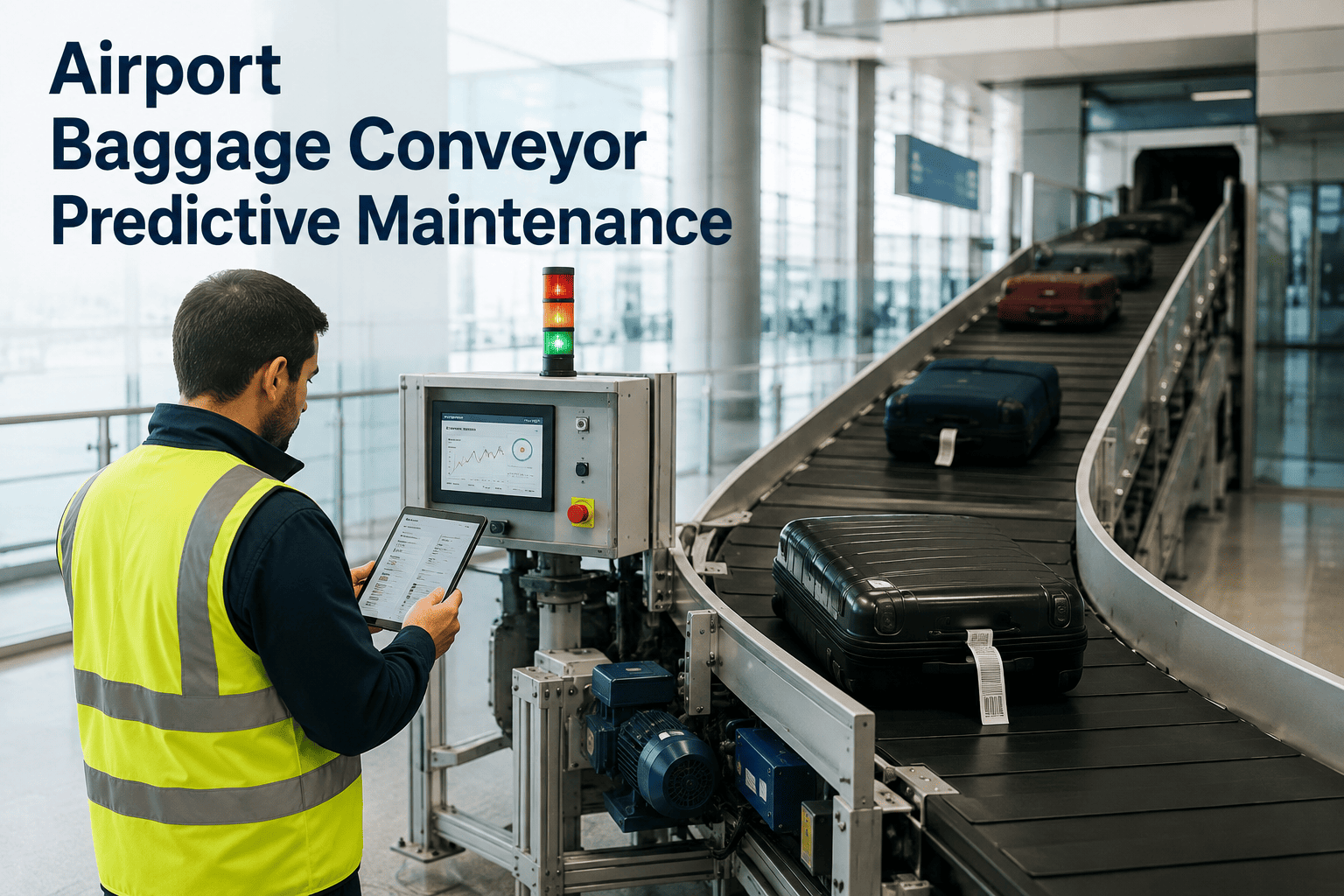
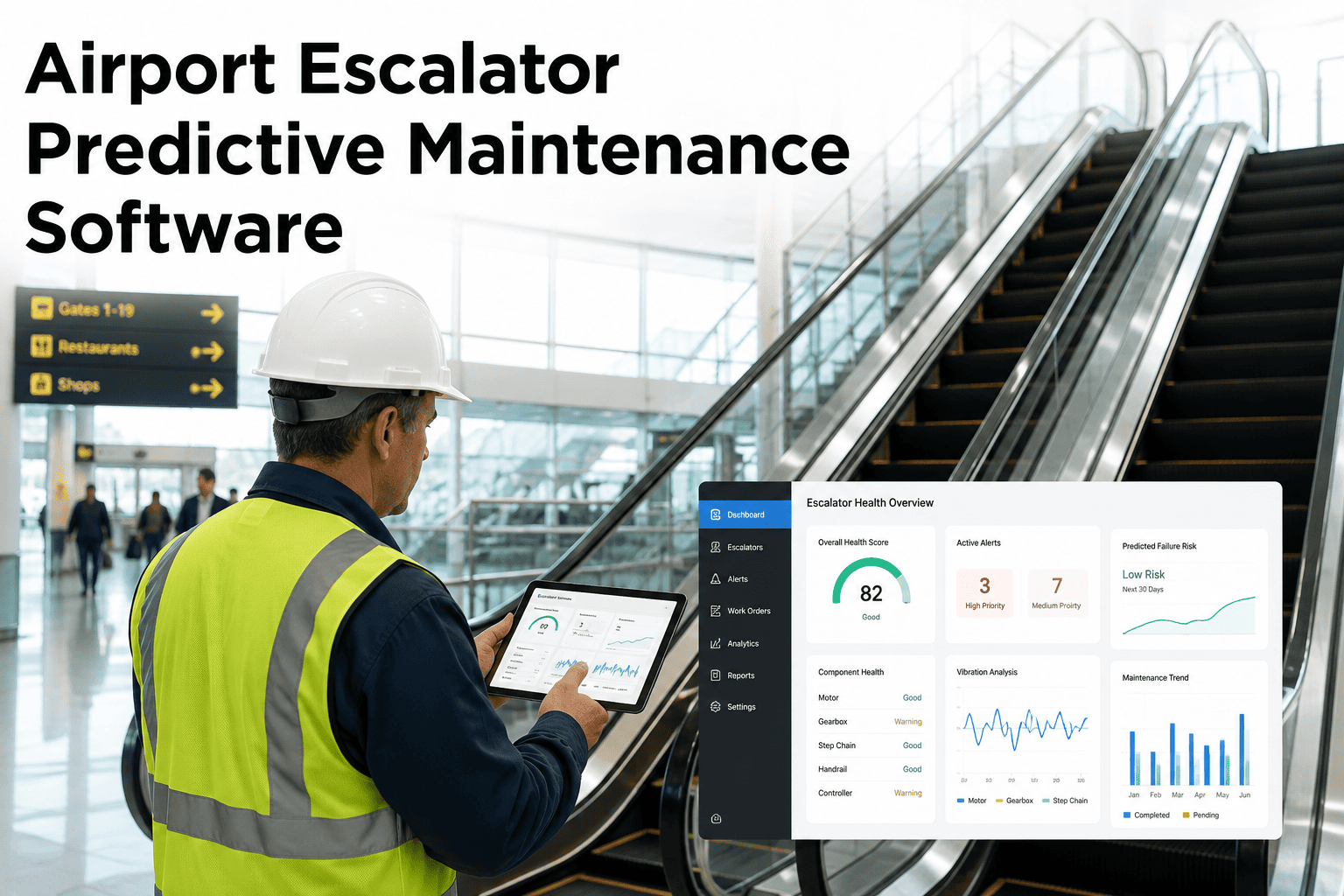
Airport equipment doesn't fail suddenly. A baggage conveyor motor bearing wearing toward seizure, a jet bridge drive mechanism losing alignment, or an escalator gearbox starting to strip its teeth all generate a rising vibration signature days or weeks before the failure becomes visible on a control room screen. Most airports still rely on scheduled listening rounds, calendar-based part swaps, or a threshold alarm that only fires once the equipment is already close to failing, which means the earliest and most reliable warning signal available on rotating equipment goes unread until it is nearly too late to act on it. Vibration monitoring paired with predictive maintenance software closes that gap by turning a continuous stream of accelerometer data into an early, specific, and actionable alert your team can schedule around instead of react to. To see how continuous vibration monitoring would work across your terminal's baggage, jet bridge, and HVAC assets, book a demo.
AVIATION MAINTENANCE · VIBRATION ANALYTICS · EARLY-WARNING DETECTION
Catch Airport Equipment Failures in the Vibration Signature, Weeks Before the Alarm
iFactory turns continuous vibration data from baggage conveyors, jet bridges, escalators, and HVAC compressors into ranked, condition-based work orders — so your team acts on the earliest reliable failure signal instead of waiting for a threshold alarm or a scheduled inspection round.
What the Vibration Spectrum Is Already Telling You
Low Frequency Band (1–10x Running Speed)
Watch
Imbalance and shaft misalignment — the earliest, most common signature on conveyor drives and gearbox couplings.
Bearing Defect Frequencies
Elevated
Rolling-element wear on inner race, outer race, or cage — the fault most likely to end in an unplanned stop.
Gear Mesh Frequencies
Normal
Tooth wear, backlash, and lubrication breakdown inside escalator and moving-walkway gearboxes.
High Frequency / Electrical Band
Watch
Motor winding degradation and rotor bar issues, often confirmed alongside a current-draw anomaly.
48+ hrs
Typical advance warning between a flagged bearing signature and an unplanned equipment stop
20–40%
Reported lifespan extension on airport assets moved from calendar-based to condition-based maintenance
30–50%
Share of vibration, current, and temperature instrumentation most airports already have installed
THE EARLY-WARNING GAP
Why the Signal Is There, But Nobody Is Reading It
Every motor, gearbox, and drive mechanism running continuously in a terminal is already producing the data that would predict its own failure. The problem is rarely a missing sensor — it is what happens, or doesn't happen, to the reading after it's captured. These are the four most common reasons the early-warning signal gets missed until it becomes an emergency work order.
No Baseline Signature on File
Without a recorded "normal" vibration profile for each asset, a slow upward trend has nothing to be compared against, so it simply blends into routine noise.
Threshold Alarms Fire Too Late
A single fixed threshold only trips once amplitude is already high, which on most bearing and gear faults is close to the end of the failure curve, not the start.
Listening Rounds Are Too Infrequent
Monthly or quarterly manual vibration checks catch a fault only if it happens to be actively degrading on the day someone walks the route with a handheld meter.
Readings Never Reach the Work Order Queue
Vibration data frequently lives in a standalone analyzer or spreadsheet, disconnected from the CMMS, so even a genuine early warning has no path into scheduled work.
ASSET-BY-ASSET
Where Vibration Monitoring Delivers the Most Lead Time
Not every airport asset benefits equally from vibration analytics. Rotating equipment with a duty cycle that runs continuously, or nearly so, generates the clearest, most repeatable failure signatures — which is also the equipment where an unplanned failure causes the most disruption to a terminal.
| Asset |
Common Vibration-Detectable Fault |
Typical Lead Time Before Failure |
| Baggage Conveyor Drive Motors |
Bearing wear, belt misalignment, gearbox tooth wear |
1–2 weeks |
| Jet Bridge Lift & Drive Mechanisms |
Hydraulic seal degradation, drive motor bearing wear |
Several weeks |
| Escalator & Moving Walkway Gearboxes |
Gear tooth wear, chain tension loss, lubrication breakdown |
2–4 weeks |
| HVAC Chiller Compressors |
Compressor bearing wear, imbalance, mounting looseness |
Days to weeks |
| Elevator Hoist Motors |
Winding degradation, sheave bearing wear |
2–3 weeks |
Lead time varies by failure mode and component, since vibration and current signatures typically drift gradually rather than jumping straight to failure — which is exactly the window a condition-based program is built to use.
See what your existing vibration data is already telling you
iFactory reviews the instrumentation you already have on baggage, jet bridge, and HVAC equipment, and shows you exactly where a connected platform would surface the earliest warning.
HOW IT WORKS
From Raw Accelerometer Data to a Ranked Work Order
Turning vibration readings into a specific, actionable maintenance task follows the same five-step path across every asset class, whether the equipment is a baggage conveyor motor or a jet bridge drive mechanism.
1
Capture a Baseline Signature
Each asset's normal vibration profile is recorded across its operating range, giving every future reading something specific to compare against.
2
Monitor Continuously, Not Periodically
Accelerometers and motor current analyzers stream data around the clock instead of waiting for the next scheduled listening round.
3
Recognize the Developing Pattern
Machine learning models trained on the asset's own operating history flag the specific frequency band and trend that indicates a developing fault.
4
Generate a Ranked, Specific Alert
The alert names the likely failure mode, an estimated time-to-failure window, and a confidence level, rather than a generic "abnormal reading" flag.
5
Dispatch an Automated Work Order
A work order is created in the CMMS automatically, with parts and procedure attached, so the repair can be scheduled during a planned window.
DETECTION METHOD COMPARISON
Manual Rounds, Periodic Routes, or Continuous Monitoring
Airports typically move through three stages of vibration-based maintenance maturity, and each stage delivers a meaningfully different detection window on the same physical failure.
| Method |
Data Continuity |
Typical Lead Time |
| Manual Listening / Handheld Checks |
Point-in-time, whenever a technician is present |
Hours to none — often after audible failure has begun |
| Periodic Vibration Route (Monthly/Quarterly) |
Scheduled snapshots, gaps between visits |
Days, if the visit lands during active degradation |
| Continuous Condition Monitoring |
24/7 streaming data against a live baseline |
1–4 weeks, depending on asset and failure mode |
COMMON MISTAKES
Where Vibration Monitoring Programs Fall Short
Instrumenting Without a Baseline Plan
Sensors get installed broadly before anyone decides which asset's normal profile actually needs to be established first.
One Threshold for Every Asset
Applying the same fixed alarm level across dissimilar motors and gearboxes produces both missed faults and false alerts.
Alerts With No Owner
A flagged reading that lands in an inbox nobody checks regularly delivers the same outcome as no monitoring at all.
Ignoring the Backlog Beyond Baggage
Programs that start and stop at baggage conveyors leave jet bridges, escalators, and chillers exposed to the same blind spot.
CASE SCENARIO
A Composite Example: The Bearing Fault That Didn't Become an Emergency
A mid-size airport's baggage handling operations team had experienced two unplanned conveyor motor failures in a single peak season, each triggering a mishandled-baggage spike and an emergency repair at premium labor rates. After deploying continuous vibration monitoring on the highest-throughput conveyor lines, the platform flagged a rising signature in the bearing defect frequency band on a drive motor roughly two weeks before it would have seized. The alert included the specific fault type, an estimated time-to-failure window, and a work order with the correct replacement bearing already attached. The repair was completed during a scheduled overnight maintenance window instead of during a peak departure bank, and the same motor was still running normally three months later after the fix. The team now treats a rising bearing-band signature as a standard planning input rather than a surprise.
GETTING STARTED
Readiness Checklist Before You Scale Vibration Monitoring
1
Identify the assets where an unplanned failure causes the most passenger or operational disruption, and start there.
2
Confirm what vibration, current, or temperature data your existing conveyor drives and motor controllers already generate.
3
Establish a documented baseline signature for each priority asset before setting any alert thresholds.
4
Connect flagged readings directly into your CMMS work order queue so an alert always has an owner and a next step.
FREQUENTLY ASKED QUESTIONS
What Airport Teams Ask About Vibration-Based Predictive Maintenance
Do we need to install new sensors, or can we use what's already on our equipment?
In most cases you don't need a full new hardware layer, since modern conveyor drives, motor controllers, and HVAC compressors already generate vibration, current, and temperature data that a connected platform can read directly. Where a specific line genuinely lacks the needed telemetry, targeted sensor additions can close that gap without replacing the whole system. A gap assessment is the fastest way to know exactly what your current equipment is already reporting.
Contact our support team to review what your existing conveyor and HVAC drives can already provide.
How much advance warning does vibration monitoring actually provide?
It depends on the failure mode and the component involved, but continuous monitoring on rotating equipment commonly flags a developing issue one to four weeks before it would otherwise cause an unplanned stop, since vibration and current signatures typically drift gradually rather than jumping straight to failure. That lead time is what allows a repair to be scheduled during a planned maintenance window instead of an emergency callout.
Book a demo to see real lead-time examples from comparable airport equipment.
Does predictive monitoring replace our scheduled inspection rounds entirely?
No, the two work together rather than one replacing the other, since scheduled inspections still catch physical wear, contamination, loose fasteners, and installation issues that vibration sensors do not directly measure. What predictive monitoring changes is the interval and priority of those inspections, since a rising vibration signature tells your team which asset needs a closer look sooner rather than treating every asset on the same fixed schedule.
Which airport assets should we start with?
Start with rotating equipment that runs continuously and where an unplanned failure causes the most disruption — typically baggage conveyor drive motors, jet bridge lift mechanisms, and HVAC chiller compressors. These assets generate the clearest, most repeatable vibration signatures and also carry the highest cost when they fail without warning, which makes them the fastest path to a measurable early win.
Book a demo to help prioritize your specific asset list.
How long does it take to establish a working baseline across a terminal?
Most deployments begin generating a reliable baseline signature on priority assets within the first few weeks of continuous data collection, though the exact timeline depends on how many assets and lines are in scope. A phased rollout — starting with your highest-impact equipment and expanding from there — typically produces a usable baseline and first alerts faster than attempting to instrument the entire terminal at once.
Contact our support team to scope a realistic timeline for your terminal.
STOP WAITING FOR THE THRESHOLD ALARM
Put Your Terminal's Vibration Data to Work Before the Next Unplanned Stop
iFactory baselines, monitors, and alerts on your baggage, jet bridge, and HVAC equipment — turning a rising vibration signature into a scheduled repair instead of an emergency call.