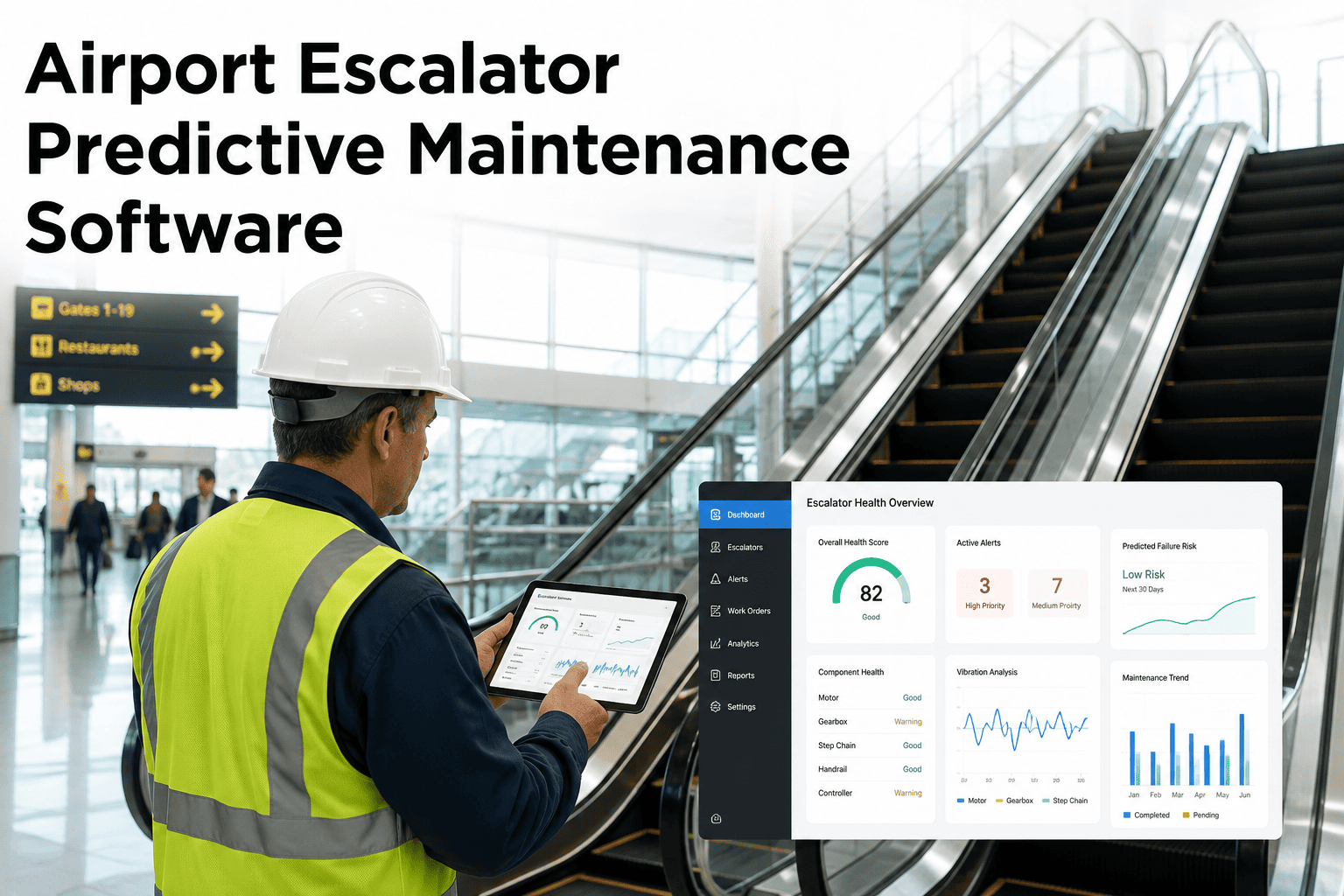
A concourse chiller plant keeps thousands of passengers comfortable through security lines, gate holdrooms, and retail concourses every single hour, and even a partial capacity loss on a July afternoon push can turn a terminal into a genuine comfort and operations problem within minutes. Airport HVAC chiller plants run harder and longer than almost any commercial cooling application, cycling through extreme occupancy swings, near-continuous operation across peak travel seasons, and mechanical rooms that rarely get a real shutdown window for anything beyond emergency repair. Most facilities and maintenance teams still find out about compressor strain, condenser fouling, or refrigerant loss only after a building management system alarm fires or a gate agent calls about a warm boarding area. Predictive maintenance software built specifically for airport HVAC chiller plants closes that gap by modeling each chiller's actual condition continuously and flagging degradation while there is still time to plan around it instead of react to it. Facilities teams evaluating what that looks like for their own terminal configuration can start by reaching out to the iFactory support team.
Your Terminal Chillers Are Already Warning You. A BMS Alarm Just Isn't Early Enough to Listen.
iFactory's predictive maintenance software models every chiller in your central plant continuously, comparing live refrigerant, temperature, and load data against how that specific unit actually behaves as it wears, so degradation gets flagged weeks before a comfort complaint or an alarm ever does.
Why Airport Chiller Plants Fail Differently Than Any Other Commercial Building
A downtown office tower cycles its chillers around a fairly predictable nine-to-five occupancy curve with genuine off-hours to rest equipment and catch up on maintenance. An airport terminal doesn't get that luxury. Gate holdrooms, baggage claim, concourse retail, and back-of-house server rooms all pull load around the clock, seasonal travel spikes push units past their normal duty cycle for weeks at a time, and a single central plant is often the only thing standing between a comfortable terminal and a public relations problem playing out in front of thousands of travelers, all while maintenance windows shrink to almost nothing during the busiest months of the year.
Duty Cycles That Never Really Rest
Near-continuous operation across peak seasons accelerates bearing wear, refrigerant breakdown, and condenser fouling far faster than the manufacturer's rated maintenance interval assumes.
Comfort Complaints Are the First Alarm
Most terminals still find out about a struggling chiller when a gate agent or passenger reports a warm holdroom, which means the degradation has already been building for days or weeks unnoticed.
One Plant, Many Critical Zones
A single central chiller plant often cools concourses, IT and server rooms, retail tenants, and baggage systems simultaneously, so one unit's failure cascades across zones that have nothing to do with each other.
Narrow Maintenance Windows
There is rarely a true shutdown window at a busy airport, so any repair that isn't planned around actual flight schedules and passenger volume becomes disruptive by default, regardless of how straightforward the repair itself actually is.
From Reactive Repairs to a Predicted Failure Window
Most airport facilities teams sit somewhere on a maturity curve without fully realizing it, and understanding where a plant currently sits is the fastest way to see what predictive maintenance actually changes.
Reactive Repair
Chillers run until something fails or a comfort complaint comes in, then a technician responds. Downtime is discovered the moment it starts affecting the terminal, not before.
BMS Alarm-Driven
A building management system flags out-of-range readings after a threshold is already crossed, which catches some problems but usually well after gradual degradation began.
Predictive, Condition-Based
A continuously updated model tracks each chiller's actual degradation trend and predicts a specific failure window, so repairs get scheduled around real condition and real flight-schedule impact.
Chiller Failure Modes and How Much Warning Each One Actually Gives
Not every chiller failure mode gives the same amount of lead time, and knowing the difference matters for how a maintenance team plans around flight schedules and passenger volume. Some degradation patterns unfold over weeks; others narrow to just a handful of days once they start accelerating.
| Failure Mode | Typical Warning Window | What the Model Tracks | Terminal Impact if Missed |
|---|---|---|---|
| Compressor Bearing Wear | 3-5 weeks | Vibration signature and motor current draw | Full compressor replacement, extended zone outage |
| Condenser Tube Fouling | 2-4 weeks | Approach temperature and heat rejection efficiency | Reduced cooling capacity across the whole plant |
| Refrigerant Leak | 4-10 days | Suction pressure trend and superheat drift | Rapid capacity loss, emergency refrigerant call |
| Evaporator Freeze-Up | 1-2 weeks | Flow rate and evaporator temperature differential | Tube damage, unplanned full shutdown |
| VFD or Drive Degradation | 2-3 weeks | Harmonic distortion and thermal load on drive components | Loss of speed control, compressor short-cycling |
Which Chiller Plant Configurations This Applies To
Airport HVAC infrastructure varies widely by terminal size and age, and a predictive maintenance program adapts to whatever configuration is already in place rather than requiring a full mechanical redesign first.
Single-Terminal Regional Airports
One or two chillers carrying the entire terminal load, where a single failure has an outsized impact and early warning matters most.
Multi-Terminal Central Plants
A shared central plant feeding several concourses through a chilled water loop, where the model tracks each chiller individually while accounting for shared header dynamics.
Mixed Air- and Water-Cooled Systems
Older terminals often blend cooling tower-fed and air-cooled units added over decades of expansion, each with different degradation signatures the model accounts for separately.
N+1 Redundant Designs
Backup chiller capacity buys time on paper, but silent degradation on a standby unit still leaves a plant exposed the moment the primary chiller actually needs relief.
Stop Waiting for the BMS Alarm to Tell You What Already Happened
iFactory connects live chiller condition data to a prediction model built for aviation duty cycles, then turns that prediction directly into a scheduled work order in your CMMS.
What a Missed Chiller Failure Actually Costs a Terminal
The cost of an unplanned chiller outage rarely shows up as a single line item, which is part of why it's so easy for facilities budgets to underestimate. The real cost spreads across several parts of the operation at once, and most of it traces back to the same root cause: nobody saw the failure coming with enough lead time to plan around it.
Passenger Comfort and Complaints
Warm holdrooms and concourses generate visible passenger complaints fast, and those complaints tend to reach airport leadership well before a maintenance report does.
Retail and Concession Revenue
Terminal retail and food service tenants depend on comfortable dwell time to drive sales, and a cooling failure directly cuts into the revenue those leases generate for the airport.
IT and Server Room Exposure
Many terminal chiller loops also cool network closets and server rooms supporting check-in, baggage, and security systems, turning an HVAC failure into an operational systems risk.
Emergency Repair Premiums
A same-day emergency chiller repair typically carries expedited parts freight and after-hours labor costs well above what the same fix would cost on a planned schedule.
How a Prediction Becomes a Scheduled Work Order
A prediction that sits in a report nobody checks doesn't actually protect a terminal from downtime. The value only shows up once the forecast turns into a planned action on a calendar that a maintenance team actually works from.
Continuous Sensor Ingestion
Refrigerant pressure, condenser approach temperature, compressor amperage, and vibration data stream in continuously from each chiller in the plant.
Unit-Specific Baseline Modeling
The system builds a behavior baseline for each individual chiller rather than applying one generic threshold across every unit in the plant.
Degradation Detection
Live readings are compared against the baseline continuously, surfacing drift patterns long before they would cross a fixed BMS alarm threshold.
Failure Window Prediction
The model converts a detected drift into a specific, dated failure window rather than a vague health score or generic warning light.
Automatic Work Order Creation
The prediction is pushed directly into your CMMS as a scheduled work order with parts and crew flagged, so it becomes planned work rather than a report someone has to remember to act on.
A Composite Scenario: The Terminal B Chiller That Never Went Down
A mid-size airport's Terminal B central plant had a recurring pattern of condenser tube fouling on its oldest chiller, typically forcing an emergency chemical clean and partial capacity loss twice a year during peak summer travel. After the plant connected condenser approach temperature and heat rejection data to a predictive model trained on the unit's own history, the system flagged a fouling trend twenty-two days ahead of what would have been the next forced outage.
The facilities team scheduled the tube cleaning for an overnight window with historically low flight volume, coordinated with operations to confirm redundant capacity from the adjacent chiller, and completed the service in under six hours with zero impact on terminal comfort. The chiller's condenser, once opened, showed fouling consistent almost exactly with the model's predicted severity, confirming the team had caught it at the right point in the degradation curve rather than too early or too late.
The facilities team went on to apply the same monitoring approach to the remaining chillers across Terminal A and Terminal C over the following season, using the Terminal B model as a starting template rather than building each chiller's baseline from scratch. Within two peak travel seasons, the plant had shifted from two forced outages a year to a fully planned maintenance calendar built around predicted degradation windows instead of guesswork.
Common Mistakes Airport Facilities Teams Make With Chiller Maintenance
Trusting the BMS as the Only Early Warning
A building management system flags problems only after a fixed threshold is crossed, which is often well past the point where a planned repair was still possible.
Applying One Maintenance Schedule to Every Unit
Chillers of different ages, configurations, and duty cycles degrade on different timelines, so a single fixed interval either over-services newer units or under-services strained ones.
Ignoring Redundant Units Until They're Needed
A standby chiller that hasn't been monitored the same way as the primary unit can fail silently, leaving a plant with far less real redundancy than it appears to have on paper.
Scheduling Repairs Without Flight-Schedule Context
A technically sound repair plan still causes disruption if it isn't timed against actual passenger volume and gate activity for that specific terminal.
Is Your Terminal Chiller Plant Ready for Predictive Maintenance
You can name the chillers most likely to cause a comfort event
If your facilities and operations teams already agree on which units run hottest or oldest, that short list is the right starting scope for a first deployment.
Your chillers already have some baseline sensor data
Existing pressure, temperature, and amperage readings from the BMS accelerate deployment significantly, though a model can still be built around new instrumentation.
Your CMMS can accept automated work order triggers
The prediction only turns into protection if it can create or flag a work order directly instead of requiring someone to manually translate a report into action.
Facilities leadership is willing to act on an early warning
A predictive program only pays off if the team schedules planned work off the forecast instead of waiting to see whether the chiller actually fails first.
Frequently Asked Questions
How is predictive maintenance different from the alarms already built into our BMS?
A building management system alerts you after a reading crosses a fixed threshold, which usually means the underlying degradation has already been building for some time. A predictive model instead learns how each specific chiller behaves and flags gradual drift long before it would ever trip a BMS alarm, giving your team a real planning window instead of a same-day emergency. Teams can see this comparison applied to their own plant by contacting iFactory support.
Do we need to replace our existing BMS or chiller controls to use this?
No, the predictive model layers on top of the sensor and control data your existing BMS and chiller controllers already generate, rather than requiring a mechanical or controls replacement. Most deployments start by pulling existing pressure, temperature, and amperage tags into the model, then add targeted instrumentation only where a specific chiller lacks the data needed for an accurate prediction.
How much advance warning can we realistically expect before a chiller failure?
Warning windows vary by failure mode, ranging from roughly three to five weeks for gradual issues like compressor bearing wear or condenser fouling down to four to ten days for faster-developing problems like a refrigerant leak. The model provides a specific predicted window rather than a single fixed number, so the exact lead time depends on which failure pattern is developing on a given unit.
Can this scale across a multi-terminal airport with several central plants?
Yes, the model tracks every chiller individually even when several units share a central plant or chilled water loop, and the platform is built to scale from a single-terminal regional airport up to a multi-terminal hub without requiring a separate system for each plant. Most multi-terminal deployments start with the highest-criticality chillers identified by the facilities team and expand from there as the model proves out on that initial scope. Book a demo to see how a multi-terminal rollout is typically scoped and sequenced.
How does a predicted failure actually turn into scheduled maintenance work?
Once the model predicts a failure window for a specific chiller, that prediction is pushed directly into your CMMS as a work order with the relevant asset, parts, and recommended timing already attached, rather than sitting in a dashboard someone has to remember to check. That closes the loop between detection and action, which is the step most alarm-based systems leave entirely up to the maintenance team to handle manually, and it's usually the single biggest reason an accurate prediction still fails to prevent downtime in practice.
Give Your Terminal Chillers the Warning System They Actually Need
iFactory builds predictive maintenance models around your airport's specific chiller plant, turning live condition data into early warnings and scheduled CMMS work orders before a comfort issue ever reaches the concourse.