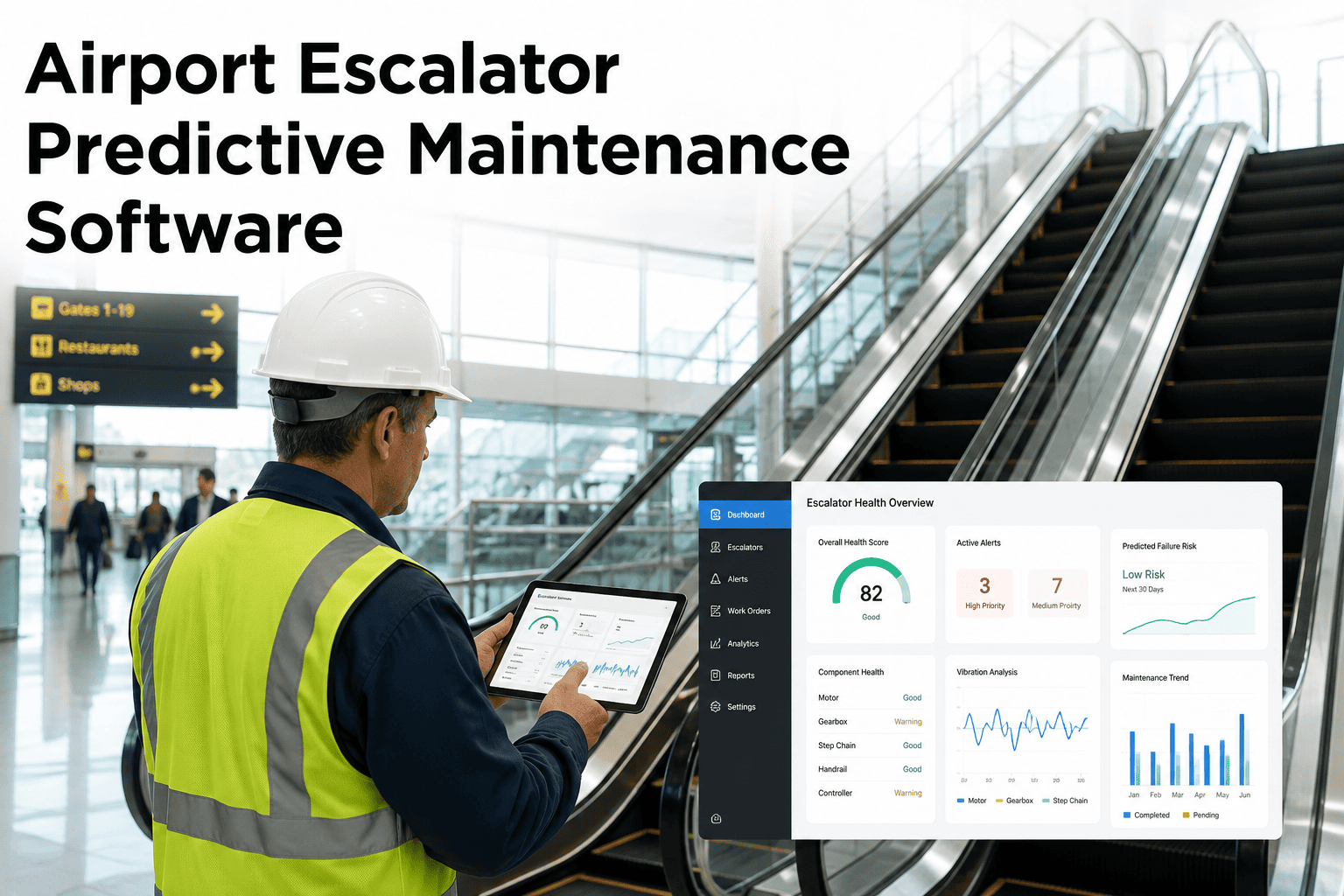
Airports run maintenance programs that were built around the calendar, not the asset. Every jet bridge, baggage conveyor, HVAC chiller, and ground support vehicle sits on a fixed inspection schedule that assumes wear happens at a predictable, uniform rate — monthly, quarterly, or after a set number of operating hours, regardless of how the equipment is actually behaving that week. That assumption holds up reasonably well for simple components, but it breaks down fast for the complex, heavily-used systems that keep a terminal moving passengers and bags on schedule. A belt drive under summer peak load wears differently than the same belt during a slow shoulder season, and a fixed quarterly inspection has no way to notice the difference until something fails between visits. Airports closing that gap are pairing scheduled inspections with condition data, and the airport predictive maintenance software from iFactory is built specifically for that transition.
Airport Operations · Maintenance Strategy
Predictive vs. Preventive Maintenance: Choosing the Right Strategy for Airport Assets
Fixed-interval preventive maintenance keeps baggage systems, jet bridges, and terminal HVAC on a predictable schedule — but it can't tell you a bearing is failing between inspections, or that a part with plenty of life left is being swapped out too soon. iFactory layers condition-based predictive maintenance on top of the PM program you already run, so airport teams keep the schedules that work and gain real-time visibility for the assets that don't.
Continuous
Condition data collected between scheduled inspections
PM-Compatible
Existing fixed-interval schedules stay in place
Early Warning
Flags emerging faults before they reach failure
The Core Limitation
Why Fixed-Interval PM Alone Falls Short at Airports
01
Equipment Wear Doesn't Follow a Calendar
A baggage conveyor gearbox under peak summer traffic degrades on a completely different curve than the same gearbox during a quiet shoulder season, yet both get inspected on the exact same fixed schedule regardless of actual load.
02
Inspections Miss the Gap Between Visits
A quarterly PM check only captures a snapshot of asset health on the day someone happens to look. A bearing that starts failing the week after an inspection has no way to signal trouble until the next scheduled visit or an outright breakdown.
03
Over-Maintenance Wastes Budget and Downtime
Fixed intervals are set conservatively to avoid failures, which means healthy components are frequently pulled apart, inspected, and sometimes replaced well before they actually need it, consuming labor hours and parts budget for no operational benefit.
04
One Missed Signal Can Cascade Through a Terminal
A single jet bridge or baggage line failure during a bank of departures doesn't stay contained — it ripples into gate delays, missed connections, and a maintenance team pulled off planned work to fight an unplanned fire.
Two Ways of Watching the Same Asset
Fixed Schedule vs. Continuous Condition Signal
Preventive (Fixed-Interval)
Q1 Inspection
Q2 Inspection
Q3 Inspection
Q4 Inspection
Predictive (Condition-Based)
Normal
Normal
Watch
Alert
Normal
Normal
The predictive row updates continuously and raises a flag the moment a trend moves outside its normal range — days or weeks before the next scheduled inspection would have caught it, and without touching the fixed PM calendar shown above it.
Three Strategies, Side by Side
Reactive vs. Preventive vs. Predictive Maintenance
| Factor | Reactive | Preventive (Fixed-Interval) | Predictive (Condition-Based) |
| Maintenance trigger |
Equipment has already failed |
A calendar date or run-hour count |
An actual change in asset condition |
| Failure visibility |
None — found after the fact |
Only at the moment of inspection |
Continuous, between inspections too |
| Parts and labor use |
Emergency, often at a premium |
Frequently replaces healthy parts early |
Matched to actual remaining life |
| Impact on operations |
Unplanned gate or terminal disruption |
Planned, but disruptive if too frequent |
Scheduled around a known risk window |
| Best fit |
Low-cost, non-critical components |
Simple, wear-predictable equipment |
Complex, high-impact, variable-load assets |
See Your Own Assets on the Timeline
Find Out Which of Your PM Tasks Are Ready to Go Condition-Based
Bring your current PM schedule and we'll walk through which tasks are well matched to fixed intervals and which ones are strong candidates for continuous condition monitoring instead.
Where the Difference Shows Up
Airport Asset Classes and the Strategy That Fits Them
Baggage Handling Conveyors
Belt tension, motor current, and gearbox vibration shift with passenger volume day to day. Condition monitoring catches drift toward a jam or drive failure long before it stops a belt mid-bank.
Passenger Boarding Bridges
A jet bridge that won't extend or retract during a tight turnaround delays a whole gate. Monitoring drive motors and lift mechanisms surfaces resistance changes before a mechanical failure strands the bridge.
Terminal HVAC and Chiller Plants
Chillers run near continuously and cycle hard during peak travel seasons. Tracking approach temperature and compressor load catches fouling and refrigerant issues well ahead of a comfort complaint or IT-room exposure.
Ground Support Equipment Fleets
Tugs, belt loaders, and de-icers see wildly uneven usage across a fleet. Condition-based scheduling replaces a blanket calendar with servicing timed to how hard each individual unit has actually been run.
Not Every Asset Needs the Same Approach
Where Fixed-Interval PM Still Makes Sense
Good Fit for Fixed-Interval PM
Simple, low-cost components with predictable, near-linear wear — filters, belts on light-duty lines, lubrication points, and safety-critical checks that regulations require on a set schedule regardless of condition data.
Good Fit for Predictive Monitoring
Complex, high-consequence, variable-load assets — jet bridge drives, conveyor gearboxes and motors, chiller compressors, and GSE fleet components where failure timing varies with actual usage rather than the calendar.
Making the Shift
How Airports Typically Layer Predictive Onto Existing PM
1
Inventory Critical Assets
2
Rank by Operational Impact
3
Instrument High-Priority Assets
4
Run PM and Predictive in Parallel
5
Extend Intervals as Confidence Builds
What Trips Teams Up
Common Mistakes When Moving Off Fixed Intervals
Ripping Out PM Before Trusting New Data
Cutting scheduled inspections the moment sensors go live, before there's enough history to confirm the condition data is catching what matters.
Instrumenting Everything at Once
Trying to monitor the entire asset base in one pass instead of starting with the handful of systems where failure actually disrupts operations.
No Clear Owner for Alerts
Condition alerts arriving in an inbox nobody checks, with no defined path from a flagged reading to an actual work order.
Treating It as All-or-Nothing
Assuming every asset must go fully predictive, when a lot of simple equipment is genuinely better served by staying on a fixed schedule.
A Composite Scenario
A Baggage Conveyor Gearbox, Two Ways
Before
A terminal's outbound baggage line ran gearbox inspections every quarter. Between visits, a bearing began wearing unevenly during a stretch of unusually high summer traffic. It failed on a Friday afternoon during a bank of departures, taking the line down for four hours and forcing bags to be hand-carried to a backup belt.
After
With vibration and motor-current monitoring added on the same gearbox, the trend moved into a Watch state five weeks before the previous failure would have occurred. The team scheduled a bearing swap during a planned overnight window, the quarterly PM inspection continued as before, and the line never went down mid-shift.
Before You Start
Readiness Checklist for a Predictive Pilot
List critical assets ranked by how much an unplanned failure would disrupt gate or terminal operations
Pull the current PM schedule for each asset, including task frequency and typical findings
Identify which assets have variable, hard-to-predict usage versus steady, predictable wear
Name who reviews condition alerts and how a flagged reading turns into a scheduled work order
Common Questions
Predictive vs. Preventive Maintenance — FAQ
Does predictive maintenance replace preventive maintenance entirely?
No, and it usually shouldn't. Most airports keep fixed-interval PM for simple, regulation-driven, or low-cost tasks and layer predictive monitoring on top for the complex, high-impact assets where failure timing genuinely varies with usage. The two approaches work best combined rather than as a full replacement of one by the other.
Our team can help map which of your tasks fit each category.
How much sensor infrastructure does predictive monitoring require?
It depends on the asset, but most pilots start with a small set of vibration, temperature, or current sensors on the specific failure points that matter most, rather than instrumenting an entire system at once. A phased rollout on your highest-impact assets keeps the initial investment focused and lets results build the case for expanding further.
Which airport assets see the fastest return from going predictive?
Assets with variable usage and high operational consequence tend to pay back fastest — baggage conveyor drives, jet bridge mechanisms, and chiller plants are common starting points because their failure modes develop gradually and their downtime cost is immediate and visible to passengers and gate staff alike.
Will this change how our maintenance team works day to day?
The existing PM calendar stays in place for the tasks that still belong on it. What changes is that condition alerts start appearing alongside scheduled work orders, giving planners advance notice to schedule repairs during planned windows instead of reacting to a breakdown mid-shift.
Book a demo to see how alerts and work orders appear together in the platform.
How long does it take to trust predictive data enough to extend PM intervals?
Most teams run predictive monitoring alongside unchanged PM schedules for a period first, comparing what the condition data flags against what the next scheduled inspection actually finds. Once that pattern holds consistently across a few cycles, intervals on the monitored assets can be extended with confidence rather than guesswork.
Stop Choosing Between Schedule and Signal
Run Preventive and Predictive Maintenance Together, on One Platform
iFactory layers condition-based monitoring onto the PM program your airport already runs, so critical assets get continuous visibility while simple, predictable equipment stays on the schedule that already works.