Airport escalators move millions of travelers between terminals, security lines, and gates every single day, and when one stalls mid-shift it creates a ripple of delay that reaches boarding gates and baggage claim within minutes. Most failures are not sudden — rising vibration, chain wear, and motor heat build for weeks before a step jams or a drive fails outright. Facilities teams usually find out only after the unit is already down, forcing an emergency shutdown during peak travel hours when passenger flow matters most. iFactory AI's predictive maintenance software gives airport MRO teams the ability to see these failures forming days or weeks in advance — Book a Demo to see it running on your terminal.
Stop Airport Escalator Failures Before They Strand a Single Passenger
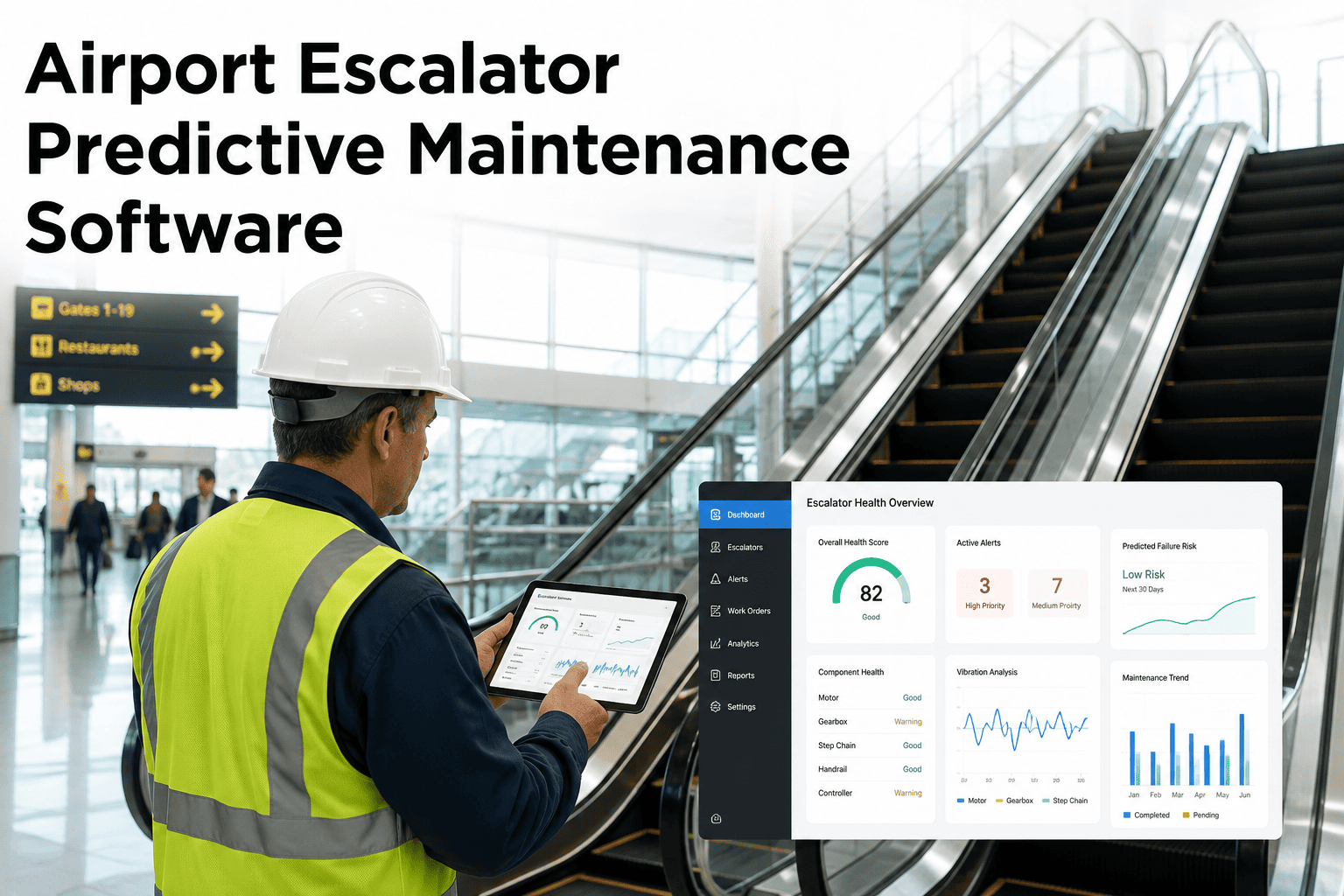
iFactory AI continuously reads vibration, temperature, current draw, and step-chain tension on every escalator and moving walkway in your terminal, flagging degrading units weeks before a breakdown — not after one.
What a Single Down Escalator Actually Costs Your Terminal
A broken escalator rarely stays a small problem. It backs up queues at security, slows connecting passengers who are already racing the clock, and forces mobility-impaired travelers onto stairs or overloaded elevators. Facilities audits at major hub airports have repeatedly found conveyances sitting out of service for extended stretches simply because nobody caught the early warning signs in time, and every additional hour of downtime compounds the disruption across the terminal. The knock-on effects reach well past the affected unit — gate agents field more complaints, wayfinding staff get pulled from other duties to redirect passenger flow, and the facilities team ends up managing the fallout from a failure that, in most cases, had been building quietly in the sensor data for days.
Typical Unplanned Downtime
Average time a single escalator sits out of service once a fault becomes visible, covering diagnosis, parts sourcing, and vendor callback scheduling.
Faults Start as Vibration Drift
Portion of major escalator failures that begin as a small bearing or step-chain vibration anomaly weeks before any visible mechanical symptom appears.
Emergency Repair Premium
Typical cost multiplier of an after-hours emergency callout compared to the same repair scheduled inside a planned maintenance window.
Daily Operating Window
Hours per day most terminal conveyances need to stay available, leaving almost no slack for a unit to be down during a shift change or peak bank.
Five Stages Every Escalator Passes Through Before It Fails
Escalator breakdowns are almost never instantaneous. Mechanical wear moves through a predictable sequence of stages, and each stage leaves a measurable signature in vibration, temperature, or current data long before a technician or passenger would notice anything wrong. The timeline below is the same progression iFactory AI's models are trained to catch — the earlier a stage is flagged, the cheaper and faster the fix. Understanding this progression is also what makes the difference between a maintenance program that reacts to noise and one that reacts to a genuine, trending signal worth dispatching a technician for.
Vibration Drift Begins
Step-chain rollers and handrail drive bearings start producing a slightly irregular vibration signature, invisible to a routine walk-by inspection but clearly present in continuous sensor data.
Bearing Temperature Rises
Friction from the developing wear pushes drive and step-chain bearing temperatures a few degrees above their established baseline, the earliest thermal fingerprint of a component under stress.
Step-Chain Elongation
The chain begins to stretch measurably, changing step spacing and load distribution — a stage that still allows a scheduled overnight repair instead of an emergency shutdown.
Motor Current Spikes
The drive motor draws noticeably more current to compensate for mechanical resistance, a strong, late-stage indicator that failure is now days away rather than weeks.
Unplanned Stop
Without intervention, the unit trips a safety circuit or jams outright, taking the escalator out of service during an unplanned window — usually the busiest hours of the day.
Reactive vs. Scheduled vs. Predictive Maintenance
Most airport facilities teams operate somewhere between reactive repairs and calendar-based preventive maintenance. Both approaches leave a gap — reactive maintenance only responds after a unit is already down, and calendar-based servicing checks a healthy machine just as often as it checks a failing one. Predictive maintenance closes that gap by reading the actual condition of every escalator, continuously, and only dispatching a technician when the data says a component is degrading. The table below breaks down how each approach actually behaves once it meets the reality of a live terminal, from detection timing through to the cost of the repair itself.
| Approach | When a Fault Is Detected | Downtime Risk | Cost Impact |
|---|---|---|---|
| Reactive Repair | Only after the unit has already stopped | High — always unplanned, always during service hours | Highest — emergency callouts and rush parts |
| Scheduled Preventive | At the next calendar-based inspection, regardless of actual condition | Moderate — faults between visits still cause stops | Moderate — services healthy units unnecessarily |
| iFactory Predictive | Days to weeks before failure, based on real sensor trends | Low — repairs are scheduled into off-peak windows | Lowest — parts and labor planned in advance |
How iFactory Predictive Maintenance Works on Your Escalators
iFactory AI is built to run across an entire terminal's vertical transportation fleet — escalators, moving walkways, and elevators — without disrupting existing building management or CMMS workflows. The process below is how a single anomaly turns into an actionable work order, from the first vibration reading to the technician's ticket. Every step happens automatically in the background, so the facilities team's first real interaction with the system is usually the alert itself, already paired with the specific unit, component, and recommended next action.
Sensor Data Collection
Retrofit or OEM vibration, temperature, and current sensors on the drive unit, step chain, and handrail motor stream continuous condition data to the iFactory edge gateway installed in the machine room.
AI Condition Modeling
Machine learning models trained on escalator failure patterns compare live readings against each unit's own healthy baseline, catching subtle drift that generic thresholds would miss entirely.
Early Warning Alert
When a component trends toward failure, the platform pushes a ranked alert to the facilities team with the specific unit, component, and estimated time-to-failure window.
Automated Work Order
A structured work order is generated automatically with the fault detail, recommended part, and suggested off-peak repair window, ready to route through your CMMS.
From a Single Concourse to a Full Multi-Terminal Hub
Airport facilities operations vary enormously in scale, but the underlying problem is the same everywhere: vertical transportation has to stay available for the full operating day, and a single unplanned stop creates an outsized impact relative to its size. iFactory AI is deployed the same way whether it is covering four escalators at a regional airport or several hundred conveyances spread across a major international hub.
Regional and Mid-Size Airports
Smaller facilities teams often cover conveyance maintenance alongside a dozen other responsibilities, with no dedicated reliability engineer watching escalator health full time. A lean sensor rollout on the highest-traffic units gives these teams the same early-warning coverage a much larger operation would build in-house, without adding headcount.
Major International Hubs
Large hub airports run hundreds of escalators, moving walkways, and elevators across multiple terminals and concourses, often serviced by several different OEM contracts. A fleet-wide condition dashboard consolidates all of that into one view, so operations leadership can see risk across the entire airport instead of terminal by terminal.
Transit-Connected Terminals
Airports with attached rail, tram, or people-mover connections carry an added layer of conveyance demand from arriving transit passengers. Predictive coverage across both the terminal and the connecting transit infrastructure keeps the entire passenger journey moving, not just the concourse.
See Your Terminal's Escalator Fleet Health in One View
iFactory AI runs a fleet assessment across your escalators, walkways, and elevators, then returns a fully mapped condition dashboard for every unit in your terminal.
What Airport Facilities Teams Get With iFactory
Deploying predictive maintenance across a terminal is not just about sensors — it is about giving facilities managers, MRO contractors, and airport operations a shared, trustworthy view of every conveyance's real condition. Here is what comes standard with an iFactory deployment across your escalators and moving walkways.
Fleet-Wide Condition Dashboard
A single live view of every escalator, walkway, and elevator across every terminal, colour-coded by current health status and trend direction.
Component-Level Fault Alerts
Alerts identify the specific component at risk — drive motor, step chain, handrail, or comb plate — so technicians arrive with the right part the first time.
Automated Work Order Routing
Detected faults generate structured work orders automatically, routed to your CMMS or directly to your OEM service contractor.
Off-Peak Repair Scheduling
Because failures are flagged days or weeks ahead, repairs get scheduled into overnight or low-traffic windows instead of interrupting boarding banks.
Compliance-Ready History
Every reading, alert, and repair is logged automatically, giving facilities teams a defensible maintenance record for audits and regulatory reviews.
Vendor-Agnostic Retrofitting
Works across escalator and elevator brands already installed in your terminal, without requiring a full equipment replacement to get started.
Escalator Fleet Health Checklist for Facilities Teams
Before deciding whether predictive maintenance is worth the investment for your terminal, run your current escalator and moving walkway program through this short checklist. If more than two or three of these sound familiar, your fleet is very likely running on reactive repairs rather than real condition data, and the sooner that gap gets closed, the fewer surprise shutdowns your team will be managing next quarter.
Your team only learns about an escalator fault when a passenger reports it or the unit trips a safety stop mid-shift.
Preventive maintenance is scheduled purely by calendar date, regardless of how each individual unit is actually performing.
Emergency after-hours callouts to your escalator service contractor happen more than once a month across the terminal.
You cannot pull up a single dashboard showing the current health status of every conveyance across all terminals right now.
Repair parts are frequently ordered on a rush basis because the failure was not visible until the unit was already down.
Audit or compliance reviews take days to compile because maintenance records live across paper logs, spreadsheets, and contractor emails.
From Firefighting Repairs to a Fleet You Can Actually Trust
Airports that move to predictive maintenance are not just cutting down on emergency repair bills — they are changing the relationship their facilities team has with the entire vertical transportation fleet. Instead of a maintenance program built around reacting to whatever breaks next, planning shifts to a calendar the team controls, built around real component-level data rather than guesswork or a fixed inspection interval that treats every unit the same regardless of how it is actually aging.
That shift matters most during the moments an airport cannot afford a surprise: peak holiday travel banks, major connecting flight waves, and periods when a terminal is already running above normal passenger volume. A facilities team working from a live, terminal-wide condition dashboard walks into those high-pressure days already knowing which units need attention, instead of finding out mid-shift when a step jams in front of a queue of travelers rushing to make a gate. iFactory AI is built to make that shift practical for teams of any size, on the equipment they already have installed, without waiting for a capital replacement cycle to get started.
Airport Escalator Predictive Maintenance — FAQs
How is predictive maintenance different from the preventive maintenance our escalator contractor already does?
Preventive maintenance follows a fixed calendar regardless of how any individual unit is actually performing, which means a healthy escalator gets serviced just as often as one already developing a fault. Predictive maintenance instead reads live vibration, temperature, and current data from each unit continuously, flagging only the machines that are genuinely trending toward failure. That shift lets your team target repairs where they are actually needed instead of spreading maintenance hours evenly across a fleet that does not fail evenly. Book a Demo to see the difference on a live dashboard.
Can iFactory AI work with the escalator brands we already have installed across our terminals?
Yes — the platform is built to be vendor-agnostic and typically retrofits onto existing escalators, moving walkways, and elevators without requiring equipment replacement. Sensors are added to the drive unit, step chain, and handrail motor, and the data streams into the same condition-monitoring platform regardless of the original equipment manufacturer. This makes it practical to roll out across a mixed fleet spanning multiple terminals and multiple decades of installed equipment. Contact our expert to confirm compatibility with your current fleet.
How much advance warning does the system typically give before an escalator would actually fail?
Warning windows vary by failure type, but many mechanical issues such as bearing wear, chain elongation, or motor strain show measurable signatures days to weeks before they would cause an unplanned stop. Catching a fault at the earlier vibration or temperature-drift stage gives facilities teams enough lead time to source parts and schedule the repair into an overnight or low-traffic window instead of an emergency callout. The exact window depends on the component and how the unit is used throughout the day.
Does this integrate with the CMMS or work order system our airport already uses?
Yes — detected faults generate structured, component-level work orders automatically, and these are designed to route directly into common CMMS platforms already used by airport facilities and MRO teams. That means alerts do not just sit in a separate dashboard; they turn into an actionable ticket with the unit, the component, and the recommended action already filled in. Integration specifics depend on your existing systems, so our team will walk through your setup during onboarding. Talk to our team about your specific CMMS.
What does a typical rollout look like across a multi-terminal airport?
Most airports start with a pilot deployment on one high-traffic terminal or concourse, retrofitting sensors onto a subset of escalators and walkways to validate baseline readings and alert accuracy against real operating conditions. Once the pilot demonstrates reliable early warnings, the deployment expands terminal by terminal, with the fleet dashboard scaling to cover every conveyance across the airport under one view. Timeline and rollout pace are shaped around your maintenance calendar and contractor schedules. Book a demo to discuss a pilot for your airport.
Give Your Facilities Team Weeks of Warning, Not a Stalled Escalator
Book a working session with iFactory AI. We map your escalator and moving walkway fleet, existing CMMS, and maintenance contracts — and return a fully specified predictive maintenance rollout plan.