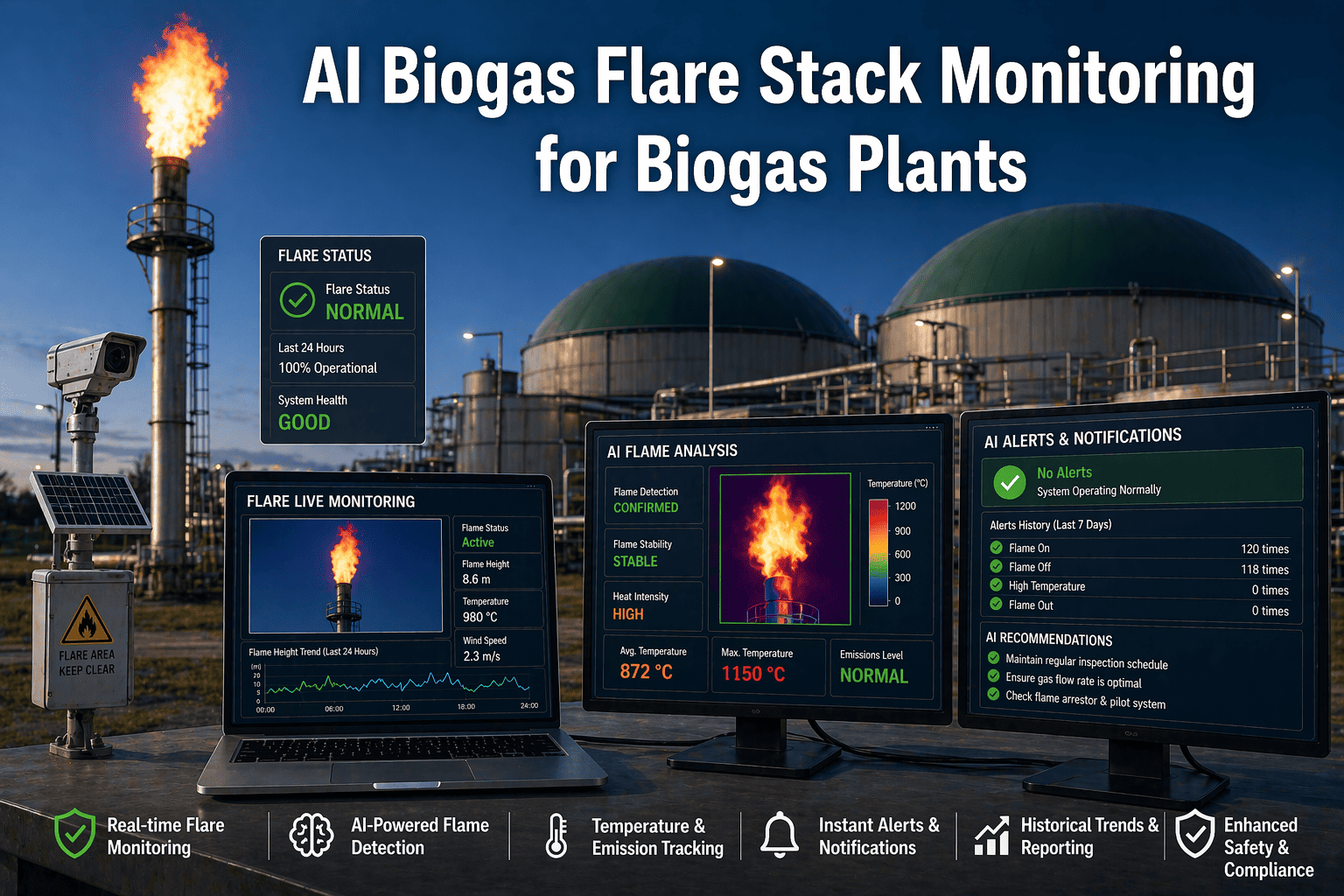
Biogas plants face an average of 22–38% operational and compliance risk annually due to undetected flare stack anomalies — not from equipment failure, but from intermittent visual checks, unreliable flame sensors, and manual observation protocols that cannot identify flame-outs, incomplete combustion, or unburnt methane release in real time. By the time methane venting events, carbon reporting discrepancies, or air quality violations are confirmed through manual audits or regulatory inspections, the compounding costs are already realized: environmental penalties, ESG target failures, community complaints, and emergency response liabilities. iFactory AI Biogas Flare Monitoring Platform changes this entirely — deploying computer vision models trained on industrial flare geometries to detect flame-out events, combustion instability, and smoke opacity in real time, classifying incident severity before uncontrolled venting occurs, and integrating directly into your existing CCTV, DCS, and gas management systems without hardware replacement. Book a Demo to see how iFactory deploys AI flare intelligence across your biogas facility within 6 weeks.
97%
Flame-out & combustion anomaly detection accuracy vs. 49% for manual observation
$480K
Average annual savings from prevented methane venting, fines, and manual monitoring labor
85%
Reduction in response time to flare performance degradation
6 wks
Full deployment timeline from camera audit to live AI flare monitoring go-live
Every Undetected Flame-Out Is a Methane & Safety Risk. AI Vision Stops It at the Source.
iFactory's AI vision engine monitors biogas flare tips, emergency flares, and pilot ignition points using existing CCTV feeds — detecting flame-outs, incomplete combustion, and unburnt gas release in real time, with automated alerts, severity classification, and EPA/CH4-ready documentation for continuous environmental compliance.
The Hidden Cost of Manual Flare Monitoring: Why Legacy Methods Fail Biogas Plants
Before exploring solutions, understand the root causes of flare operation risk in biogas generation environments. Manual visual observations and basic thermocouple monitoring introduce systemic gaps that compound over time — gaps that AI vision directly addresses.
Intermittent Observation Blind Spots
Manual flare checks occur on fixed schedules. Flame-outs, pilot failures, or combustion instability between observation windows go undetected — allowing minor deviations to become uncontrolled methane venting events.
Incomplete Combustion & Methane Slip
Poor air-to-gas ratios, low calorific value biogas, or steam assist imbalances cause incomplete combustion. Without real-time visual verification, plants emit potent greenhouse gases and fail Subpart W GHG reporting thresholds.
Regulatory & ESG Exposure
EPA, state air boards, and corporate ESG frameworks require verifiable flare combustion records. Manual logs lack timestamped visual evidence, continuous methane tracking, and automated audit trails for regulatory submissions.
Safety & Equipment Degradation
Recurrent flare tip overheating, flashback risk, or unburnt gas accumulation near flare bases creates explosion hazards and accelerates refractory degradation. Reactive maintenance increases downtime and capital replacement costs.
How iFactory Solves Biogas Flare Monitoring Challenges in Biogas Plants
Traditional flare monitoring relies on periodic walkdowns, single-point flame sensors, and reactive incident reporting — all of which respond after combustion failure has already occurred. iFactory replaces this with a continuous AI vision layer trained on biogas flare imagery that detects the precursors to flare failure, not the venting notices themselves. See a live demo of iFactory detecting simulated flame-outs, pilot failures, and incomplete combustion in an industrial biogas facility.
01
AI-Powered Flame & Combustion Analytics
iFactory ingests video feeds from existing flare-facing cameras and applies computer vision models trained on flame geometry, tip luminosity, and smoke opacity — detecting flame-outs and combustion anomalies with 97% accuracy, updated every 5 seconds.
02
Severity Classification and Alert Prioritization
Proprietary ML models classify each detection as stable combustion, pilot flicker, incomplete combustion, full flame-out, or smoke/opacity exceedance — with confidence scores attached. Operators receive graded alerts, not raw video feeds. False positive rate drops to under 5%.
03
Predictive Flare Failure Forecasting
iFactory's temporal reasoning engine identifies flare conditions trending toward flame-out 10–30 minutes before impact — giving operators time to adjust biogas flow, ignite backup pilots, or optimize air assist proactively.
04
CCTV, DCS & Gas Control Integration
iFactory connects to Honeywell, Siemens, ABB, and Rockwell DCS environments plus existing CCTV infrastructure and gas flow meters via RTSP, ONVIF, OPC-UA, and REST APIs. No new cameras required in most deployments. Integration completed in under 8 days.
05
Automated EPA/CH4 Compliance Documentation
Every flare event — detected, classified, and resolved — generates a structured compliance report with timestamped video evidence, combustion duration tracking, and methane destruction efficiency logs. Audit-ready for EPA Subpart W, EU ETS, and state air quality directives.
06
Flare Operation Decision Support
iFactory presents ranked action recommendations per alert — adjust biogas valve position, activate secondary pilot, modify steam assist ratio, or initiate emergency isolation — with risk scores and estimated venting penalty cost per minute of delay. Teams act on verified visual data, not assumptions.
The Flare Integrity Framework™
iFactory introduces a proprietary framework to measure and optimize biogas flare compliance across four critical dimensions unique to biogas generation environments:
01
Detection Precision
Flame recognition accuracy, tip geometry mapping, and low-light/steam condition compensation
02
Response Velocity
Time from flame-out detection to alert generation to control room notification and pilot reignition
03
Emission Compliance
Continuous combustion logging, methane destruction tracking, and GHG/air permit documentation
04
Operational Safety
Explosion risk mitigation, unburnt gas monitoring, and flare tip/equipment longevity optimization
How iFactory Is Different from Generic CEMS or Flame Sensors
Most industrial monitoring vendors deliver basic UV/IR flame detectors or generic video analytics wrapped in a dashboard. iFactory is built differently — from the biogas flare combustion workflow up, specifically for environments where visual flame verification accuracy, real-time methane tracking, and EPA documentation determine regulatory standing and operational continuity. Talk to our AI flare monitoring specialists and benchmark your current flare observation approach directly.
iFactory AI Flare Monitoring Implementation Roadmap
iFactory follows a fixed 5-stage deployment methodology designed specifically for biogas plant flare compliance workflows — delivering pilot detection results in week 3 and full production coverage by week 6. No open-ended implementations. No operational disruption.
01
Camera Audit
Map existing CCTV & identify flare coverage gaps
02
System Integration
Connect CCTV, DCS, GHG reporting via APIs
03
Model Calibration
AI training on plant-specific flare imagery & lighting
04
Pilot Validation
Live detection on 1–3 critical flare stacks
05
Full Production
Facility-wide AI flare monitoring live
6-Week Deployment and ROI Plan
Every iFactory engagement follows a structured 6-week program with defined deliverables per phase — and measurable ROI indicators beginning from week 3 of deployment. Request the full 6-week deployment scope document tailored to your biogas flare configuration.
Weeks 1–2
Discovery & Design
Current flare monitoring workflow assessment across primary, secondary, and emergency flares
Camera coverage mapping and AI model design aligned with flare geometry and atmospheric conditions
Integration planning with DCS, biogas flow control, and GHG reporting systems
Weeks 3–4
Pilot & Validation
Deploy AI vision detection to high-risk zones: main flare tip, pilot ignition array, emergency flare base
Alert workflows and EPA documentation protocols activated; false positive tuning with environmental team
First flame-out & combustion anomaly detections captured — ROI evidence begins here
Weeks 5–6
Scale & Optimize
Expand to full facility flare network: all operational, standby, and emergency flares
Automated EPA/GHG compliance reporting activated for Subpart W, EU ETS, and state air permits
ROI baseline report delivered — methane venting avoidance, monitoring labor reduction, and audit efficiency gains
? ROI IN 4 WEEKS: MEASURABLE RESULTS FROM WEEK 3
Facilities completing the 6-week program report an average of $92,000 in avoided venting penalties and monitoring costs within the first 4 weeks of full production rollout — with flame-out & combustion anomaly detection improvements of 39–64% detected by week 3 pilot validation.
$92K
Avg. savings in first 4 weeks
39–64%
Detection improvement by week 3
78%
Reduction in manual flare inspection labor
Eliminate Flare Blind Spots. Deploy AI Flare Monitoring in 6 Weeks. ROI Evidence in Week 3.
iFactory's fixed-scope deployment program means no open timelines, no camera replacement costs, and no months of customization before you detect your first combustion excursion.
Use Cases and KPI Results from Live Deployments
These outcomes are drawn from iFactory deployments at operating biogas facilities across three flare monitoring scenarios. Each use case reflects 6-month post-deployment performance data. Request the full case study report for the flare monitoring scenario most relevant to your plant.
A 5MW agricultural biogas facility operating a continuous duty flare was experiencing recurring pilot flame-outs traced to biogas composition variability and wind-induced draft fluctuations. Legacy thermocouple sensors missed 62% of short-duration flame-outs between 4-hour inspection rounds. iFactory deployed AI vision flare analytics on the primary stack, with models trained on flame geometry, pilot luminosity, and atmospheric variability. Within 3 weeks of go-live, the system detected 17 early-stage flame-out events at the precursor phase — before any measurable methane venting occurred.
17
Early-stage flame-outs detected in first 3 weeks
$215K
Estimated annual methane venting cost prevented
96%
Detection accuracy on pilot & main flame events
A landfill gas facility was receiving quarterly state air quality notices for visible smoke and incomplete combustion during high-load periods, traced to improper steam-to-biogas ratios and unmonitored flare tip degradation. Manual visual checks could not reliably quantify combustion efficiency across varying gas calorific values. iFactory deployed AI vision combustion analytics with smoke opacity modeling and heat shimmer correlation, enabling proactive adjustment of steam assist and biogas flow before emissions breached permit limits. The facility achieved zero visible emission citations post-deployment and reduced steam consumption by 18% through targeted modulation.
0
State visible emission citations post-deployment
18%
Reduction in steam assist consumption
$178K
Annual compliance & utility cost value
A municipal wastewater biogas complex struggled with inconsistent emergency flare readiness documentation during EPA Subpart W audits. Manual logs and periodic photos lacked timestamped, verifiable evidence for combustion status and methane destruction efficiency. iFactory deployed AI vision flare monitoring across the emergency flare bank and primary stack, with automated opacity quantification and EPA-ready report generation. All 9 emergency flare observations in the subsequent audit cycle were resolved with defensible video evidence, and the plant achieved zero compliance findings in its annual GHG reporting review.
100%
Flare readiness observations resolved with video evidence
0
Compliance findings in Subpart W GHG audit
$142K
Annual compliance documentation labor savings
See Real-World Flare Intelligence in Action
Industrial biogas operations cannot afford reactive flare management. Unmonitored flame-outs compound into methane venting, regulatory penalties, and unplanned production halts. Schedule a live demonstration to witness how AI vision transforms intermittent flare checks into continuous, auditable combustion intelligence — with measurable ROI evidence from day one.
What Biogas Plant Leaders Say About iFactory AI Flare Monitoring
The following testimonial is from an environmental compliance director at a facility currently running iFactory's AI flare monitoring platform.
We transformed our flare monitoring from a reactive, subjective process to a proactive, defensible system. iFactory's AI vision detects flame-outs and combustion instability the moment they occur — not hours later during the next inspection round. In the first quarter alone, it flagged 22 pilot failures and incomplete combustion events that would have resulted in uncontrolled methane release. More importantly, every detection includes timestamped video evidence and continuous combustion tracking. That documentation alone streamlined our Subpart W audit and gave our legal team confidence during a state air quality inquiry. The system paid for itself in avoided venting penalties and reduced manual checks — but the real value is the operational certainty that comes from continuous, verifiable flare integrity.
Director of Environmental & Process Safety
Agricultural Biogas Complex, Iowa, USA
Frequently Asked Questions
Does iFactory require new cameras or hardware to be installed?
In most deployments, iFactory connects to existing CCTV infrastructure via RTSP or ONVIF protocols — no new cameras required. Where coverage gaps are identified during the Week 1 camera audit, iFactory recommends targeted additions only (typically 1–3 cameras per flare stack), not a full system overhaul. Integration is complete within 8 days in standard environments.
Which biogas plant systems does iFactory integrate with?
iFactory integrates natively with Honeywell Experion, Siemens PCS 7, ABB System 800xA, Rockwell PlantPAx, and custom biogas control systems via OPC-UA and REST APIs. It also connects to existing gas flow meters, DCS platforms, and GHG reporting tools like CEDRI or custom environmental management systems. Integration scope is confirmed during the Week 1 camera audit.
How does iFactory handle variable lighting, weather, or steam assist conditions common near flare stacks?
iFactory's AI models are pre-trained on biogas flare imagery across varied lighting, fog, steam plumes, and atmospheric conditions. The platform includes adaptive preprocessing for low-contrast enhancement, background subtraction, and steam-correlation modeling. Model calibration during Week 3–4 fine-tunes detection thresholds for your facility's specific visual and meteorological environment.
Can iFactory operate with intermittent network connectivity?
Yes. iFactory offers edge-deployment options with local inference processing and store-and-forward alerting. Detections are processed on-premises and sync to the central platform when connectivity restores. Zero detection gaps during network interruptions — critical for continuous flare compliance monitoring.
How does iFactory align with EPA methane tracking and GHG reporting standards?
iFactory's combustion tracking models are calibrated against EPA Subpart W reporting protocols and validated using continuous flame duration logs, smoke opacity thresholds, and gas destruction efficiency calculations. The platform generates combustion percentages and venting timelines aligned with GHG inventory requirements, with confidence intervals and calibration records included in automated compliance reports for audit defensibility.
What if our facility has unique flare configurations or multi-stack layouts?
iFactory's model builder allows configuration of custom detection zones, combustion thresholds, and escalation rules without code. Our implementation team works with your environmental, operations, and maintenance teams during Week 1–2 to align the platform with your specific flare geometries, gas compositions, and compliance obligations under EPA, EU ETS, or state air permits.
Stop Missing Flame-Outs. Start Detecting Them in Real Time. Deploy AI Flare Monitoring in 6 Weeks.
iFactory gives biogas plant environmental and operations teams real-time flame detection, combustion-quality alerts, EPA/GHG-ready compliance documentation, and seamless system integration — fully deployed in 6 weeks, with ROI evidence starting in week 3.
97% flame-out detection accuracy with existing CCTV
DCS, gas control & GHG reporting integration in under 8 days
EPA Subpart W & state air permit audit-ready reports
Edge deployment option for low-connectivity flare zones