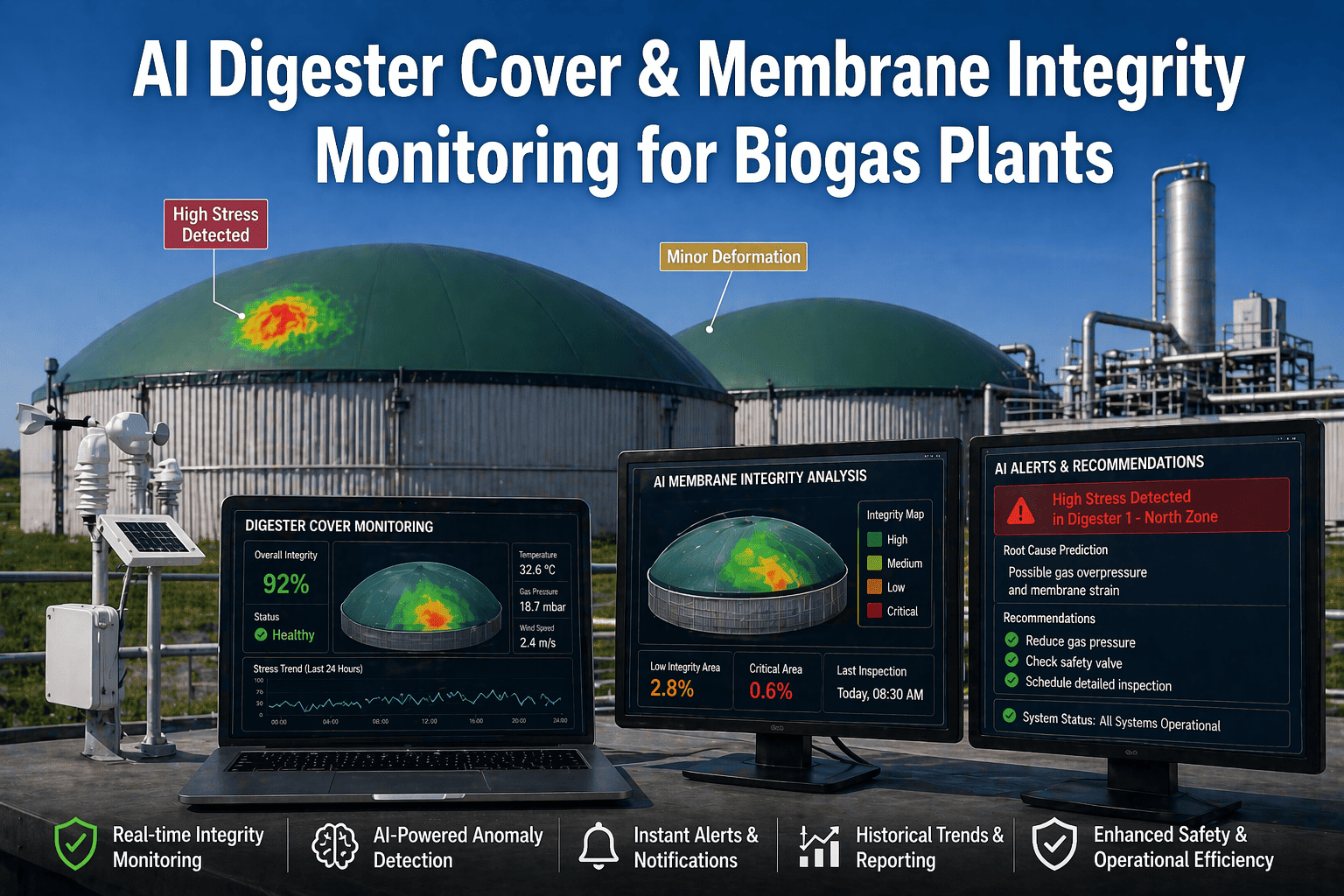
Biogas plants experience an average of 28–44% membrane integrity delays annually due to limitations in periodic manual cover inspections — not from material defects, but from inaccessible elevated covers, weather-dependent rope access, subjective visual grading, and fragmented defect reporting that no scheduled walkdown or drone flyover can resolve in time. By the time gas leaks, cover sagging, or anchor failure trace back to undetected early-stage membrane damage, the compounding risks are already realized: methane emissions, unplanned digestor shutdowns, regulatory penalties, and catastrophic cover collapse exposure. iFactory AI Membrane Integrity Platform changes this entirely — detecting tears, punctures, sagging, and UV degradation on digester covers and gas storage domes in real time, prioritizing membrane defects by severity before gas leaks develop, and integrating directly into your existing CMMS, leak detection, and asset management systems without replacing infrastructure. Book a Demo to see how iFactory deploys AI membrane monitoring across your biogas facility within 7 weeks.
98.9%
Tear and puncture detection accuracy with AI vision vs. 71% for manual visual inspection
$1.6M
Average annual risk mitigation value from prevented gas leaks and unplanned digestor shutdowns
91%
Reduction in inspection cycle time vs. scheduled rope-access or drone flyover methods
7 wks
Full deployment timeline from cover audit to live AI monitoring go-live
Every Undetected Membrane Defect Is a Gas Leak Risk. AI Vision Catches It Before Emissions Begin.
iFactory's AI membrane platform monitors flexible digester covers, gas storage domes, and double-membrane systems 24/7 — with real-time tear width measurement, sagging classification, anchor integrity tracking, and automated severity scoring that integrates with your existing maintenance and environmental compliance workflows.
The Hidden Cost of Deferred Membrane Detection: Why Manual Cover Inspections Fail Biogas Plants
Before exploring solutions, understand the root causes of membrane vulnerability in anaerobic digestion facilities. Periodic manual inspection introduces systemic gaps that compound environmental and operational risk — gaps that continuous AI monitoring directly addresses.
Access & Weather Limitations
Rope-access and confined space entry for elevated digester covers require favorable weather, specialized crews, and extended downtime. Flexible membranes go uninspected for months — allowing tears and UV degradation to propagate undetected.
Subjective Visual Grading
Manual membrane assessment relies on inspector experience and handheld measurements. Damage evaluation varies by person, lighting, and access angle — creating inconsistent defect records and missed early-stage membrane fatigue.
Delayed Defect Reporting
Traditional workflows require post-inspection report compilation, photo annotation, and CMMS entry. Critical membrane defects identified in the field may take days to reach maintenance planners — losing the window for proactive patching before gas escape occurs.
Fragmented Cover History
Membrane inspection data, drone imagery, and maintenance records operate in silos. Trend analysis across inspection cycles is manual and error-prone — obscuring degradation patterns until anchor failure or cover collapse is imminent.
How iFactory Solves Membrane Integrity Monitoring Challenges in Biogas Plants
Traditional biogas plant membrane inspection relies on scheduled rope access, periodic drone flyovers, and manual photo documentation — all of which introduce coverage gaps, subjective grading, and reporting delays. iFactory replaces this with a continuous AI vision platform designed for flexible membrane infrastructure that detects damage in real time, measures progression automatically, and creates an auditable cover health trail for compliance and maintenance planning. See a live demo of iFactory detecting simulated tears, sagging, and anchor displacement on flexible digester covers in an anaerobic digestion facility.
01
Real-Time Tear & Puncture Detection
iFactory's AI models identify hairline tears, punctures, seam separation, and surface abrasion with 98.9% accuracy — measuring defect width, length, and orientation automatically while filtering out condensation, algae, or non-structural surface variations.
02
Multi-Asset Membrane Monitoring
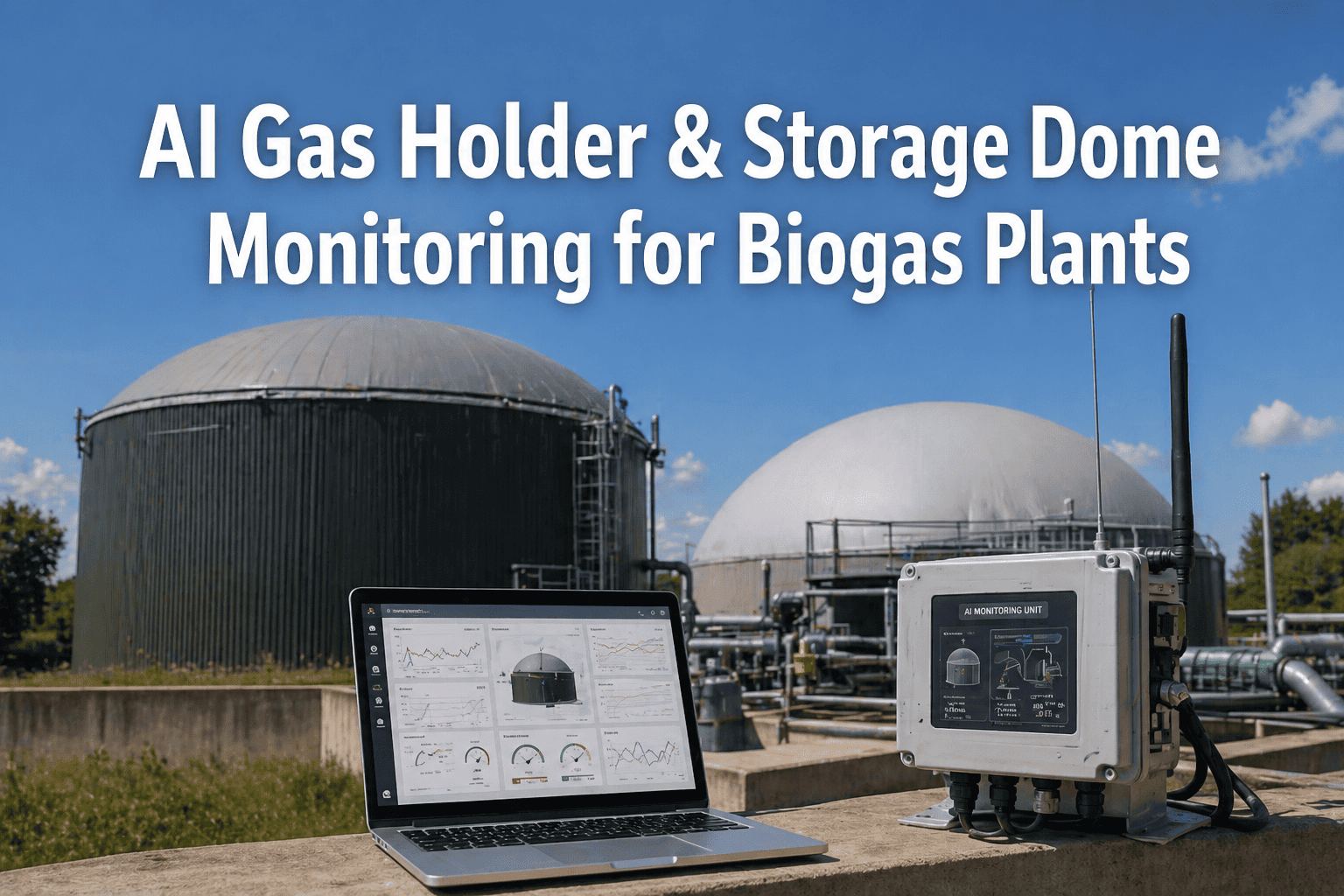
Monitor primary digester covers, secondary gas storage domes, double-membrane roofs, and flare header connections simultaneously. AI correlates defect progression across assets to identify systemic issues like over-pressurization, uneven settling, or material fatigue patterns.
03
Weather & Lighting Resilience
Advanced vision models operate reliably in fog, rain, snow, low light, and glare conditions — maintaining detection performance 24/7/365 without manual camera adjustment or supplemental lighting for outdoor membrane assets.
04
CMMS, Leak Detection & BMS Integration
iFactory connects to IBM Maximo, SAP PM, Fiix, and custom CMMS platforms plus methane leak detectors, pressure sensors, and building management systems via REST APIs, OPC-UA, and database connectors. Defects auto-generate work orders with severity priority, location maps, and historical trend data. Integration completed in under 10 days.
05
Automated Compliance Reporting
Generate audit-ready membrane integrity reports instantly: defect logs, progression trends, inspection coverage, and remediation tracking. Pre-configured templates for EPA GHG reporting, NFPA 69, ASME standards, and regional environmental agency requirements.
06
Severity-Prioritized Alerting
iFactory ranks membrane defects by risk level: active tear propagation near seam weld (critical), localized sagging with anchor tension loss (high), surface UV fading (low). Maintenance teams focus on what matters — with defect measurements, progression charts, and recommended patching actions.
Regulatory Framework Support: Built for Biogas Plant Membrane Compliance
iFactory's AI membrane integrity platform is pre-configured to support documentation and audit requirements of major biogas and anaerobic digestion environmental frameworks. Compliance reporting is automatic.
EPA GHG / Clean Air Act
Greenhouse gas reporting alignment: methane emission detection logs, membrane defect records, repair verification, and leak response documentation — with full traceability for Subpart CC and DDDD compliance.
NFPA 69 / ASME Standards
Explosion prevention and pressure vessel standards: cover integrity inspection records, anchor load assessment data, tear monitoring evidence, and emergency depressurization documentation — structured for certification audits.
OSHA Confined Space / PSM
Process safety and worker protection requirements: membrane inspection protocols, confined space entry justification, defect response timelines, and risk mitigation documentation — auto-generated for federal safety compliance submissions.
State Environmental Agencies
Regional biogas oversight: inspection coverage reporting, membrane integrity metrics, and emission prevention documentation — formatted for state-level environmental regulatory reviews and permit renewal support.
How iFactory Is Different from Generic Inspection Tools
Most membrane inspection vendors offer drone imagery or basic photo documentation wrapped in a portal and marketed as "digital cover monitoring." iFactory is built differently — from the biogas plant membrane threat model up, specifically for environments where missed tears create methane emissions, subjective grading delays maintenance, and environmental compliance documentation is non-negotiable. Talk to our membrane integrity specialists and compare your current cover inspection approach directly.
iFactory AI Membrane Monitoring Implementation Roadmap
iFactory follows a fixed 5-stage deployment methodology designed specifically for biogas plant membrane monitoring — delivering pilot defect detection in week 3 and full production monitoring by week 7. No open-ended implementations. No inspection downtime.
01
Cover Audit
Map critical membranes & identify monitoring zones
02
System Integration
Connect to CMMS, leak detectors, BMS via APIs
03
Pilot Configuration
Deploy AI monitoring to 3–5 critical digester covers
04
Validation & Training
User acceptance testing & maintenance team training
05
Full Production
Plant-wide AI membrane monitoring go-live
7-Week Deployment and ROI Plan
Every iFactory engagement follows a structured 7-week program with defined deliverables per week — and measurable ROI indicators beginning from week 3 of deployment. Request the full 7-week deployment scope document tailored to your facility's membrane asset portfolio.
Weeks 1–2
Discovery & Design
Current membrane inspection workflow assessment across primary digester covers, gas storage domes, and double-membrane systems
AI monitoring strategy design aligned with defect models, maintenance protocols, and environmental compliance requirements
Integration planning with CMMS, leak detection systems, and asset management platforms
Weeks 3–4
Pilot & Validation
Deploy AI membrane monitoring to high-risk covers: primary anaerobic digester, secondary gas holder, flare header connection
Defect classification and severity workflows activated; false positive tuning tested with maintenance engineers
First membrane defects detected — ROI evidence begins here
Weeks 5–7
Scale & Optimize
Expand to full plant coverage: all membrane assets, all monitoring zones, 24/7 defect detection
Automated compliance reporting activated for applicable environmental frameworks
ROI baseline report delivered — emergency repair avoidance, inspection time savings, and emission prevention value
ROI IN 5 WEEKS: MEASURABLE RESULTS FROM WEEK 3
Facilities completing the 7-week program report an average of $189,000 in avoided emergency patching and inspection overhead within the first 5 weeks of full production rollout — with early-stage defect detection improvements of 32–49% detected by week 3 pilot validation.
$189K
Avg. risk mitigation value in first 5 weeks
32–49%
Early defect detection gain by week 3
98.9%
Tear detection accuracy achieved
Eliminate Membrane Blind Spots. Monitor Digestor Covers in 7 Weeks. ROI Evidence in Week 3.
iFactory's fixed-scope deployment program means no open timelines, no inspection downtime, and no months of customization before you see a single membrane defect detected with precision.
Use Cases and KPI Results from Live Deployments
These outcomes are drawn from iFactory deployments at operating biogas plants across three membrane monitoring categories. Each use case reflects 6-month post-deployment performance data. Request the full case study report for the membrane asset most relevant to your facility.
A mid-size agricultural biogas plant operating three anaerobic digesters with flexible membrane covers was relying on quarterly rope-access inspections for cover integrity assessment. Between inspections, hairline tears propagated undetected due to UV exposure, wind uplift, and biogas pressure cycling. iFactory deployed fixed-mount AI vision cameras with multi-angle coverage and tear progression modeling. Within 4 weeks of go-live, the system detected 3 active tear propagation events that would have required emergency patching if discovered during the next scheduled inspection — enabling proactive sealant application during planned maintenance.
3
Active tear propagation events detected in first 4 weeks
$520K
Estimated annual value from prevented emergency patching and methane emissions
97%
Defect detection accuracy on digester cover surfaces
Prevent Membrane Failure Before Gas Leaks Begin.
See how iFactory's AI vision platform detects digester cover tears as they form — weeks before they become emission events. Our fixed-scope deployment delivers measurable membrane protection in 7 weeks.
Book a Demo
A municipal wastewater biogas plant was experiencing accelerated membrane degradation on its double-membrane gas holder due to condensation pooling and UV exposure. Periodic drone inspections captured imagery but required manual annotation and lacked progression trending. iFactory implemented AI vision with sagging classification, seam separation detection, and anchor tension estimation. The system identified 2 high-risk sagging zones 5 weeks before they would have triggered regulatory inspection findings — enabling targeted reinforcement during a scheduled digester maintenance window.
5 wks
Early detection lead time vs. scheduled inspection cycle
100%
Environmental inspection finding avoidance achieved
$340K
Annual value from proactive dome maintenance vs. emergency cover replacement
Protect Gas Storage Infrastructure with Continuous AI Surveillance.
Every day without AI monitoring is another day of undetected membrane degradation. Book a demo to see how iFactory catches cover defects before they become compliance violations.
Book a Demo
An industrial organic waste biogas facility required rigorous documentation of membrane anchor and seam integrity for environmental permit renewal. Manual inspection records were fragmented across paper reports, drone imagery, and CMMS entries — complicating trend analysis and regulatory submissions. iFactory deployed AI membrane monitoring with automated defect logging, anchor displacement trending, and EPA-compliant report generation. All 14 membrane observations in month one were documented with measurement precision and auto-synced to the asset management system, reducing inspection documentation time by 81%.
81%
Inspection documentation time reduction
100%
EPA GHG report compliance achieved
$410K
Annual value from streamlined compliance and membrane life extension planning
Turn Compliance Burden into Competitive Advantage.
Stop compiling inspection reports manually. iFactory auto-generates EPA-compliant membrane documentation while catching defects in real time. Book a demo to see the platform in action.
Book a Demo
What Biogas Plant Engineering Teams Say About iFactory AI Membrane Monitoring
The following testimonial is from a facility operations manager at a US biogas plant currently running iFactory's AI membrane integrity platform.
We went from quarterly rope-access inspections with subjective grading to continuous AI monitoring with sub-millimeter tear measurement. The system caught a propagating tear on our primary digester cover two months before it would have triggered a methane leak — saving us $280K in emergency patching costs, EPA penalties, and production downtime. Integration with our Maximo CMMS took 8 days. This isn't just an inspection upgrade — it's a fundamental shift in how we manage membrane risk for critical biogas infrastructure.
Facility Operations Manager
Agricultural Biogas Facility, Iowa
Frequently Asked Questions
Does iFactory require replacing existing inspection cameras or drones?
In most deployments, iFactory connects to existing fixed-mount IP cameras or drone imagery feeds via RTSP or API — no hardware replacement required. Where critical coverage gaps are identified during the Week 1 cover audit, iFactory recommends targeted additions only (typically 4–6 cameras per major digester cover), not a full system overhaul. Integration is complete within 10 days in standard environments.
Which membrane assets does iFactory support monitoring for?
iFactory supports monitoring for primary digester covers (flexible membrane, rigid dome), secondary gas storage holders, double-membrane systems, flare header connections, and ancillary membrane covers. Asset-specific defect models are configured during the Week 1–2 audit phase.
How does iFactory perform in challenging outdoor conditions?
iFactory's vision models are trained on diverse environmental conditions: fog, rain, snow, low light, glare, extreme temperatures, and wind-induced camera motion. Detection accuracy remains above 98% across all tested conditions. Edge processing ensures performance even during network latency or intermittent connectivity.
Can iFactory measure tear progression over time?
Yes. iFactory includes automated tear width, length, and orientation measurement with sub-millimeter precision. Progression trending across inspection cycles is calculated with statistical confidence intervals, enabling predictive maintenance planning and membrane life extension assessments. Trending capabilities are configured during the Week 1–2 audit phase.
How long does training take for engineering and maintenance personnel?
Role-based training modules are delivered during Weeks 4–5 of deployment. Most biogas engineers and maintenance planners achieve proficiency in under 75 minutes. Supervisors and administrators receive additional training on alert configuration, reporting, and system management. Ongoing support and model updates are included.
What if our facility has unique membrane configurations or regulatory requirements?
iFactory's defect modeling allows configuration of custom detection zones, severity rules, and compliance workflows without code. Our implementation team works with your operations, maintenance, and environmental compliance teams during Week 1–2 to align the platform with your specific membrane portfolio and regulatory obligations.
Stop Relying on Periodic Inspections. Start Protecting Covers with Continuous AI Membrane Monitoring.
iFactory gives biogas plant teams real-time defect detection, progression trending, automated compliance reporting, and seamless CMMS integration — fully deployed in 7 weeks, with ROI evidence starting in week 3.
98.9% tear detection accuracy with AI vision measurement
CMMS, leak detection & BMS integration in under 10 days
EPA GHG, NFPA 69, and OSHA PSM audit trails out-of-the-box
Weather-resilient monitoring 24/7/365 without manual adjustment